10 Stone Fireplace Decor Ideas with Balanced Arrangements
A stone fireplace is the kind of feature that carries a whole living room. The stone has weight and texture,…
A stone fireplace is the kind of feature that carries a whole living room. The stone has weight and texture, the firebox anchors the wall, and everything you set on the mantel reads bigger than it would anywhere else. That is exactly why styling one well matters: too little and the wall feels unfinished, too much and the stone disappears behind clutter. This roundup gives you ten balanced arrangements built for real stone fireplaces, each one measured for a standard mantel and written so you can recreate it in a single afternoon. Every idea names the materials, the placement, the effort involved, and a realistic lower-cost way to get the same look.
Jump to an idea
- A single branch in a sturdy vessel
- Layered frames with generous negative space
- A pair of lamps on a wide surround
- A low floral arrangement
- A small clock balanced by a tall object
- A cluster of stoneware pieces
- A framed botanical pair
- A restrained row of bud vases
- An off-center stack of books
- A trailing plant safely away from heat
A note on working and nonworking fireplaces
Before you style anything, know which kind of fireplace you have. Every arrangement below is designed for the mantel shelf and the stone surround, which sit outside the firebox opening and are the normal places for decor. If your fireplace works and you light fires, keep every combustible item outside the clearances documented in the unit’s manual. The widely used building guidance (NFPA 211 and the International Residential Code) calls for no combustible mantel or trim within 6 inches of the firebox opening, with limits on how far trim may project above it, so check your own unit’s documented numbers and keep everything clear of them. If your fireplace is nonworking and sealed, treat the firebox as unused and decorative only, and say so plainly: none of the styling below pretends a decorative arrangement is a working fire.
1. A single branch in a sturdy vessel

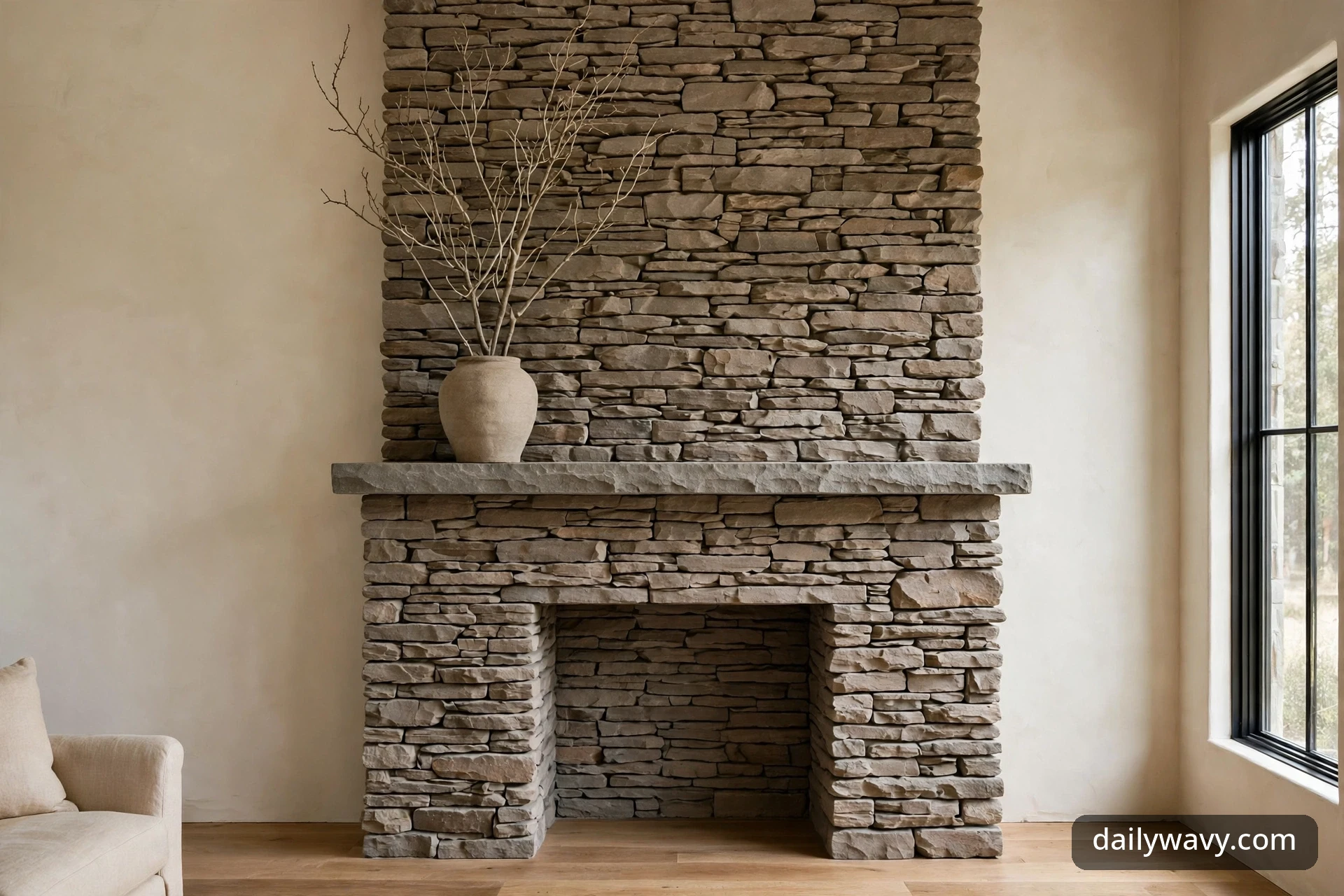
There is a particular quiet that settles over a room when the mantel holds exactly one thing. A single bare branch in a heavy vessel often does more for a stone fireplace than a whole shelf of small objects, because the stone already supplies texture and the branch supplies line. The bare wood reads sculptural against rough stone, and the tall vertical pulls the eye up the full height of the chimney breast, which makes standard 8-foot ceilings feel taller than they are.
What you need
- A heavy, stable vessel: a stoneware floor vase or crock at least 12 inches tall and 6 inches wide at the base, so it cannot tip. Stoneware, ceramic, or cast concrete all work.
- One branch, 36 to 48 inches long overall, with interesting structure: curly willow, bare manzanita, or a pruned fruit-tree limb.
- A few handfuls of dry sand or small river stones to weight the vessel.
- Pruning shears to trim side twigs to a clean silhouette.
How to build it
- Measure your mantel. A standard mantel shelf is 60 to 72 inches wide and 8 to 12 inches deep. Place the vessel about 12 to 18 inches from one end, roughly at the one-third mark, leaving the rest of the shelf empty.
- Fill the vessel one-third full with sand or stones for ballast, then set the branch in and pack around the base so it stands straight.
- Step back and trim any twig that pokes awkwardly toward the room or crosses in front of the stone in a distracting way. You want one clean gesture, not a thicket.
- Leave at least 6 inches of empty shelf between the vessel and anything else. Nothing else goes on the mantel.
Effort and cost
This is a 30-minute project. A good stoneware vessel runs $40 to $90 at home stores, and branches are free if you prune your own yard or ask a neighbor with fruit trees. Florists and craft stores sell curly willow stems for $8 to $15 each.
Lower-cost alternative
Use a clean, empty paint can wrapped in a length of burlap or linen, tied with twine, and a branch cut from your own yard. The whole thing costs under $10 and the look is honestly close.
Safety note
On a working fireplace, a dried branch is combustible, so keep it on the mantel shelf at the far end, well outside the 6-inch zone around the firebox opening, and never lean branches against the stone near the opening. On nights you light a fire, move it off the mantel entirely. If the fireplace is nonworking, note that the firebox below is unused and purely decorative, and the branch lives on the mantel as styling, not fuel.
2. Layered frames with generous negative space
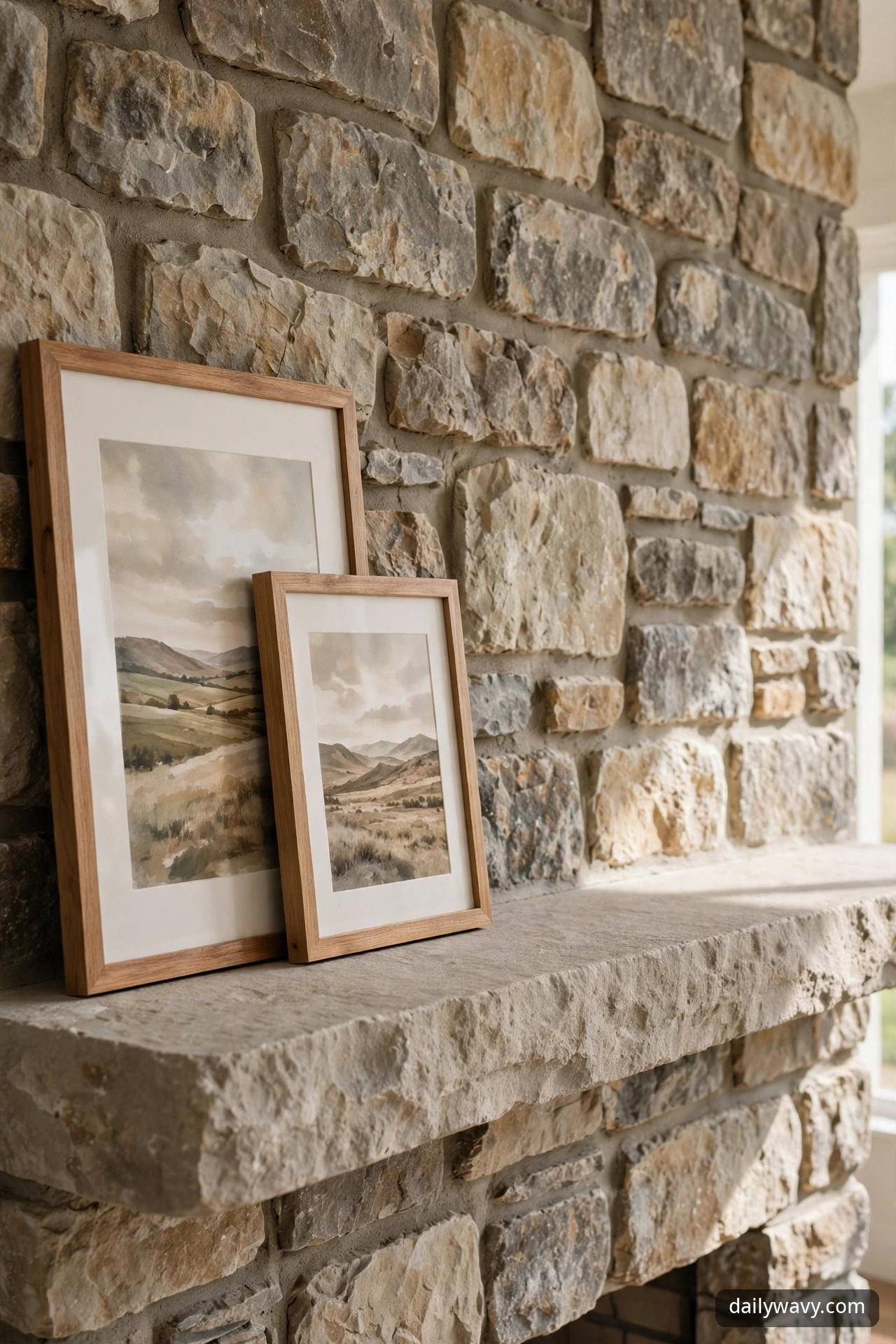
Layered frames are the designer’s answer to the blank stretch of stone above a mantel, and the trick is in the second half of the name: generous negative space. Two or three frames leaned against the chimney breast, overlapping by a few inches, with half the mantel left completely empty, reads calm and deliberate. Fill every inch and the same frames read as clutter. The empty space lets the stone show through, which is the point of having a stone fireplace in the first place.
What you need
- Two or three frames in graduated sizes, for example 16×20, 11×14, and 8×10 inches. Matching wood tones or all-black frames keep it cohesive.
- Prints or art in warm neutrals: landscapes, abstract washes, or architectural sketches. Anything with a quiet palette works.
- Small adhesive bumper pads for the back bottom edge of each frame so they grip the shelf.
How to build it
- Lean the largest frame against the stone at one end of the mantel, about 12 inches from the end. It should tilt back roughly 10 degrees; bumper pads on the bottom edge stop it sliding.
- Layer the medium frame in front and slightly to the side, overlapping the large one by 3 to 4 inches. If you use a third frame, tuck it in front of the medium one.
- Keep the layered group within one half of the mantel. The other half stays completely empty. That empty half is the design; do not fill it with a candle or a plant.
- Check sightlines from the main seat in the room. The frames should read as one composed group, not three separate items.
Effort and cost
About an hour including choosing art. Decent wood frames run $15 to $40 each, and printable art from independent artists costs $5 to $20 per download. A full layered set lands around $60 to $120.
Lower-cost alternative
Thrift stores are full of solid wood frames for $3 to $8. Sand lightly, paint them all the same warm white or black, and print free public-domain landscape art at a copy shop for a few dollars a sheet.
Safety note
Frames leaned on the mantel sit above and beside the firebox opening on the shelf itself, which is standard styling. On a working fireplace, keep them out of the documented clearance zone near the opening, and never hang or lean anything directly over an open firebox where rising heat can warp wood or scorch paper.
3. A pair of lamps on a wide surround
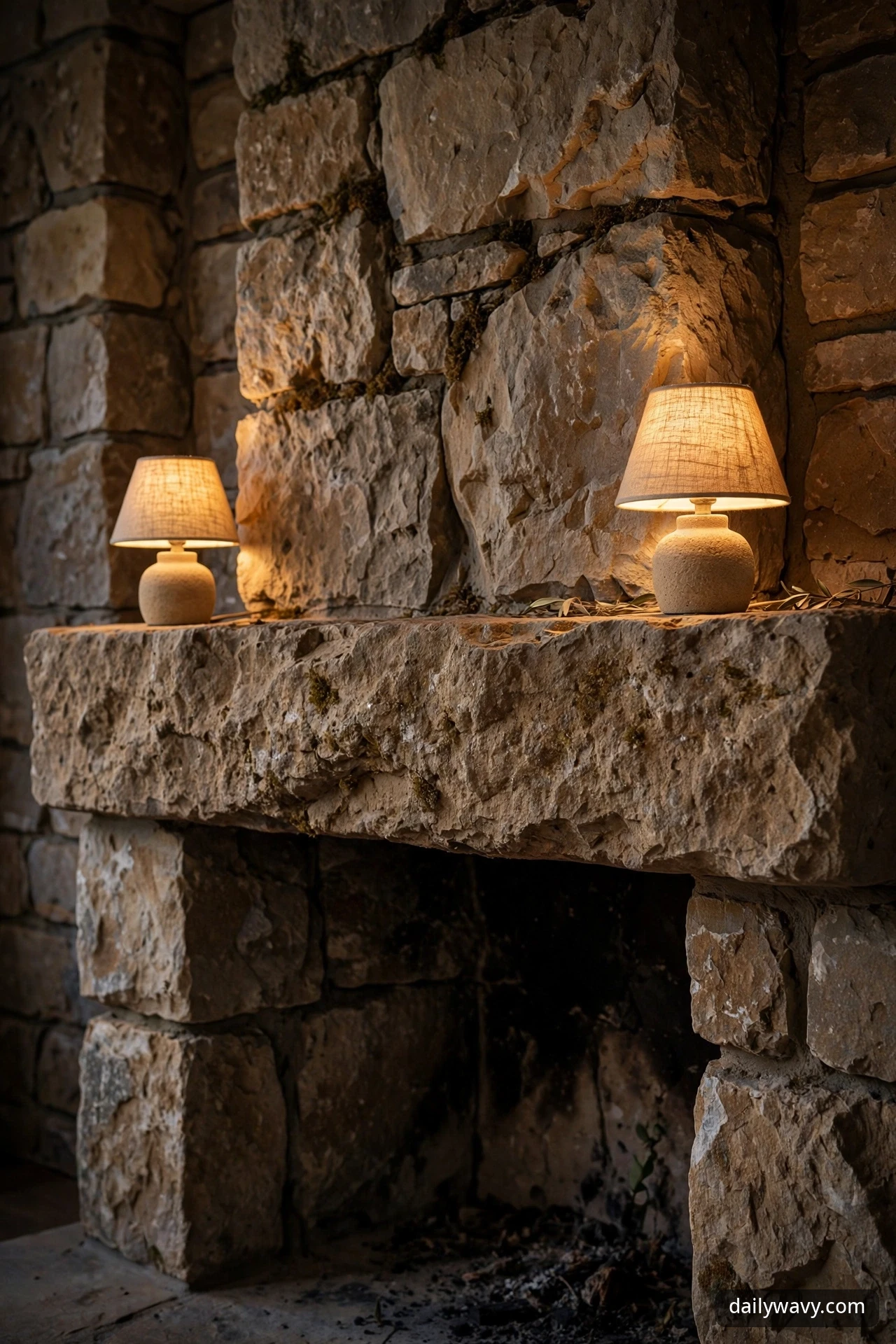
Symmetry is a fast route to a mantel that looks finished, and a pair of small lamps is symmetry with a bonus: real light. On a wide stone surround, two matching lamps flanking the center of the mantel give the whole wall a gentle evening glow that overhead lights cannot match. The stone catches the warm light and the texture deepens, which is one of the most flattering things you can do for a stone fireplace after dark.
What you need
- Two identical small table lamps, 12 to 16 inches tall including the shade. Mini buffet lamps or small gourd lamps are the right scale; full-size table lamps will crowd a mantel.
- Warm-white LED bulbs, 2700K, 40 to 60 watt equivalent. Avoid cool daylight bulbs, which turn warm stone gray.
- A cord channel or cord cover in a color close to your stone to run the cords neatly down behind the surround.
How to build it
- Measure the mantel and mark the center. Place one lamp about 18 to 24 inches to each side of center, depending on mantel width. On a 60-inch mantel, 20 inches off center leaves a comfortable gap in the middle.
- Angle both shades very slightly inward so the light washes toward the middle of the mantel rather than straight out into the room.
- Run cords down the back of the surround to the nearest outlet, using an adhesive cord channel painted or chosen to blend with the stone.
- Leave the center of the mantel for one low, simple object if you want it, or nothing at all. The lamps are the composition.
Effort and cost
About an hour including cord management. Matching small lamps run $30 to $70 each, so budget $60 to $140 for the pair plus bulbs and cord covers.
Lower-cost alternative
Buy two identical thrift-store lamps ($8 to $15 each) and replace the shades with matching new drum shades ($12 to $20 each). Same silhouette, less than half the price.
Safety note
Lamps on the mantel are standard, but on a working fireplace keep them and their cords outside the documented clearance zone, and never drape cords across or in front of the firebox opening. Unplug the lamps when you have a real fire going if they sit within the heat-affected area above the opening.
4. A low floral arrangement

A low floral arrangement centered on the mantel is the classic move for a reason: it softens the hard line where the stone meets the wall and adds life without height that competes with the chimney breast. The key word is low. Anything taller than about 12 inches above the shelf starts to block the stone and fight the architecture. Kept low and wide, flowers read as a finishing layer rather than a barricade.
What you need
- A wide, low vessel: a footed bowl, a low trough, or a shallow ceramic bowl 12 to 18 inches long and no more than 6 inches tall.
- A flower frog or a ball of chicken wire to hold stems in place.
- Fresh or high-quality faux stems in a restrained palette: cream, blush, sage, and one deeper accent. Eucalyptus, ranunculus, garden roses, and dried grasses all work.
How to build it
- Set the frog or wire in the vessel and fill with water if using fresh flowers.
- Build the arrangement wide, not tall: lay the longest stems nearly horizontal so the finished piece spreads 16 to 24 inches across but rises no more than 10 to 12 inches above the shelf.
- Center the vessel on the mantel. Step back to the main seat and check that the top of the arrangement clears the sightline to the stone above; you should see stone, then flowers, then shelf, in clean bands.
- Refresh water every two to three days for fresh stems, and keep a small towel under the vessel to protect the stone from water rings.
Effort and cost
About 45 minutes to arrange. A good low bowl costs $25 to $60, and a grocery-store flower haul of $20 to $35 fills it generously. Faux stems cost more upfront, $40 to $80, but last for years.
Lower-cost alternative
Forage greenery from your yard, clipped branches, seed heads, or grasses, and set them in a wide soup bowl you already own. Dried and foraged arrangements cost almost nothing and suit stone beautifully.
Safety note
Keep the arrangement centered and low so it stays clear of the firebox opening on a working fireplace. Fresh flowers and dried grasses are combustible; never place them near the opening or anywhere inside the documented clearance zone, and move the arrangement off the mantel entirely on nights you light a fire.
5. A small clock balanced by a tall object
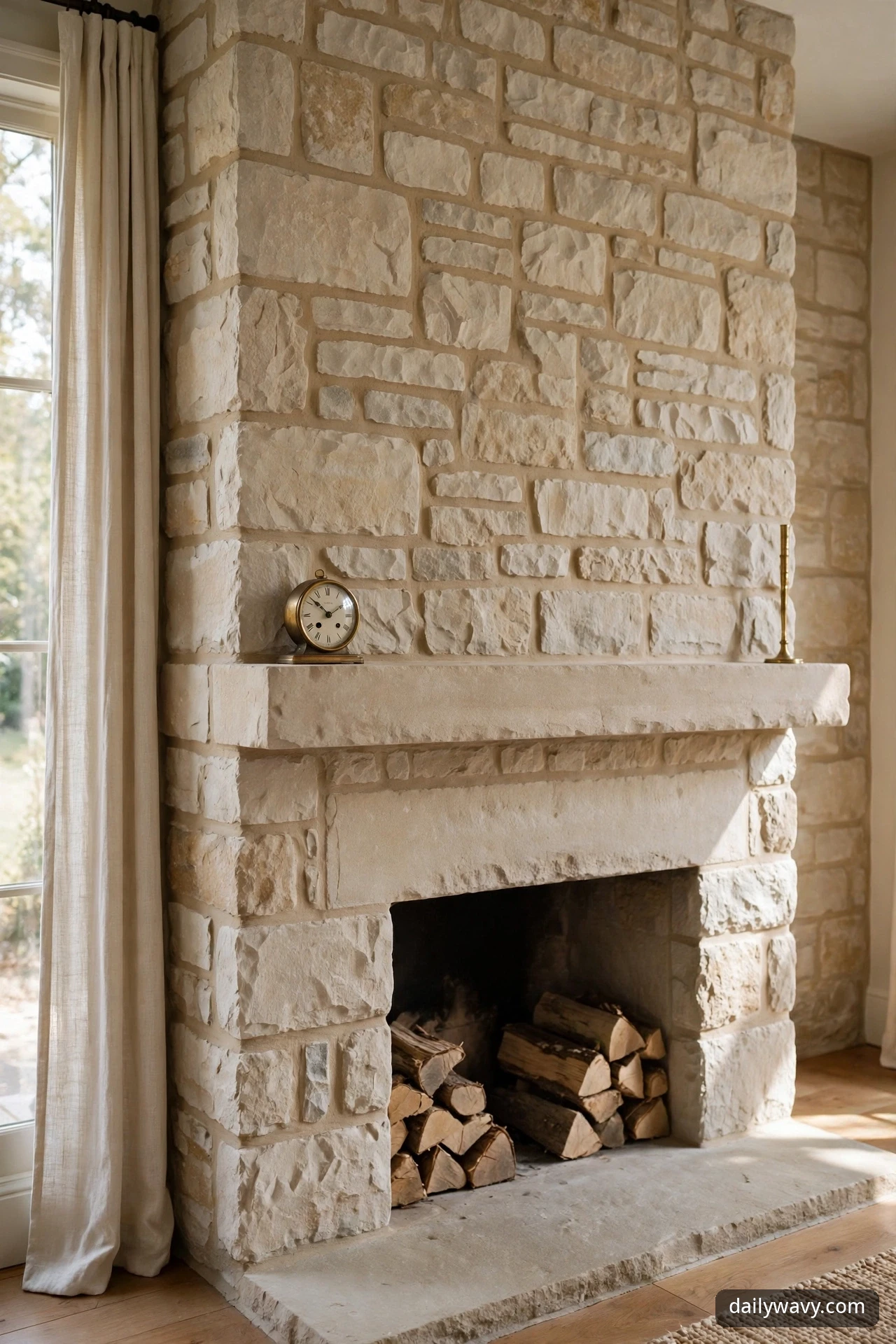
This is the classic asymmetrical balance trick, and it works because the two objects negotiate with each other across the mantel. A small clock on one side holds visual weight through detail and shine; a tall, simple object on the other side, a candlestick, a slim vase, a tall lantern, holds weight through height. Together they feel settled without being mirrored, which suits stone’s naturally informal texture better than rigid symmetry sometimes does.
What you need
- A small mantel clock or round wall-style clock, 6 to 10 inches in diameter, with a readable face.
- One tall, simple object 18 to 24 inches tall: a pair of slim candlesticks counts as one visual unit, or use a single tall vase or lantern.
- A small felt pad under the clock to protect the stone shelf.
How to build it
- Place the clock on the mantel about 10 to 14 inches from one end. This is your anchor.
- Set the tall object at the opposite end, about 10 to 14 inches from that end. The two pieces should face each other across the empty middle.
- Stand at the room’s main viewpoint and squint. The clock and the tall object should feel like equal visual weights on a seesaw. If the tall object dominates, move it a few inches farther out; if the clock disappears, nudge the tall piece closer to center or choose a slimmer one.
- Leave the middle third of the mantel empty. The empty space is what makes the balance legible.
Effort and cost
About 30 minutes of arranging, most of it stepping back and nudging. A decent mantel clock runs $30 to $80, and a tall candlestick or vase runs $20 to $50. Budget $50 to $130 total.
Lower-cost alternative
Use a clock you already own and balance it with a tall glass bottle or a floor candlestick you move up from elsewhere in the house. The balance trick works with any two objects of contrasting scale, bought or borrowed.
Safety note
Candles in tall holders are fine as decor, but on a working fireplace only burn them when the fire is out, and keep every open flame well outside the documented clearances. Battery-operated pillar candles give the same warm look with none of the risk and are worth considering near any working firebox.
6. A cluster of stoneware pieces
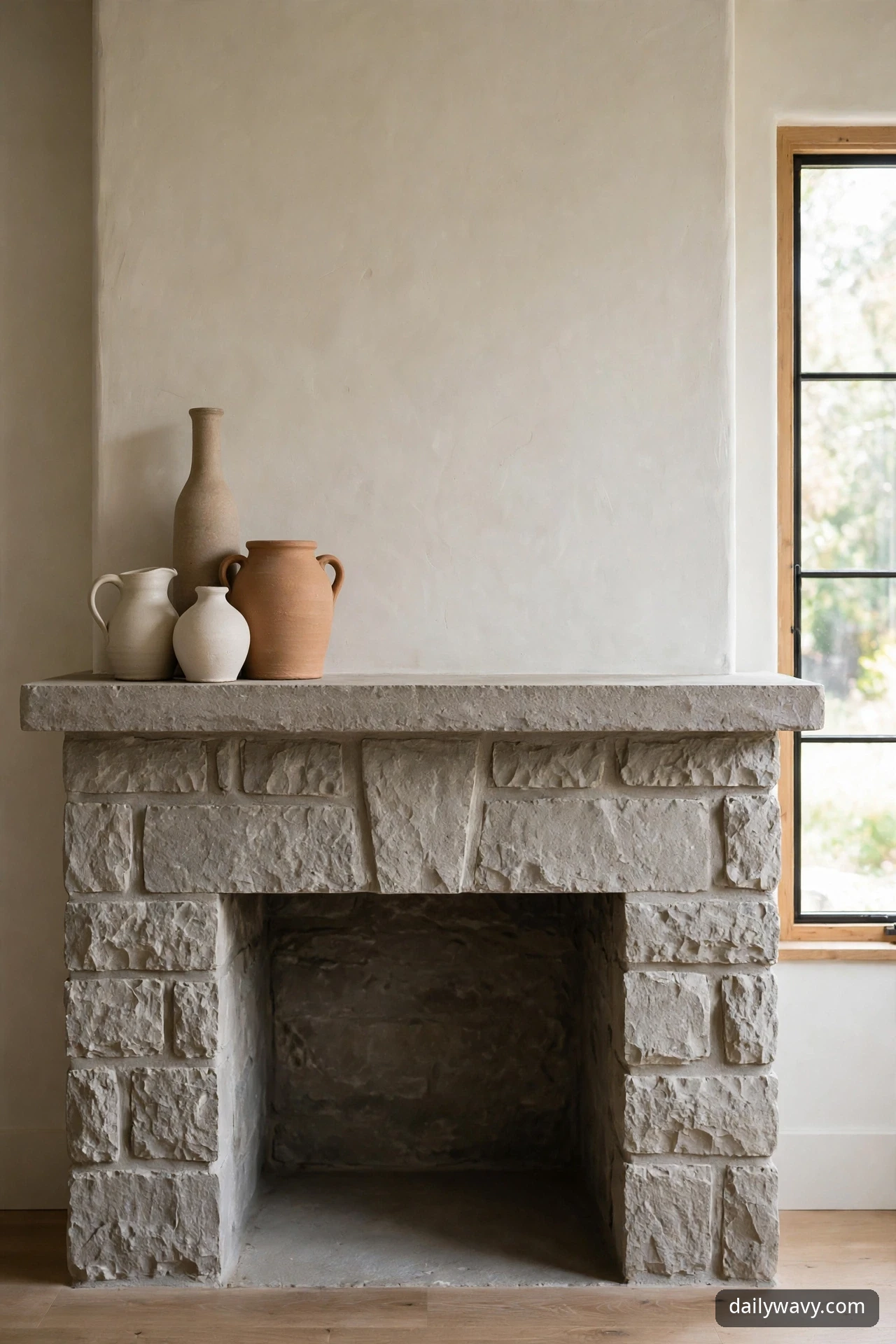
Stone on stone is a combination that rarely fails. A cluster of handmade-looking stoneware pieces, pitchers, vases, crocks, in warm whites, oatmeal, and clay tones, echoes the fireplace’s own material without matching it. The slight variations in glaze and shape keep the group lively, while the shared material keeps it calm. This is the arrangement for people who want the mantel to feel collected rather than decorated.
What you need
- Five to seven stoneware pieces in graduated heights, roughly 6 to 16 inches tall. Mix shapes: a pitcher, two vases, a crock, a small bowl.
- A consistent palette: warm white, sand, oatmeal, soft gray, or natural clay. Avoid mixing in bright colors or glossy finishes that fight the matte stone.
- Museum putty or small adhesive dots for the smallest pieces if you have curious pets or live in an earthquake-prone area.
How to build it
- Group the pieces toward one end of the mantel, covering about one-third of its length. Odd numbers read better than even, so aim for five or seven.
- Place the tallest piece at the back, medium pieces in the middle, and the smallest in front and slightly to the side, so the cluster reads as a triangle from the front.
- Overlap the pieces slightly, 1 to 2 inches, so they read as one cluster rather than a row of separate objects. Let a handle or spout break the silhouette for character.
- Leave the remaining two-thirds of the mantel empty. One cluster, one empty stretch: that is the whole composition.
Effort and cost
About 30 minutes to arrange, plus collecting time. Individual handmade-look stoneware pieces run $15 to $45 each, so a cluster of six lands around $90 to $200 if bought new.
Lower-cost alternative
Build the cluster slowly from thrift stores and flea markets, where stoneware crocks and pitchers sell for $5 to $15. A collected-over-time cluster actually looks better than a bought-all-at-once set, because the slight mismatches are the charm.
Safety note
Stoneware and ceramic are non-combustible, which makes this one of the safest arrangements for a working fireplace. Still, keep the cluster on the mantel shelf and outside the documented clearance zone near the firebox opening, and do not set pieces on the hearth directly in front of an opening where they could be knocked into the fire area.
7. A framed botanical pair
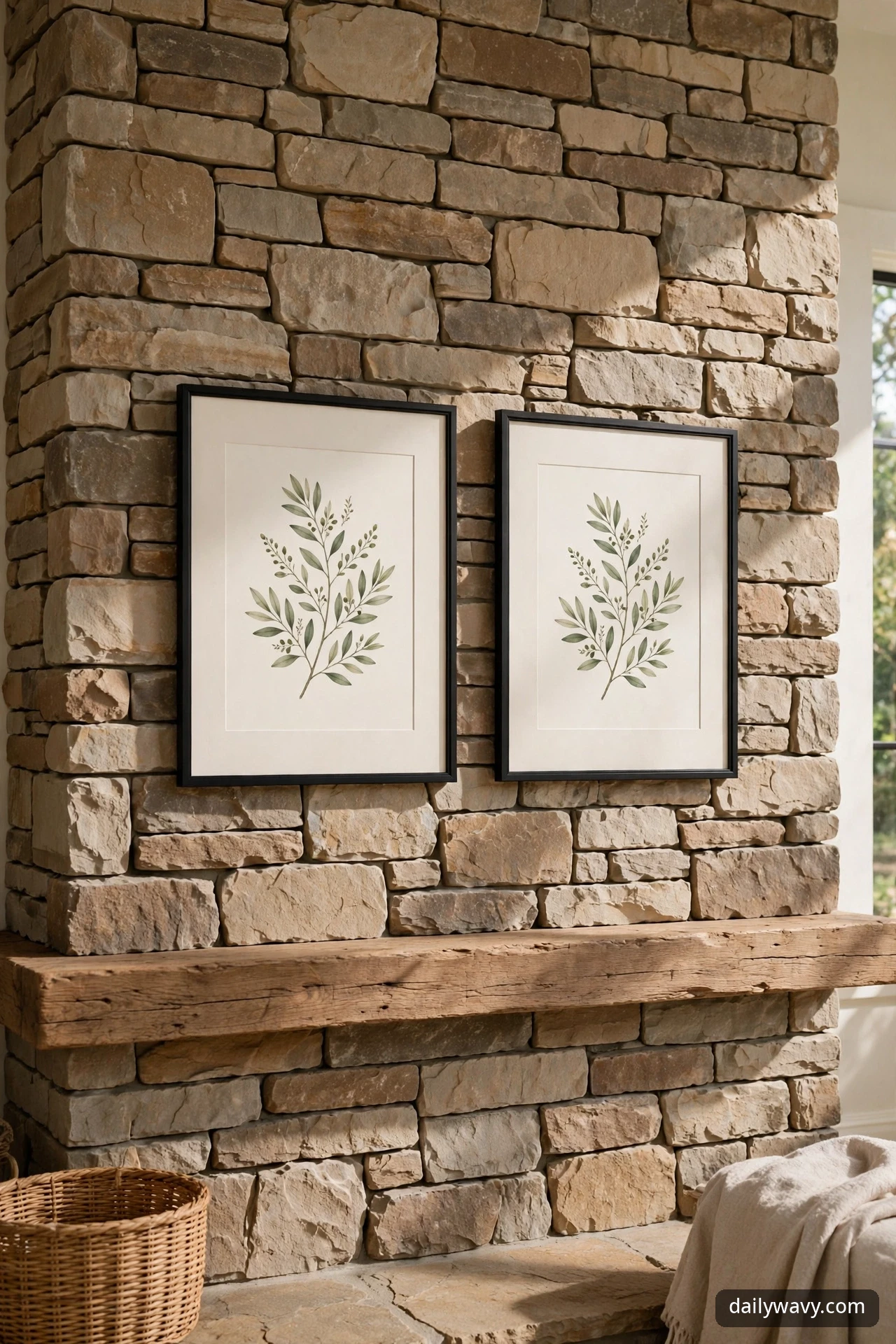
Two matching botanical prints hung side by side on the stone above the mantel bring a quiet, collected feeling to the wall without the fussiness of a full gallery. Botanicals suit stone fireplaces especially well: leaves and stems echo the organic texture of the rock, and the simple frames keep the wall feeling calm. Hung as a true pair, same frame, same mat, same size, they read as one intentional gesture.
What you need
- Two identical frames, 11×14 or 12×16 inches, with mats. Simple wood or thin black metal frames work best against stone.
- Two coordinating botanical prints: a true pair from the same series, or two prints in the same style and palette.
- A masonry drill bit and appropriate wall anchors, or a pair of strong adhesive stone hangers rated for the frame weight if you prefer not to drill. Check the hanger rating against your actual frame weight.
How to build it
- Measure the chimney breast and mark the center. The pair should hang centered over the mantel, with the bottom of the frames 6 to 10 inches above the mantel shelf.
- Hang the two frames side by side with 2 to 3 inches between them, using a level to keep the tops even. On uneven stone, measure from a fixed reference like the mantel shelf rather than trusting the stone courses.
- Step back and confirm the pair reads centered from the main seat. Stone walls are rarely perfectly symmetrical, so trust your eye from the sofa more than the tape measure.
- Keep the mantel below simple: the pair is the artwork, so the shelf needs only one low object or nothing at all.
Effort and cost
About an hour including hanging. Two frames with mats run $30 to $70, prints $10 to $40, and hardware under $10. Budget $50 to $120 total.
Lower-cost alternative
Press real leaves and ferns between book pages for two weeks, mount them on cardstock, and frame them in matching thrift-store frames. Genuine pressed botanicals in matching frames look more expensive than they are.
Safety note
Anything hung on the chimney breast above the mantel must respect the documented clearances on a working fireplace: no combustible frame or mat within 6 inches of the firebox opening, and check that rising heat will not warp frames or scorch prints. If in doubt, keep art higher on the breast, well above the heat zone, and confirm against the unit’s manual.
8. A restrained row of bud vases
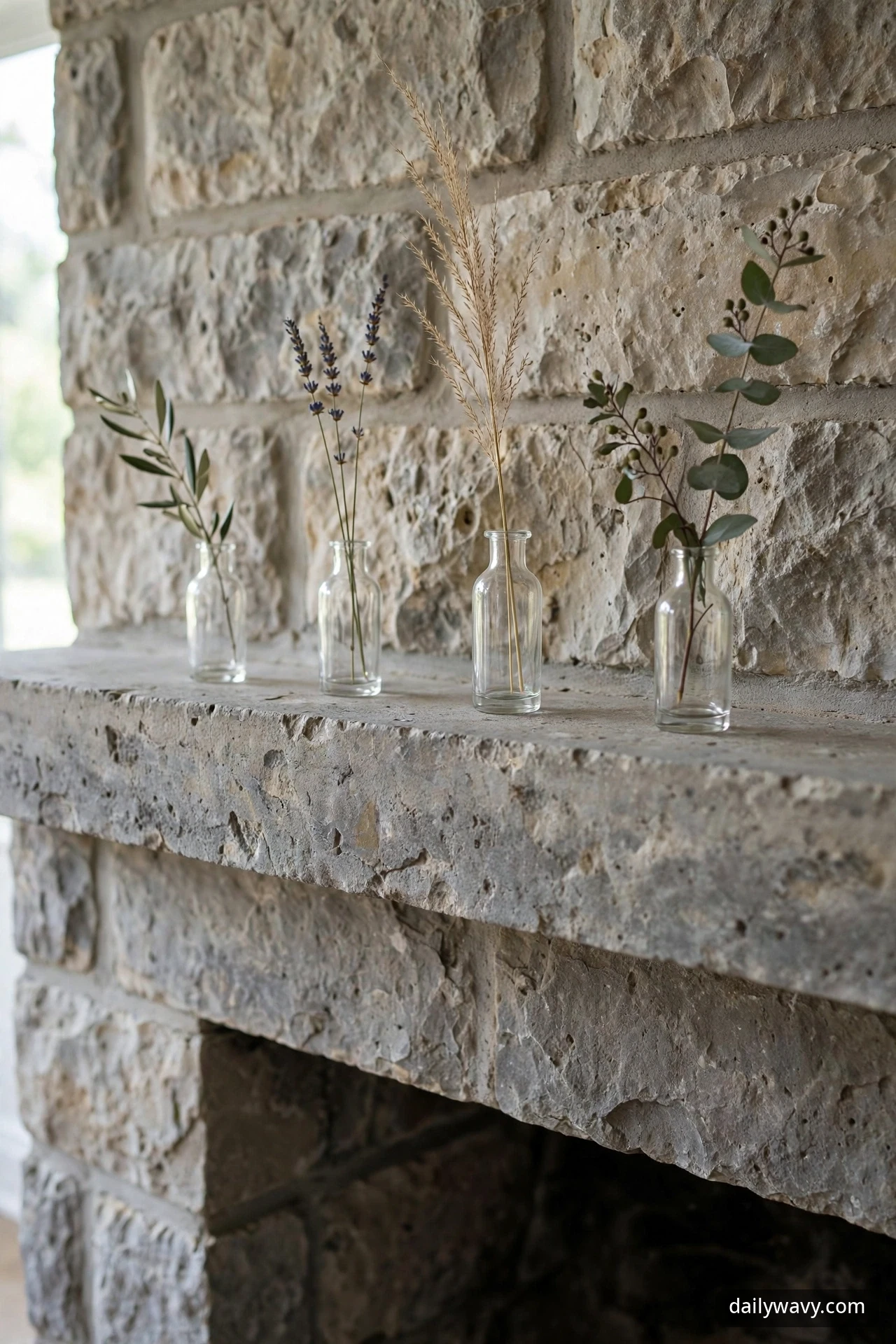
A row of small bud vases, each holding a single stem, is minimalism with a pulse. The repetition of the small vessels creates rhythm across the mantel, the single stems keep it from feeling fussy, and the whole thing takes five minutes to refresh. Against rough stone, the delicate scale contrast is the entire point: tiny, precise, alive, set against big, rough, permanent.
What you need
- Three to five bud vases, 4 to 6 inches tall, in the same material or a tight palette: all clear glass, all stoneware, or all brass.
- Single stems to suit: one rose each, sprigs of eucalyptus, single ranunculus, or even single stems of dried lavender.
- A small pitcher or cup of water kept nearby for easy refills.
How to build it
- Line the vases along the mantel with 4 to 6 inches between each one. A straight row suits a formal room; a gently staggered row, alternating 1 inch forward and back, suits a relaxed one.
- Keep the row to one half or the middle third of the mantel. A full-width row of tiny vases reads as a border rather than an arrangement.
- Cut each stem to a different height, varying by 1 to 3 inches, so the row has a gentle rhythm instead of a flat top line.
- Refill water every two days and trim stem ends weekly. Single stems drink fast in small vases.
Effort and cost
Fifteen minutes to set up, five minutes a week to maintain. Bud vases run $6 to $18 each, so a row of four costs $25 to $70. Stems from the grocery store add $5 to $10 a week if you refresh often.
Lower-cost alternative
Save small glass bottles, spice jars, or tincture bottles, remove the labels with hot soapy water, and use them as a mismatched-but-cohesive row. Single stems from your own garden make the whole thing free.
Safety note
Bud vases are small and light, which means they tip easily, so keep the row back from the mantel’s front edge and outside the documented clearance zone on a working fireplace. Glass near a fire can also catch and throw surprising reflections, so position the row where it will not glare into the main seat when the fire is lit.
9. An off-center stack of books
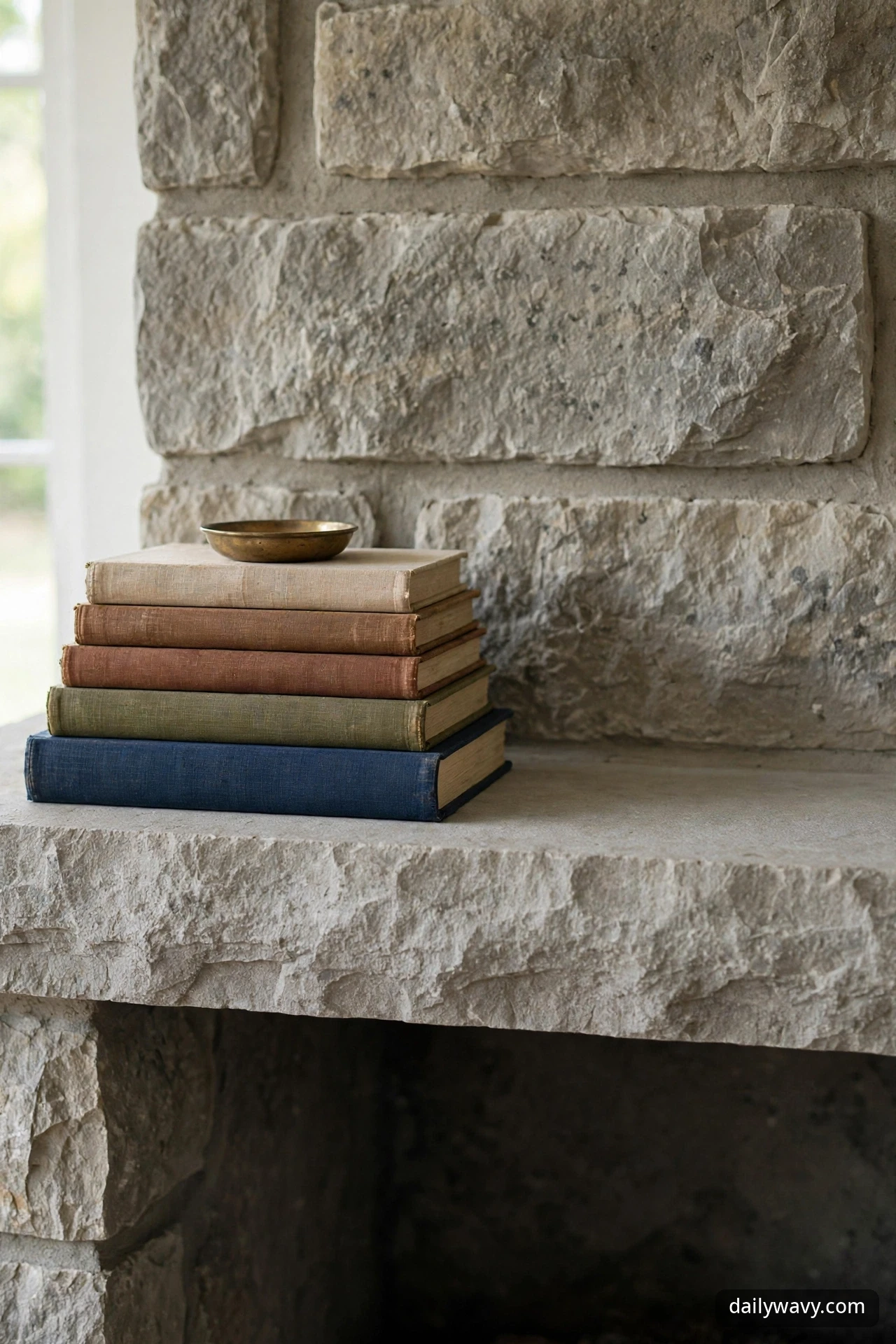
An off-center stack of books is a very livable idea in this roundup: it uses things you already own, it invites touch, and it gives the mantel a relaxed, intellectual weight. The off-center placement is doing the design work. A centered stack reads formal and a little stiff; pushed to one side with empty shelf beside it, the same books read casual and confident. Top the stack with one small object and the composition is complete.
What you need
- Four to seven coffee-table or art books with attractive spines and covers. Remove dust jackets if the boards underneath look better.
- One small object for the top: a paperweight, a small stone, a brass dish, or a tiny framed photo.
- A felt pad under the bottom book to protect the stone shelf.
How to build it
- Stack the books largest on the bottom, smallest on top, aligning the spines flush on one side and letting the front edges step back naturally.
- Place the stack 12 to 18 inches from one end of the mantel, roughly at the one-third mark. The remaining two-thirds stays empty.
- Set the single small object on top of the stack, slightly off-center. One object only; two starts to look like a display case.
- Check the total height. The stack plus topper should stay under about 14 inches so it does not compete with the stone above.
Effort and cost
Twenty minutes, mostly choosing which books earn the spot. If you already own the books, the cost is zero. A new art book runs $25 to $50 if you want to add one fresh spine to the mix.
Lower-cost alternative
Library sales and thrift stores sell handsome hardcovers for $1 to $3. Choose by spine color and size rather than subject.
Safety note
Books are combustible, so on a working fireplace keep the stack on the mantel shelf well outside the documented clearances, never on the hearth near the opening, and never inside the firebox of a nonworking fireplace unless you explicitly treat that firebox as unused decor space. Keep the stack low and stable so it cannot topple toward the fire area. On nights you light a fire, move the stack off the mantel entirely.
10. A trailing plant safely away from heat
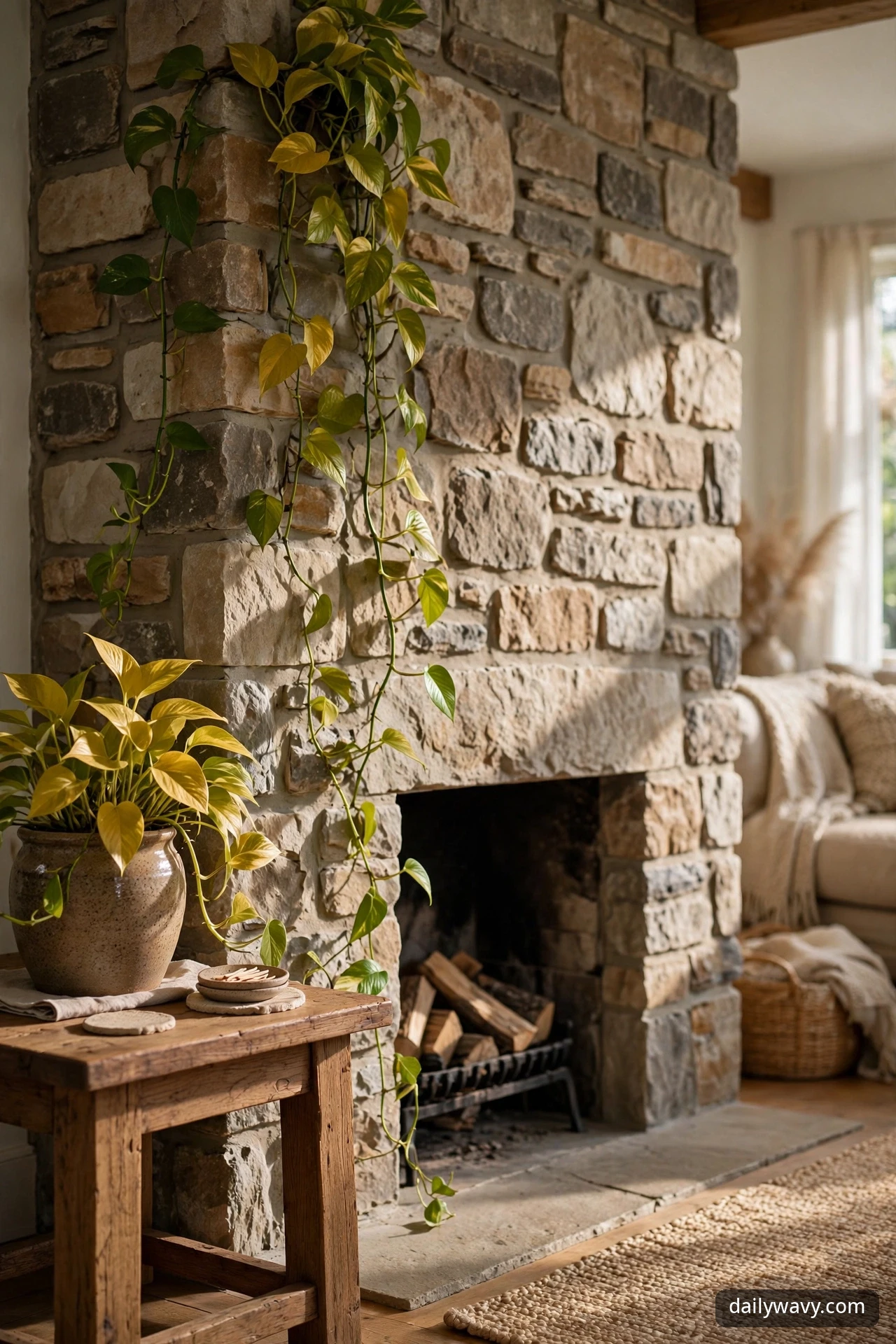
A trailing plant softens the hard geometry of a stone fireplace beautifully, but the placement has to be deliberate: safely away from heat. Set a pothos or philodendron at the far end of a wide mantel, or on a side table beside the fireplace, and let the vines drape down the stone. The living green against gray stone is a pretty contrast, and it costs almost nothing to maintain.
What you need
- A trailing plant: golden pothos, heartleaf philodendron, or English ivy are the reliable choices. Buy a full 6-inch pot so the trails start at 12 inches or longer.
- A heavy pot with a saucer, 6 to 8 inches in diameter, in stoneware or ceramic so it cannot tip on the shelf.
- Optional small adhesive hooks or clear clips if you want to train a vine along the stone, kept well clear of the firebox.
How to build it
- Choose the end of the mantel farthest from the firebox, or better, a sturdy side table or plant stand beside the fireplace. Measure: the pot should sit at least 3 feet horizontally from the firebox opening on a working fireplace, so the mantel end only works on a wide mantel.
- Set the pot on its saucer and let the longest vines trail over the front edge of the shelf or table. Arrange the trails so they fall naturally rather than in a single rope.
- Rotate the pot a quarter turn every two weeks so growth stays even, and trim any vine that starts reaching toward the firebox.
- Water when the top inch of soil is dry, and empty the saucer so water never sits against the stone.
Effort and cost
Twenty minutes to place, five minutes a week to water and rotate. A full 6-inch pothos costs $12 to $25, and a decent stoneware pot with saucer runs $20 to $40.
Lower-cost alternative
Root pothos cuttings in water from a friend’s plant, which is free, and pot them up in a thrifted ceramic bowl with a drainage hole drilled carefully, or set a small plastic nursery pot with drainage inside the bowl. In a few months you will have the same trailing effect for almost nothing.
Safety note
This is the idea where placement matters most. On a working fireplace, live plants and dry trailing vines are combustible and must stay completely outside the documented clearances, at least 3 feet from the firebox opening is a sensible minimum, and never above or beside the opening where rising heat will scorch leaves. If your fireplace is nonworking, state plainly that the firebox is unused, and still keep the plant off the mantel directly above it so falling leaves never drift into the opening.
Frequently asked questions
How many items should I put on a stone fireplace mantel?
Fewer than you think. Every idea above uses one composed group, a pair, a row, or a single object, with deliberate empty space around it. Three to seven objects total is the comfortable range for a standard 60 to 72 inch mantel. If you cannot see stone between your objects, remove something.
Can I decorate a working fireplace the same way as a nonworking one?
The arrangements look the same, but the rules differ. On a working fireplace, every combustible item must stay outside the clearances documented in the unit’s manual, commonly no combustibles within 6 inches of the firebox opening. On a nonworking fireplace, the firebox is unused, so you have more freedom, but say so plainly and never style a sealed firebox to look like a working fire.
What colors work best with a stone fireplace?
Restrained warm neutrals: cream, oatmeal, sand, soft gray, warm white, natural wood, and clay tones. Stone already brings color variation and texture, so the decor should calm the palette rather than add to it. One deeper accent, like black frames or dark bronze, is plenty.
How do I hang things on a stone chimney breast without damaging it?
Use a masonry bit and anchors rated for the weight, drilling into mortar joints rather than the stone faces when possible, since mortar is easier to patch. For light frames, adhesive stone hangers rated for the actual frame weight are a drill-free option. Always check the weight rating against your real frames.
My mantel is narrow. Which ideas still work?
The bud vase row suits narrow shelves of 6 to 8 inches deep, since the vases are small. The single branch and the off-center book stack can work on an 8-inch shelf if you choose a vessel with a base at least an inch narrower than the shelf and books that sit fully on it. Skip the lamp pair and the wide floral bowl on narrow mantels, and always keep every object fully on the shelf with at least an inch of shelf in front of it. For more on furnishing tight spaces around a strong focal wall, our narrow living room layout guide covers furniture placement for narrow rooms.
How often should I change my mantel decor?
Seasonally is the natural rhythm: refresh stems weekly, swap the whole arrangement three or four times a year, and let the stone itself carry the room between changes. A mantel that evolves slowly looks collected; one that changes monthly looks restless.
Stone fireplaces reward restraint more than any other feature in the house, and the ten ideas above all follow the same quiet logic: one clear gesture, honest materials, and enough empty space for the stone to speak. If you are styling the entry that leads into the room, our small entryway decor ideas use the same measure-first thinking, and the full home decor collection has more room-by-room guides in this style.