12 Small Window Curtain Ideas to Frame Your Space
A small window is one of the easiest things in a room to get wrong. Hang a skimpy panel and…
A small window is one of the easiest things in a room to get wrong. Hang a skimpy panel and the whole wall looks unfinished. Hang something heavy and the light you came for disappears. The fix is simpler than most people think: a curtain treatment scaled to the window, not the room. These 12 ideas are built for the windows that actually live in houses, bathroom sashes, kitchen casements, hallway slits, the narrow bedroom window above a dresser. Each one explains what to measure, what materials to buy, how to hang it, and a lower-cost way to get a similar look, so the finished window reads as intentional rather than apologetic.
Jump to an idea
- A Tonal Pattern With Plain Surroundings
- A Muted Accent Color
- A Small-Scale Botanical Motif
- A Clean Geometric Repeat
- A Darker Trim Against A Light Field
- A Relaxed Fabric Texture
- A Plain Treatment With Simple Hardware
- A Soft Check Pattern
- A Natural-Fiber Look Suited To The Room
- A Calm Monochrome Pairing
- A Restrained Vintage-Style Fabric
- A Linen-Look Finish With Neat Hems

Small window curtain basics: measure first, then choose fabric
Small windows punish guesswork, so start with four measurements before you look at a single fabric. First, the frame: measure the outside width and height of the trim. Your rod should extend 4 to 6 inches past the trim on each side, and sit 4 to 6 inches above the top of the frame. On a small window that extra width matters more than on a big one: it lets the panels stack mostly over the wall, so the glass stays uncovered when the curtains are open. Second, the length. For a window with a radiator or furniture underneath, hem the panels so they stop 1 to 1.5 inches above the sill or appliance, and never let fabric rest on or drape over a heat source. Where the wall is clear, let the panel fall to just below the sill or all the way to the floor. Third, fullness. A flat panel looks thin and unfinished. Plan on fabric width equal to 1.5 to 2 times the rod length so the folds read as deliberate.
Fabric choice is really a room choice. Kitchens and bathrooms need fabrics that tolerate steam and splashes: polyester blends, cotton-poly weaves, or fabrics labeled washable and quick-drying. Avoid heavy dry-clean-only textiles near a shower or a stove. Bedrooms and living rooms can take natural fibers and deeper textures. For privacy, hold the fabric up to a window at midday: a light-filtering weave glows and shows silhouettes, while adding an inexpensive privacy liner or choosing a denser weave gives daytime privacy without blackout weight. Finally, cords. Any looped pull cord or beaded chain is a strangulation hazard for small children, so use cordless rods, wand-drawn tracks, or cordless cellular options in kids’ rooms and keep tie-backs high and out of reach everywhere else. Hang the rod with screws driven into studs or proper drywall anchors, since even a small rod with lined panels carries real weight. Every idea below assumes these basics.
1. A Tonal Pattern With Plain Surroundings

A pattern that stays within one color family is one of the safest ways to make a small window feel dressed without making it feel busy. Picture a soft greige fabric carrying a barely-there stripe or pin-dot in a slightly deeper shade of the same color. From across the room it reads as texture, not pattern, and the window holds its own against the wall instead of disappearing into it. This is the treatment for rooms that already have something to say: a colored wall, a patterned rug, a gallery ledge. The curtain does not compete, it completes.
What to measure: Frame width plus 8 to 12 inches total for the rod; 4 to 6 inches above the frame for the bracket line. Choose a panel length that clears the sill by about an inch if anything sits below the window.
Materials: Two curtain panels in a tonal pattern (tone-on-tone stripe, pin-dot, or small damask), in a cotton or cotton-poly blend; a slim 3/4-inch rod with simple finials; ring clips or a rod pocket; wall anchors.
Placement: Center the rod on the window so equal amounts of wall show on each side. When open, each panel should stack onto the wall beside the trim, leaving the full glass visible. Steam or press the panels before hanging so the pattern lies flat.
Approximate effort: An afternoon, including a hardware store trip and pressing. Expect $40 to $90 for ready-made panels and a basic rod.
Lower-cost alternative: Buy plain panels in the right base color and add a single row of tonal grosgrain ribbon along the inner edge with iron-on hem tape; the ribbon reads as a pattern from a distance.
2. A Muted Accent Color

A muted accent color works like punctuation on a small window: one quiet note that makes the whole wall make sense. Think sage, dusty clay, faded indigo, or warm taupe pulled from something else in the room, a chair cushion, a rug border, the glaze on a bowl. Because the window is small, the color reads as an accent rather than a commitment, which means you can go slightly deeper than you would on a full wall of drapery. The result feels styled quickly, because the eye links the curtain to the room instantly.
What to measure: The rod line at 4 to 6 inches above the frame, extending 4 to 6 inches past the trim on each side. Note the room’s existing accent so the curtain color matches it within a shade or two.
Materials: Two solid panels in a muted accent color, light-filtering weight for living spaces or lined for bedrooms; a wooden or matte-black rod; ring clips; wall anchors. For kitchens or bathrooms, choose a washable polyester blend in the same muted tone.
Placement: Hang so the panels stack to the sides of the glass when open. If the window sits over a sink or counter, keep the hem at sill length and make sure the fabric cannot trail into the work area.
Approximate effort: One afternoon. Budget $35 to $80 for ready-made panels and hardware.
Lower-cost alternative: Dye white cotton panels with a single bottle of muted-tone fabric dye in a washing machine, following the dye manufacturer’s instructions, for the price of a bottle of fabric dye plus the cost of the panels.
3. A Small-Scale Botanical Motif

Botanicals are the classic small-window pattern because they read as nature rather than decoration. The rule is scale: the motif should be small enough that several repeats fit across the width of one panel, leaf sprigs, tiny ferns, scattered buds, never a single giant bloom that gets sliced awkwardly by the window’s narrow frame. On a small window a small-scale botanical feels like wallpaper’s calmer cousin. It brings the outside in without demanding attention, which makes it ideal for bedrooms and studies where you want softness without visual noise.
What to measure: Rod width and drop as for a standard outside mount. Count how many pattern repeats span one panel width before buying; three or more repeats across a panel keeps the motif from looking cut off.
Materials: Two panels in a small-scale botanical print on cotton or cotton-poly; a rod in wood or brushed nickel; ring clips or back tabs; wall anchors. Choose a print where the ground color echoes the wall paint so the window feels continuous with the room.
Placement: Center the pattern horizontally by sliding the panel on the rod before tightening rings, so a full motif lands near the window’s center rather than a half-cut one at the edge.
Approximate effort: An afternoon, plus time to compare prints in daylight. Expect $45 to $100.
Lower-cost alternative: A plain cream panel with a stenciled border of small leaves along the bottom edge, painted with fabric paint, gives the botanical feeling for the price of the panel plus a few dollars of paint.
4. A Clean Geometric Repeat

Geometric repeats give a small window a crisp, tailored feeling, especially in rooms with modern furniture. Small diamonds, thin grids, or offset dots in two tones read as architecture rather than decoration, and they hold their shape visually even on a narrow panel. The key is contrast kept low: charcoal on ivory, warm gray on white, deep green on natural linen. High contrast on a small window shouts; low contrast on a small window converses. This treatment suits hallways, home offices, and any room where you want the window to look sharp but not fussy.
What to measure: Standard outside mount measurements, plus the repeat size on the fabric. A repeat of 1 to 3 inches suits a small window; larger repeats get cut awkwardly at the edges.
Materials: Two panels in a low-contrast geometric print, medium weight so the folds hold; a straight rod with minimal finials; ring clips; wall anchors. For an office, add a privacy liner if the print is sheer.
Placement: Hang panels so the pattern’s grid lines run true vertical and horizontal; twist the panel on the rings until the lines look straight, then tighten. Keep the hem just below the sill or at floor length if the wall is clear.
Approximate effort: One afternoon. Budget $40 to $95 for panels and hardware.
Lower-cost alternative: Plain ivory panels with a hand-painted thin grid in fabric marker along the leading edge only; the geometry shows where the eye lands, and the rest stays simple.
5. A Darker Trim Against A Light Field

Trim is the tailor’s trick for small windows: a darker band along the leading edge of a light panel draws a clean vertical line that makes the window look taller and the curtain look custom. It works on almost any light fabric, linen, cotton, or a simple weave, and the contrast does the styling work for you. Choose the trim color from the room’s darker notes: a charcoal band over ivory echoes a black picture frame, a deep olive band over oatmeal picks up a plant pot. The band should be narrow, 2 to 4 inches, so it reads as a detail rather than a border.
What to measure: Outside mount measurements for the rod; for the trim, measure the finished panel length and plan the band to run the full drop of the leading edge.
Materials: Two light-colored panels; 2 to 4 inch wide grosgrain ribbon, fabric band, or contrast fabric strips for the trim; iron-on hem tape or a sewing machine; a rod and rings; wall anchors.
Placement: Apply the trim to the inner (leading) edge of each panel before hanging, keeping it straight and evenly spaced from the edge. Hang so the trimmed edges meet or nearly meet at the window’s center when closed.
Approximate effort: A weekend afternoon if you are adding the trim yourself; under an hour if the panels come pre-trimmed. Expect $30 to $85.
Lower-cost alternative: Buy plain panels and add the trim with iron-on hem tape and grosgrain ribbon; the whole upgrade costs very little on top of basic panels.
6. A Relaxed Fabric Texture
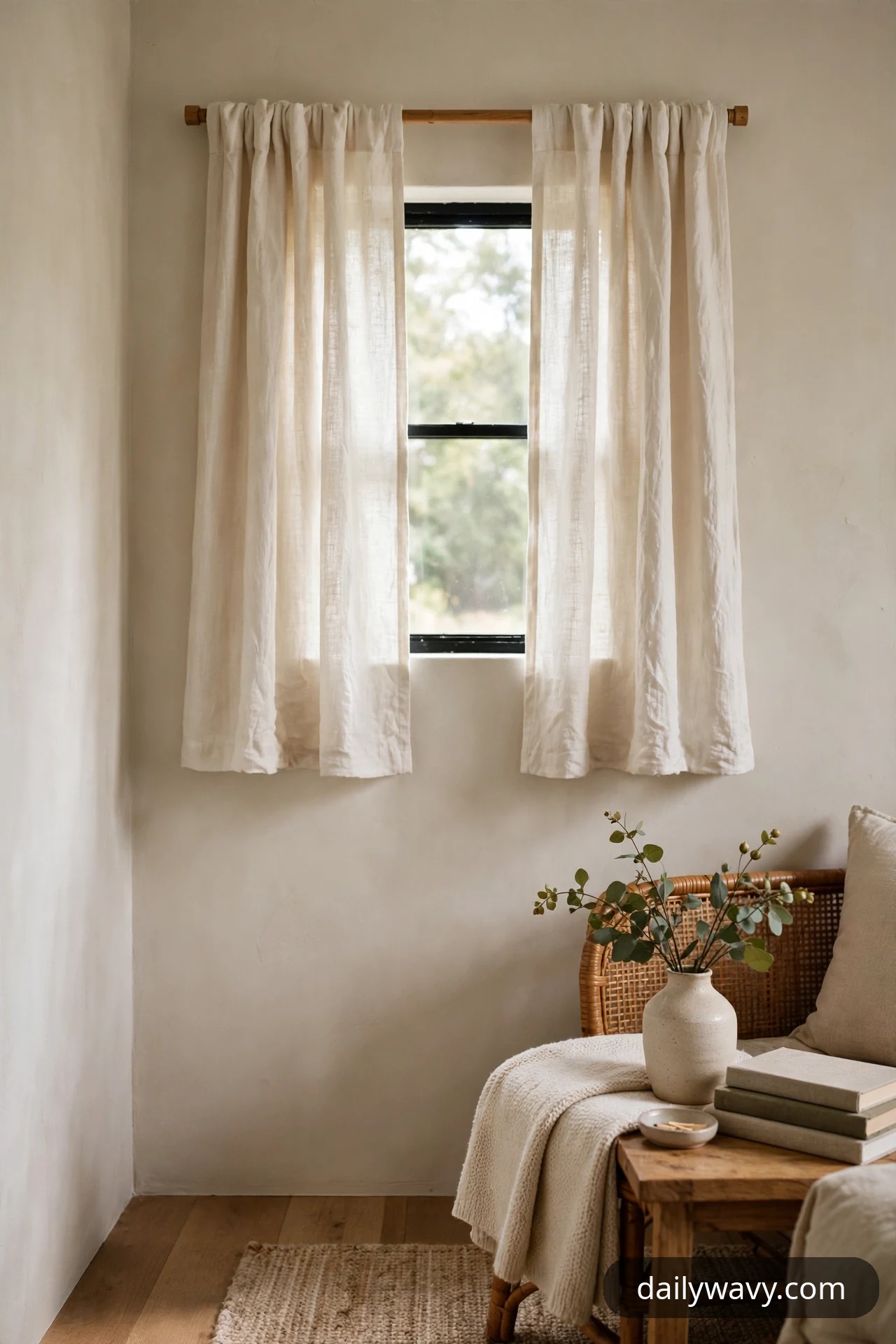
Some small windows do not need pattern or color, they need texture. A slubby cotton, a loose weave, or a crinkled gauze catches light differently across its surface, so the window feels layered even in a single quiet color. Relaxed textures forgive wrinkles, which makes them one of the most forgiving choices for a rental or a room where the curtains get opened and closed daily. On a small window, texture keeps the treatment from reading as a flat sheet of fabric; it gives the eye something to land on without adding visual weight.
What to measure: Outside mount measurements. Because textured fabrics are often lighter weight, plan on 2 times fullness so the gathers read as intentional.
Materials: Two panels in a textured weave (slub cotton, crinkled gauze, or a loose linen look) in warm white, oatmeal, or soft gray; a simple rod; ring clips with a loose gather; wall anchors.
Placement: Gather the panels loosely rather than pulling them taut; the texture shows best in soft folds. Let the hem fall just below the sill for a casual feel, and keep the fabric clear of any radiator below.
Approximate effort: An afternoon. Budget $35 to $80.
Lower-cost alternative: Washed cotton flat sheets in the right tone, hung with ring clips and gathered generously, give a relaxed texture for the price of the sheets.
7. A Plain Treatment With Simple Hardware
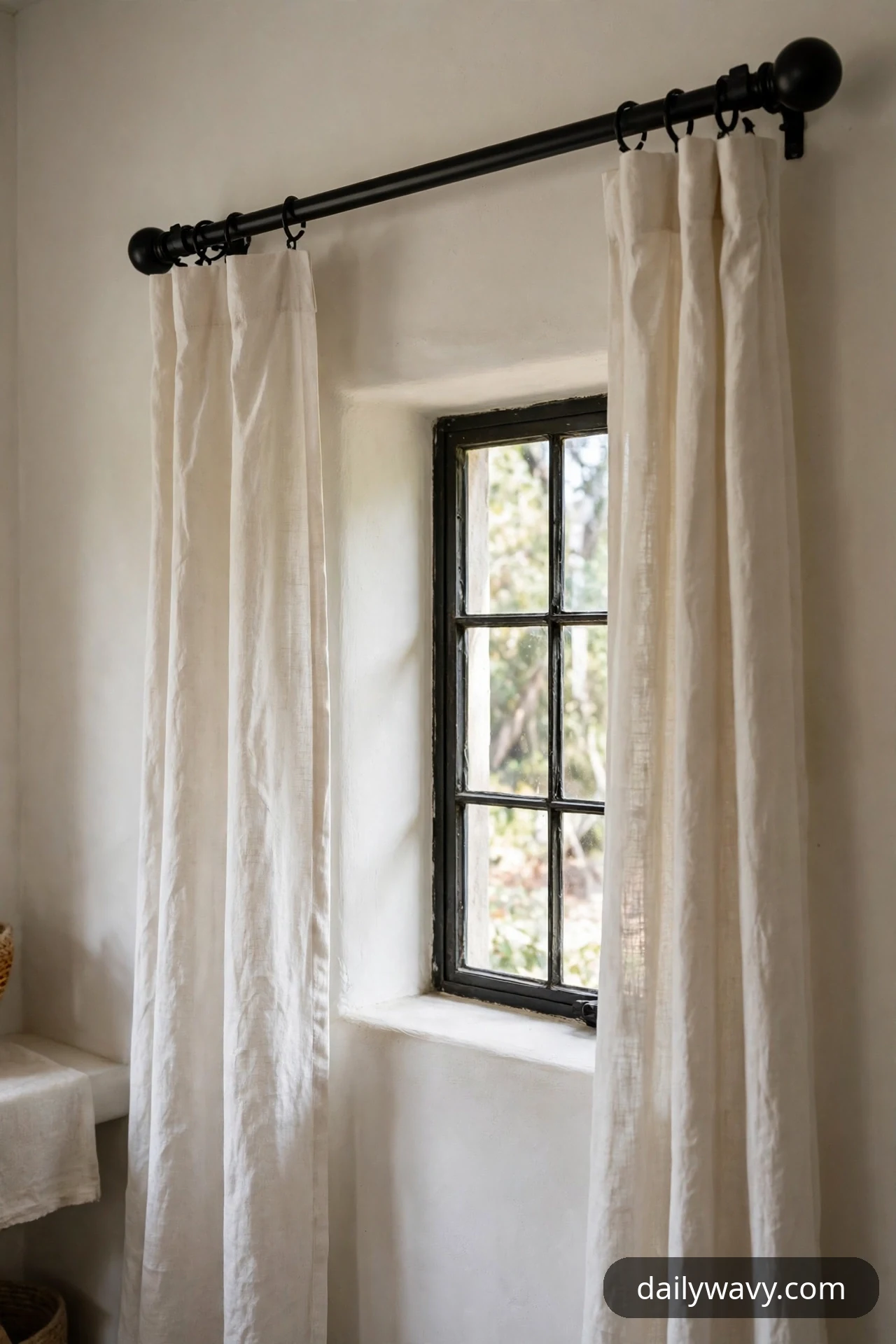
When the window itself is the feature, a beautiful frame, an old sash, a deep sill, the curtain should get out of the way and the hardware should do the talking. A plain panel in a quiet color on a well-chosen rod looks deliberate rather than default, and it lets the architecture carry the room. The hardware is the whole design decision here: a slim matte-black rod with round finials in a modern room, a warm wood rod with simple ends in a traditional one. Spend the design budget on the rod, keep the fabric simple, and the small window looks finished.
What to measure: Outside mount measurements, plus the projection of the rod brackets: make sure the rod sits 2 to 3 inches off the wall so the plain panels can stack without crushing against the trim.
Materials: Two plain panels in a solid, light-filtering fabric; one quality rod in the finish that suits the room (matte black, brushed brass, or warm wood); coordinating rings; wall anchors or screws into studs.
Placement: Mount the rod level and centered; plain panels show crooked rods mercilessly, so check with a level twice. Let the panels stack fully onto the wall when open so the window architecture is completely visible.
Approximate effort: An afternoon, most of it spent choosing the rod. Expect $50 to $120, with the rod as the biggest line item.
Lower-cost alternative: A basic rod spray-painted in matte black or brushed brass looks far more expensive than it is; pair it with plain ready-made panels for a finished look without spending much.
8. A Soft Check Pattern
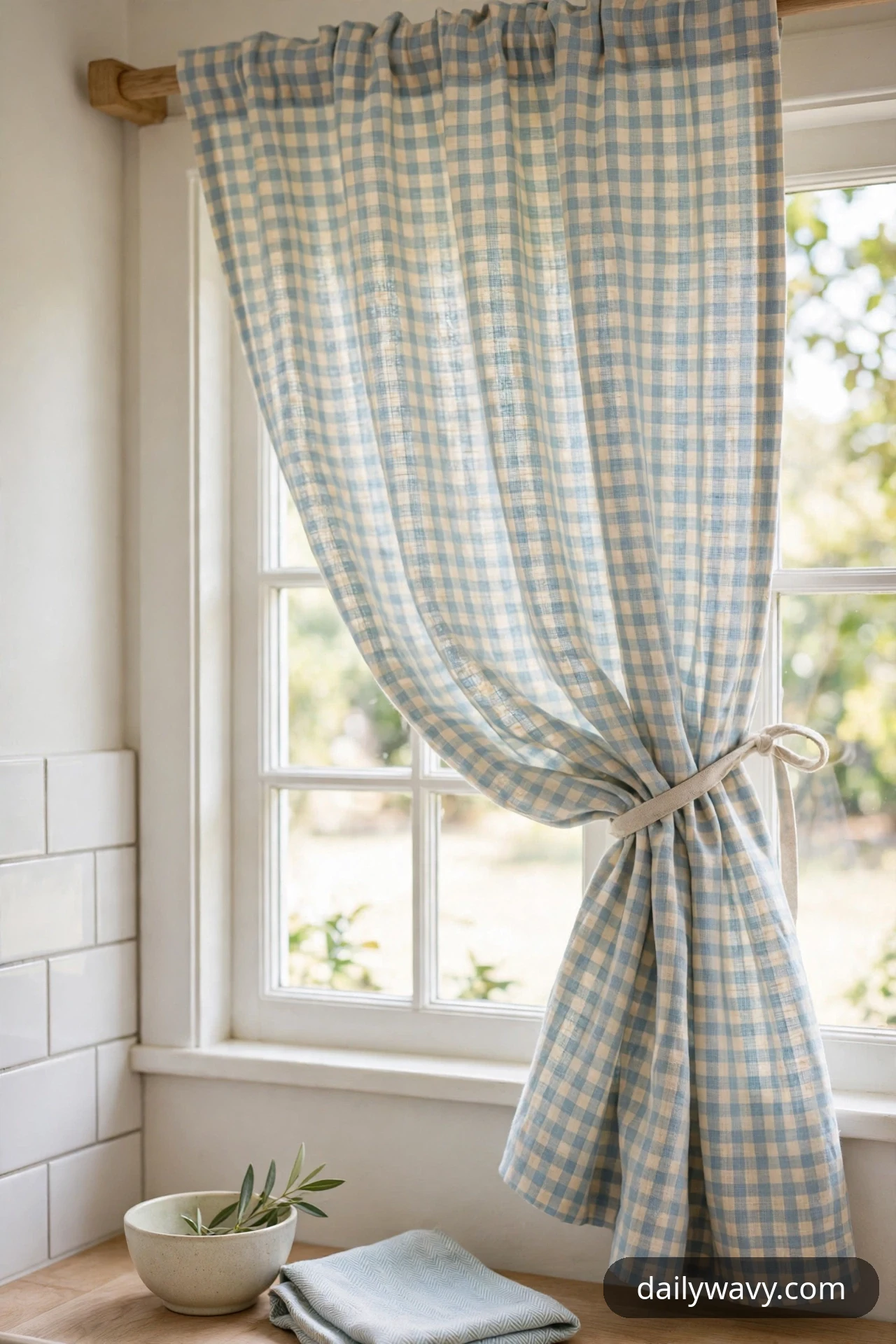
Checks are the friendly pattern for small windows. A soft gingham or windowpane in pale blue and cream, sage and white, or warm gray and ivory brings a kitchen or breakfast room to life without the fussiness of a floral. Keep the check small, under 1.5 inches, so the pattern repeats comfortably across a narrow panel. Soft checks read as cheerful rather than country when the colors stay muted and the rest of the room stays calm, which is why they work as well in a modern kitchen as in a farmhouse one.
What to measure: Outside mount measurements; note the distance from the window to the nearest cabinet or shelf so the stacked panel does not block a door swing. For kitchens, sill length is usually right.
Materials: Two panels in a small-scale soft check, in a washable cotton-poly blend for kitchens; a simple rod; ring clips; wall anchors. Choose a check whose lightest tone matches the wall or cabinet color.
Placement: Hang at sill length where the window sits over a counter, keeping the hem at least an inch above the backsplash. In a dining corner, floor length is fine. Make sure the fabric stays clear of the stove and any heat source.
Approximate effort: An afternoon. Budget $35 to $75.
Lower-cost alternative: Plain cream panels with a painted check border along the bottom third, done with fabric paint and painter’s tape for crisp lines, cost little more than the panels themselves.
9. A Natural-Fiber Look Suited To The Room
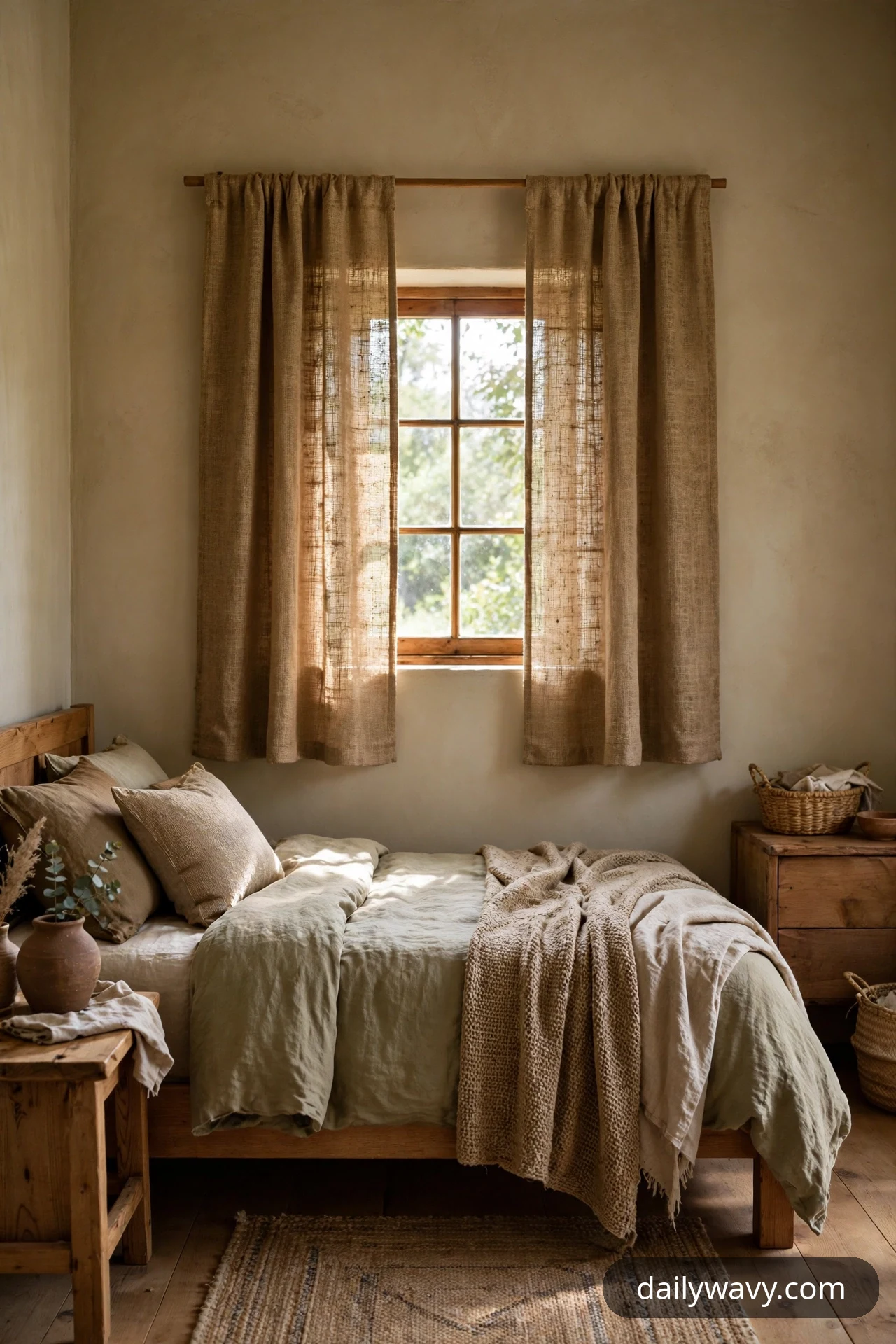
Jute tones, hemp weaves, and nubby natural-fiber looks bring an earthy calm to a small window, especially in bedrooms and rooms with wooden furniture. The trick is matching the fiber feeling to the room: a coarse jute look suits a rustic or coastal room, while a fine, even natural weave suits a modern organic one. True natural fibers can be fussy near moisture, so in bathrooms and kitchens choose a synthetic that mimics the look, many polyester weaves now read convincingly as jute or hemp while shrugging off steam. On a small window the texture does all the work; keep the color in the fiber’s natural range and skip any pattern.
What to measure: Outside mount measurements. Note the room’s humidity: if the window steams up regularly, plan on a synthetic-look fabric rather than true jute or hemp.
Materials: Two panels in a natural-fiber look weave (jute-tone, hemp-look, or nubby cotton) in the fiber’s natural color range; a wooden rod for warmth; ring clips; wall anchors. For damp rooms, specify a washable synthetic weave.
Placement: Hang so the panels frame the glass symmetrically; natural weaves look best with generous fullness, so use the full 2 times multiplier. Keep hems clear of radiators and sills that collect condensation.
Approximate effort: An afternoon. Expect $40 to $90.
Lower-cost alternative: Burlap-look table runners or wide burlap ribbon, hemmed and hung with ring clips, give the natural-fiber feeling on a very small window for very little money.
10. A Calm Monochrome Pairing
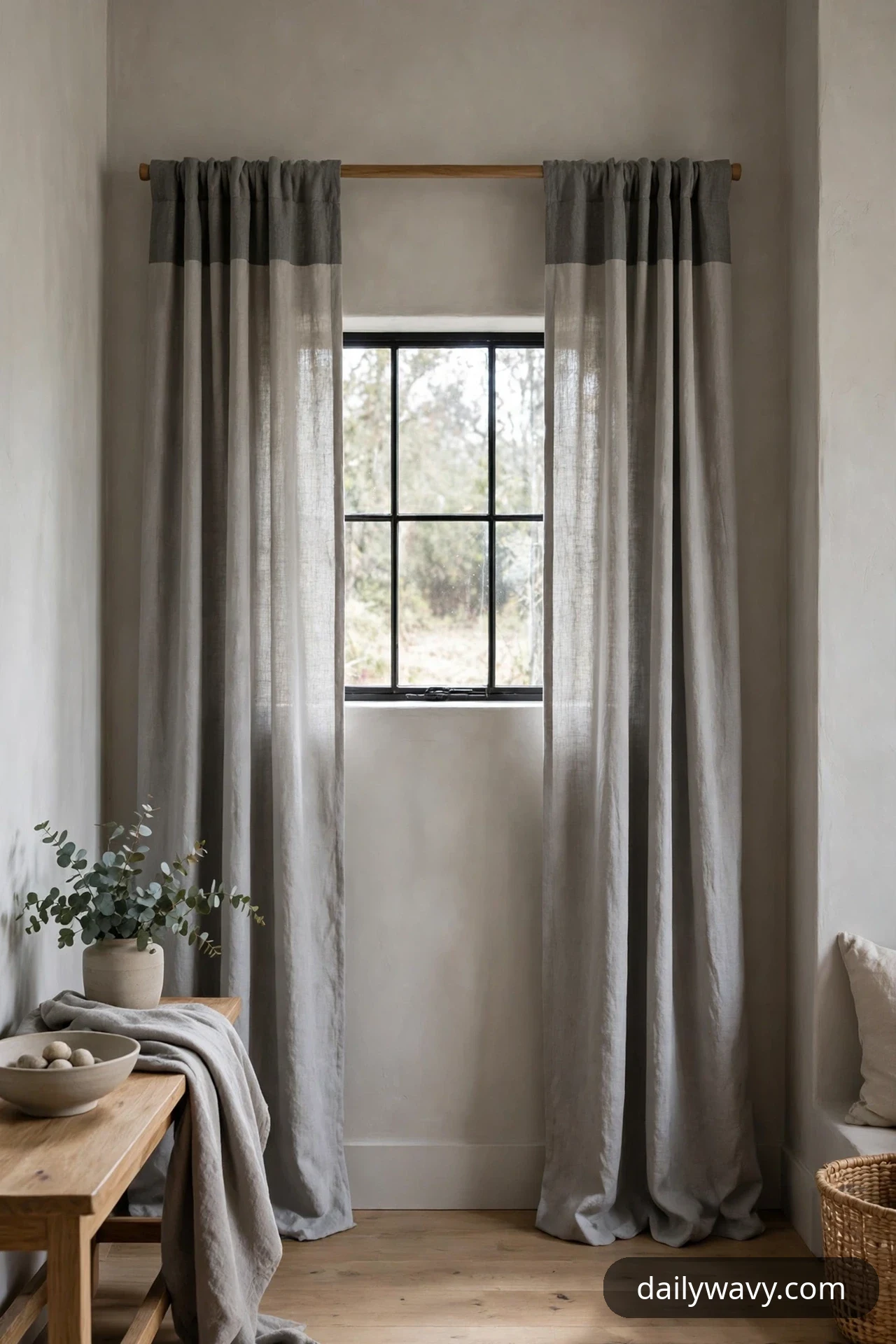
A monochrome pairing, two tones of the same neutral on one window, gives a small window depth without introducing a new color. Picture soft gray panels with a slightly darker gray band across the top, or warm white panels with an oatmeal header. The pairing creates a horizontal line that makes the window feel wider, which is useful on tall, narrow sashes. Keep both tones within the same family and within a few shades of each other; the effect should feel like shading, not striping. This is a good treatment for rooms that are already neutral and need quiet structure rather than decoration.
What to measure: Outside mount measurements. Plan the pairing: decide whether the darker tone goes at the top (a header band of 6 to 10 inches) or along the leading edge.
Materials: Two panels in the lighter tone; a coordinating fabric or wide ribbon in the darker tone for the header or edge band; iron-on hem tape or basic sewing; a rod and rings; wall anchors.
Placement: Attach the darker band before hanging, keeping the seam straight. Hang so the band sits level across both panels; a crooked band is the first thing the eye catches.
Approximate effort: A weekend afternoon if you are making the pairing yourself. Expect $35 to $85.
Lower-cost alternative: Two plain panels in adjacent tones from the same ready-made line, one hung as the main panel and one cut down as a header band, achieve the pairing with no sewing beyond a hem.
11. A Restrained Vintage-Style Fabric
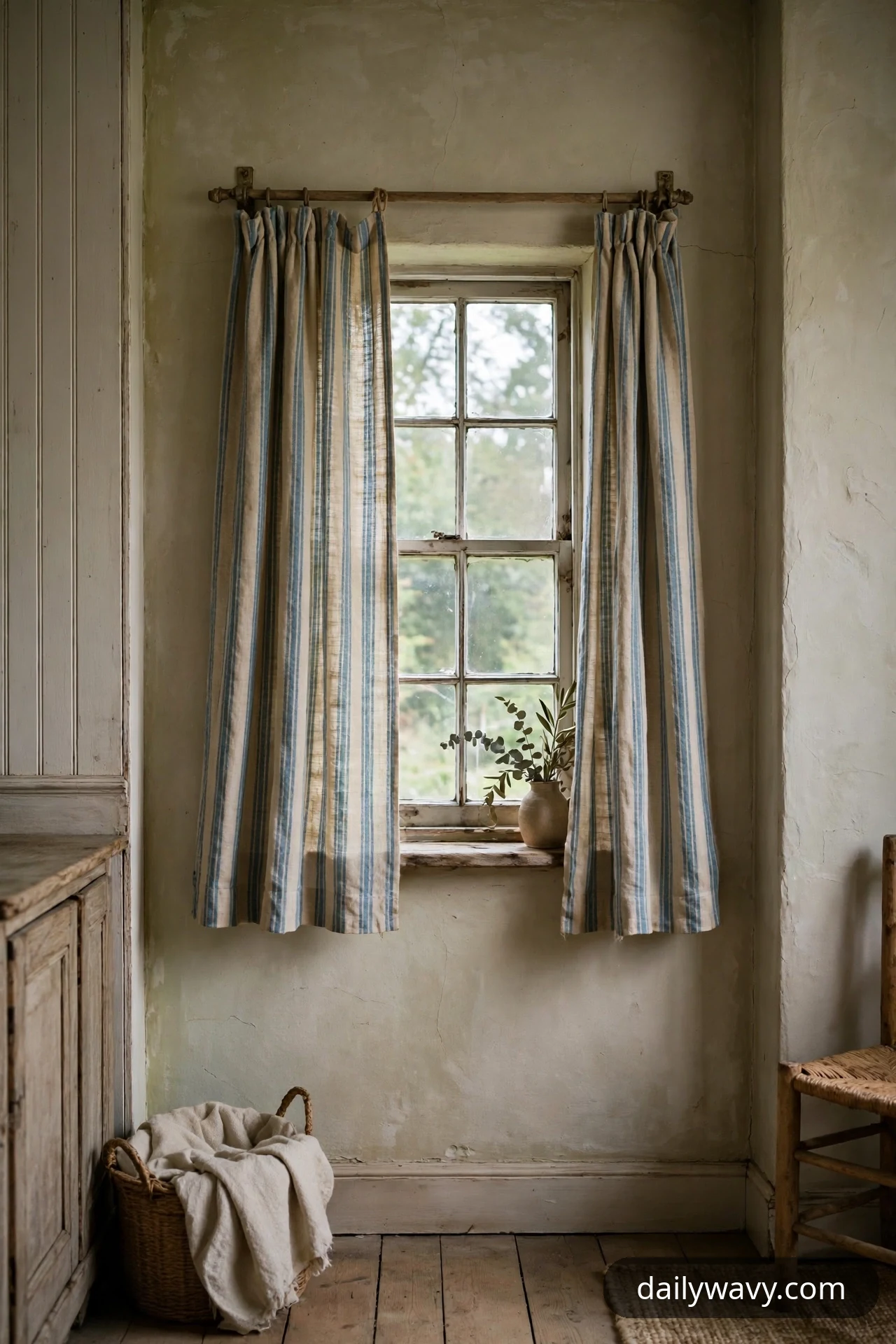
Vintage-style fabrics bring character to a small window, but restraint is what keeps them from turning the room into a theme. A faded ticking stripe, a small faded floral, or a washed-out toile in muted tones gives an older home’s window a sense of history without shouting about it. Choose fabrics that look sun-faded rather than bright: muted blues, dusty roses, soft grays on a natural ground. The faded quality is what makes them work on a small window; bright vintage prints overwhelm narrow frames. This treatment suits older homes, cottages, and any room with existing vintage pieces that the curtain can quietly echo.
What to measure: Outside mount measurements. Vintage-style prints often come in narrower fabric widths, so check that two panels give you the 1.5 times fullness minimum.
Materials: Two panels in a restrained vintage-style print (faded ticking stripe, small faded floral, or muted toile); a rod in aged brass, black, or wood; ring clips; wall anchors.
Placement: Center the print’s main motif on each panel before fixing the rings. In a child’s room, use a cordless rod or wand-drawn track, and keep any tie-backs well out of reach.
Approximate effort: An afternoon, plus hunting time for the right print. Expect $45 to $110.
Lower-cost alternative: Tea-dye plain white panels (soak in strong black tea, then rinse) and add a single row of vintage-style striped ribbon along the bottom for a faded, aged feeling at minimal cost.
12. A Linen-Look Finish With Neat Hems
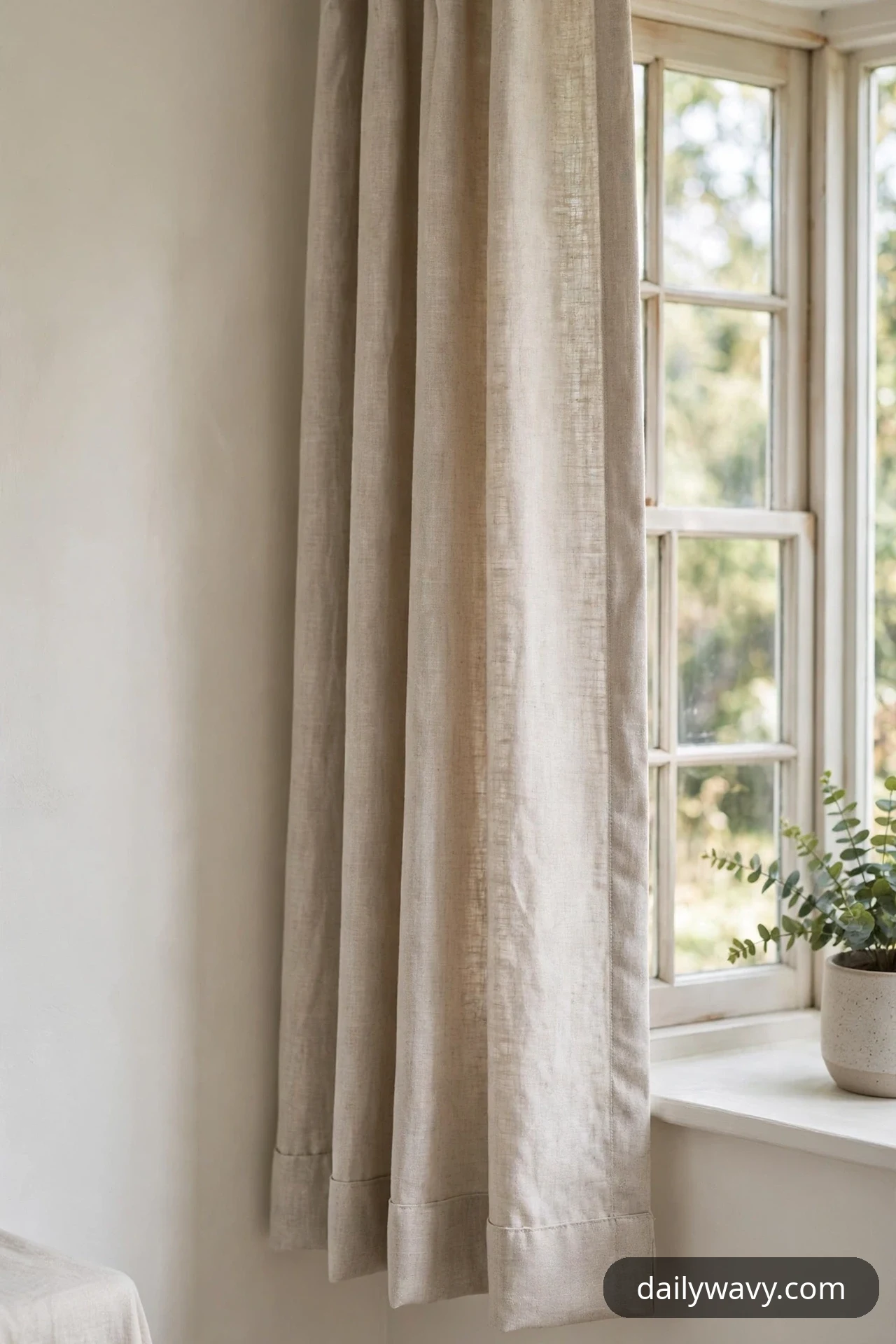
Few details make a small window look more finished than a crisp hem. A linen-look fabric with pressed, even hems reads as tailored and intentional, the curtain equivalent of a pressed shirt. The linen look gives you the texture without the price or the wrinkling of true linen, and neat hems keep a narrow panel from looking homemade in the wrong way. This is the treatment for rooms where everything else is tidy: a clean desk area, a styled hallway, a minimal bedroom. The details to get right are the hem width (2 to 3 inches reads as deliberate), the pressing (steam every fold line), and the hanging (panels at exactly equal lengths).
What to measure: Outside mount measurements, then the exact finished length for both panels, measured from the same point on the rod. Mark both panels together so they match to the quarter inch.
Materials: Two linen-look panels in a natural tone; an iron and pressing cloth; a rod and rings; wall anchors. If you are hemming ready-mades, iron-on hem tape in a matching weight.
Placement: Press the side hems and bottom hem before hanging, then hang and check that both panels break at exactly the same point. Adjust ring positions rather than re-hemming if one side sits high.
Approximate effort: An afternoon, half of it pressing. Expect $40 to $85.
Lower-cost alternative: Plain cotton panels pressed with crisp hems and a starched finish give the tailored linen look for the cost of the panels plus an hour with the iron.
Small window curtain FAQ
How wide should a curtain rod be for a small window?
Extend the rod 4 to 6 inches past the window trim on each side, so the total rod is 8 to 12 inches wider than the frame. This lets the panels stack over the wall instead of covering the glass when open, which is what makes a small window look bigger rather than smaller.
Should small window curtains touch the floor?
Only when the wall below the window is clear. If a radiator, dresser, or counter sits beneath, hem the panels to stop 1 to 1.5 inches above the sill or the obstruction, and never let fabric rest on a heat source. Floor length looks elegant but wrong when it pools behind furniture.
What fabric works best in a bathroom or kitchen window?
Washable synthetics or cotton-poly blends that dry quickly and resist mildew. Avoid heavy cotton velvets, silks, and anything labeled dry-clean only near steam and splashes. A polyester weave that mimics linen or jute gives the natural look without the moisture problems.
How do I get privacy without losing all the light?
Choose a light-filtering weave rather than a sheer, or add an inexpensive privacy liner behind a decorative panel. Hold the fabric up to the window at midday before you buy: you want glow without clear silhouettes. For bedrooms, a lined panel or a separate blackout roller behind the curtain handles nights.
Are curtain cords safe around children?
Looped cords and beaded chains are a strangulation hazard for small children. In kids’ rooms and play areas, use cordless rods, wand-drawn tracks, or cordless shades, and keep any tie-backs high and out of reach. The U.S. Consumer Product Safety Commission has long warned about corded window coverings near young children, so treat cordless as the default wherever children sleep or play.
How full should the panels be on a narrow window?
Plan on fabric totaling 1.5 to 2 times the rod width. A single flat panel on a small window looks thin; the folds are what make the treatment read as curtains rather than a piece of cloth. Lighter fabrics need the fuller end of that range.
The window is small; the decision is not
Twelve ideas, one shared principle: a small window rewards the same care as a big one, just scaled down. Measure the frame, the rod line, and the drop before you shop. Match the fabric to the room’s moisture, light, and privacy needs, not just its colors. Keep cords out of children’s reach and fabric off heat sources. Do those few things and any of these treatments will make the window look like it was always meant to be there. If you are styling a whole room around the window, our small bedroom with a queen bed guide shows how window treatments fit into a complete small-space plan, and the small bathroom storage guide covers moisture-smart choices for the smallest wet rooms. Several of these same treatments appear in our living room curtain ideas and bedroom curtain ideas roundups, sized for the bigger windows in those rooms. For the room around it all, browse the Home & Decor archive.