20 Home Office In A Living Room Ideas for a Thoughtful Work Area
Fitting a workspace into your living room rewards thought over square footage. You do not need a spare bedroom or…
Fitting a workspace into your living room rewards thought over square footage. You do not need a spare bedroom or a renovation to carve out a place to answer emails or pay bills in peace. You need a plan for light and cables, and a clear sense of where work starts and the sofa ends.
Every idea below names real measurements, materials, and a lower-cost way to get there, so you can pick what suits your room and skip the rest. Nothing here demands a permit or a power drill. A plant, a pinboard, a basket, a better chair: small moves, thoughtfully placed, that let the living room stay a living room while your work gets a proper home.
Jump to an idea
- A Plant Positioned Out Of The Keyboard Zone
- A Soft Pinboard With Organized Notes
- A Shallow Drawer Divider
- A Laptop Stand With A Separate Keyboard
- A Basket For Spare Equipment
- A Simple Curtain Managing Window Glare
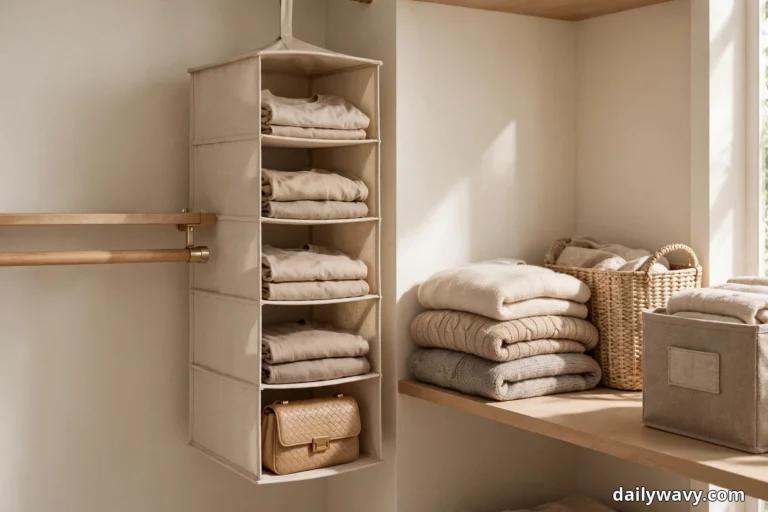
- A Narrow Bookcase At The Side
- A Neutral Desk Mat
- A Closed Box For Chargers
- An Adjustable Task Chair With Clear Legroom
- A Small Movable Side Cart
- A Dedicated Charging Corner
- A Restrained Two-Color Accessory Palette
- A Wall Calendar
- A Compact Lamp Off The Main Work Area
- A Vertical File Holder
- A Small Tray For Everyday Tools
- A Cable Channel Beneath The Desk
- A Shelf Above Seated Eye Level
- A Calm Artwork Beside The Screen
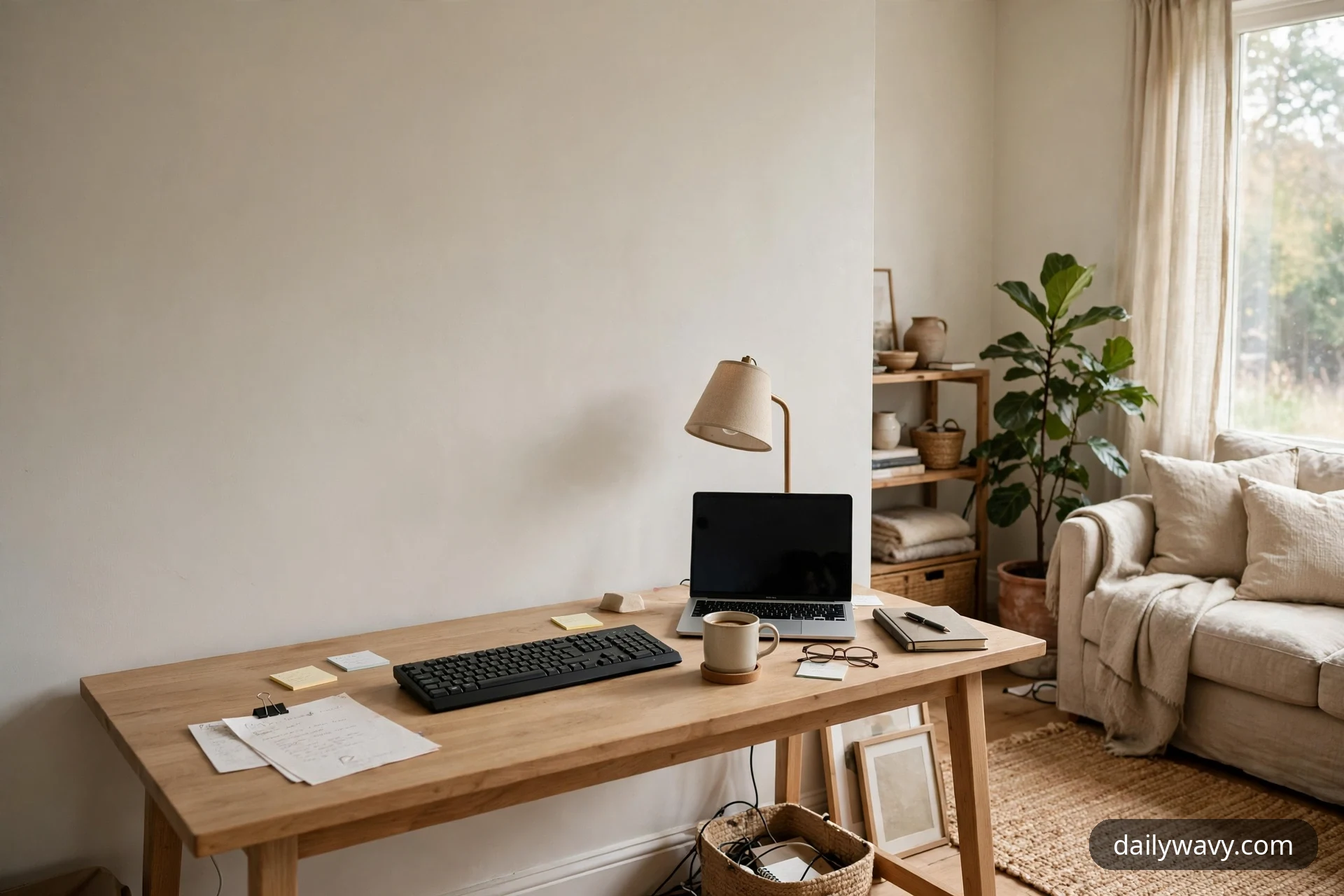
The Living Room Work Rules Before You Start
Measure the zone you are claiming before you buy anything. A tape measure, not a wish, is the difference between a setup that feels intentional and one that feels like a desk crash-landed in the sitting room. Tape out a rectangle on the floor: most single-person setups live comfortably in a footprint of 4 to 5 feet wide and 2 to 3 feet deep, and you will want 3 feet of clear pull-out space behind the chair.
Glare is the first thing to solve, not the last. Sit in the chair at your usual working hour and look at a dark screen. If you see the window reflected in it, the desk needs to turn. Side light is kinder than backlight, and a simple curtain fixes most glare problems for under fifty dollars.
Keep cables boring. Every cable you can see is one more reason the corner reads as clutter instead of calm, so plan the route from outlet to desk before the desk arrives, not after. And protect your knees: nothing under the desk except a power strip and your feet, with at least 24 inches of legroom width and 18 inches of depth before anything else intrudes. If your living room layout has awkward walls or a narrow traffic path, the same tape-on-the-floor trick from our narrow living room layout ideas applies perfectly here: map the walking lane first, then place the work zone around it.
1. A Plant Positioned Out Of The Keyboard Zone
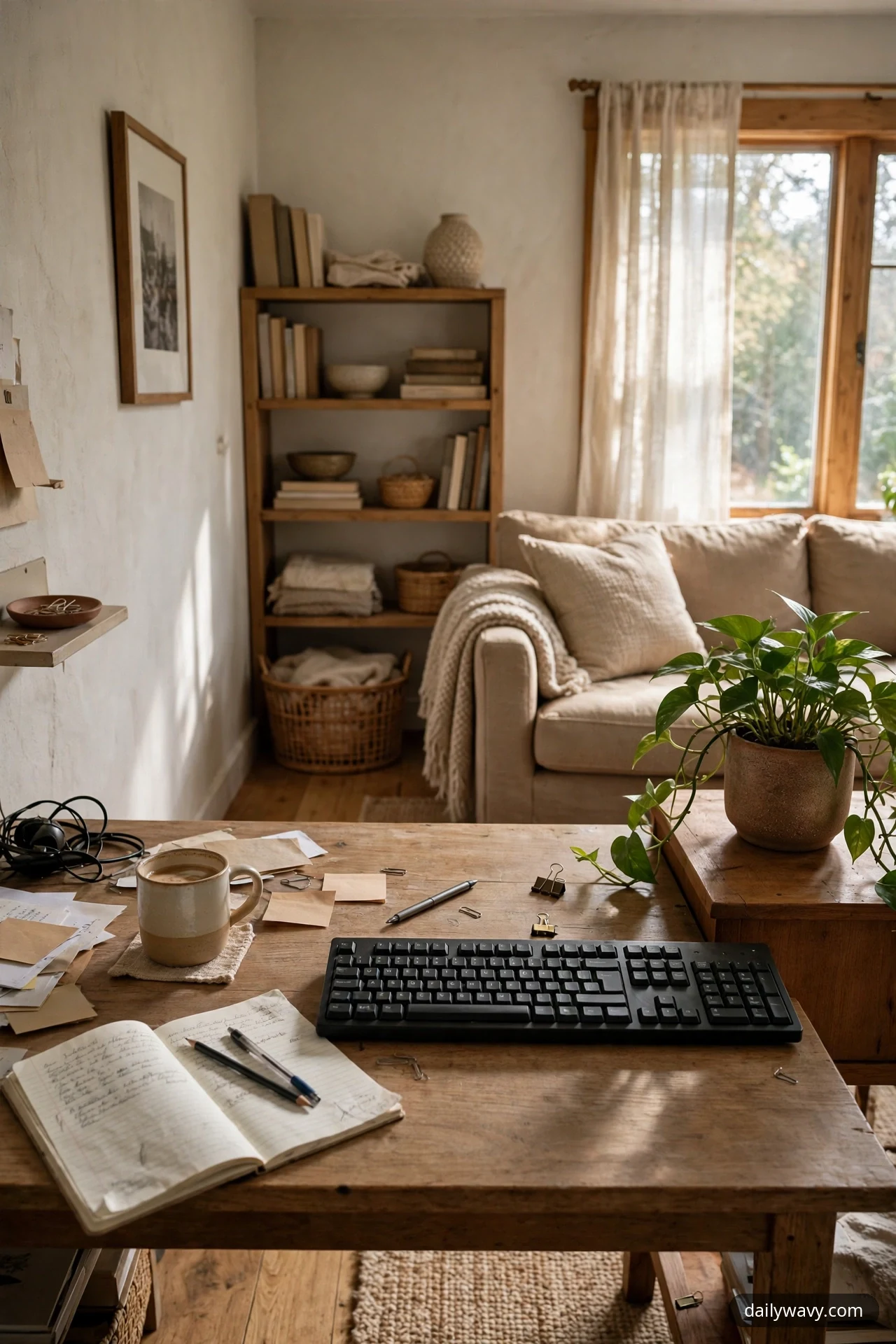
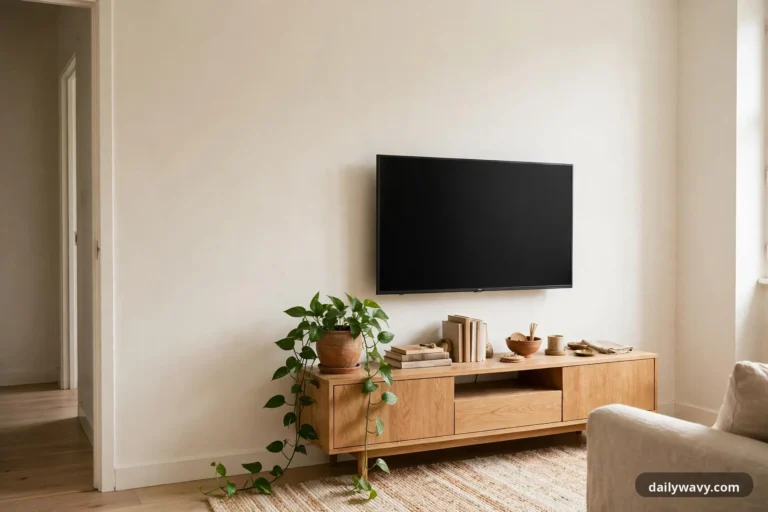
A plant changes the temperature of a workspace without changing its function, and that is exactly why the placement matters more than the species. Set the pot at least 12 inches beyond the far edge of your keyboard, to the side your dominant hand does not favor. You get the green in your peripheral vision and the leaves never brush your wrists while you type. A trailing pothos on a small plant stand works beautifully here, because the height lifts the foliage above desk clutter without widening the footprint.
What to measure: the clear span of desk edge beside the monitor. Materials: one forgiving plant in a 6 to 8 inch pot, a saucer, and a 10 to 14 inch plant stand. Placement: side of the desk, beyond keyboard reach, where it will not block the window. Approximate effort: fifteen minutes, plus a weekly watering reminder on your phone. Lower-cost alternative: a single stem in a glass jar of water on a stack of books; pothos roots happily in water for months. Pothos is toxic to cats and dogs if chewed, so keep it out of reach of pets that nibble plants.
2. A Soft Pinboard With Organized Notes
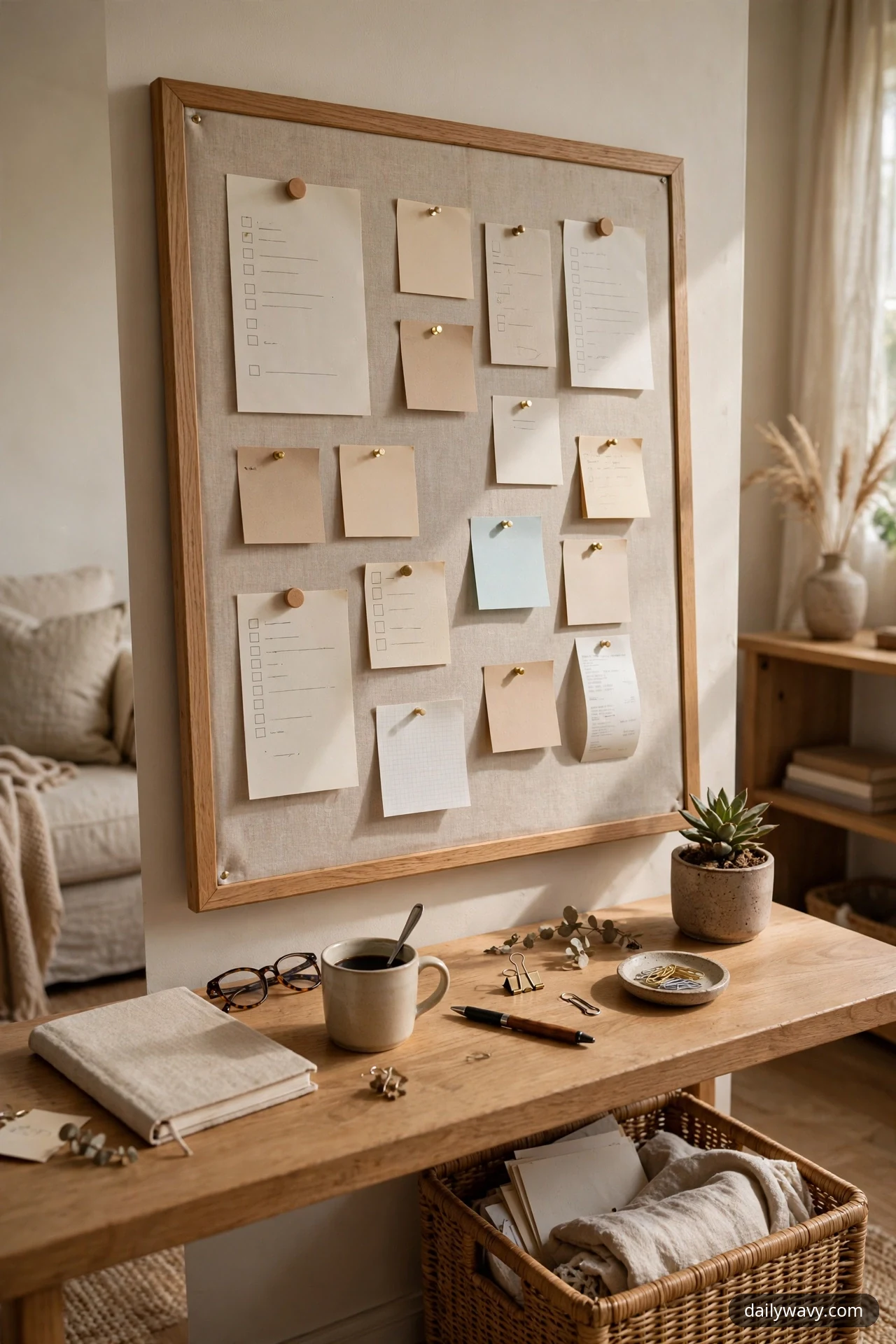
A pinboard is a pressure valve for a desk that shares a room. Receipts, tickets, the note with the dentist’s number: they all need somewhere to wait that is not the work surface. A fabric-covered board about 24 by 18 inches, hung just left of the monitor, centered near seated eye height, keeps the paper trail visible without letting it colonize the desk. Limit it to one layer of notes. When the board is full, something gets filed or recycled. That rule keeps it a tool, not a collage.
What to measure: the wall span beside or above the desk, and your seated eye height (roughly 44 to 48 inches from the floor for an average chair). Materials: a fabric pinboard, push pins, and two picture-hanging strips rated for the board’s weight. Placement: within arm’s reach of the seated position, off the main sight line to the TV. Approximate effort: thirty minutes. Lower-cost alternative: a cork tile square from a craft store, mounted the same way.
3. A Shallow Drawer Divider
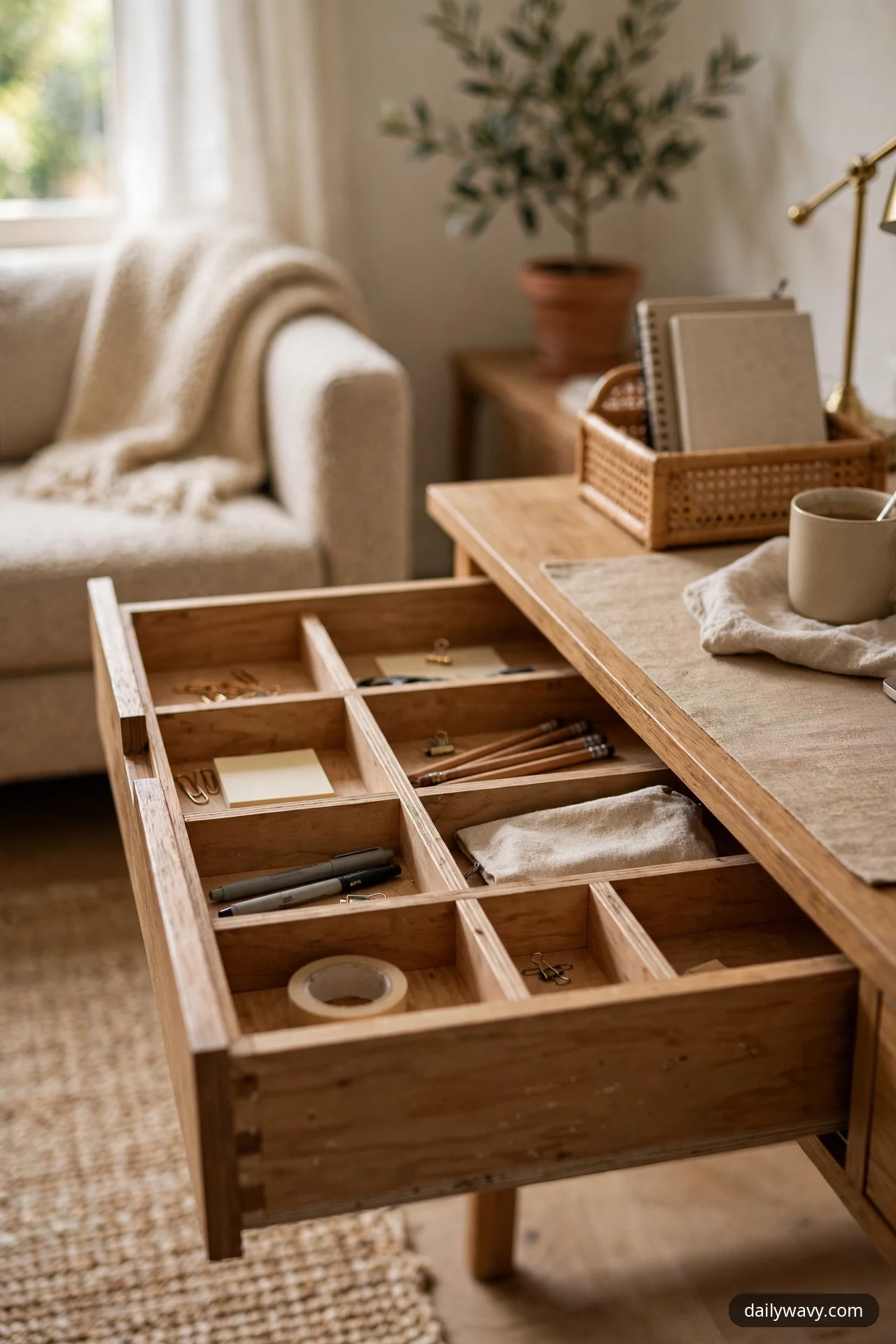
The drawer nearest your dominant hand becomes the whole office when you do not have a spare room: pens, sticky notes, a stapler, the charging cable you always need. A shallow bamboo divider tray, cut to fit, turns that drawer from a junk slide into a set of compartments you can reach without looking. The key measurement is the drawer’s interior depth; most desk drawers are 3 to 5 inches deep, and the divider should sit at least half an inch below the drawer top so it never jams.
What to measure: interior width, depth, and height of the drawer, in inches. Materials: an adjustable bamboo drawer organizer and a small ruler. Placement: the top drawer closest to your dominant hand. Approximate effort: ten minutes. Lower-cost alternative: small cardboard boxes trimmed to height and covered in kraft paper.
4. A Laptop Stand With A Separate Keyboard
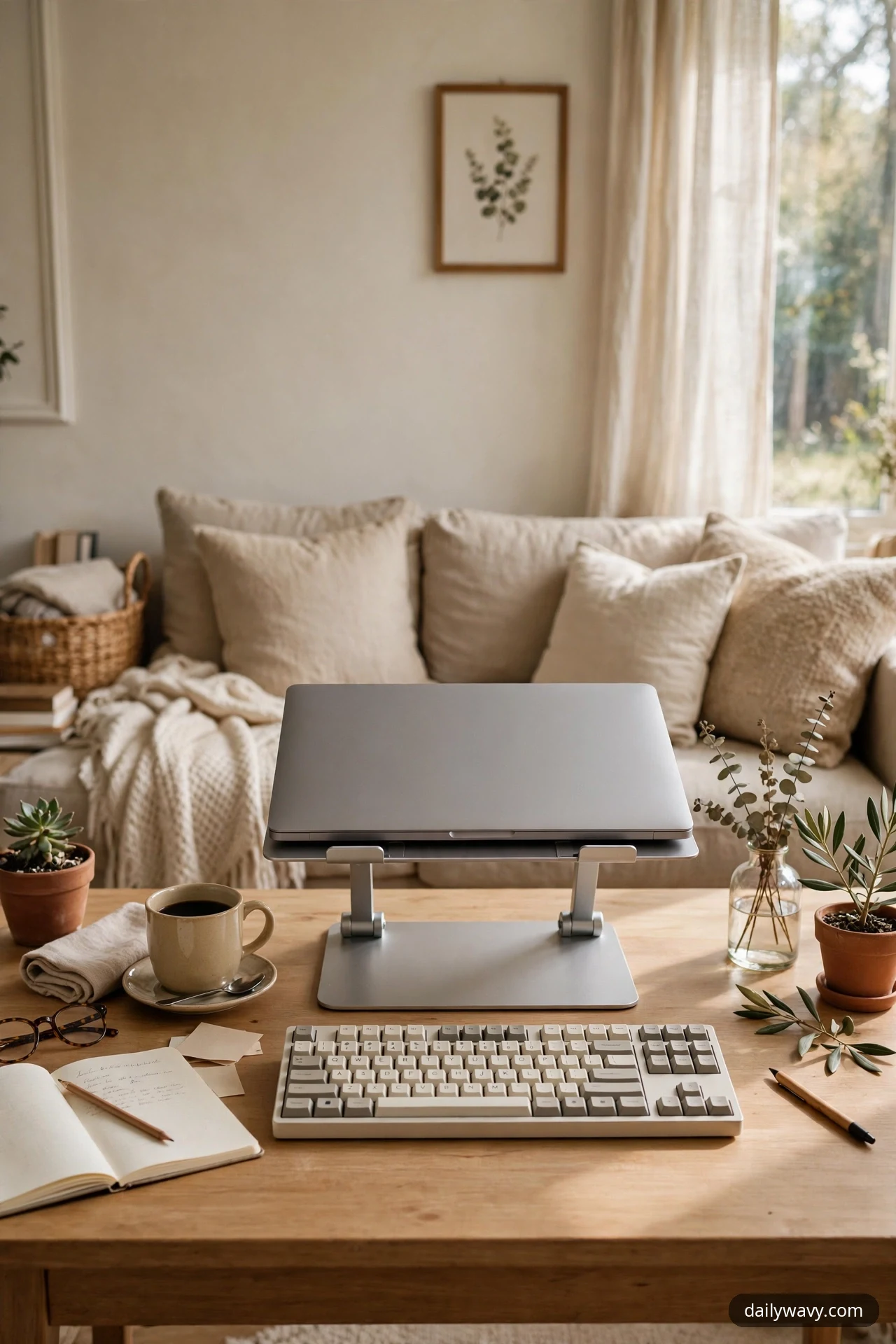
A laptop lying flat on a desk puts the screen below your natural gaze, and a separate keyboard lets the stand fix that. Raise the laptop so the top third of the screen sits roughly at eye level, then place the keyboard 4 to 8 inches from the desk edge with the mouse beside it. This is one of the cheapest comfort upgrades in this guide, and it folds flat into a drawer when the workday ends, which matters when the desk is also the room everyone watches movies from.
What to measure: your seated eye height and the desk depth (you need about 26 inches to fit laptop on stand plus keyboard comfortably). Materials: a folding aluminum laptop stand, a separate keyboard, and a mouse. Placement: centered on the desk, screen tilted slightly back. Approximate effort: five minutes. Lower-cost alternative: a sturdy shoebox-sized stack of books under the laptop, with any spare keyboard.
5. A Basket For Spare Equipment
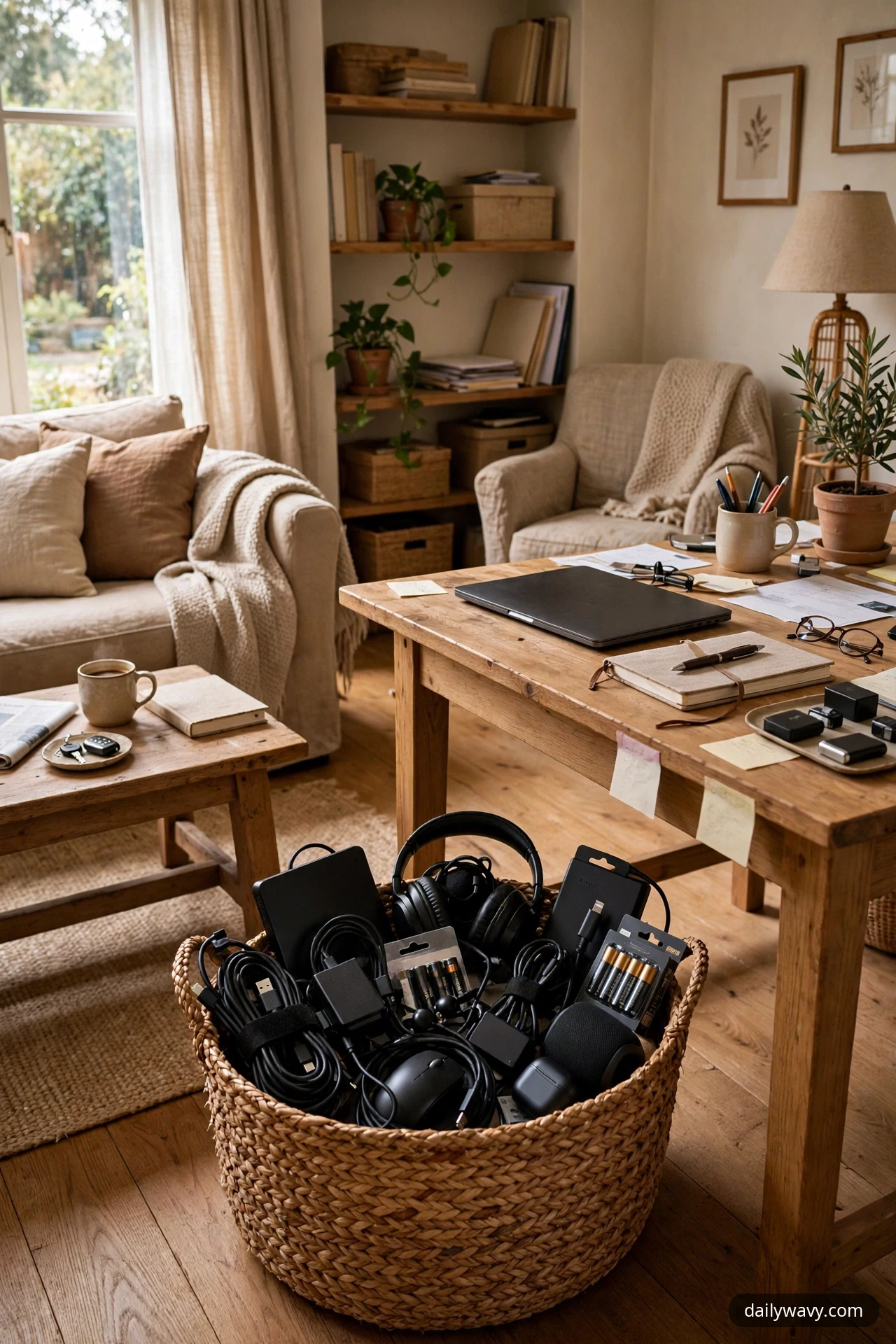
Spare equipment is the quiet enemy of a shared room: the old charger, the backup mouse, the headset you use twice a week. A lidded seagrass basket about 14 inches square, parked under the desk or beside the bookcase, swallows all of it. Because the lid closes, the basket reads as furniture instead of storage, and because it is woven, it blends with warm neutrals instead of shouting “office supplies.” Label nothing; if you cannot remember what is in the basket, you own too much spare equipment.
What to measure: the under-desk clearance or the gap beside the bookcase where the basket will live. Materials: one lidded basket roughly 12 to 16 inches square. Placement: under the desk against the wall, or tucked beside the desk within arm’s reach. Approximate effort: ten minutes including a declutter pass. Lower-cost alternative: a sturdy paper grocery bag, folded down, slipped behind a chair.
6. A Simple Curtain Managing Window Glare
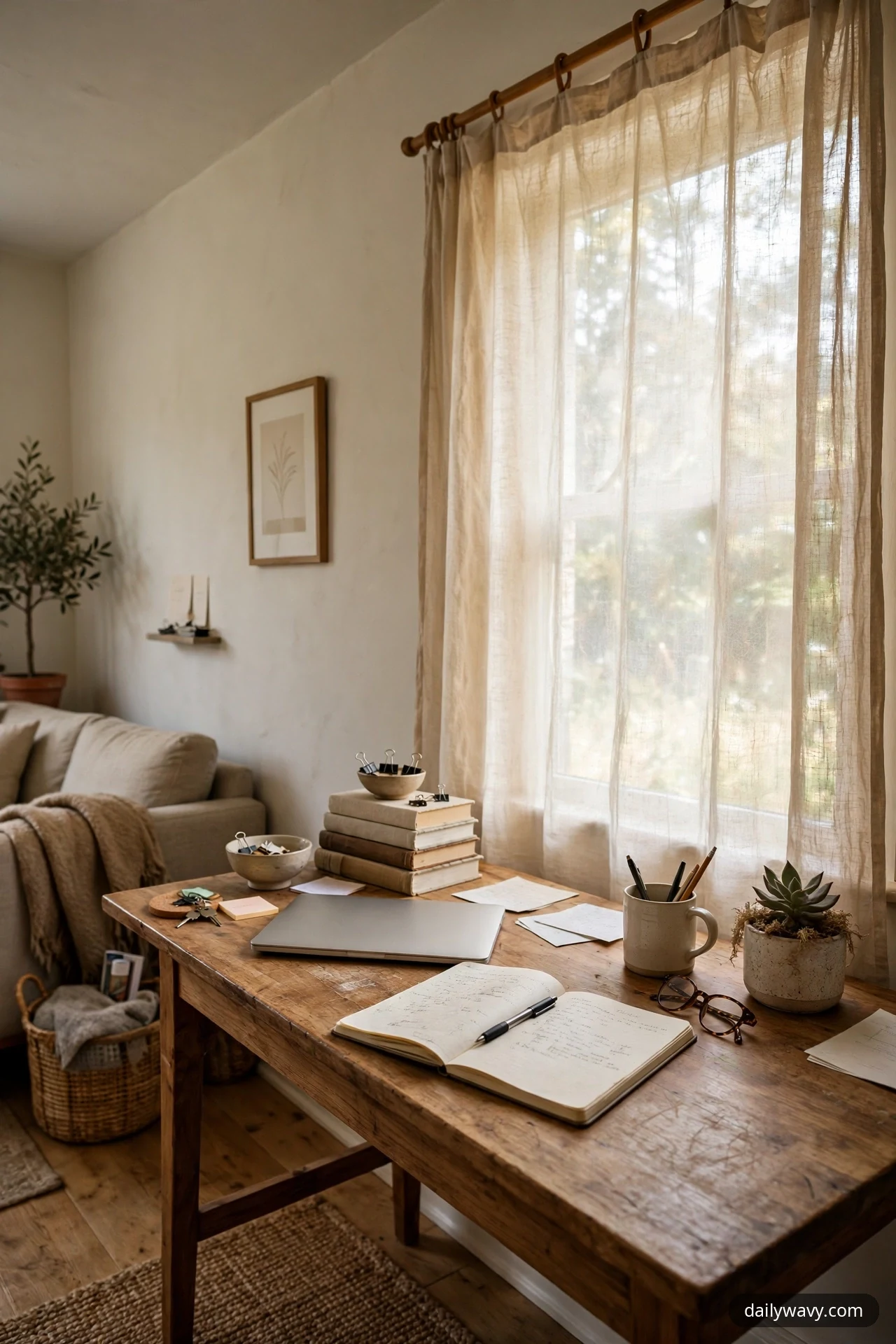
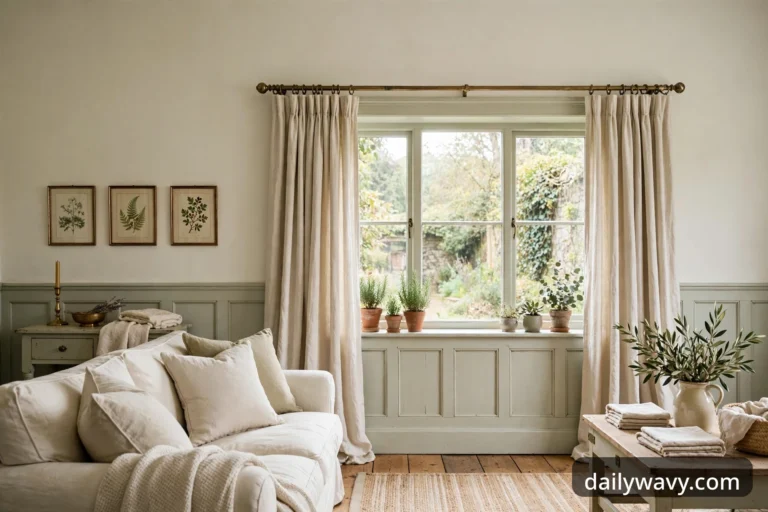
A window behind or beside your screen will wash out the display by mid-morning, and squinting through it for eight hours is miserable. A single linen curtain panel on a slim tension rod lets you soften the light instead of fighting it. You do not need blackout fabric; a medium-weight weave cuts direct glare while keeping the room’s daylight character. Mount the rod 4 to 6 inches wider than the window frame on each side so the panel stacks clear of the glass when open.
What to measure: window width plus 8 to 12 inches for the rod, and drop length from rod to sill or floor. Materials: one tension rod or slim wall-mounted rod, one linen-look curtain panel, and two hooks if you want a tieback. Placement: the window nearest the screen, panel drawn to the screen side during work hours. Approximate effort: twenty minutes, no drilling with a tension rod. Lower-cost alternative: a spring rod from a discount store with a flat cotton sheet folded to size.
7. A Narrow Bookcase At The Side

A 12 to 16 inch deep bookcase parked at the desk’s flank does double duty: work references on the lower shelves, living room objects on the upper ones, so the piece belongs to the room and not just to the job. Keep the footprint small enough that it never juts past the desk edge into the walking lane. The bottom shelf, hidden behind the desk return, is the perfect home for the printer or the box of cables nobody wants to see.
What to measure: the wall run beside the desk and the ceiling height (most narrow cases are 60 to 72 inches tall). Materials: one narrow bookcase, wall anchor hardware (use it, even in a rental, with removable anchors), and a level. Placement: flush against the wall at the desk’s side, anchored for safety. Approximate effort: one hour including assembly. Lower-cost alternative: a stack of two sturdy milk crates, screwed together, on a low bench.
8. A Neutral Desk Mat
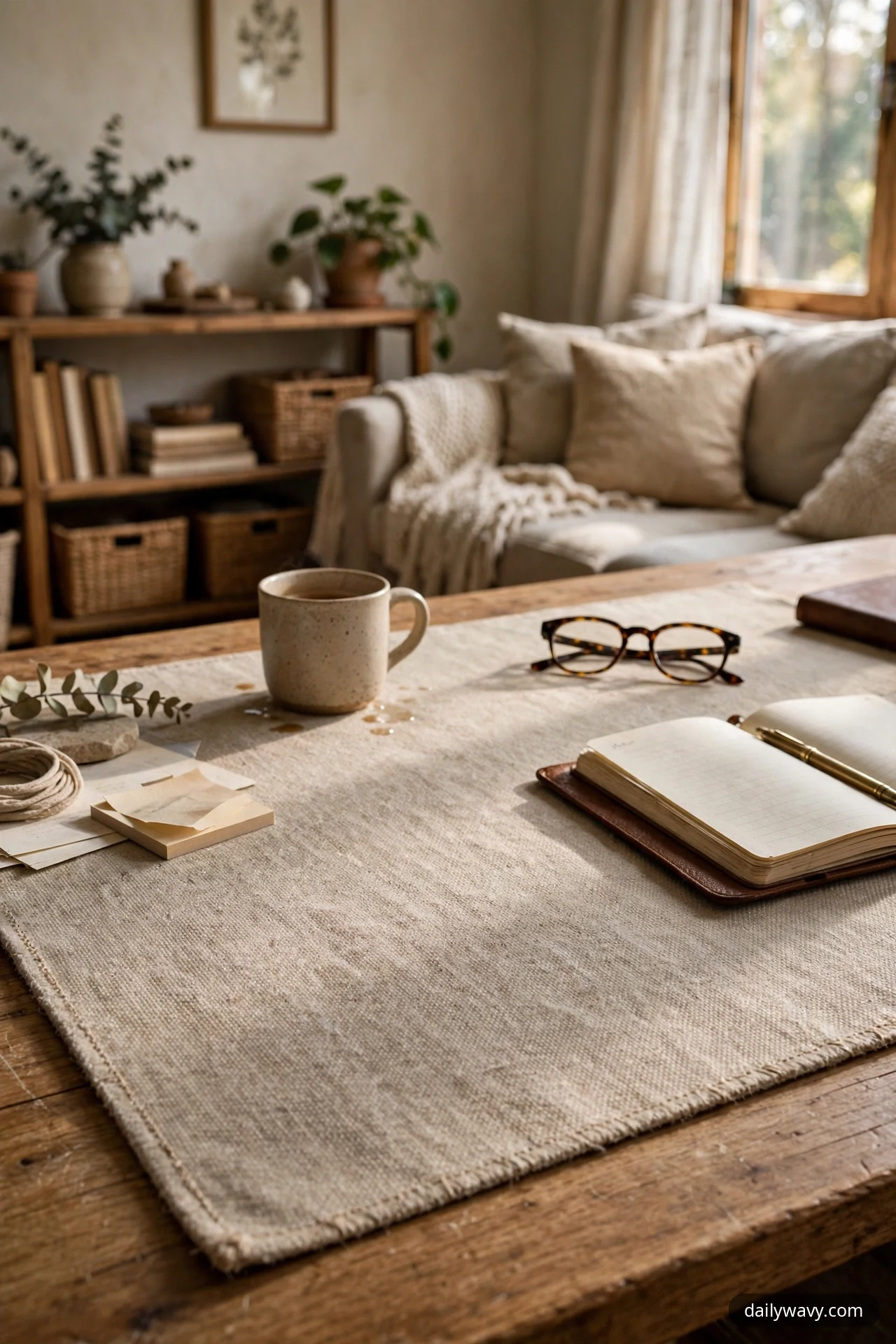
A desk mat does three quiet jobs: it protects the desk surface, it defines the work zone visually, and it gives your mouse a consistent surface. Choose a warm neutral, leather-look or felt, roughly 32 by 14 inches, big enough for the keyboard and mouse with a few inches to spare. When the mat is rolled up at day’s end, the desk is instantly a living room table again. That small ritual, mat down for work, mat up for evening, is one of the simplest ways to draw the boundary between office and home.
What to measure: desk depth (the mat should leave at least 4 inches of bare desk at the back for the monitor stand or laptop hinge). Materials: one large desk mat in a warm neutral. Placement: centered under keyboard and mouse. Approximate effort: two minutes. Lower-cost alternative: a felt furniture pad or a table runner cut to size.
9. A Closed Box For Chargers
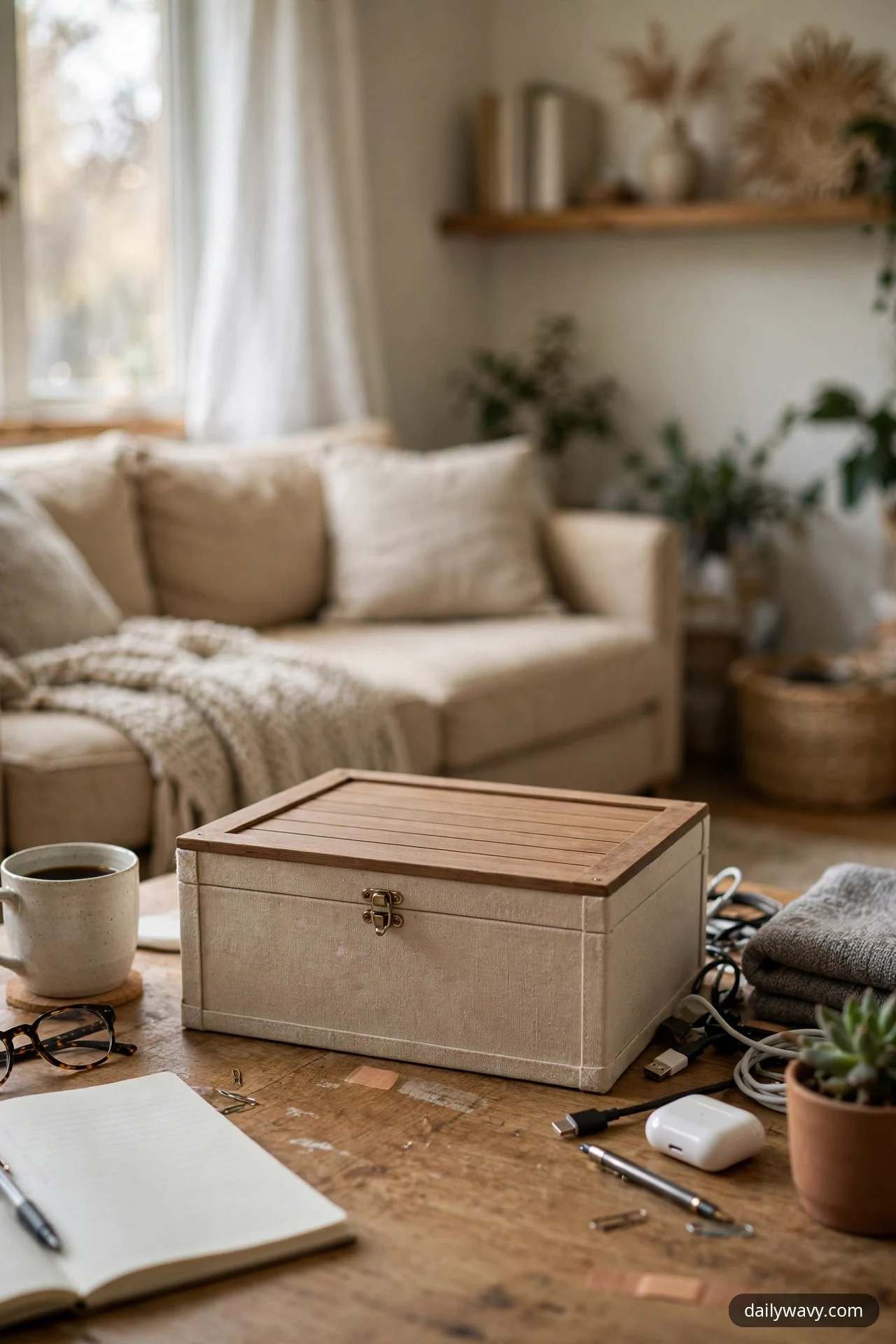
Chargers multiply like rabbits, and a tangle of white cables is the fastest way to make a corner look temporary. A closed box, roughly 12 by 8 inches, with cable slots cut or molded into the sides, hides a power strip and every brick and cable attached to it. Run the strip inside, feed the cords through the slots, close the lid, and the whole mess becomes a neat wooden or fabric box that sits on the floor behind the desk leg. Do not overload the strip, and keep the box’s cable slots unblocked so air can move.
What to measure: the footprint where the box will sit (behind the desk leg, against the wall) and the length of your longest cable run. Materials: one cable management box, a 6-outlet power strip that fits inside, and short cables where possible. Placement: on the floor behind the desk, between desk and wall. Approximate effort: twenty minutes. Lower-cost alternative: a shoebox with two holes cut in the back, covered in neutral fabric.
10. An Adjustable Task Chair With Clear Legroom
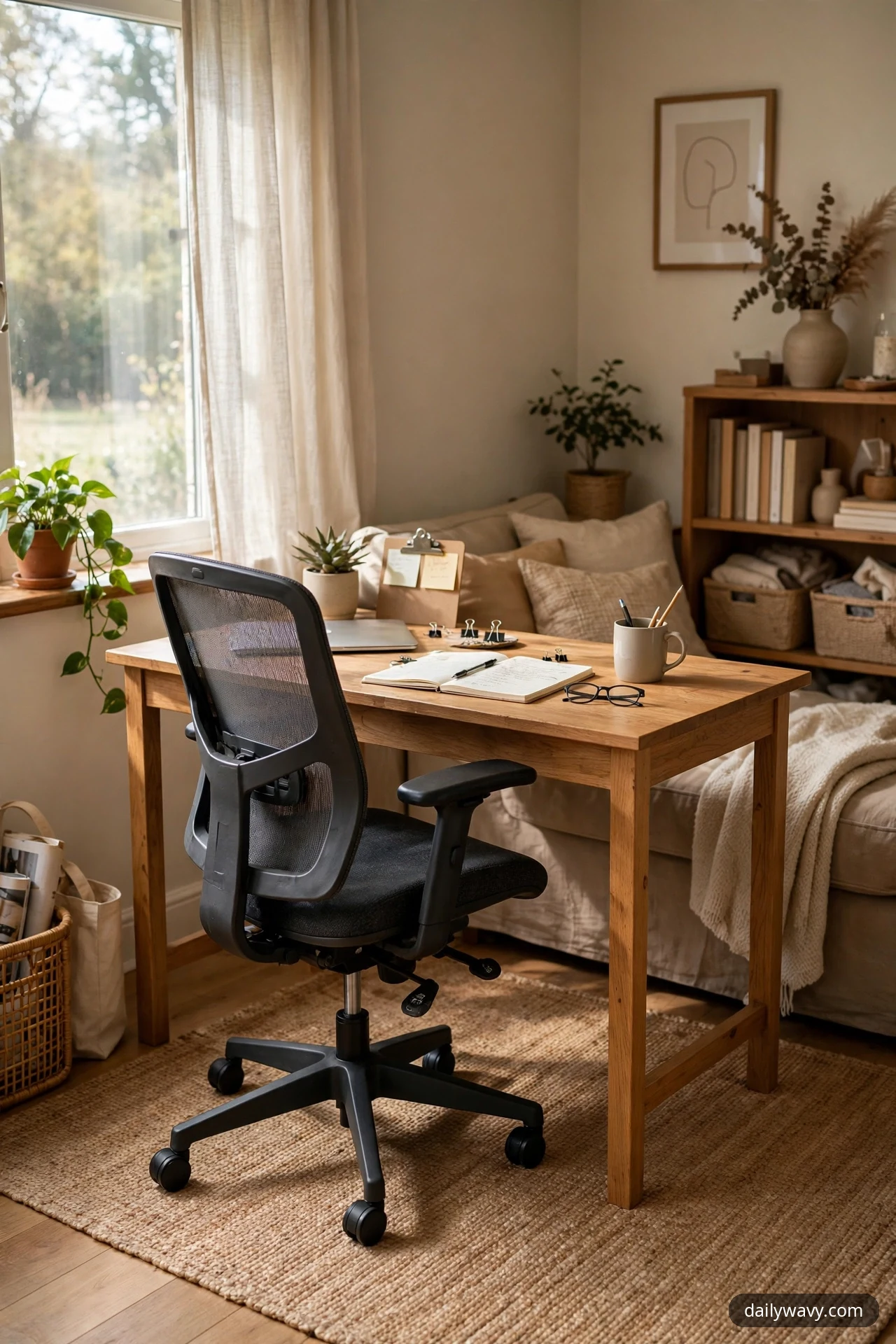
The chair is the one piece worth spending on, because it is the piece your body meets for the longest. A task chair with adjustable seat height, and ideally a lockable tilt, lets you set your feet flat on the floor and your thighs roughly level. Keep the under-desk zone sacred: no storage boxes, no baskets, no footstool pile within the 24-inch legroom width. When guests come, a good task chair tucks fully under the desk, and a throw draped over its back makes it disappear into the living room.
What to measure: desk height (standard is 29 to 30 inches), your seated knee height, and the clear floor space for tucking the chair. Materials: one adjustable task chair with a five-star base. Placement: centered on the desk, pushed fully under when not in use. Approximate effort: thirty minutes of assembly. Lower-cost alternative: a dining chair with a firm cushion, plus a footrest box so your feet do not dangle.
11. A Small Movable Side Cart
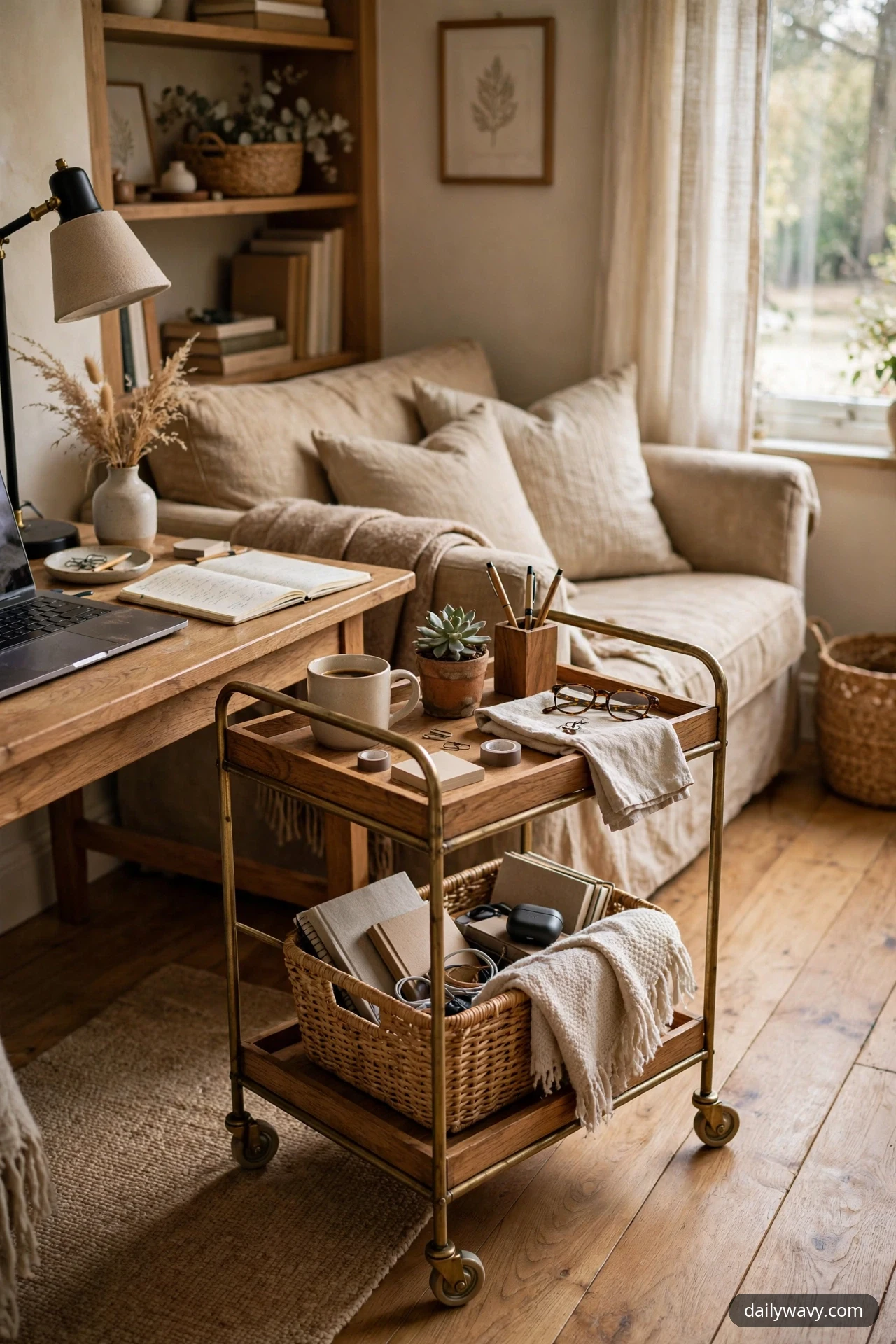
A three-tier rolling cart is the workhorse of a living room office. Loaded with printer paper, notebooks, and the headset, it rolls to the desk for work hours and parks beside the sofa, or even in a closet, when the day ends. The 18 by 12 inch footprint slips into gaps a bookcase cannot, and locking casters keep it still on hard floors. Choose one in white or warm gray so it reads as a side table when it is not working.
What to measure: the gap where the cart will park (minimum 20 inches wide to roll in and out comfortably). Materials: one three-tier rolling cart with locking casters. Placement: beside the desk during work, parked out of the traffic path after. Approximate effort: twenty minutes of assembly. Lower-cost alternative: a thrifted bar cart, repainted, with the same tiers.
12. A Dedicated Charging Corner
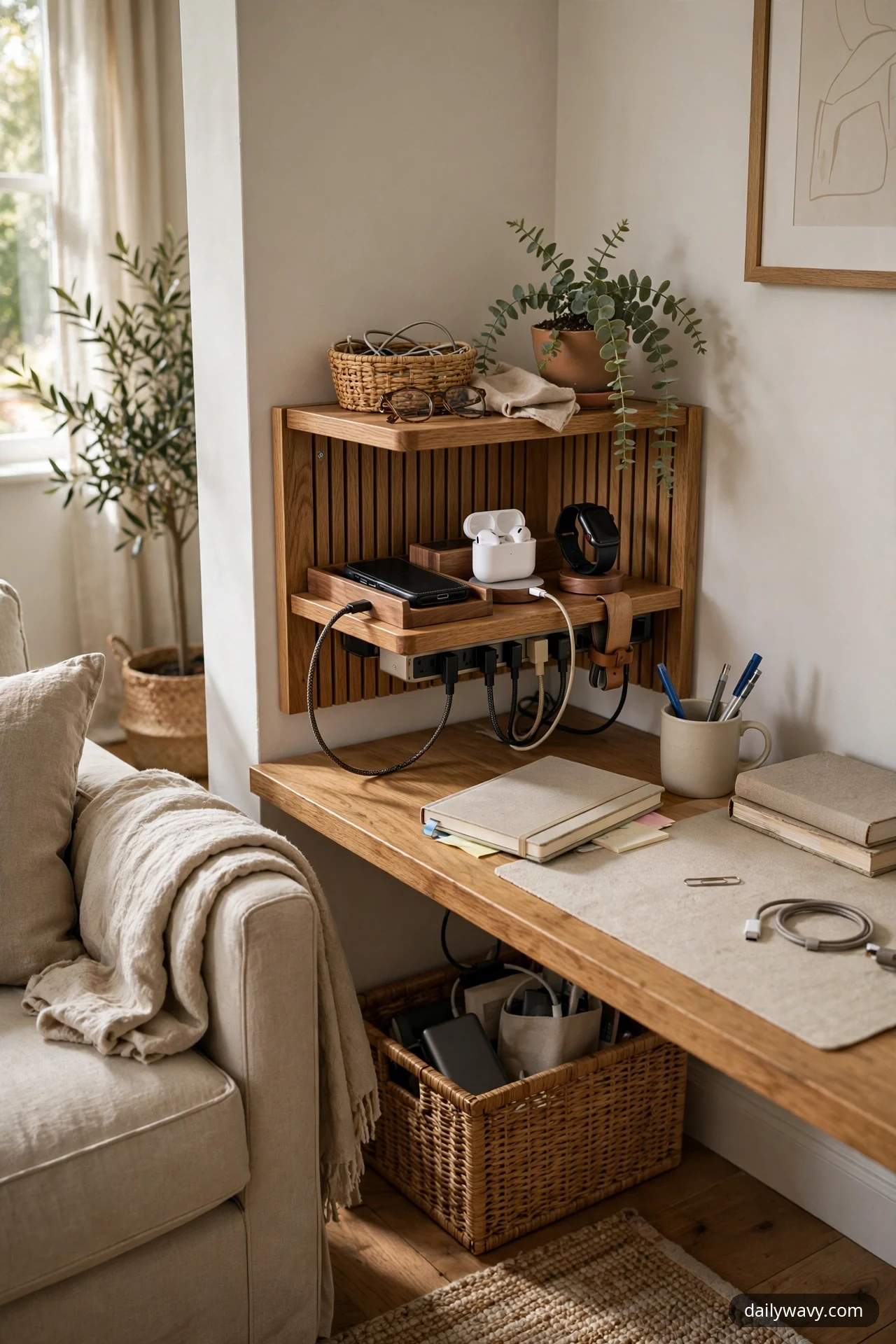
Phones, earbuds, and the e-reader all need power, and none of them need to sprawl across the desk. Claim one small surface, the top of the bookcase, the windowsill, a corner of the side table, and make it the single charging spot. A short multi-port charger and cables cut to 1 foot keep the footprint to about 8 inches square. Everything charges there, and only there. The desk stays a place for work, and you stop hunting for a cable every morning.
What to measure: the surface you are claiming (aim for 8 to 10 inches square of clear space). Materials: a multi-port USB charger, short cables, and a small tray to corral them. Placement: a fixed spot away from the desk but within the work zone. Approximate effort: fifteen minutes. Lower-cost alternative: one power strip screwed under the side table with the cables zip-tied.
13. A Restrained Two-Color Accessory Palette
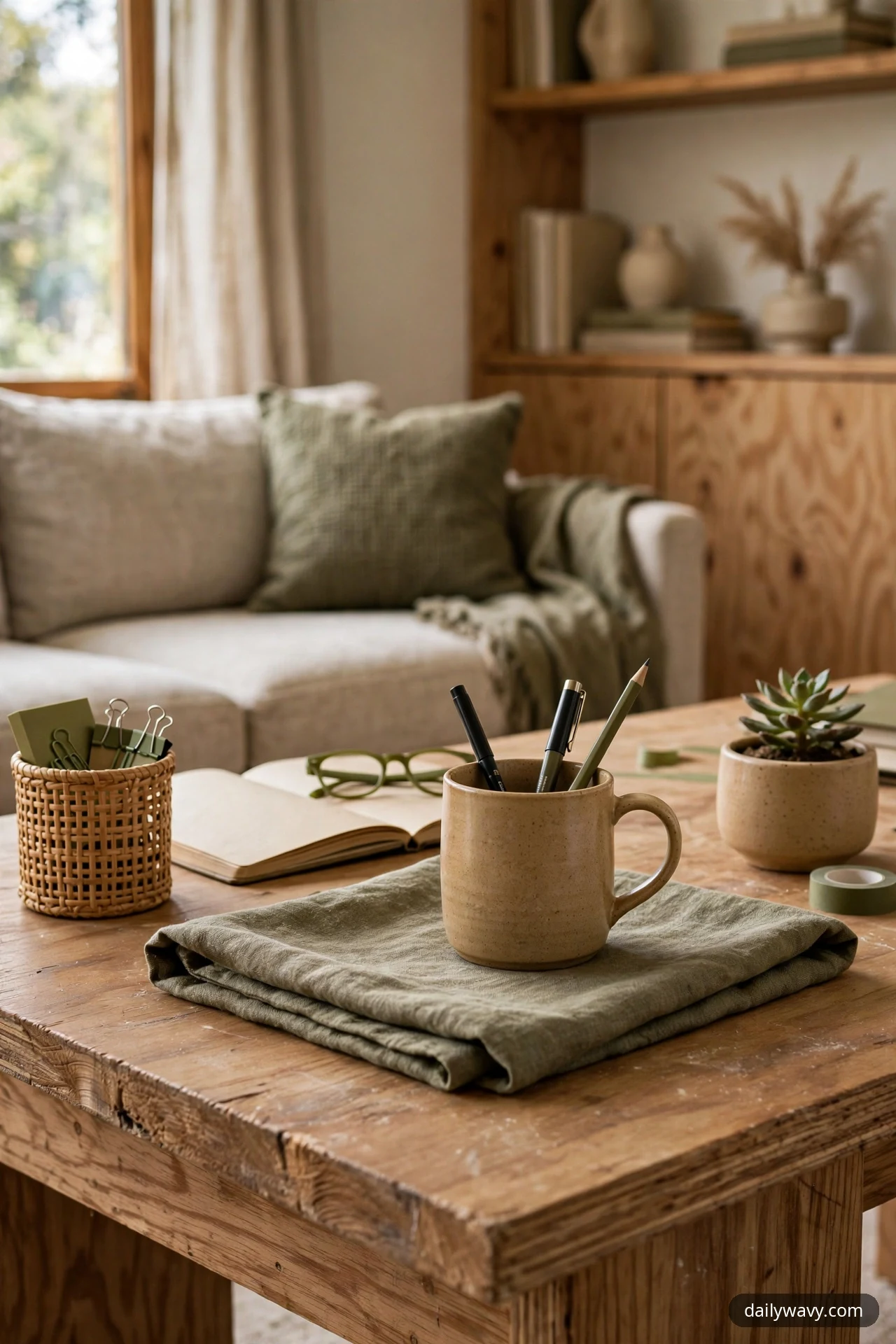
A workspace scattered with random colors looks like clutter even when it is organized. Pick two: warm wood and soft white, or black and natural linen, and let every visible accessory, the pen cup, the tray, the clock, the desk lamp base, stay inside that pair. The desk suddenly reads as designed rather than accumulated. This costs almost nothing if you apply it to what you already own: move the off-palette items to a drawer and bring out the two that match.
What to measure: nothing, this one is a sorting pass. Materials: your existing accessories, sorted. Placement: visible surfaces carry the two colors; everything else lives in closed storage. Approximate effort: twenty minutes. Lower-cost alternative: spray paint is the classic trick, though if you spray, work outdoors or in a well-ventilated area; even simpler is a kraft-paper wrap on mismatched boxes.
14. A Wall Calendar
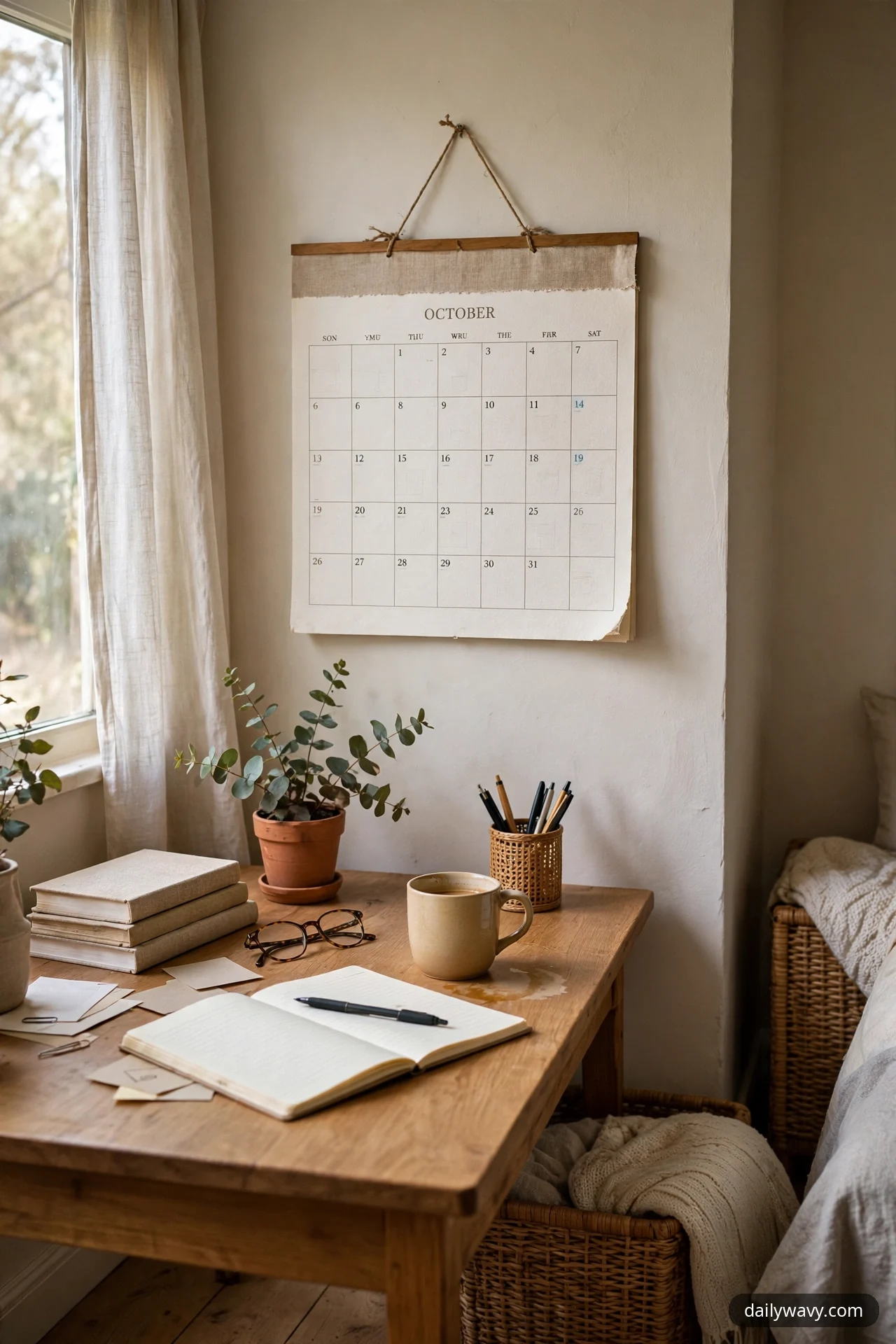
A wall calendar is a deadline machine that never needs charging, and in a shared room it quietly tells the household your schedule too. Hang a 12 by 12 inch monthly calendar on the wall section beside the desk, at seated eye level, and write the big dates in pen. Appointments, school holidays, the plumber. Digital calendars are better for reminders; a paper one is better for the glanceable shape of the month. Keep the marker color in your two-color palette.
What to measure: the wall section beside the desk, and seated eye height for the center of the calendar. Materials: one wall calendar and a removable hanging strip. Placement: beside the desk, never behind the monitor where you cannot read it. Approximate effort: ten minutes. Lower-cost alternative: a printed free calendar from a template site, mounted on a clipboard.
15. A Compact Lamp Off The Main Work Area
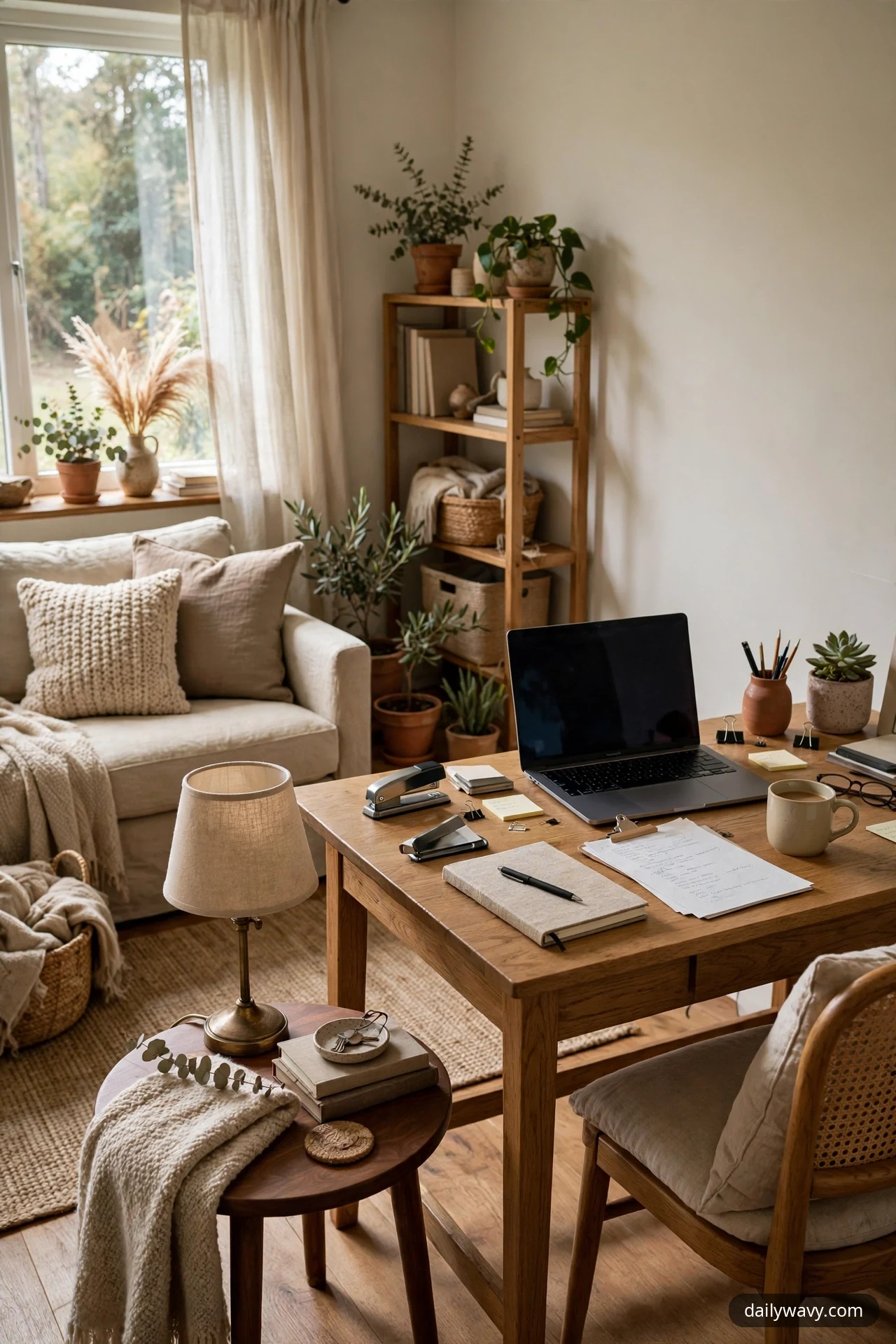
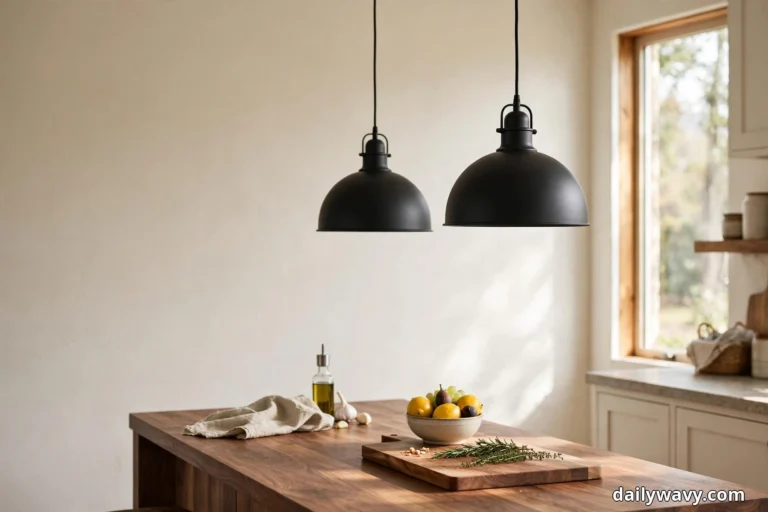
Overhead room light is designed for evenings on the sofa, not for reading documents at three in the afternoon. A compact lamp on the side table or bookcase, aimed at the wall rather than at your eyes, adds a pool of warm light that softens screen contrast without creating a second glare source. A small LED bulb in the 2700K warm range, in a shade no wider than 10 inches, is plenty. Place it 2 to 3 feet to the side of the screen, never directly behind it.
What to measure: the side surface where the lamp will sit (aim for a 10-inch square minimum). Materials: a compact table lamp and a warm-white LED bulb. Placement: to the side of the screen, bouncing light off the wall. Approximate effort: ten minutes. Lower-cost alternative: a clip-on reading light attached to the bookcase shelf.
16. A Vertical File Holder

Paper that lies flat spreads; paper that stands up behaves. A vertical file holder, about 10 inches tall with three to five slots, turns the in-tray pile into a tidy row on the desk’s back edge. Give each slot a job: incoming, to file, current project. The holder’s footprint is barely 4 by 10 inches, and because it sits at the back of the desk, it doubles as a visual screen that hides the monitor cables from the sofa side. Empty the incoming slot every Friday, no exceptions.
What to measure: the back edge of the desk (you need about 10 inches of width and 5 inches of depth). Materials: one vertical file sorter in wood or metal. Placement: along the back edge of the desk, slots facing you. Approximate effort: five minutes, plus the Friday habit. Lower-cost alternative: a dish rack from the kitchen, repurposed, which holds folders just as well.
17. A Small Tray For Everyday Tools
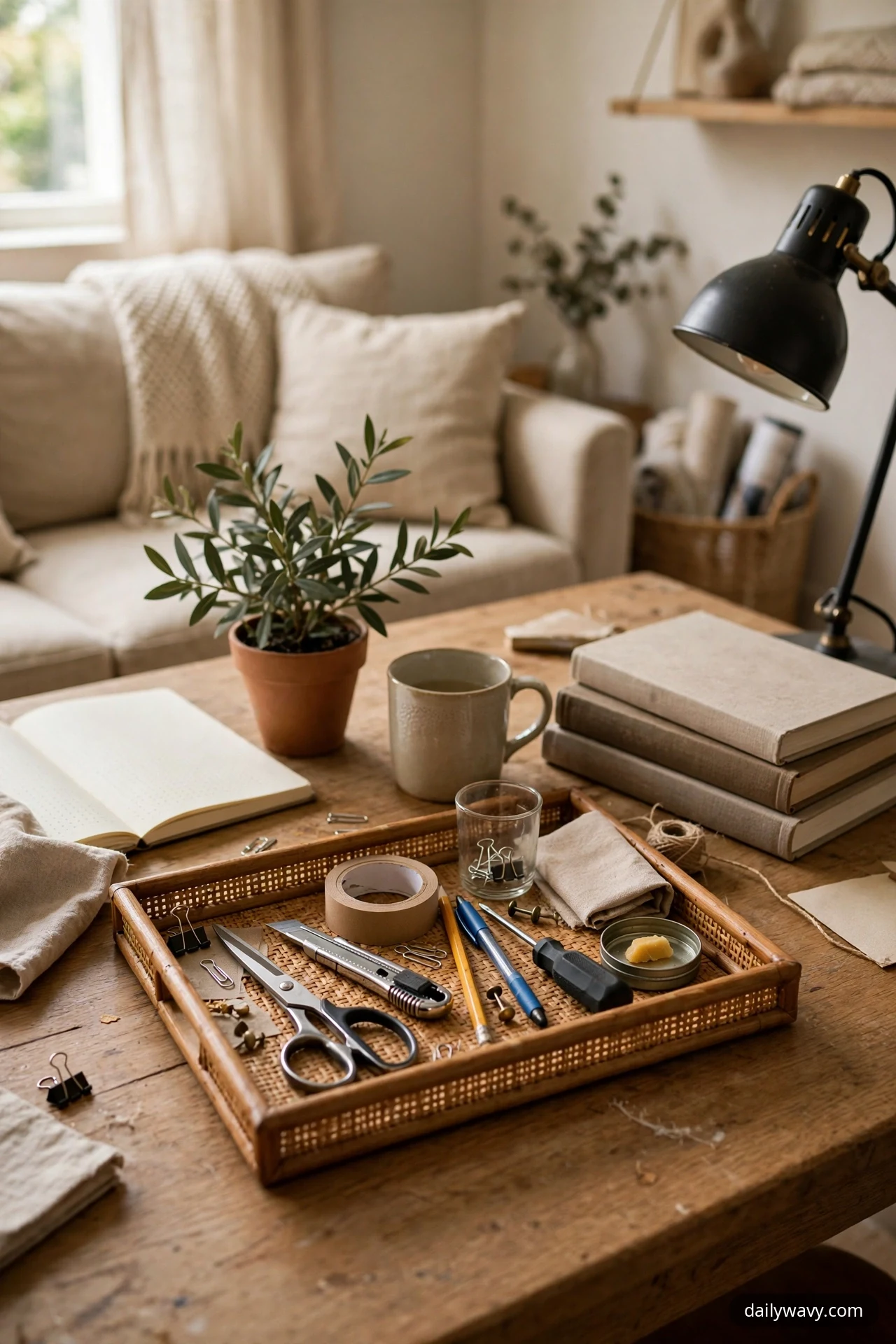
Scissors, a letter opener, the tape dispenser, the good pen: the tools you reach for ten times a day deserve one shallow home, not five different spots. A tray about 12 by 6 inches on the desk’s non-dominant side corrals them into a single zone you can lift and move in one motion. When the tray is full, something gets put away. When guests arrive, the whole tray slides into the drawer and the desk is clean in moments.
What to measure: the desk edge on your non-dominant side (about 12 inches of clear width). Materials: one shallow tray in your palette color. Placement: non-dominant side of the desk, within reach but out of the typing zone. Approximate effort: five minutes. Lower-cost alternative: a baking sheet pan in a neutral finish, which is exactly the right shape.
18. A Cable Channel Beneath The Desk

The cable box hides the power strip; a cable channel hides the journey. A stick-on channel about 2 inches wide runs along the underside of the desk’s back edge, carrying the monitor cable, the charger, and the lamp cord from the desk down to the box in one clean line. Self-adhesive channels need no tools and peel off without damage, which makes them ideal for rentals. The sofa-side view of your desk goes from “server room” to “furniture” quickly.
What to measure: the run from desk back edge to the cable box or floor (usually 2 to 3 feet). Materials: one adhesive cable channel kit with corner pieces, plus zip ties for the slack. Placement: along the underside of the desk’s back edge, dropping to the cable box. Approximate effort: fifteen minutes. Lower-cost alternative: a strip of fabric, hemmed into a tube and safety-pinned under the desk.
19. A Shelf Above Seated Eye Level
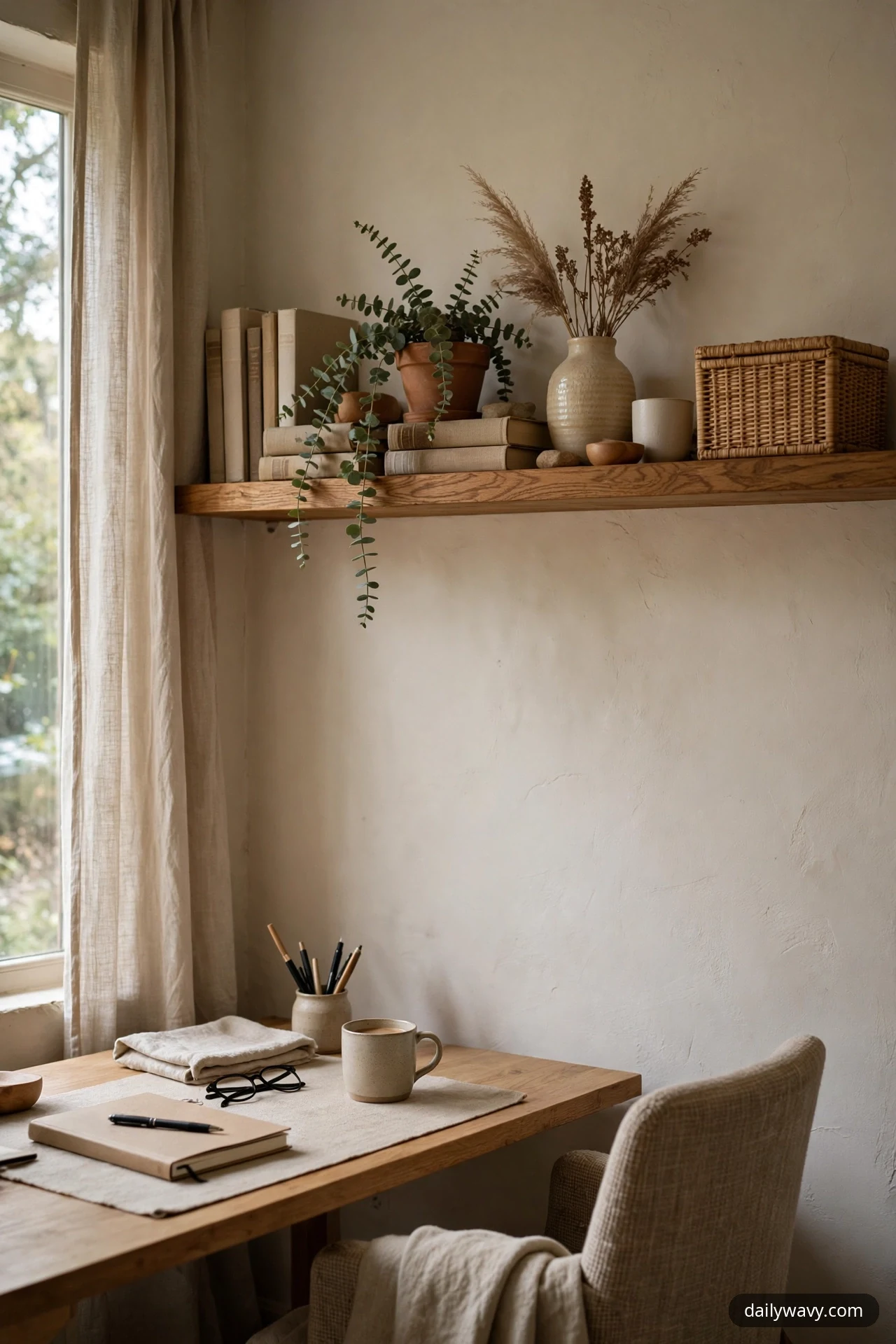
The wall above the desk is usually dead space, and a single shelf at about 60 inches from the floor puts it to work without crowding your sight line. Reference books, the nice notebook, a small clock: all within stand-and-reach distance, none of them on the desk. Keep the shelf 10 to 12 inches deep so it clears your head when you stand, and load the heaviest items over the wall studs. In a rental, two heavy-duty removable strips rated for 16 pounds each can hold a light pine shelf with a few light items; keep the total well within the strips’ combined rating and follow the strips’ instructions for your wall type.
What to measure: the wall width above the desk and 60 inches up from the floor; check for studs if you will drill. Materials: one 24 to 36 inch shelf with brackets, or a floating shelf kit. Placement: centered above the desk, bottom of shelf at about 58 to 62 inches from the floor. Approximate effort: forty-five minutes. Lower-cost alternative: a picture ledge, which is shallower but perfect for books and small frames.
20. A Calm Artwork Beside The Screen
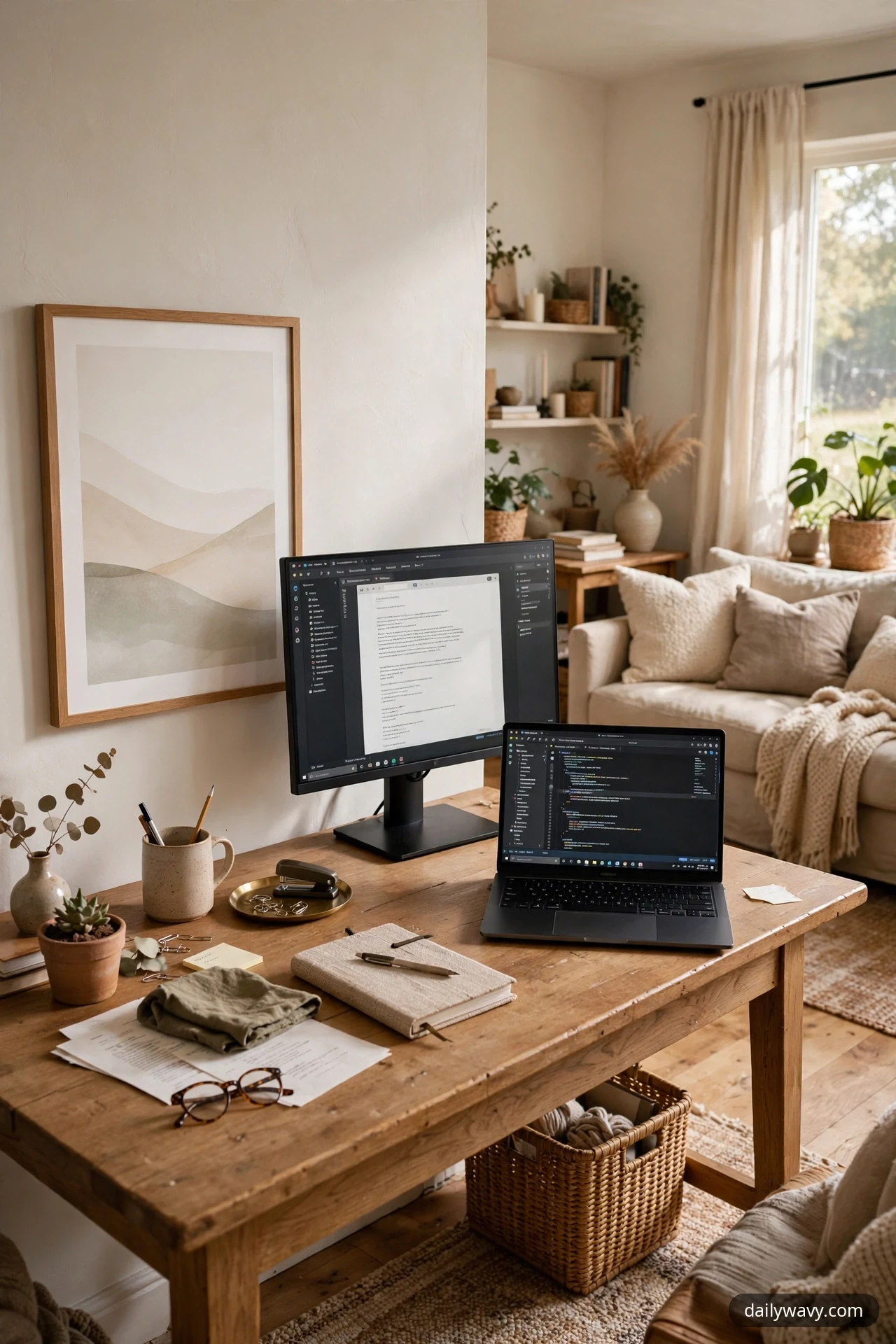
A workspace in a shared room should give your eyes somewhere kind to land when you look up from the screen. One calm piece, a landscape print, a soft abstract, a framed botanical, hung beside the monitor at eye level, does more for the feel of the corner than any organizer. Keep it restful rather than stimulating: muted colors, simple composition. It is also the clearest signal to the household that this corner is a considered part of the room, not a desk that wandered in.
What to measure: the wall section beside the screen, aiming for a frame 11 by 14 inches or larger so it holds its own. Materials: one framed print and a removable hanging strip. Placement: beside the screen at seated eye level, not above it. Approximate effort: ten minutes. Lower-cost alternative: a page from an old calendar or art book, framed in a thrifted frame.
Frequently asked questions
Where is the best place to put a desk in a living room?
Near a side window is the classic answer: daylight falls across the work instead of into the screen, and you face the room rather than a wall. Keep 3 feet of clear space behind the chair so you can pull out and stand without shuffling furniture. If the only wall is shared with the TV, angle the desk so the screen faces away from the television’s sight line; you will thank yourself during evening work sessions.
How do I hide my office when guests come over?
Close the lids and slide the trays into drawers, roll up the desk mat, push the chair fully under the desk, and park the rolling cart in a closet. The cable box and channel do the heavy lifting permanently, since nothing looks like an office faster than a cable tangle. A throw over the chair back and one candle on the desk (never leave a burning candle unattended) finish the transformation quickly.
Will a workspace make my living room feel smaller?
Only if it blocks a traffic path or crowds the window. Keep every piece inside a taped 4 by 3 foot zone, keep the walking lane clear, and choose open or light-colored pieces over bulky dark ones. A tidy, bounded work corner can make the rest of the room feel more intentional, not less, much like the compact zones in our small entryway decor ideas prove that small footprints can still feel generous.
What about video calls from the living room?
Face the camera toward your calmest wall, which is often the one with the artwork or the bookcase. A curtain behind you softens daylight so you are not silhouetted, and the shelf above eye level stays out of frame. Do a test call and screenshot it; what you see is what colleagues see, and a few minutes of rearranging beats months of apologizing for the background.
Can I really work at a desk without a proper ergonomic setup?
You can make a shared-room desk far more comfortable with the basics in this guide: screen near eye level, keyboard close, feet flat, light from the side. But no decorative arrangement replaces proper ergonomic support if you work long hours or have ongoing discomfort. If you get persistent aches, that is a conversation for a qualified professional, not a styling fix.
How do I keep work papers from taking over the room?
The vertical file holder is the front line: three slots, and paper that does not fit in a slot gets filed or recycled the same day. Pair it with the Friday empty-the-incoming-slot rule, and the living room never becomes an archive. For the papers you must keep, file them the same day so nothing lingers. Our small pantry organization ideas show the same kind of tidy, bounded thinking in another small space.
A Thoughtful Corner, Not a Takeover
A home office in a living room works when it behaves like a good guest: it knows its space, it keeps its things tidy, and it disappears gracefully when the evening belongs to everyone. Start with the measurements, solve the glare and the cables first, and build outward from there. You do not need all twenty ideas. Five or six, chosen for your room and your habits, will do more than a shopping cart full of organizers ever could.
If the rest of the living room needs the same measured treatment, browse our Home & Decor ideas for room-by-room guides, and save your favorite setups from this guide to revisit when you are ready. If a bedroom corner is available after all, our home office in a bedroom ideas apply the same measured thinking in that room. The best work corner is the one that fits your life as it actually is, sofa, sunlight, cables and all.