20 Gray Sofa Styling Ideas with Colors and Textures That Work Together
A gray sofa is a forgiving starting point in home decorating. It sits between warm and cool, pairs with almost…
A gray sofa is a forgiving starting point in home decorating. It sits between warm and cool, pairs with almost every color, and gives you room to change the mood of a room without replacing the biggest piece in it. The trick is not buying more gray. It is choosing the right colors and textures around it: pillows with enough contrast, a throw with real softness, a rug that grounds the seating, and light that flatters the fabric. This guide gives you twenty complete styling ideas, each one a small scene you can recreate this weekend. Pick the ones that fit your room, and the gray starts to look like the smartest choice you made.
Jump to an idea
- A low ceramic lamp on a side table
- One large artwork above the sofa
- A pair of floor cushions nearby
- A striped pillow beside a solid one
- A woven basket for a folded blanket
- A small round accent table
- A soft ottoman with a serving tray
- A framed art pair centered above seating
- A narrow console behind the sofa
- A reading lamp beside one arm
- A washable rug with a subtle pattern
- A linen curtain backdrop
- A vintage trunk used as a table
- A single sculptural vase on a nearby shelf
- An upholstered bench facing the sofa
- A tall plant beside the arm
- A rug layered over a plain natural-fiber rug
- Textured cushions with a plain throw
- A tonal rug anchoring the sofa
- A contrasting wood coffee table
Start with your gray: warm, cool, or true
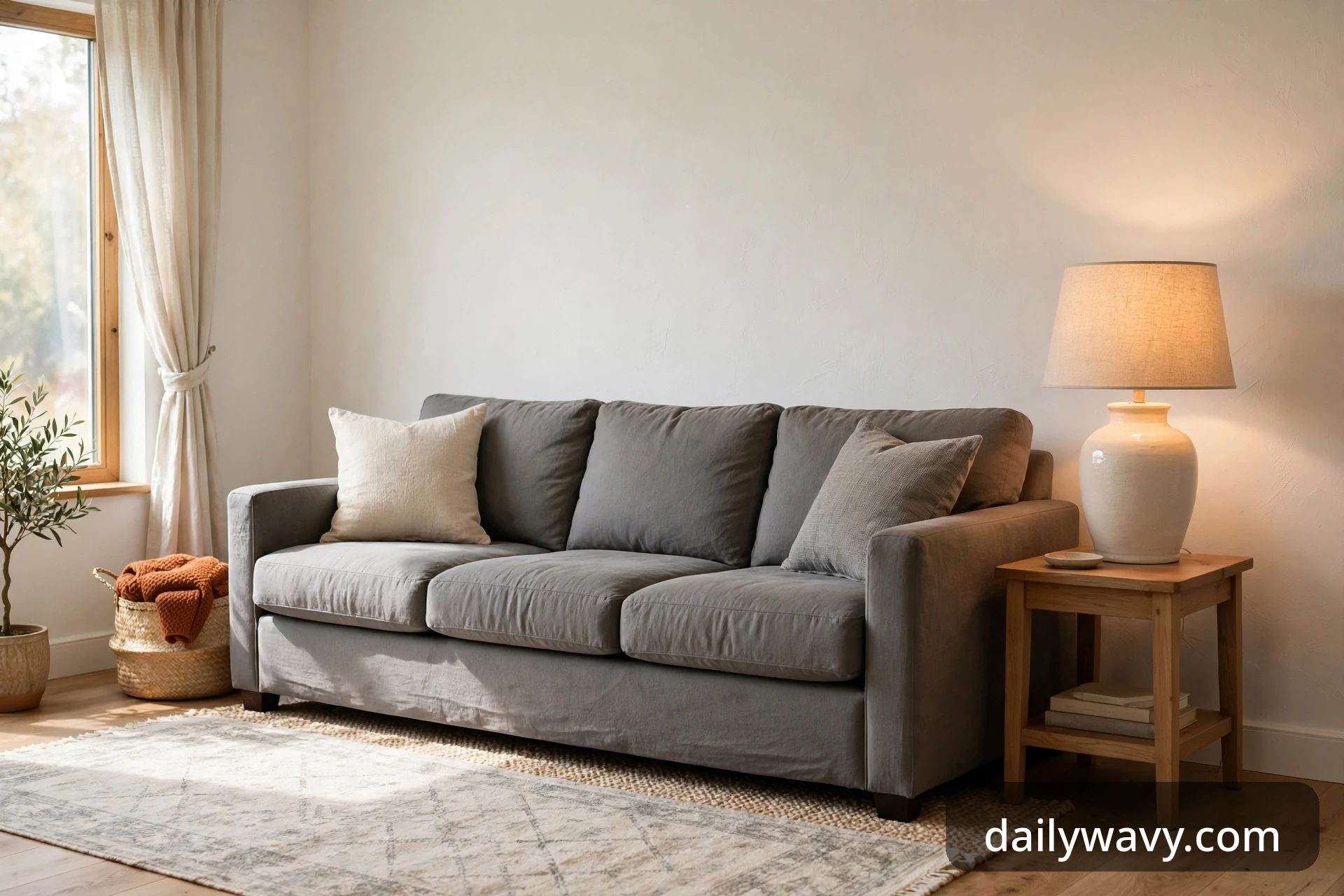
Before you style anything, look at your sofa in daylight. Gray almost always leans one way. Hold a white sheet of paper against the fabric. If the gray looks greenish or brownish next to the paper, it leans warm. If it looks blue or icy, it leans cool. If it stays neutral, you have a true gray.
Warm grays love warm partners: cream, camel, terracotta, olive, warm wood. Cool grays love crisp partners: white, navy, charcoal, light oak, glass and chrome. True grays take either direction, which is why they are the easiest of all.
Pillow sizing works off one rule. For a standard three-seat sofa, use two 22-inch pillows at the corners, then layer smaller ones in front: 20-inch, then 18-inch or a lumbar pillow around 14 by 22 inches. Larger pillows behind, smaller in front. The sofa itself never needs more than five or six pillows; more than that and it looks staged instead of livable.
Rug scale is just as simple. The front legs of the sofa should sit on the rug, and the rug should extend at least 18 inches past each end of the sofa. For most rooms, that means an 8 by 10 foot rug. In a small living room, a 6 by 9 foot rug works if the front legs still land on it. If the rug floats in front of the sofa with all legs off, it will look like a mat instead of an anchor. If you are working on a small entryway first, our small entryway decor ideas show how the same anchoring logic works on a tighter footprint.
1. A low ceramic lamp on a side table
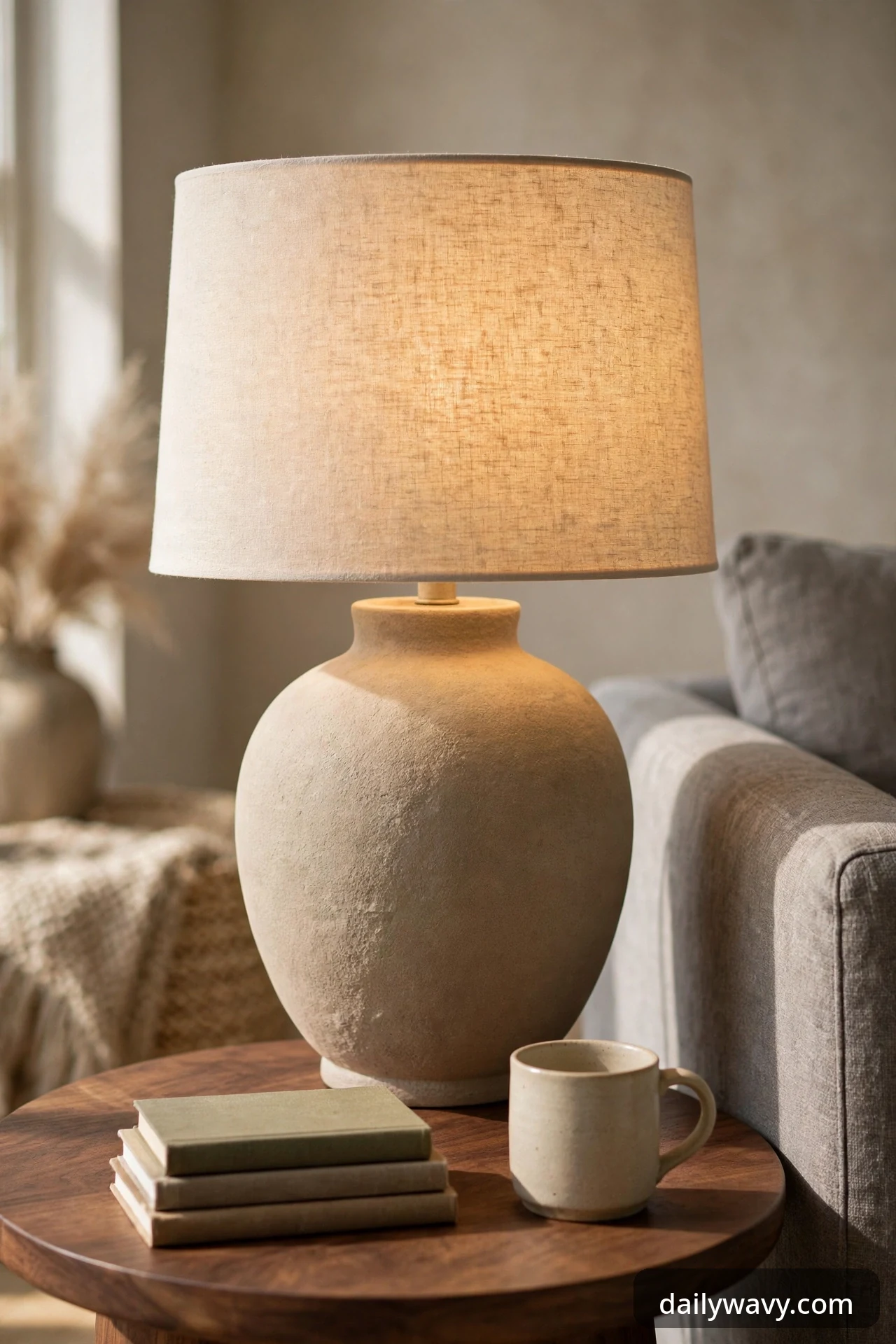
There is a reason this is the first idea. A low lamp changes everything about how gray fabric reads in the evening. Gray under warm lamplight looks rich and soft; under a harsh overhead light it can look flat and cold. Put a ceramic lamp on a side table next to the sofa, low enough that the shade sits below eye level when you are seated, and the whole corner starts to glow.
Choose a ceramic base in a matte finish: ivory, sand, or soft sage. A matte glaze catches the light without glaring, and the handmade feel of ceramic adds warmth that balances gray's coolness. The shade should be a simple drum or tapered shape in natural linen. Keep the bulb warm, around 2700K, and use a three-way or dimmable bulb if you can so the corner can go from reading bright to evening soft.
The side table itself should be about the height of the sofa arm or up to 2 inches taller. Too low and the lamp disappears; too tall and the whole arrangement looks top-heavy. If your sofa is a standard depth, a table with a 16 to 18 inch diameter top gives the lamp room to sit with space for a coaster or a small book. Real materials matter here: wood, stone, or metal frames keep the look grounded. Plastic side tables can read cheap next to real upholstery, no matter how good the lamp is.
2. One large artwork above the sofa
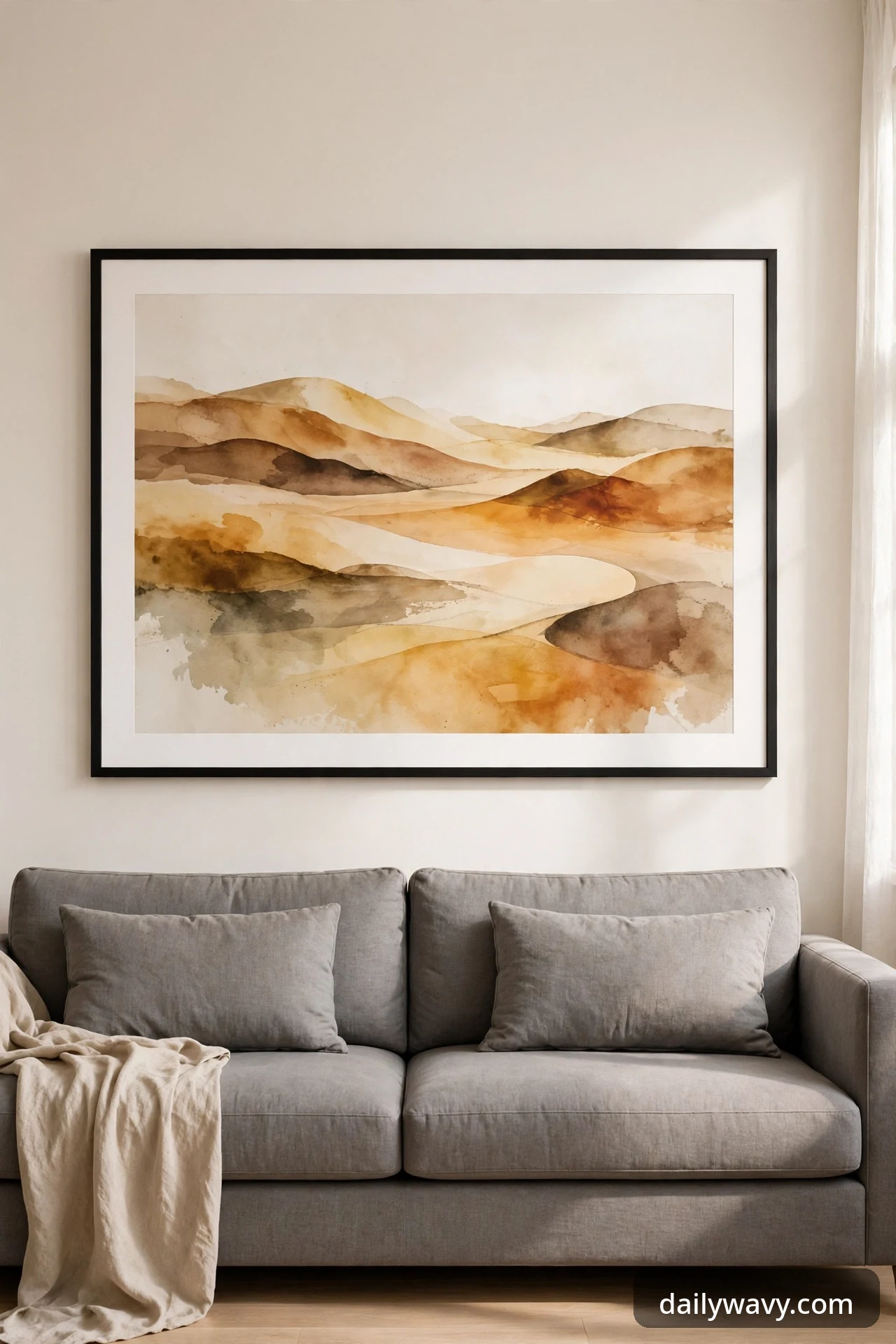
A gray sofa needs something to look up at. Bare wall above a sofa makes even the best room feel unfinished, and one large piece of art often does more than a cluster of small frames. Aim for a piece that is roughly two-thirds the width of the sofa. On an 84-inch sofa, that means a frame around 55 to 60 inches wide. The bottom of the frame should hang 6 to 8 inches above the sofa back. Use a hook and wall anchor rated for the frame's weight.
The art itself should pull in the colors you want around the gray. An abstract landscape with warm neutrals, a botanical print with sage greens, or a textural monochrome piece all give the gray sofa context. Gray is a neutral; it takes its cues from what surrounds it. Give it colors to echo and it stops reading as plain.
For a warm gray sofa, art with ochre, rust, or warm sand tones will pull out the brown in the fabric. For a cool gray sofa, art with blues, black ink, or white space will sharpen it. True gray handles either. If you are choosing between two pieces, pick the one with more texture visible in the print: visible brushwork, linen canvas texture, or a heavy wood frame. Gray sofas look best against things with depth, because the sofa fabric itself is usually flat.
3. A pair of floor cushions nearby
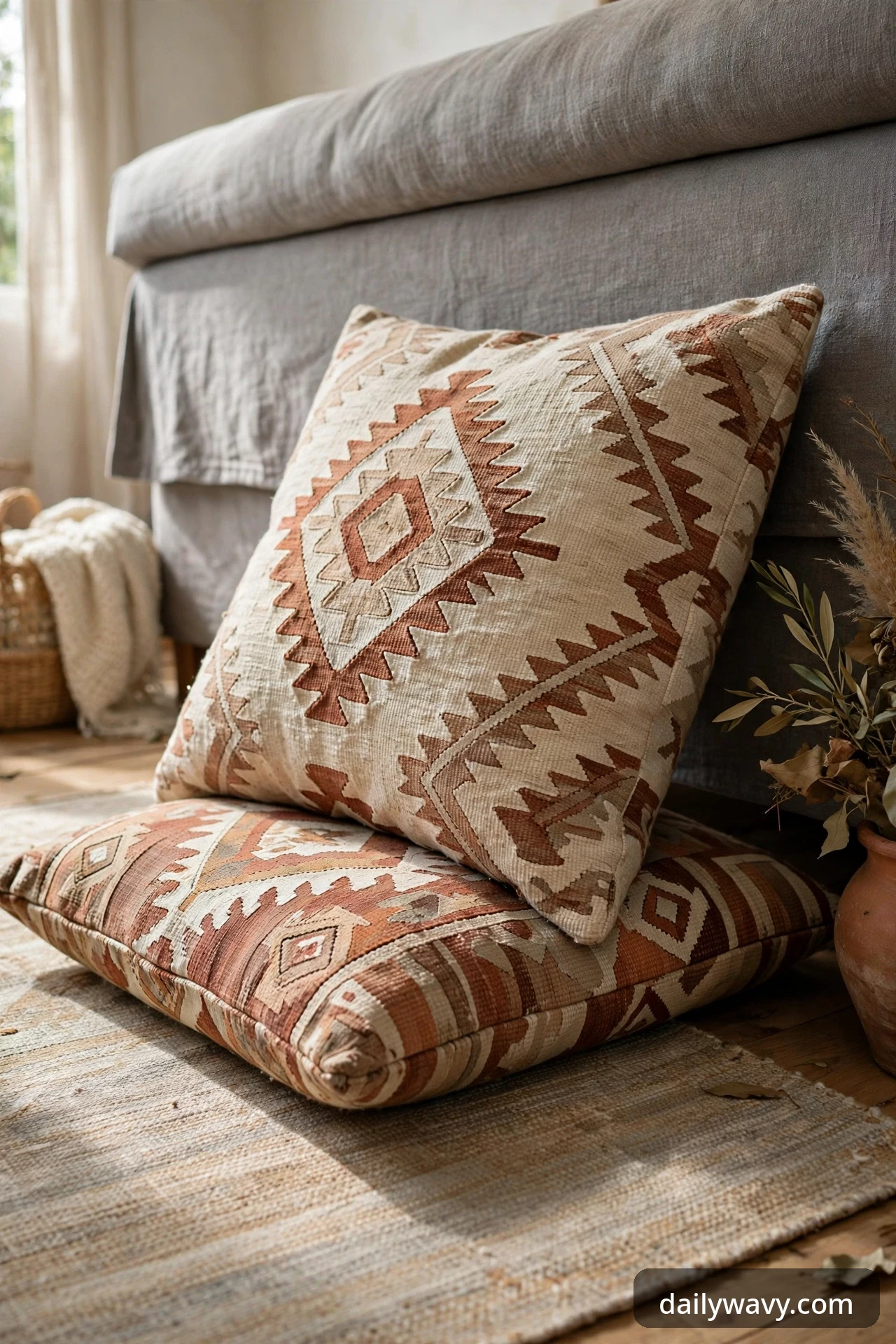
Floor cushions are an underused styling piece in a living room. Tucked near the gray sofa, they soften the base of the arrangement and give the room something low and informal to contrast with the sofa's structure. They also solve the real problem of where guests sit when the sofa is full.
Look for floor cushions at least 24 inches square and 5 to 6 inches thick, with a removable, washable cover. Anything smaller slides around and looks like a throw pillow that fell off. The cover fabric should be sturdy: canvas, kilim-style flatweave, or a heavy linen. Pattern is welcome here because the cushions sit low and out of the sofa's sightline; a kilim stripe or a subtle geometric print adds color without competing with the sofa pillows.
Stack them leaning against the sofa base or a nearby wall when not in use, two high. A small pile of floor cushions looks intentional; one cushion shoved in a corner looks forgotten. In a small living room, floor cushions are genuinely useful as extra seats, and the arrangement principles match what we cover in our narrow living room layout ideas, where every low piece has to earn its floor space.
4. A striped pillow beside a solid one
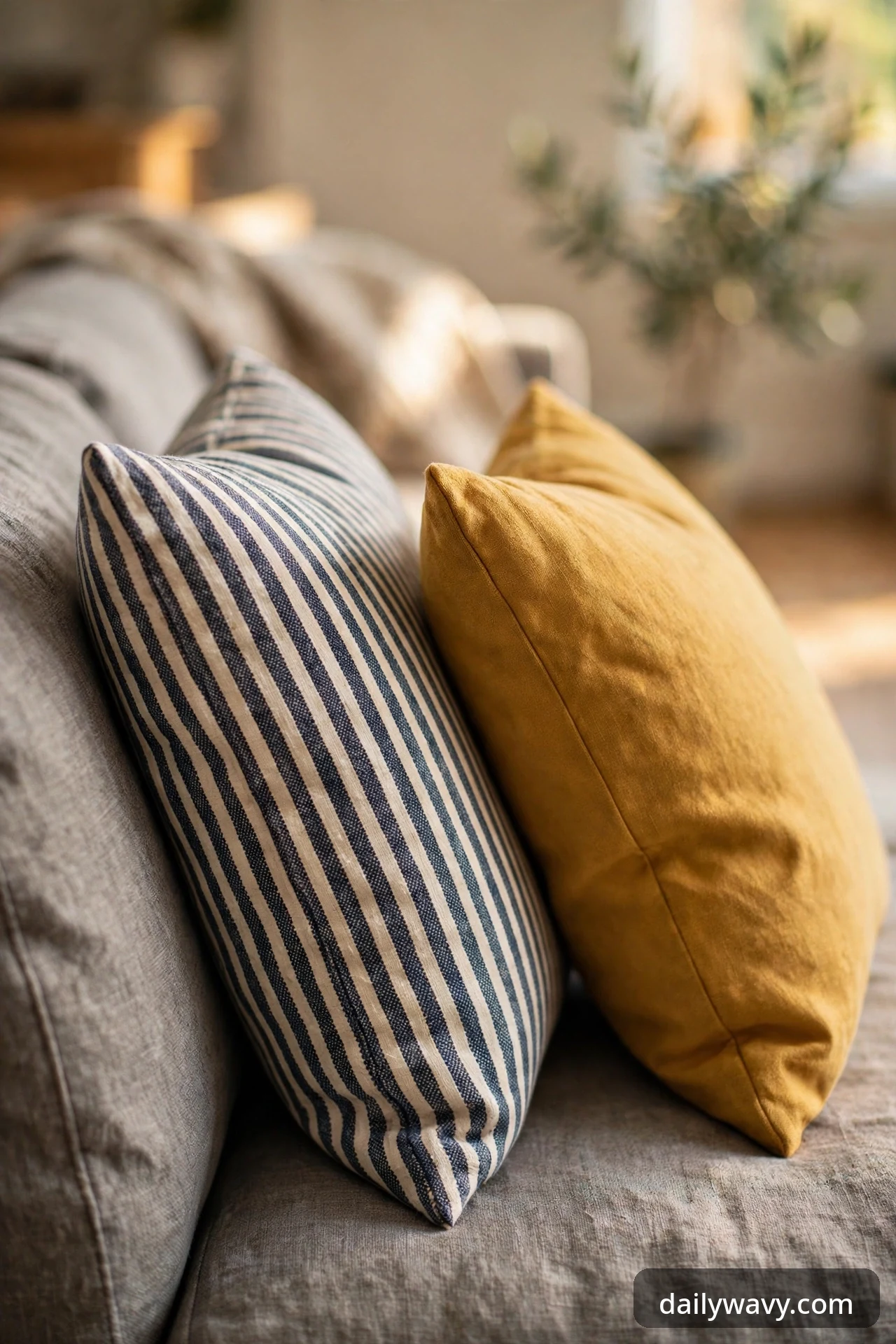
This is a fast pillow formula that works well on gray. One striped pillow, one solid pillow, placed together on each end of the sofa. The stripe brings pattern and movement; the solid brings weight and color. Together they read as a designed pair instead of two random pillows.
The striped pillow should pick up two colors: one from the room and one neutral. A cream and navy stripe, a sand and charcoal ticking stripe, or a sage and ivory stripe all work against gray. Keep the stripe scale medium. Hair-thin pinstripes disappear from across the room, and very wide awning stripes can overpower a standard sofa.
The solid pillow beside it is where the color lives. Mustard, terracotta, forest green, dusty blue, or a warm blush all have enough personality to carry the pairing. The solid should be the same size as the striped one, or one inch smaller, so the stripe stays visually in charge. Both covers should be washable, because the end pillows are the ones people actually lean on. A zipper hidden along one edge is the mark of a well-made cover; sewn-shut pillows never survive long on a real sofa.
5. A woven basket for a folded blanket
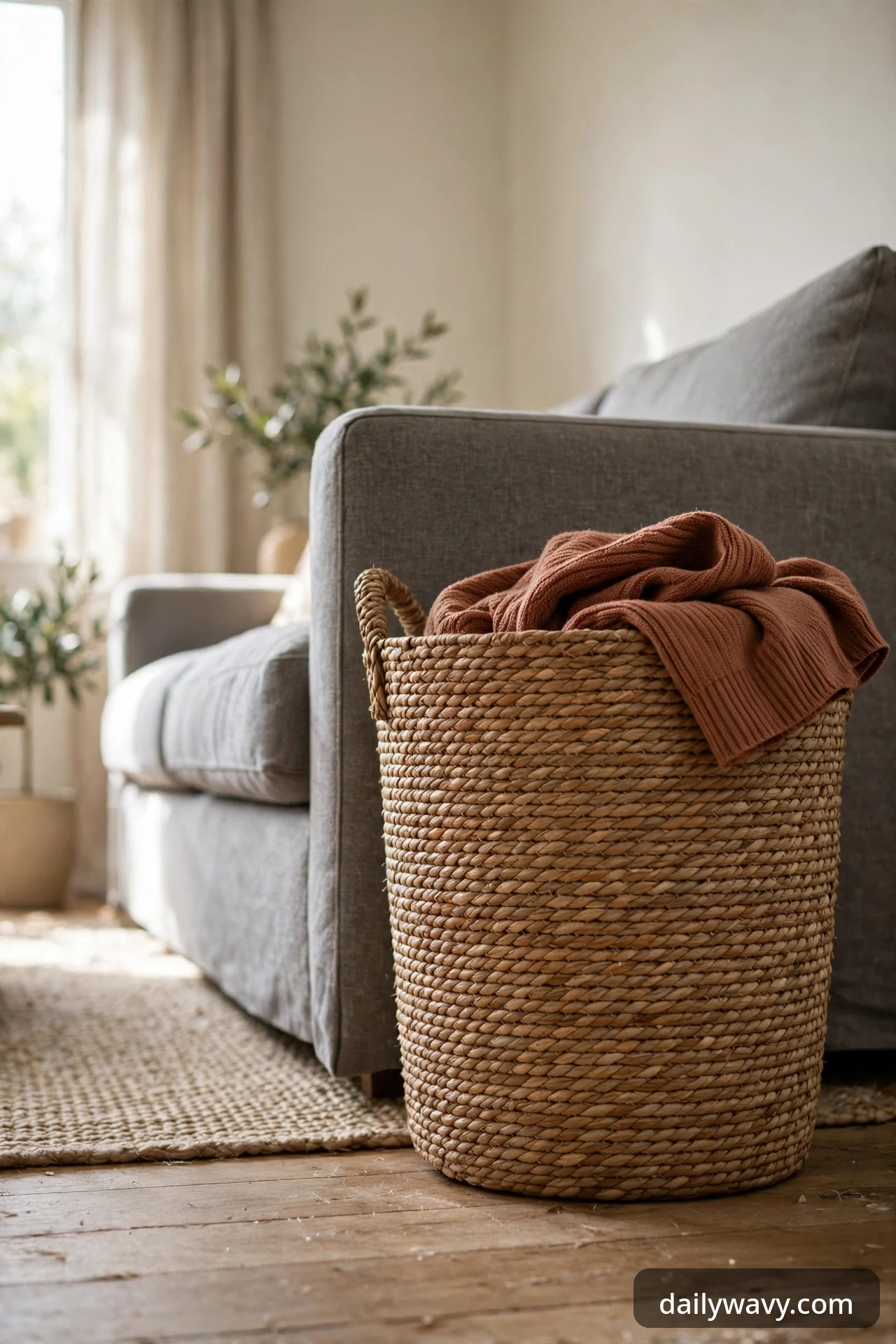
Gray sofas pair naturally with woven baskets. The basket adds rough, natural texture that makes the flat gray fabric look softer by contrast, and it gives folded throws a home that is better than draping them over the arm. A throw draped over the sofa arm tends to slide; a basket keeps it accessible and tidy.
Choose a basket tall enough that the folded blanket sits upright with its top peeking out: about 18 to 22 inches tall for a standard throw folded in thirds. Seagrass, water hyacinth, or rattan all have the right organic warmth. The weave should be tight enough to hold its shape but open enough to look handmade.
Place the basket on the floor at one end of the sofa, slightly in front of the arm. The folded blanket should be the accent color of the room: a rust throw, a mustard knit, or a cream cable knit, depending on your palette. Roll the blanket instead of folding it if the basket is narrow; a roll shows off the texture and fits a slimmer basket. Empty the basket once a season and shake it out, because baskets collect dust on their inner walls. Lining the bottom with a cloth napkin you can wash keeps the basket clean with zero effort.
6. A small round accent table
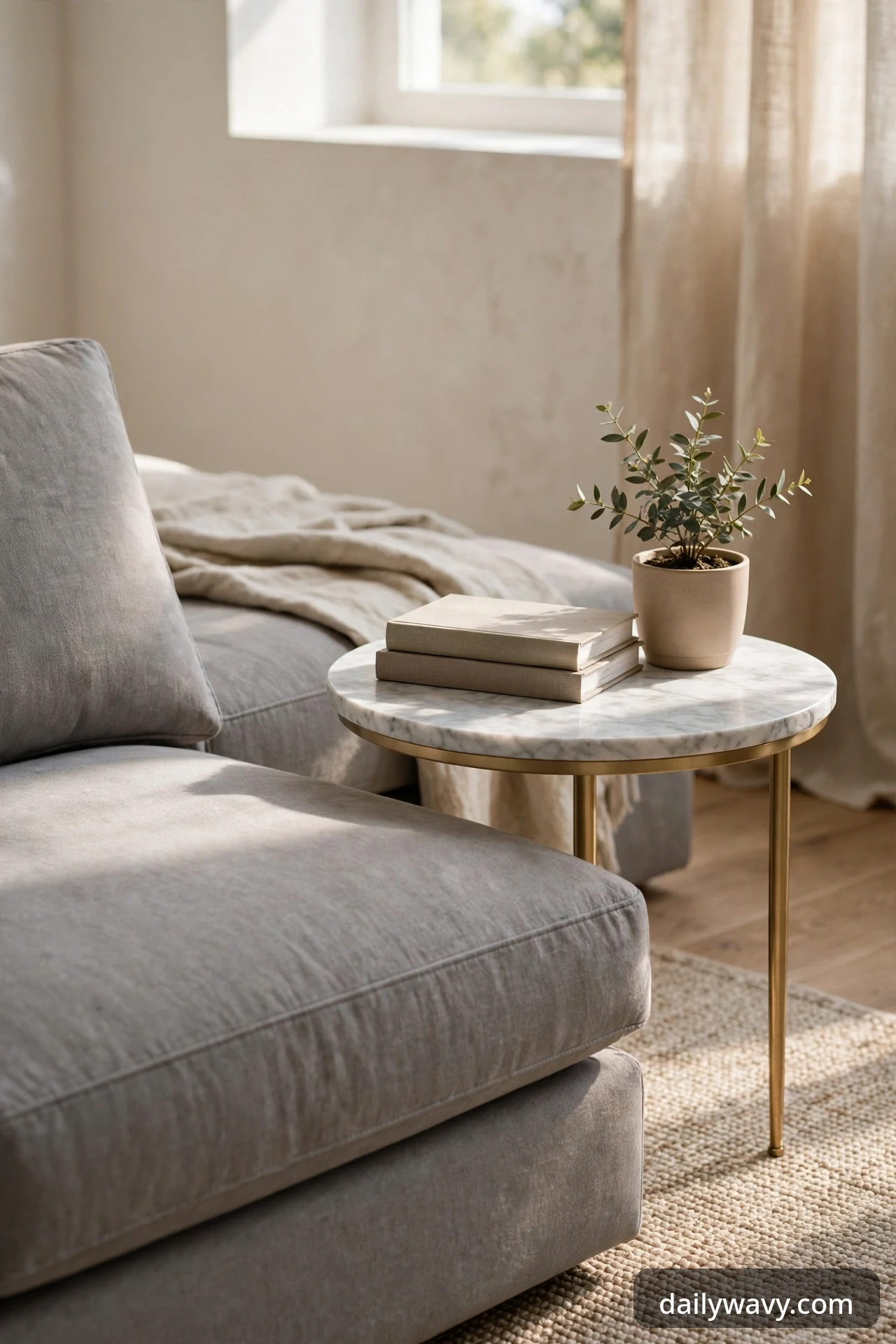
Every gray sofa needs a landing spot within arm's reach, and a small round accent table is a forgiving option. Round tables have no corners to bump, they sit happily in tight spots, and their softness contrasts nicely with the sofa's straight lines. Put one at the end of the sofa opposite the side table, or between the sofa and a chair.
The diameter should be 14 to 18 inches and the height roughly level with the sofa arm. A marble top with a slim metal base reads elegant; a solid wood drum table reads warm and modern; a rattan pedestal reads relaxed. Against gray, all three work, so choose based on the room's direction. The key is that the table looks intentional, not like a leftover. One material with a clean finish usually looks better than a busy mixed-media design at this small scale.
Style the top with two things, never more: a small plant or a stack of two books with a candle on top. Three or more objects on an 18-inch top looks cluttered. And keep the surface clear enough that it can actually hold a mug. An accent table that cannot hold a drink is decoration, not furniture, and living rooms need furniture.
7. A soft ottoman with a serving tray
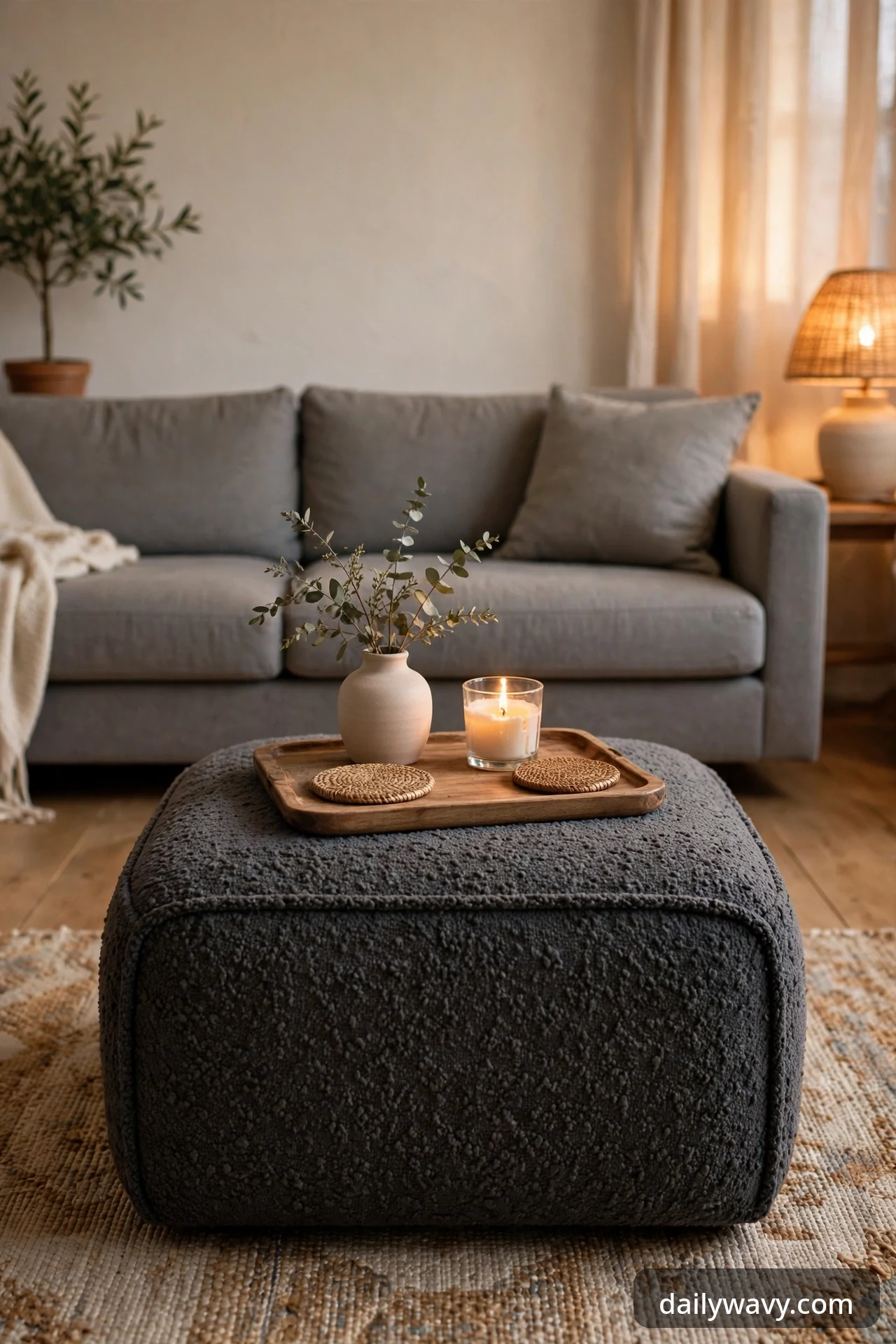
An ottoman does double duty in front of a gray sofa: footrest and coffee table, depending on the hour. That is exactly why it needs a serving tray. Without a tray, the ottoman top is too soft to hold anything; with a tray, it becomes the room's most flexible surface. Feet go on the uncovered half, drinks and books go on the tray.
The ottoman should be upholstered in something with texture that contrasts the sofa: bouclé, a chunky weave, or tufted velvet in a color one step darker or lighter than the sofa. If the sofa is medium gray, the ottoman can be charcoal for drama or light greige for softness. Size it about two-thirds the length of the sofa and half its depth, so it tucks in without crowding the walkway. There should be 14 to 18 inches between the ottoman and the sofa edge, enough to walk past without turning sideways. Keep main walking routes through the room at least 30 inches wide.
The tray should be rigid with a raised lip: wood, lacquered, or hammered metal. It needs to be large enough to hold a candle, a small vase, and two coasters without feeling crowded, so look for something around 18 by 12 inches. The tray keeps the ottoman looking styled instead of lumpy, and it lifts off in one motion when you want the full surface for feet.
8. A framed art pair centered above seating
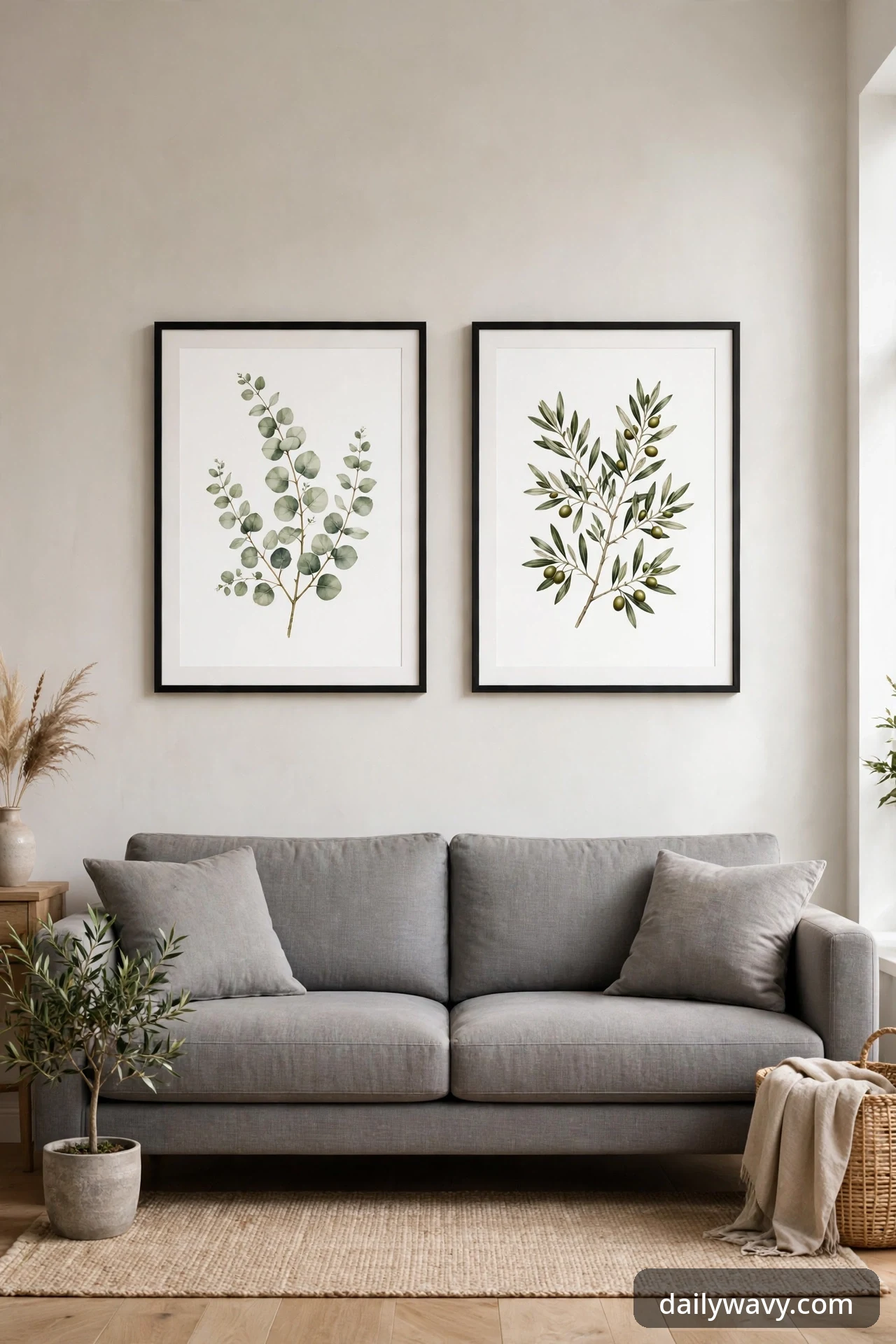
If one large artwork feels like too much commitment, a pair of framed prints is the flexible answer. Two matching frames, hung side by side and centered over the sofa, give the wall structure and symmetry. They also let you combine two images: a photograph and a print, two botanical studies, or two abstracts that share a palette.
The frames should match exactly: same size, same finish, same matting. Symmetry is what makes a pair look deliberate instead of accidental. Hang them so the outer edges of the frames span about two-thirds the sofa width, with 2 to 3 inches of space between them. The center point between the two frames should sit 57 to 60 inches from the floor, which is standard gallery height, and the frames will naturally clear the sofa back by 6 to 8 inches. Use hooks and wall anchors rated for each frame's weight.
Matting matters more than people expect. A wide white or ivory mat, 3 to 4 inches, gives each piece breathing room and connects to light walls. Against a gray sofa, the mat's brightness lifts the whole arrangement. Thin black frames with white mats are the classic combination because they disappear; the art gets all the attention. Heavy ornate frames compete with the sofa for visual weight and usually lose.
9. A narrow console behind the sofa
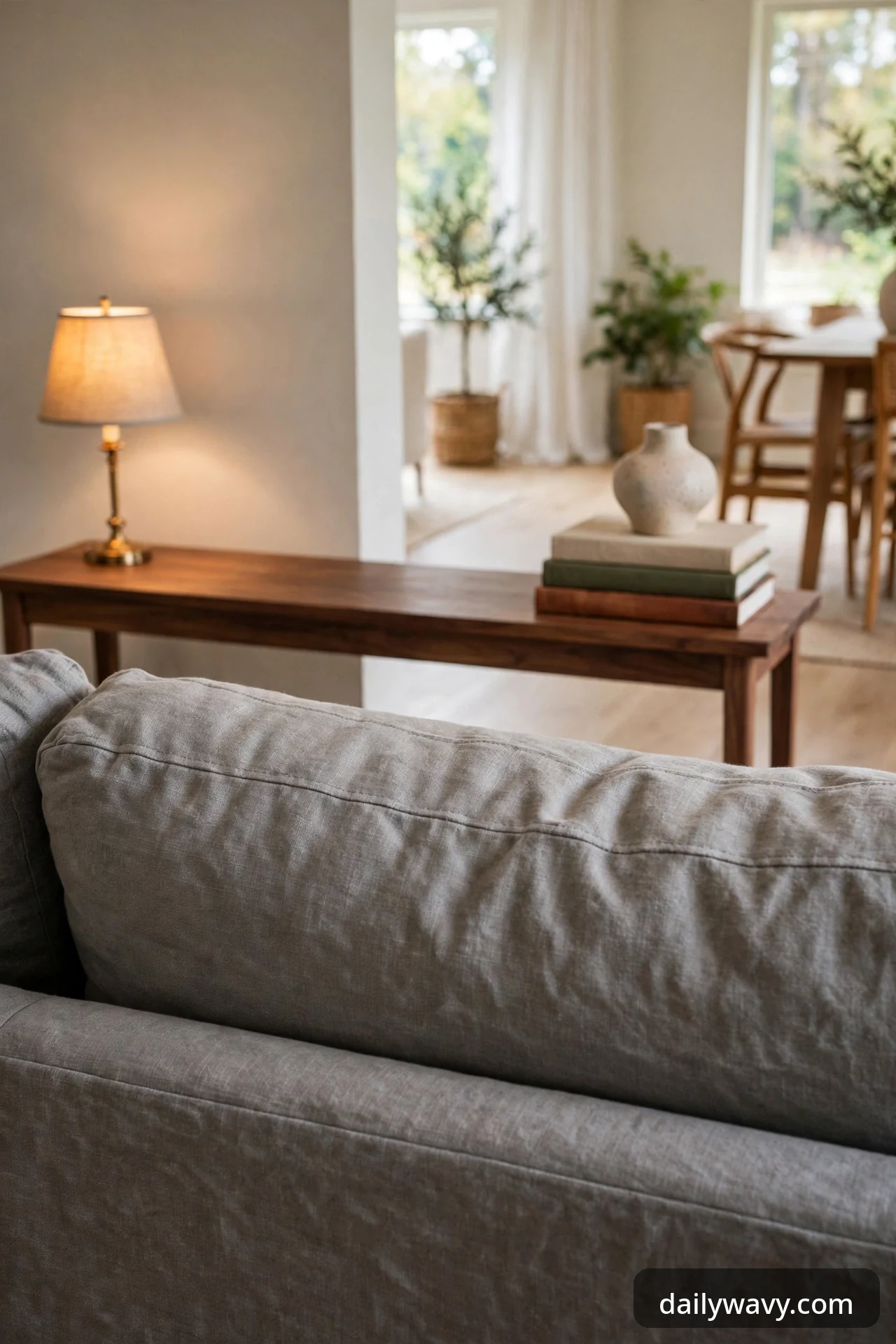
In a room where the sofa floats instead of hugging the wall, a narrow console behind it finishes the back view and gives the room a sense of architecture. The back of a gray sofa, seen from the entry or the dining area, is a big blank slab of fabric. A console breaks it up and adds a surface for styling.
The console should be 10 to 14 inches deep, no more, and sit 2 to 4 inches below the sofa back height or flush with it. Any taller and it reads as a barricade; any lower and it disappears behind the cushions. Length should be at least half the sofa length so it looks anchored rather than floating. A simple wood console in oak or walnut warms up a cool gray sofa; a black or dark stained console sharpens a warm gray.
Style it in a low profile. Two table lamps, one at each end, is the classic arrangement and it lights the whole seating zone. Or use one lamp and a stack of books with a small object on top. Keep everything low enough that sightlines across the room stay open. A console that blocks views between the living area and the rest of the room makes the space feel cut in half. Behind-sofa styling also pairs naturally with our entryway guide, since both deal with the line where one zone meets the next.
10. A reading lamp beside one arm
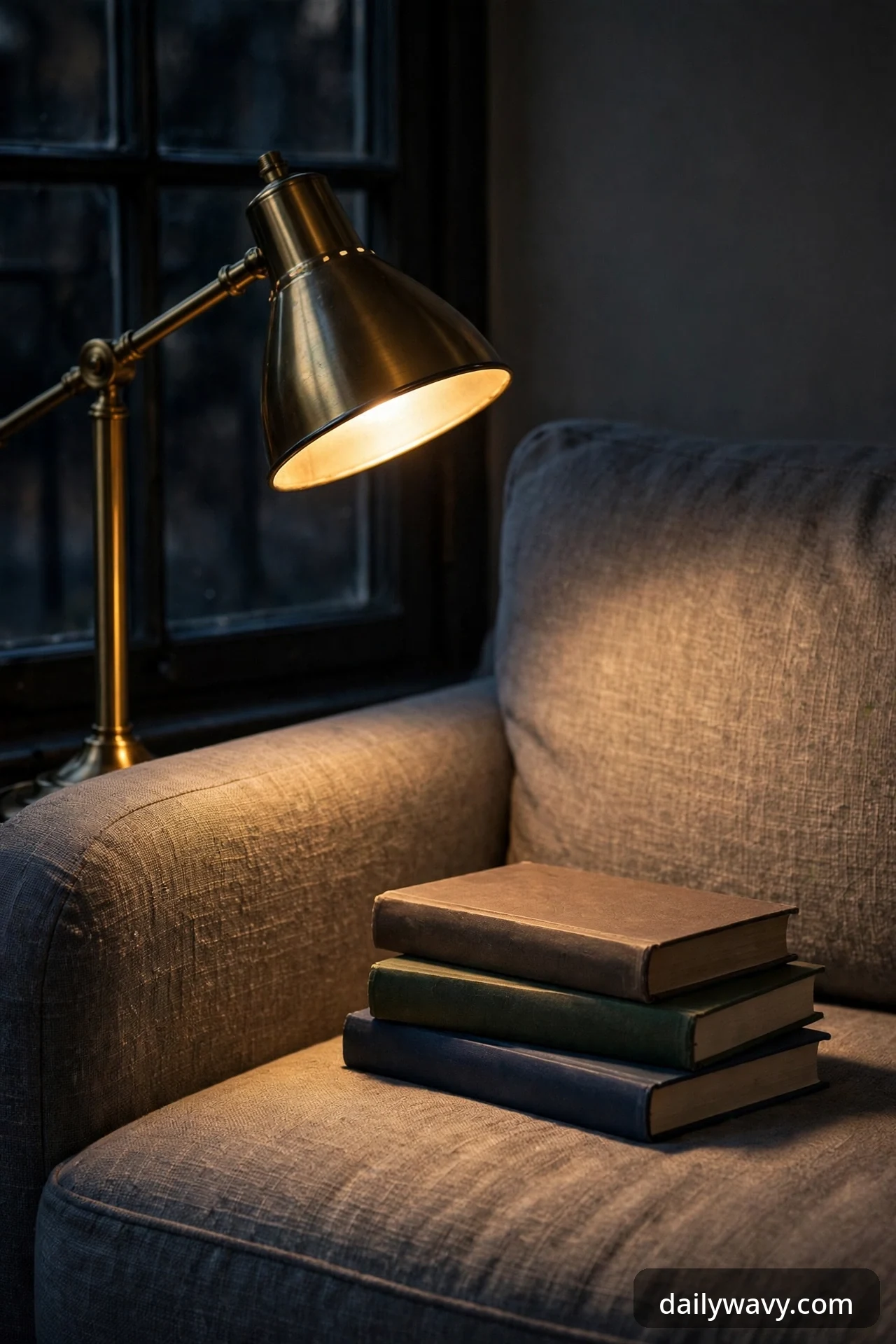
A reading lamp is different from a table lamp: it is task lighting with a job to do. The shade should direct light down and slightly forward over the sofa arm, which means a pharmacy lamp, an angled shade, or a swing-arm wall light. Floor-standing reading lamps work when there is no side table; swing-arm sconces work when floor space is tight.
Position the lamp head about 40 to 48 inches off the floor, which puts the light source just above shoulder height for someone seated. The light should fall on the lap or the book, not blast across the room. An adjustable arm is worth the money because the reading spot shifts: sometimes it is the corner seat, sometimes the middle. A lamp that swings solves this without being moved.
The finish should echo the room's other metals. If your hardware is brass, choose a brass or warm gold lamp. If it is black or chrome, match that. Mixed metals work in a room, but the lamp is small and close to the sofa, so matching keeps it calm. A warm bulb, 2700K, keeps the light from feeling clinical. Cool bulbs on gray fabric can make the sofa look slightly blue, which is a tint gray is better without.
11. A washable rug with a subtle pattern
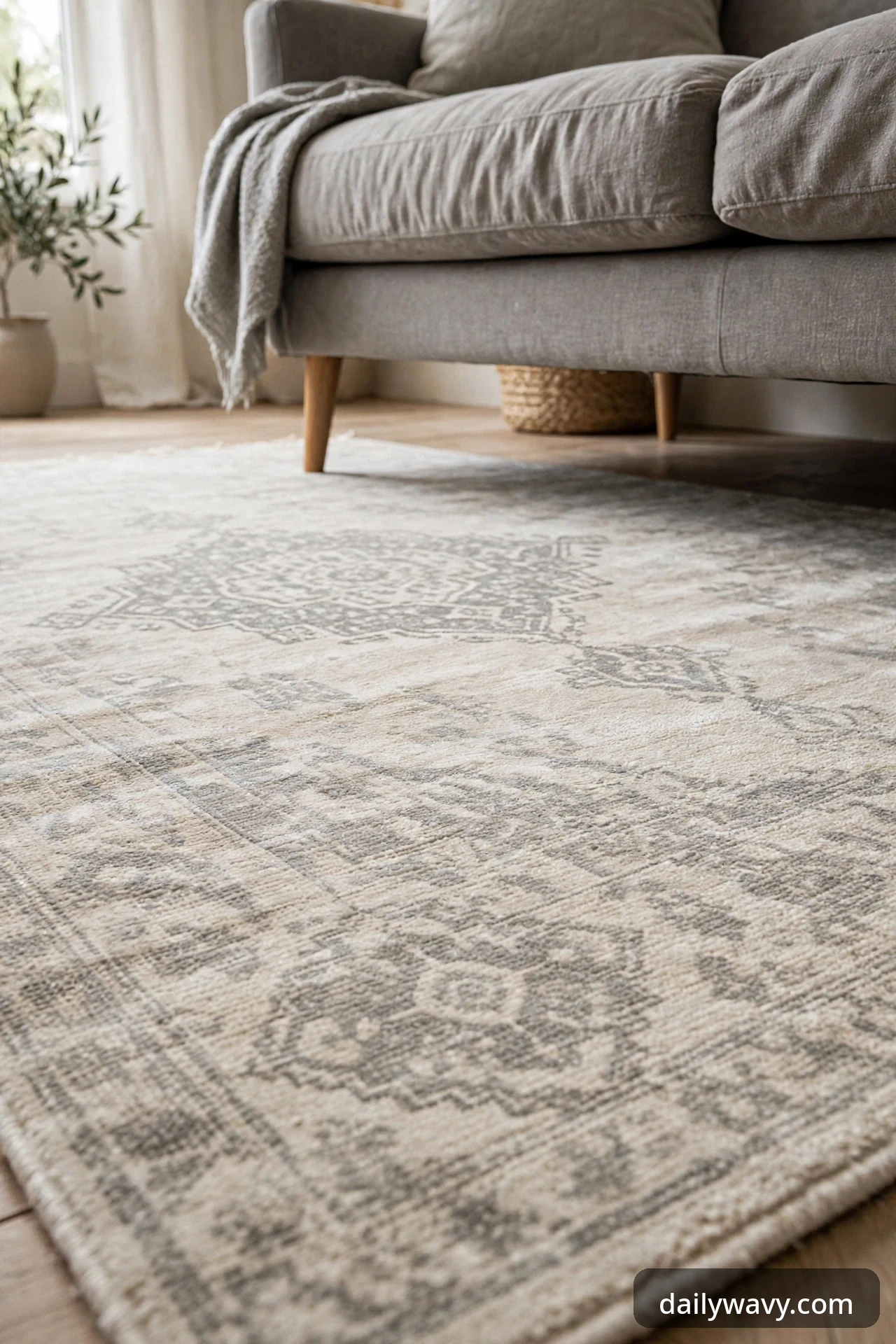
Gray sofas live in real houses, and real houses have pets, kids, and spilled coffee. A washable rug under the seating area removes the anxiety that keeps people from buying a light-colored rug. Modern washable rugs come in a two-part system: a washable top layer and a padded, non-slip base. The top layer goes in the machine, the base stays put.
For a gray sofa, choose a subtle pattern rather than a bold one. The sofa is already a large quiet surface; the rug should support it, not compete with it. A tone-on-tone Persian-style medallion, a soft trellis, or an abstract watercolor wash in grays and creams gives the floor interest without demanding attention. From standing height, a subtle pattern reads almost solid; from the sofa, it adds the texture your feet feel.
Scale follows the same rule as any rug: front legs of the sofa on the rug, 18 inches past each end. An 8 by 10 foot size fits most living rooms. Wash the rug cover every three to six months depending on traffic, and vacuum the base weekly. If the cover fits your machine matters: measure the folded cover against your washer drum before you commit, because an 8 by 10 cover is a heavy load. Front-load washers handle it; small top-loaders with an agitator may not.
12. A linen curtain backdrop
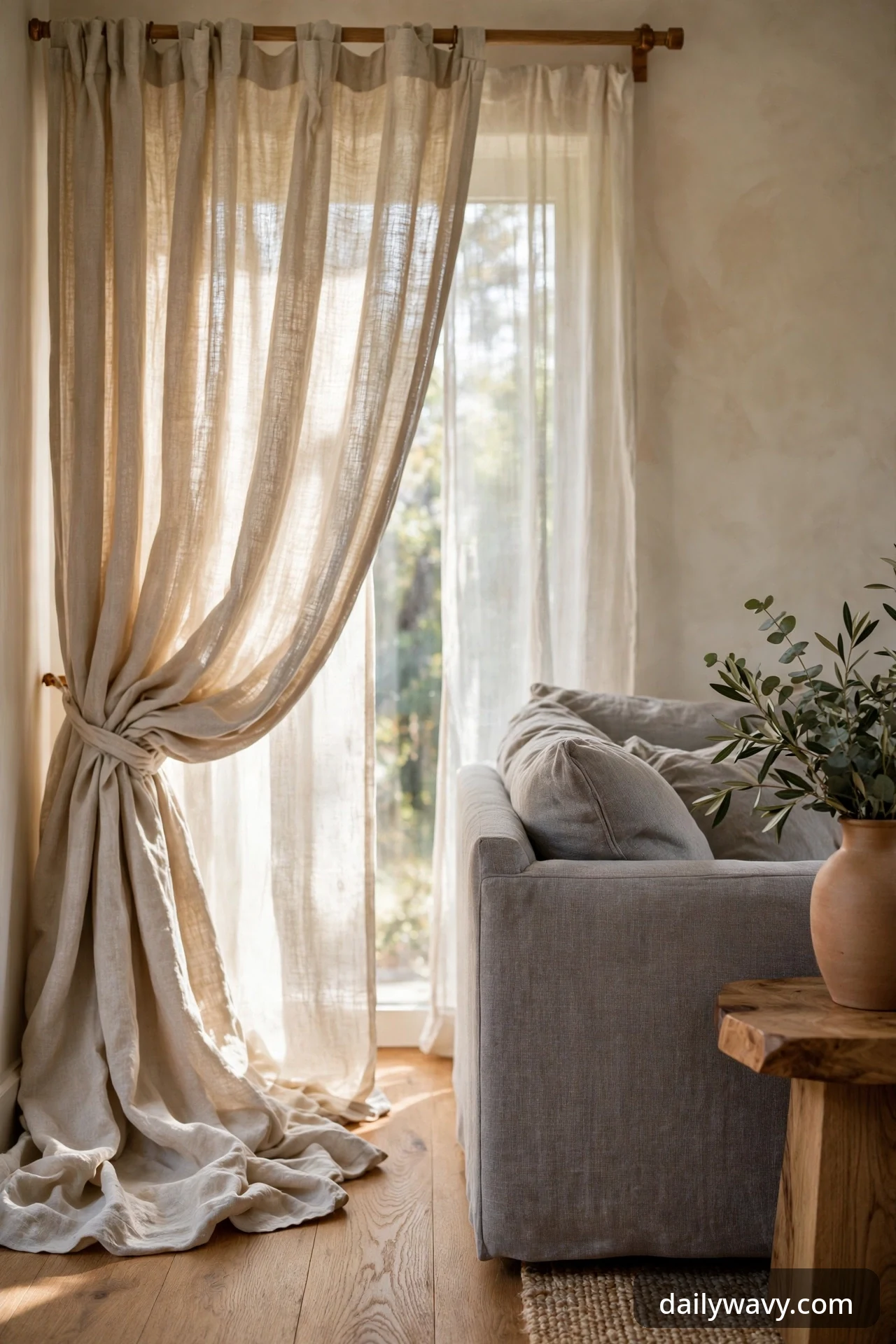
The wall behind or beside a gray sofa often gets ignored, but curtains are one of the biggest textile surfaces in the room. Linen curtains bring a soft, natural backdrop that makes gray upholstery look more expensive than it is. The slight wrinkle and slub of linen reads as relaxed and lived-in, which is exactly the energy a gray sofa needs.
Hang the rod high and wide: 4 to 6 inches above the window frame and 3 to 4 inches past the frame on each side. The curtains should just kiss the floor or puddle very slightly, about an inch. Floor-length linen that stops at the sill usually looks like a mistake. For width, buy panels that are 1.5 to 2 times the window width so the fabric gathers instead of pulling flat.
Color is where this gets strategic. Against a warm gray sofa, choose curtains in oatmeal, flax, or warm white. Against a cool gray, choose a natural linen with a slightly grayer cast, or a soft white. The curtains and the sofa should be in the same color family but not the same exact shade, because identical tones look like you tried to match and missed. Two close but distinct neutrals look intentional. Linen wrinkles are part of the charm; iron the panels once when they go up and then let them be.
13. A vintage trunk used as a table
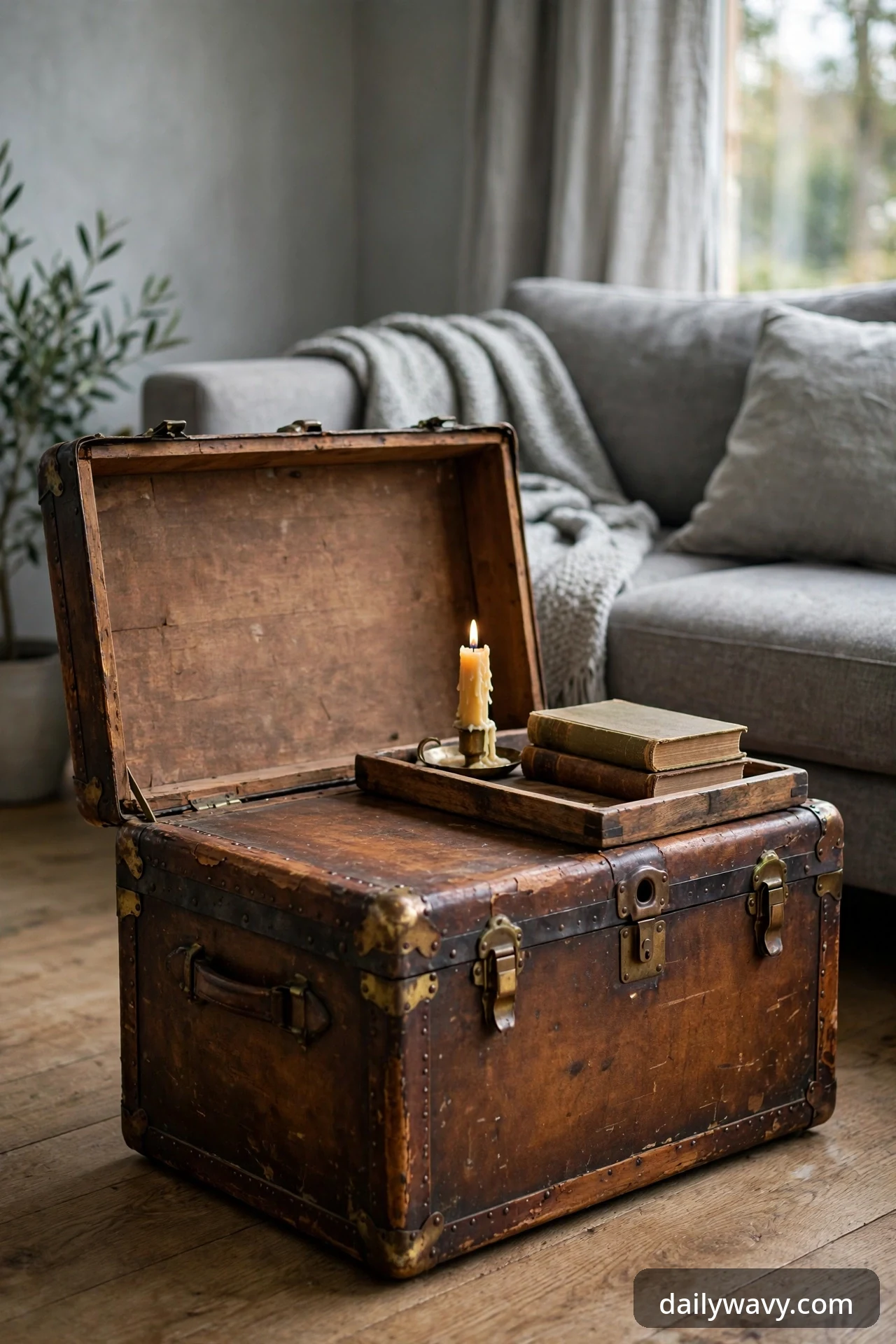
A vintage trunk in front of a gray sofa is storage and sculpture at once. It holds the blankets, board games, and remotes that clutter a coffee table, and its aged surface gives the room a sense of history that a new gray sofa cannot provide on its own. The contrast between old and new is what makes the pairing work.
The trunk should be 30 to 40 inches wide and no taller than 20 inches, so it functions at coffee-table height. The lid must open fully without hitting the sofa; leave 6 to 8 inches of clearance for the lid swing. Check that the trunk is structurally sound: the corners should be tight, the latches should work, and the interior should be clean and dry. Check that the lid has a stay or prop so it cannot slam shut on fingers. Line the inside with cedar blocks or a simple cotton liner if it smells musty; old trunks often do.
Style the top the way you would a coffee table, but lighter. A trunk top is a working surface, so keep it to a tray with a candle and a small stack of books, and leave half the lid clear for actual use. The trunk's hardware, brass corners or leather straps, becomes part of the room's metal story, so it should loosely match or complement your other finishes. One vintage piece per room is a good guideline; two trunks or three vintage pieces tip into a theme.
14. A single sculptural vase on a nearby shelf
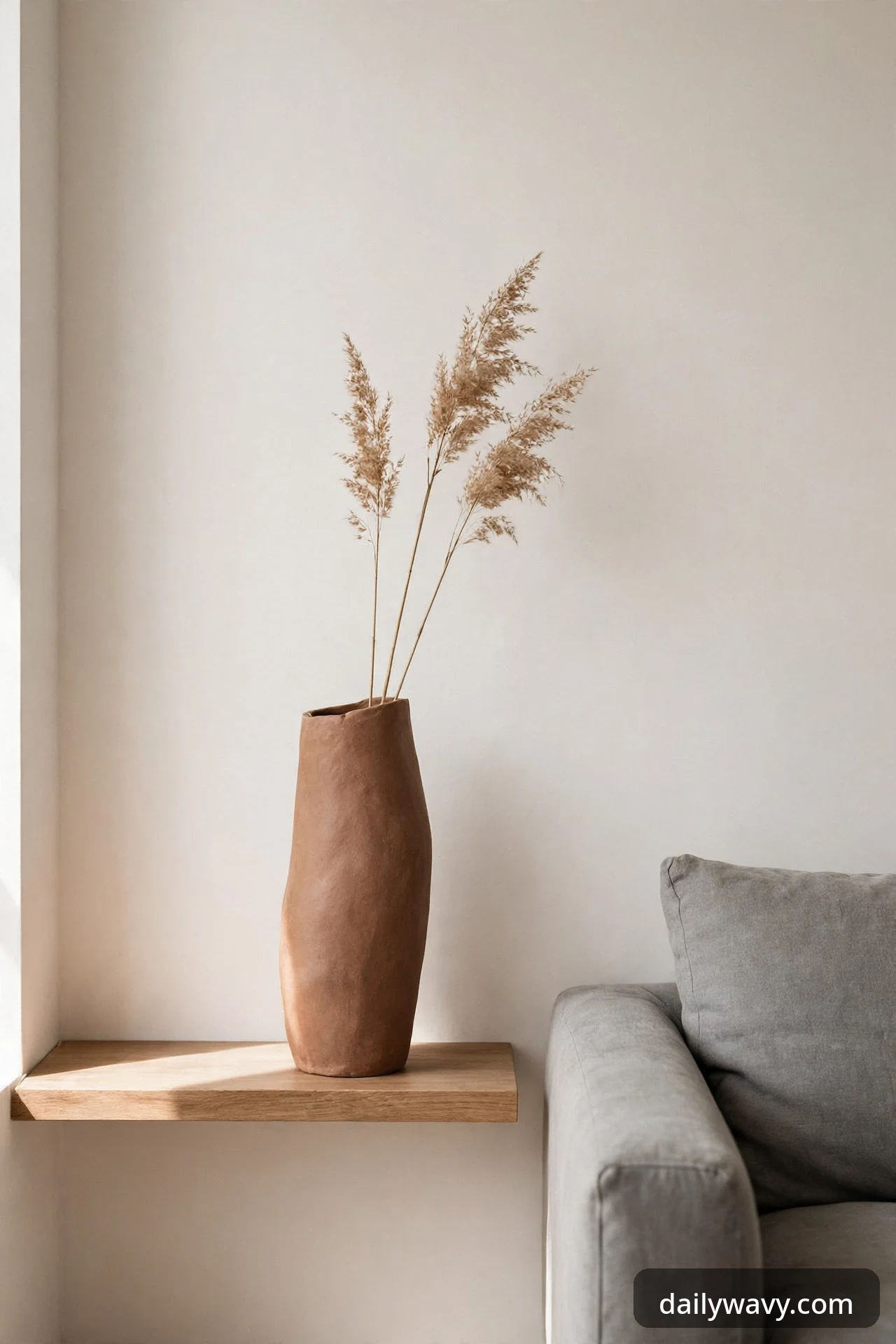
Gray sofas are quiet, and quiet rooms need one object with real presence. A single sculptural vase on a nearby shelf or console gives the eye somewhere to land. The key word is single. Three vases grouped together is a collection; one vase is a statement. A statement is what the gray sofa needs beside it.
Look for a vase with an unusual silhouette: an asymmetric curve, a tall narrow neck, a heavy hand-thrown base. The material can be ceramic, stone, or blown glass in a smoked or amber tone. Against gray, an earthy terracotta or a deep green vase provides the color contrast; a matte black or white vase provides the shape contrast. Either direction works. The vase should be at least 10 inches tall if it sits alone on a shelf; anything smaller disappears at room scale.
Leave it empty, or put in three to five stems of dried grasses or a single branch. Dried elements suit the sculptural approach because they hold their shape; fresh flowers need water changes and a vase this special deserves to look good between flower runs. The shelf itself should be clear around the vase, with 6 to 8 inches of empty space on each side. Negative space is what makes the vase read as sculpture instead of clutter.
15. An upholstered bench facing the sofa

In a larger living room, a bench facing the gray sofa completes the conversation zone without the formality of two facing sofas. It gives the arrangement a second side, which makes the room feel balanced and designed. It also provides flexible seating: two people fit on a 48-inch bench, and it moves easily when the room needs to change.
The bench upholstery should relate to the sofa without copying it. If the sofa is a flat-weave gray, the bench can be a textured bouclé in cream or a velvet in a deep accent color like forest green or navy. Keep the height of the bench seat within 2 inches of the sofa seat height so the two pieces look like they belong together. The bench length should be roughly half to two-thirds the sofa length; a bench as long as the sofa looks like a duplicate, and a very short bench looks stranded.
Place the bench so the distance between the sofa edge and the bench is 30 to 36 inches when no coffee table sits between them. If there is already a coffee table, the bench goes on the far side of it. A bench with a lower shelf or open base keeps the floor visible underneath, which matters in smaller rooms because visible floor reads as more space. Upholstered benches with storage inside are worth considering, but the storage lid must open without hitting the coffee table, so measure the swing before you buy.
16. A tall plant beside the arm
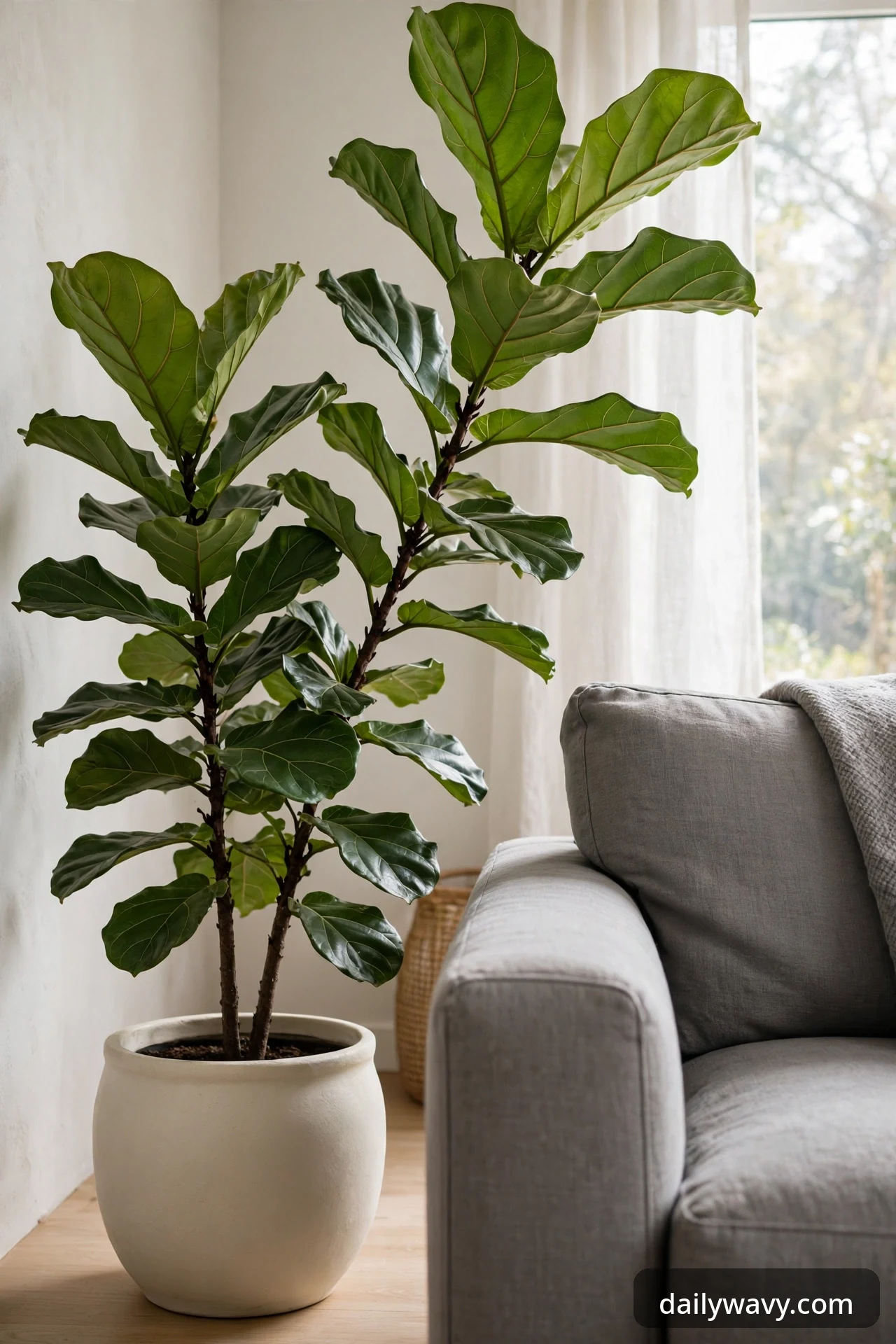
Nothing wakes up a gray sofa faster than green. A tall plant beside the sofa arm adds height, life, and a color that gray cannot produce on its own. The vertical line of the plant balances the horizontal mass of the sofa, and the leaves bring movement to a room full of straight edges.
Choose a plant that fits your light and your habits. A fiddle-leaf fig needs bright indirect light and consistent watering; a snake plant or ZZ plant tolerates low light and neglect. For beside the sofa, the plant should reach 4 to 6 feet at maturity so its canopy clears the sofa arm and meets the wall art zone. A plant that tops out at 3 feet will look like it is hiding; a plant that towers over the sofa looks like it owns the room.
The pot is half the styling. A matte ceramic pot in cream, terracotta, or charcoal grounds the plant and connects it to the room's palette. The pot should have a saucer or a waterproof liner, because water on hardwood or carpet is a real problem next to a sofa. Place the plant 6 to 12 inches from the arm, close enough to feel part of the arrangement but far enough that leaves do not brush the upholstery. Rotate the plant a quarter turn every two weeks so it grows evenly instead of leaning toward the window.
17. A rug layered over a plain natural-fiber rug
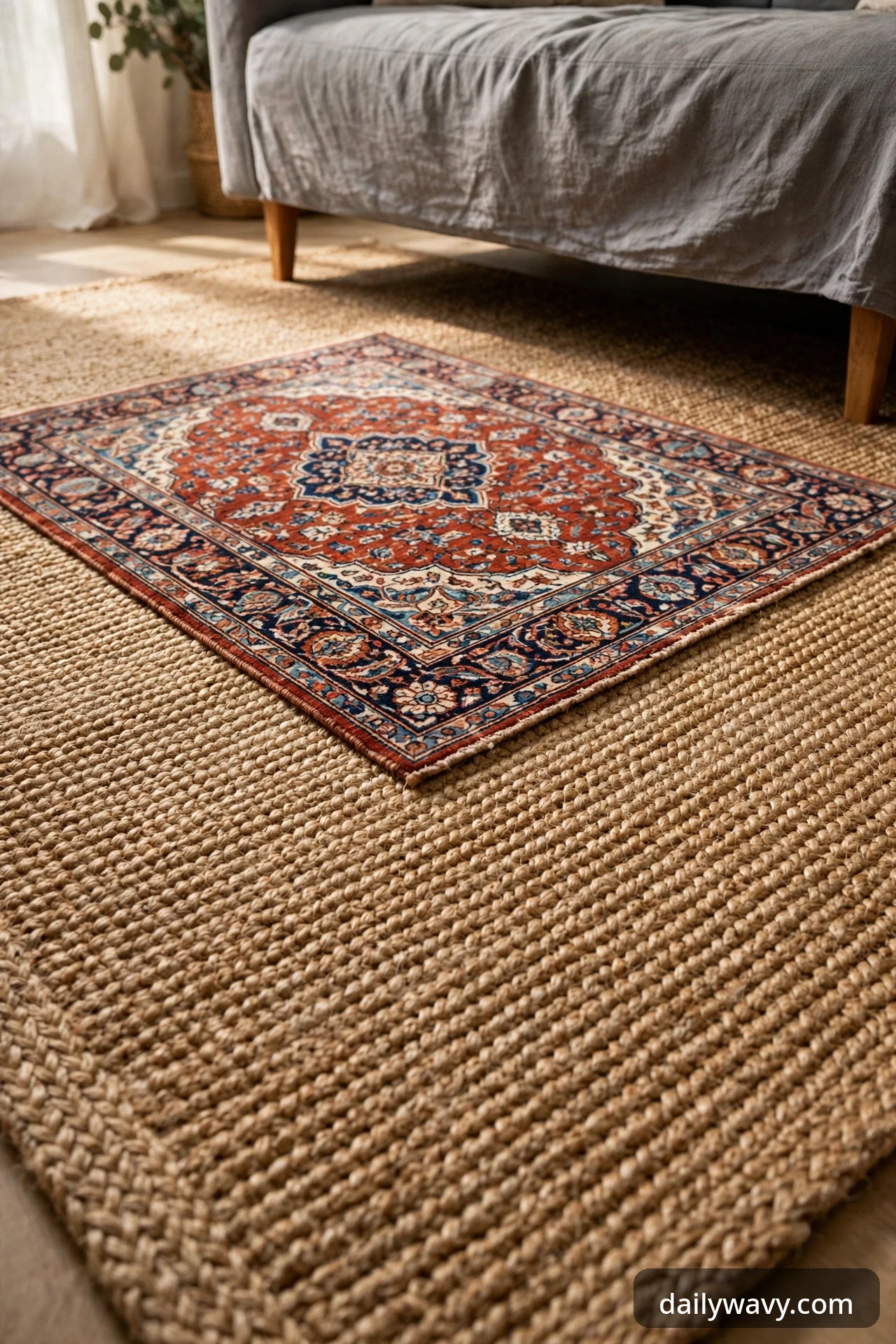
Layering a smaller patterned rug over a large natural-fiber rug is the designer's shortcut to a collected, textured floor. The base rug, usually jute, sisal, or a flat cotton weave, covers the room at a low price and adds organic texture. The top rug brings the pattern and color that the gray sofa needs beneath it.
The base rug should be large: 9 by 12 feet in a living room, or at least an 8 by 10. It should sit flat and tight to the floor with no curling edges, which means a bound or finished edge rather than a raw one. The top rug goes centered under the seating group, rotated to the same orientation as the base, and should be about two-thirds the size of the base so 12 to 18 inches of the natural fiber shows on all sides. That visible border is the whole point; it frames the patterned rug like a mat frames a print.
For a gray sofa, the top rug can carry more color than a standalone rug because the base rug calms it down. A vintage-style Persian with rust and navy, a Moroccan trellis in cream and gray, or an abstract with warm neutrals all work. Keep the top rug low-pile, under half an inch, so the two layers sit stable and chairs or ottomans do not wobble. Use a rug pad under the top layer, not just under the base, to prevent the layers from slipping against each other.
18. Textured cushions with a plain throw
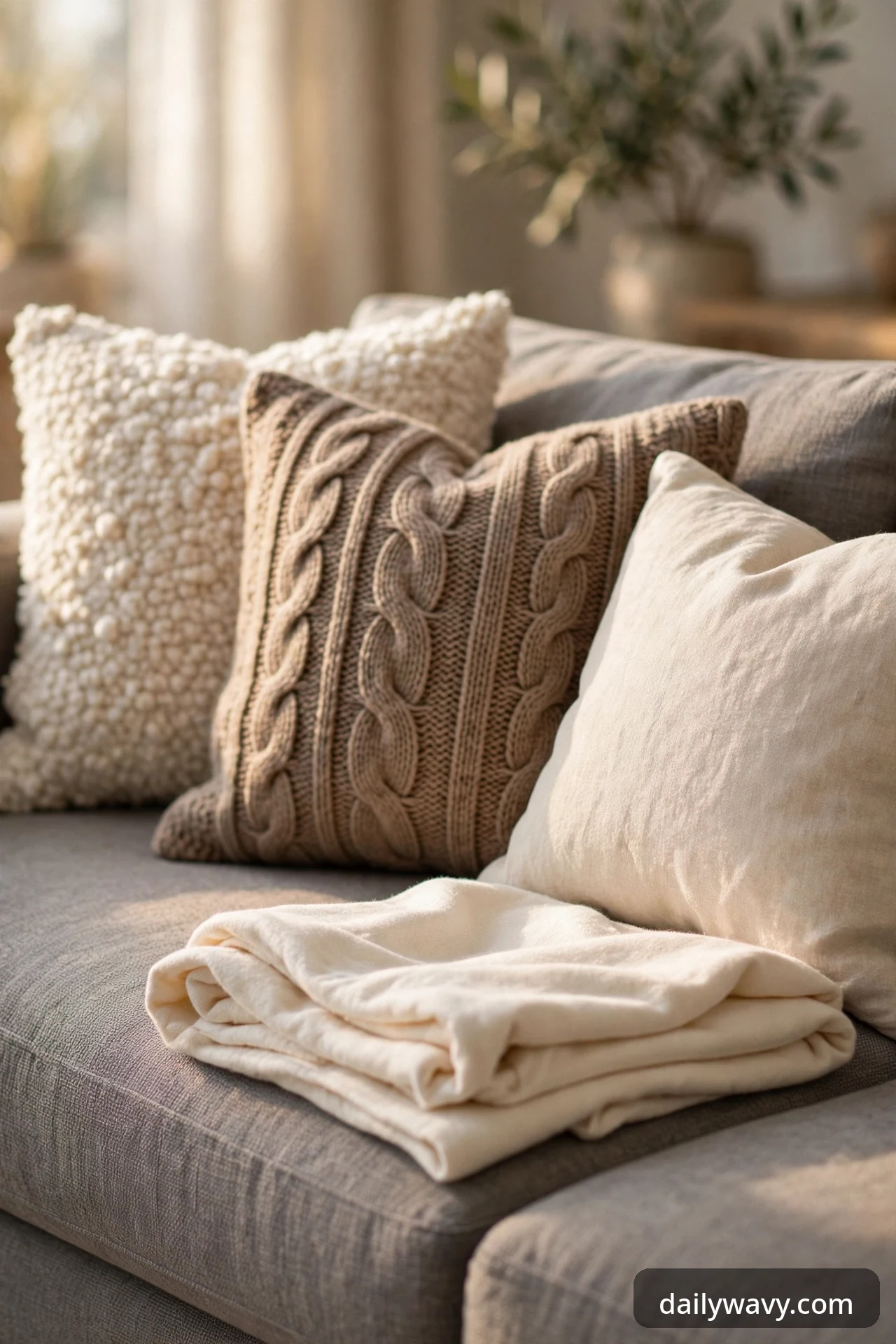
This is the pillow formula for people who find patterns tiring. Instead of prints and stripes, the sofa gets texture: bouclé, cable knit, quilted cotton, raw linen, nubby wool. The cushions all stay in one calm palette, creams, grays, warm taupes, and the interest comes from how the fabrics catch the light differently. A plain throw over one arm or folded on one seat adds the last layer.
Mix at least three textures. A bouclé pillow next to a smooth linen pillow next to a chunky knit creates a surface you want to touch, which is the entire goal. Keep the color range tight: all the pillows should sit within two or three steps of each other on the neutral scale. The moment one pillow goes bold, the formula breaks and you are back to pattern mixing.
The plain throw should be the softest thing in the room: a washed linen, a fine merino, or a lightweight cashmere blend. Fold it in thirds lengthwise and lay it across one sofa cushion, or drape it over the arm on the side away from the reading lamp. The throw's job is to invite, not to decorate, so it should look touchable rather than arranged. Washable covers are well worth prioritizing here because textured fabrics show wear faster than smooth ones; check the cleaning code on every tag before you buy.
19. A tonal rug anchoring the sofa

A tonal rug is the minimalist answer to the gray sofa question. The rug stays in the same color family as the sofa, gray on gray, or gray with greige, and the room's color comes entirely from the pillows, art, and objects. This works because it makes the seating area feel like one continuous, calm zone, and the accent colors elsewhere pop harder against the quiet background.
The risk with tonal rugs is flatness, so texture has to do the work. A high-low pile, a subtle Moroccan trellis in tone-on-tone, or a hand-knotted wool with visible weave variation all give the eye something to find without introducing new colors. The rug should be one to two shades different from the sofa, not identical. An identical match looks like an accident; a close-but-different tone looks deliberate.
Scale is the same as ever: front legs on the rug, 18 inches past each end, 8 by 10 for most rooms. But with a tonal rug, the border and the edge matter more, because there is no pattern to hide a thin or curling edge. Choose a rug with a finished, substantial edge, and use a thick rug pad underneath. The pad adds the plushness underfoot that a flat tonal rug can lack, and it keeps the rug from creeping on hard floors.
20. A contrasting wood coffee table
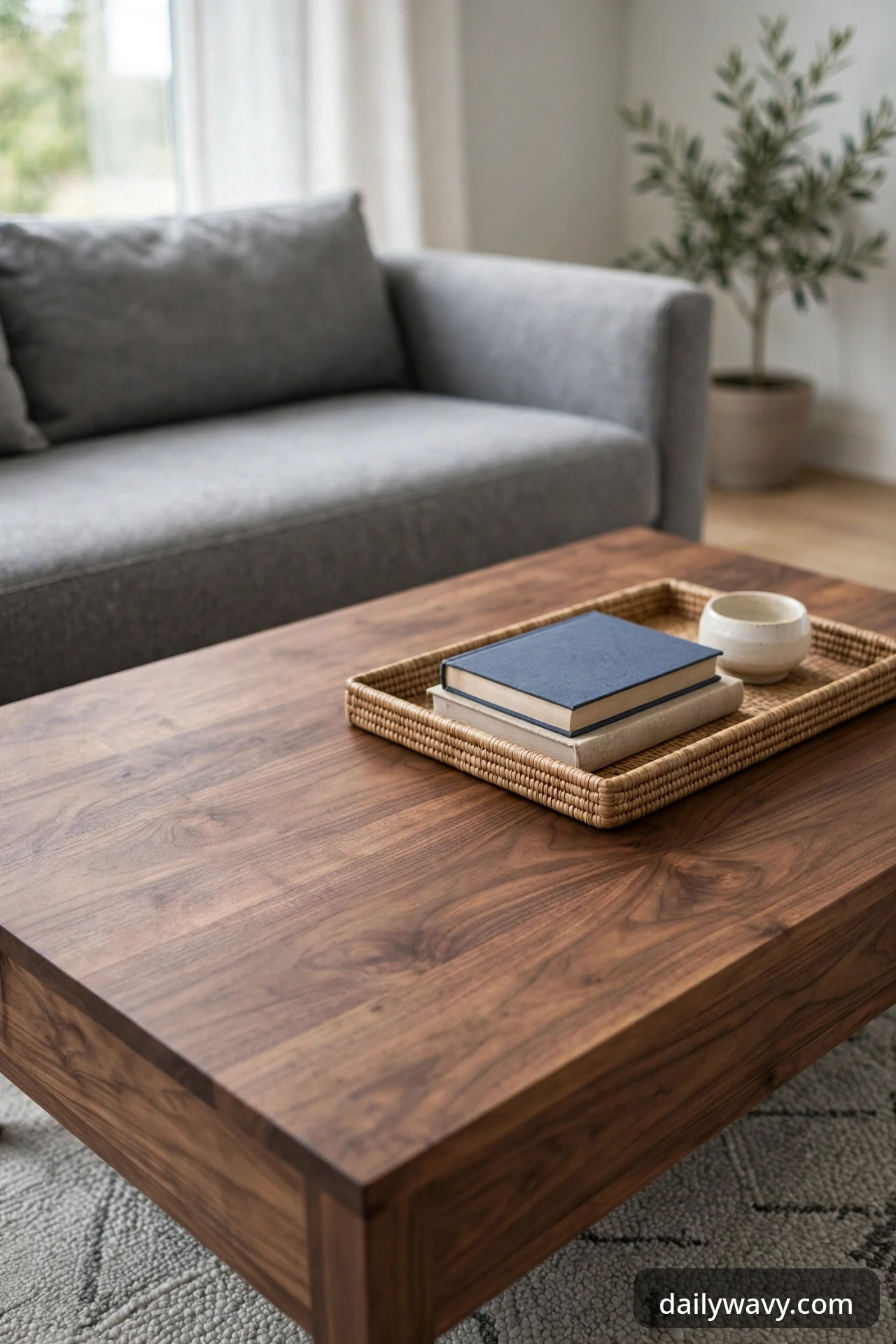
A gray sofa next to a gray coffee table or a glass table can feel cold and unfinished. Wood fixes it. A coffee table in a contrasting wood tone, warm walnut against cool gray, or pale oak against warm gray, adds the organic warmth that balances the sofa's neutrality. The grain of real wood gives the room a natural pattern that no fabric can.
The contrast should be real but not extreme. Medium walnut, honey oak, or a warm acacia all have enough color to stand out against gray without shouting. Avoid very dark espresso, which can look heavy next to a light gray sofa, and avoid gray-washed wood, which repeats the sofa instead of contrasting it. The table's finish should be matte or satin; high-gloss wood looks formal and shows every fingerprint.
Size the table to the sofa: the length should be about two-thirds the sofa length, and the height should be within 2 inches of the seat height, usually 16 to 18 inches. There should be 14 to 18 inches between the table edge and the sofa, close enough to set down a mug without leaning. Style the top with a low tray, a stack of two or three books, and one object, and keep half the surface clear for daily use. A coffee table that cannot hold four mugs and a snack plate is failing at its job.
Frequently asked questions
What colors go best with a gray sofa?
Gray pairs with almost everything, but the strongest partners are the ones with enough saturation to give the gray context. Warm options include terracotta, mustard, camel, olive, and rust. Cool options include navy, forest green, dusty blue, and charcoal. White and cream almost always work as the lightener. The gray's undertone should guide you: warm grays suit warm partners, cool grays suit cool partners, and true grays take either.
Should my pillows match my gray sofa or contrast it?
Contrast is the stronger choice. Pillows in the same gray as the sofa disappear into it and make the seating look like one big cushion. Aim for pillows that are at least two shades lighter or darker than the sofa, or in a clear accent color. The strongest arrangements combine both: one or two light neutrals and one or two saturated accents.
How do I tell if my gray sofa is warm or cool?
Hold a sheet of white paper against the fabric in daylight. If the gray looks brownish, greenish, or taupe next to the paper, it is warm. If it looks blue or icy, it is cool. If it stays stubbornly neutral, it is a true gray. This one test answers most styling questions, because warm grays and cool grays want different partners.
What size rug should go under a gray sofa?
The front legs of the sofa should sit on the rug, and the rug should extend at least 18 inches past each end. For most living rooms, that means an 8 by 10 foot rug. In smaller rooms, a 6 by 9 works if the front legs still land on it. Layering a smaller patterned rug over a large natural-fiber rug is a good way to get the scale right on a budget.
Can I mix warm and cool tones around a gray sofa?
Yes, but keep one temperature dominant. A cool gray sofa with mostly cool pillows and one warm wood table looks collected. A room that splits evenly between warm and cool with no clear leader looks undecided. Pick the temperature that matches your gray, then let the other one appear in small doses: a wood table, a brass lamp, a single warm throw.
Are washable rugs worth it?
For high-traffic living rooms, yes. A two-part washable rug with a machine-washable cover and a non-slip base holds up well and removes the fear of spills. Vacuum regularly and wash the cover every three to six months. Check that the cover fits your washer before buying, because a full-size rug cover is a heavy load.
Closing
A gray sofa is a quiet commitment to flexibility. None of these twenty ideas requires replacing it. Each one changes what the gray means: warmer with wood and terracotta, crisper with navy and white, softer with linen and bouclé, livelier with plants and art. Start with the room's light and your sofa's undertone, get the rug scale and pillow sizing right, and then layer in the textures that make you want to sit down.
If you are styling the rest of the room to match, our Home & Decor ideas have more room-by-room guides, and the narrow living room layout ideas cover the same scale and spacing rules for tighter spaces. Save the ideas you like, change one thing this weekend, and let the gray do the rest.