
10 Closet Office Ideas for a Thoughtful Work Area
There is a particular satisfaction in closing a closet door at the end of the workday and watching your office…
There is a particular satisfaction in closing a closet door at the end of the workday and watching your office disappear. A closet office, the much-loved cloffice, asks very little of your home: a few feet of width, a door you already own, and the willingness to treat a storage nook like a real workspace. These ten ideas keep the setup honest. Together they respect the actual dimensions of a reach-in closet, manage glare and cables instead of ignoring them, and leave you enough legroom to sit comfortably for a full workday. Pick the ideas that fit your space, measure twice, and build a work area that earns its keep.
In This Guide
- A Laptop Stand With A Separate Keyboard
- A Basket For Spare Equipment
- A Simple Curtain Managing Window Glare
- A Narrow Bookcase At The Side
- A Neutral Desk Mat
- A Closed Box For Chargers
- An Adjustable Task Chair With Clear Legroom
- A Small Movable Side Cart
- A Dedicated Charging Corner
- A Restrained Two-Color Accessory Palette
The Closet Office Rules Before You Measure Anything
A closet is a small box with a door, which makes it wonderfully simple to plan and wonderfully easy to get wrong. Before you buy a single thing, take honest measurements. A standard reach-in closet is about 24 inches deep and anywhere from 4 to 8 feet wide. That depth is the number that decides everything. A desk surface 20 to 24 inches deep fits, but it leaves almost no margin behind it, so every item you place has to justify its footprint.
Light comes next. Most closets were never wired for work. If yours has no window and no fixture, plan a real task light before you plan furniture. A warm-to-neutral lamp in the 2700K to 4000K range, aimed at the desk rather than at your eyes, makes the space feel like a room instead of a cupboard. If the closet does have a window, or faces one across the room, glare becomes the problem to solve rather than darkness.
Cables need a route, not a wish. Find the nearest outlet before you commit to a layout, because a closet office lives or dies on whether power reaches the desk cleanly. Heat matters too. Laptops and chargers warm a small enclosed space faster than you expect, so leave the door open during long sessions or crack it a few inches. And be honest about storage: the clothes and boxes currently living in that closet need a real new home, not a pile on the guest bed. Our guide to small pantry organization shows how the same zone-and-label thinking rescues cramped storage anywhere in the house.
Finally, keep the chair honest. You need roughly 24 to 30 inches of knee clearance under the desk and enough room to pull the chair out and sit down without a shuffle. A pretty chair that you cannot sit in properly is not a workspace, it is a photograph. A comfortable setup also does not cure anything; if long hours at a desk leave you sore, that is a conversation for a professional, not a decor project.
1. A Laptop Stand With A Separate Keyboard
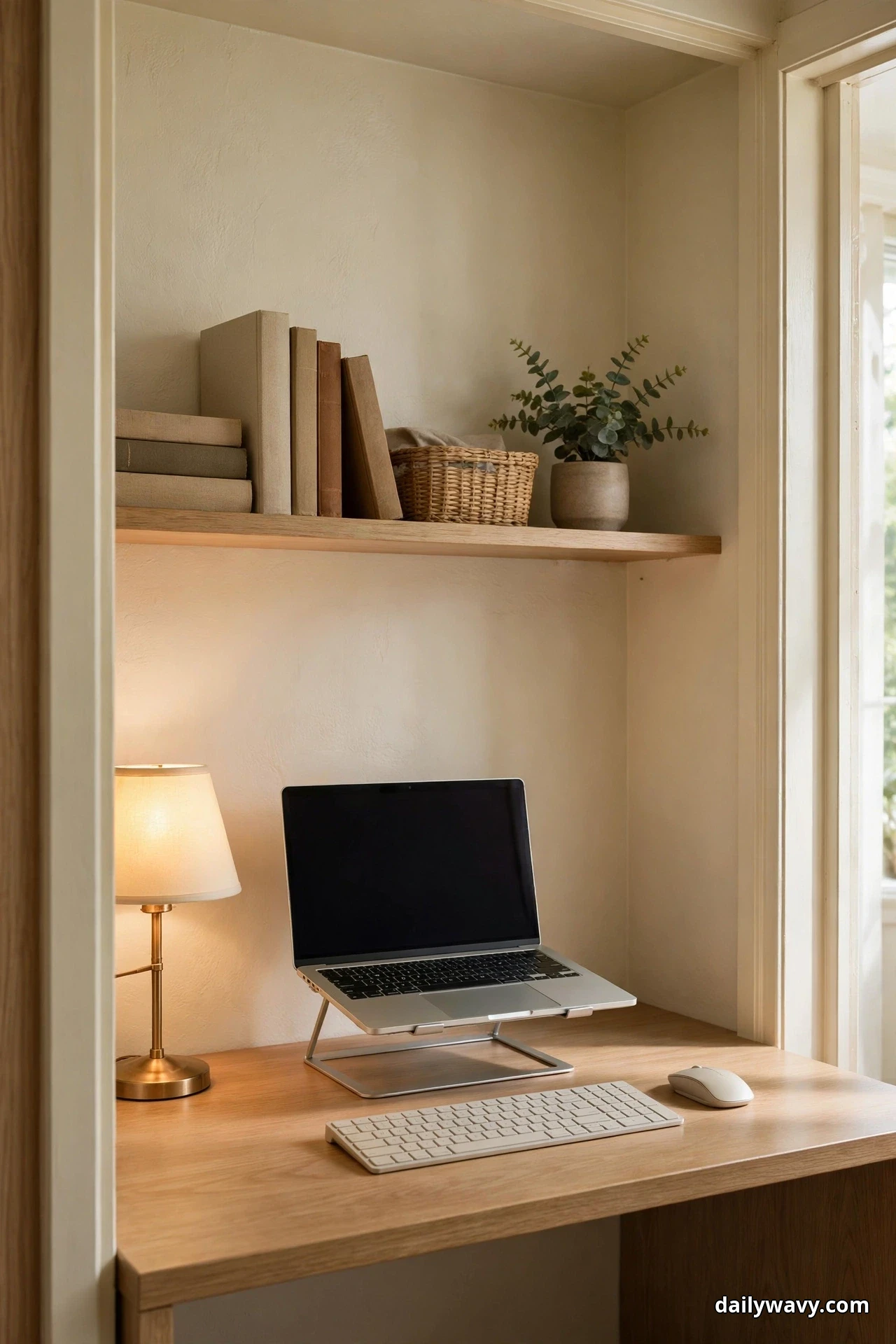
The single most effective upgrade in a closet office is also the simplest: lift the laptop and type on something else. A stand raises the screen closer to eye level, which matters enormously when your desk is only 20 inches deep and you cannot push the screen back. A separate keyboard and mouse then sit at the desk edge, where your hands naturally fall. The whole arrangement buys you posture and screen distance without buying a single extra inch of space.
What to measure: the width of your desk surface and the height from the desk to the closet shelf or rod above. Most laptop stands add 4 to 6 inches of height. Make sure the raised screen still clears anything mounted above it, and that the stand’s footprint, usually about 9 by 11 inches, leaves room for the keyboard in front.
How to do it: center the stand on the desk, angle the laptop screen slightly back, and place the keyboard so your wrists stay straight with elbows near your sides. Keep a small book or riser nearby at first; some people prefer the laptop one notch lower, and you will only know after a day of real work.
Good to know: if you use a separate monitor later, the same stand can hold the laptop off to the side as a second screen, which is exactly how this idea grows with you.
2. A Basket For Spare Equipment
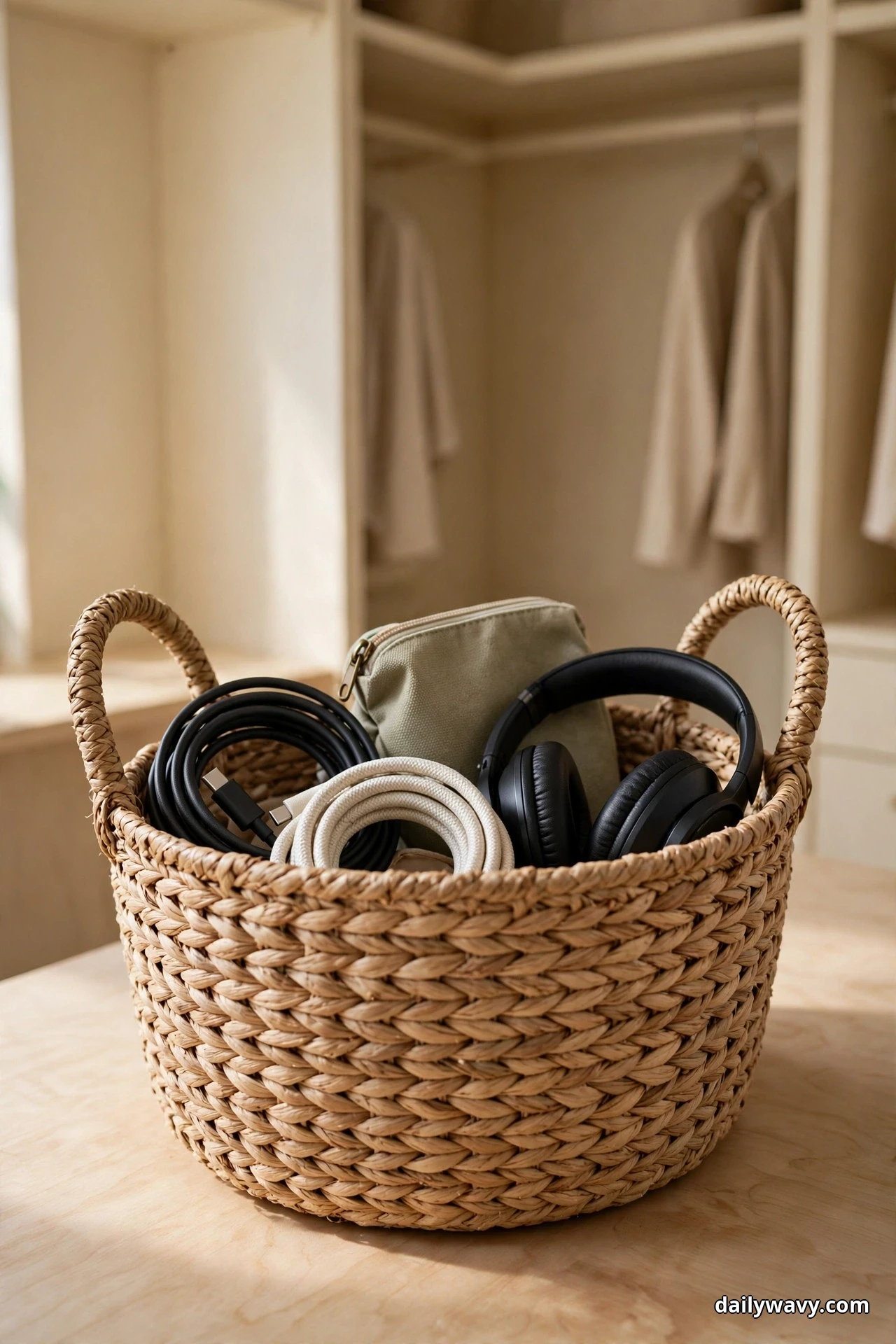
Closet offices collect spare equipment the way desks collect paper: a headset, a backup drive, a tangle of dongles, the microphone you use twice a month. A single basket, kept on the desk or on a shelf above it, gives all of it one address. The trick is restraint. One basket, not three, and nothing in it that you have not touched in a month.
What to measure: the shelf or desk corner where the basket will live. A basket around 10 to 12 inches wide and 6 to 8 inches tall fits most spare gear without swallowing the desk. Measure the depth too; a deep closet shelf can hide a basket entirely, so pull it forward to the shelf edge where you can see inside.
How to do it: choose a basket with handles and a weave tight enough that small items do not slip through. Group the spares by type before they go in, cables coiled and secured with a simple tie, small items in a pouch inside the basket. Label nothing; you will remember what is in one basket.
Good to know: natural fibers like seagrass or cotton rope suit the warm-neutral palette, and they forgive the dust that closets collect. The same single-basket discipline works in tight bathrooms too, as our small bathroom storage ideas show.
3. A Simple Curtain Managing Window Glare

Glare is the quiet saboteur of the closet office. The screen sits close to your face, the walls are close on three sides, and any window light, whether inside the closet or opposite its open door, bounces straight into your eyes. A simple curtain solves it without a renovation. Mount it at the closet opening if there is a window behind you, or at the room window if the glare comes from across the room.
What to measure: the window or opening the curtain will cover, plus the drop. A curtain that just covers the glass is enough; you are filtering light, not blacking out a bedroom. For a closet doorway, measure the full opening width and add a few inches per side so light does not leak around the edges.
How to do it: a tension rod inside the closet doorway needs no drilling and holds a light linen panel perfectly. At a room window, a simple rod with a light-filtering curtain softens the light while keeping the room bright. Choose a warm white or natural linen; heavy dark curtains make a small office feel like a cave.
Good to know: position the curtain so you can adjust it through the day. Morning sun and afternoon sun hit differently, and a curtain you never touch is decoration, not a solution.
4. A Narrow Bookcase At The Side

One narrow bookcase turns a closet desk into a complete workstation. It holds the reference books, the notebooks, the printer paper, and the small supplies that would otherwise colonize the desk surface. Placed at the side of the desk, it keeps everything within arm’s reach without stealing legroom.
What to measure: the gap beside the desk, and the depth of the bookcase. A unit 10 to 12 inches deep and 12 to 18 inches wide slides into most reach-in closets alongside a desk. Check the height against the closet’s hanging rod or shelf; you want the top of the bookcase clear for a plant or a lamp.
How to do it: face the bookcase outward if the closet is deep enough to walk into, or angle it slightly toward the desk chair so the spines face you. Anchor tall units to the wall with a simple anti-tip strap, closets are small and a tipping bookcase has nowhere safe to fall. Keep the heaviest books on the lowest shelf.
Good to know: a bookcase with a few closed cubbies at the bottom hides the unpretty supplies and keeps the visible shelves calm. Restraint on the shelves is the whole point; a bookcase crammed edge to edge reads as storage, not as an office.
5. A Neutral Desk Mat
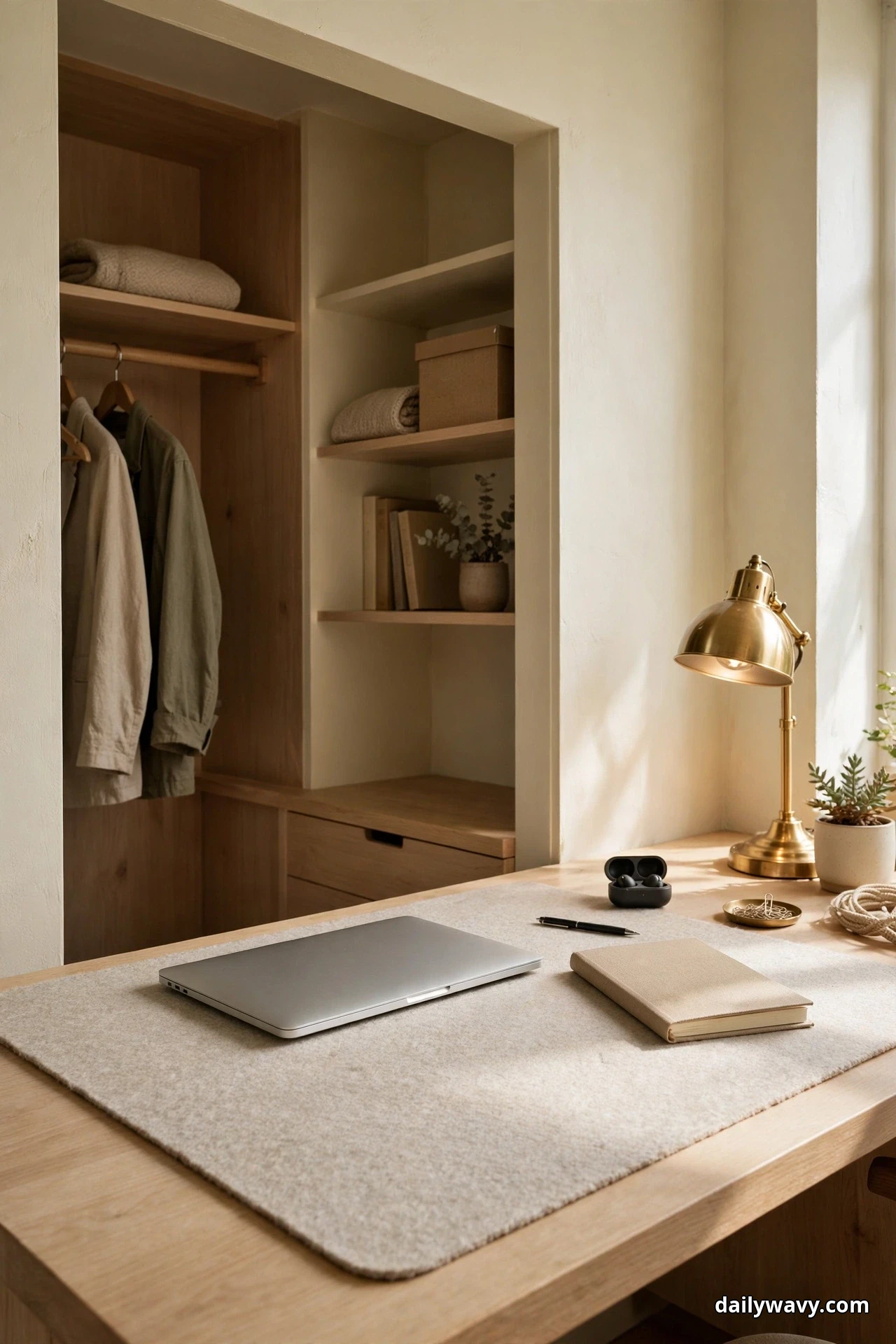
A desk mat is the fastest way to make a closet desk feel intentional. It defines the work zone on a surface that might otherwise be a bare board or a repurposed shelf, protects the finish from keyboard scratches and coffee rings, and gives the mouse a smooth, consistent surface. In neutral tones it also quiets the visual noise of cables and devices.
What to measure: the desk surface. A mat around 24 by 14 inches suits a laptop plus a separate keyboard and mouse; larger mats, 31 by 15 inches, work if the desk runs the full closet width. Leave a few inches of bare desk at the back for cable routing.
How to do it: lay the mat centered on the keyboard zone, not centered on the desk. Your hands should rest fully on the mat with the keyboard near its front edge. Leather, cork, or felt mats all work; choose a warm neutral, tan, oatmeal, or soft gray, that sits quietly against the desk.
Good to know: a mat with a slight texture keeps a laptop stand from sliding and muffles the small sounds of typing that echo in a hard-walled closet. It is a small comfort that pays off every single day.
6. A Closed Box For Chargers

Chargers are the visual static of every home office, and in a closet there is nowhere for them to hide. A closed box with cable slots corrals the power strip, the laptop brick, and the phone charger into one contained unit. The desk reads clean, the floor stays clear, and you stop kicking a tangle of cables every time you sit down.
What to measure: the power strip and the largest charger brick. The box needs to swallow both with the lid closed, so measure the strip’s length and add an inch. Ventilation slots matter; chargers generate heat, and a sealed box in a small closet is a bad idea.
How to do it: place the box at the back corner of the desk or on the floor just beside the desk leg, wherever the outlet is closest. Thread cables through the slots, coil the excess inside, and label nothing. One cable out to the laptop, one to the phone, everything else stays inside.
Good to know: choose a box in wood, woven fiber, or matte ceramic rather than glossy plastic. It sits in your sightline all day, and a calm material makes the whole desk feel calmer. Check the box stays cool during a long workday; if it runs warm, leave the lid ajar.
7. An Adjustable Task Chair With Clear Legroom
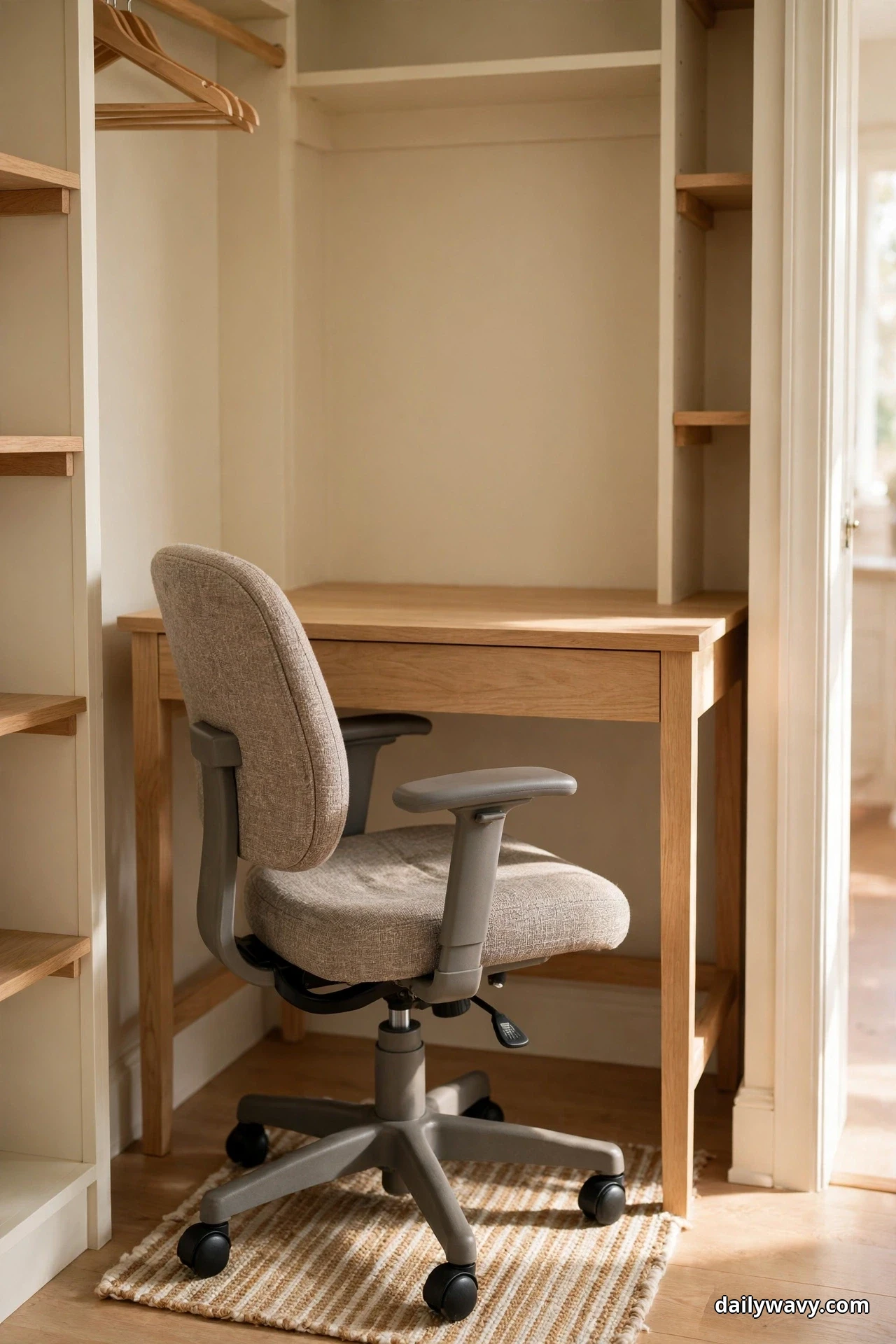
The chair is where closet offices most often fail, because a beautiful small chair that cannot adjust is a decoration you sit on. An adjustable task chair, one with seat height and a back that actually supports you, is worth the floor space it takes. The key is choosing a compact model and then protecting its legroom fiercely: no boxes under the desk, no cables across the footwell.
What to measure: the knee space under the desk, front to back, and the width you have to pull the chair out. You want at least 24 inches of clear depth for your knees and enough room to roll back without hitting the opposite wall or door. Measure with the desk in place, not from memory.
How to do it: set the seat height so your feet rest flat and your knees sit roughly level with your hips, then adjust the desk accessories to meet you, not the other way around. Keep the area under the desk completely clear; in a 24-inch-deep closet, even a small footstool or bag steals space your legs need.
Good to know: a chair with a five-star base rolls and swivels, which helps enormously in a tight space, but check the base diameter against your measured floor area. And remember the honest limit: a good chair supports comfort, it does not fix pain. Persistent discomfort deserves professional advice, not new furniture.
8. A Small Movable Side Cart
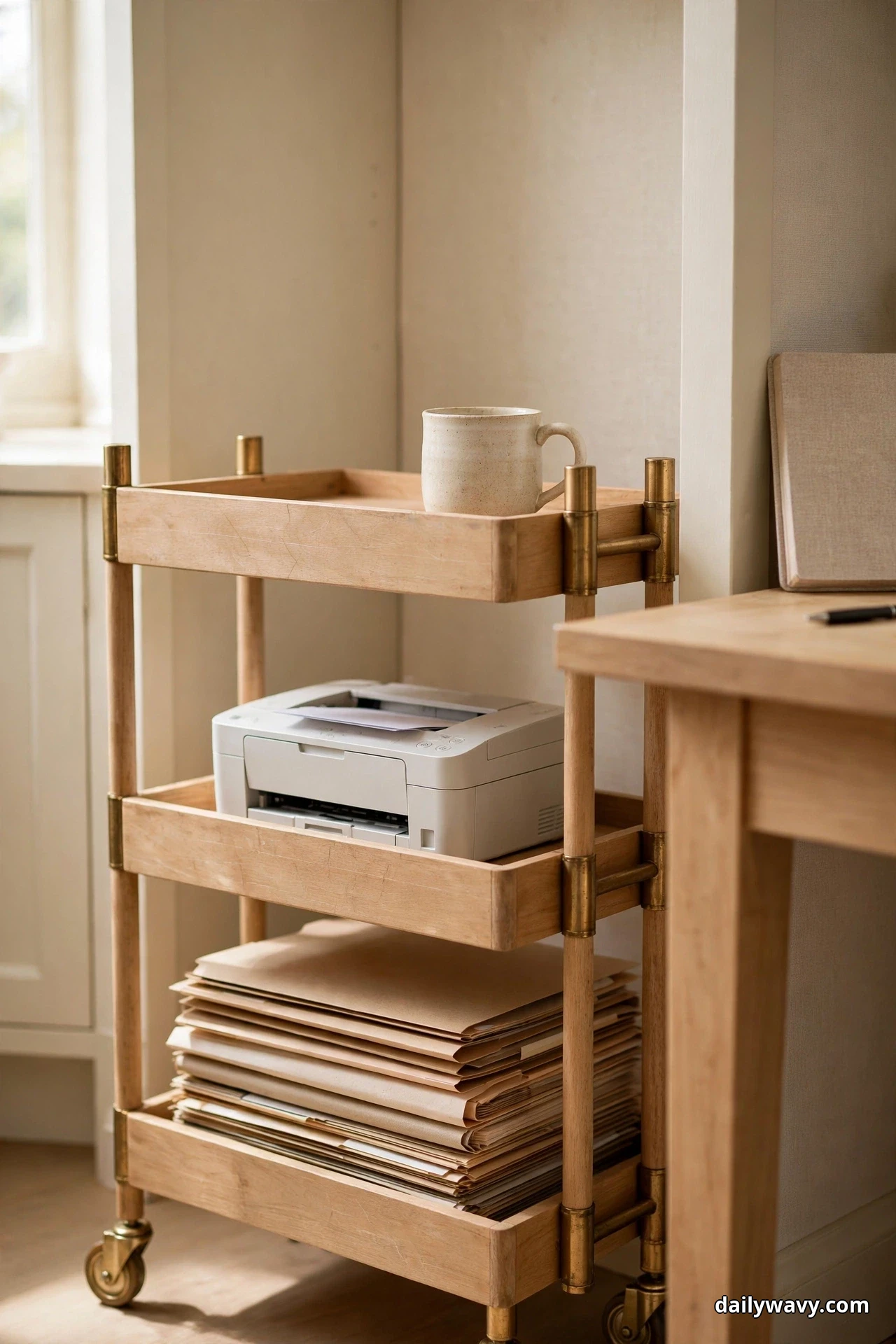
A small rolling cart is the closet office’s extra pair of hands. It holds the printer, the current project’s folders, or the tea tray, and it rolls out of the way when you need the floor space. Because it moves, it never permanently commits a single square inch, which is exactly the flexibility a tiny workspace needs.
What to measure: the cart’s footprint and the clear floor in front of the closet. A three-tier cart around 15 by 12 inches tucks beside most desks or parks just outside the closet doorway during work hours. Measure door swing too; a cart parked in a door’s path will drive you mad within a week.
How to do it: assign each tier a job: top for active work, middle for supplies, bottom for the things you reach for least. Lock the casters when it is parked beside the desk so it does not drift. When the workday ends, roll it inside and close the door, the whole office vanishes.
Good to know: a cart in a warm metal or light wood finish doubles as a style piece, and the same roll-it-away logic suits any tight layout. Our narrow living room layout ideas use the same principle of furniture that moves instead of fights the floor plan.
9. A Dedicated Charging Corner
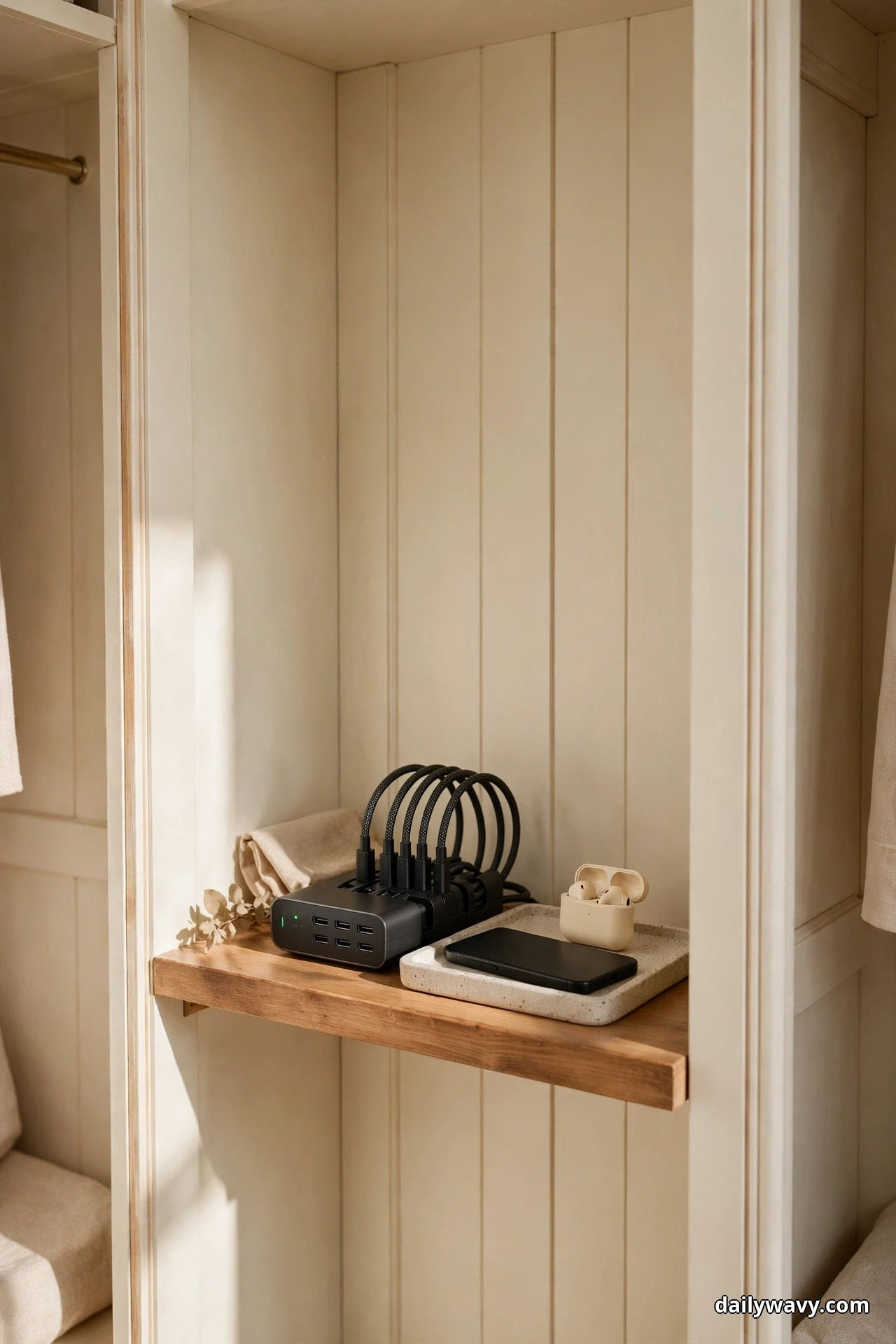
A charging corner is a small, deliberate station where every device lands at the end of the day: phone, earbuds, watch, and the laptop itself. Giving charging one fixed spot ends the nightly hunt for cables and keeps devices off the work surface during the day, which is half the battle in a 20-inch-deep desk.
What to measure: one corner of the desk or one shelf, about 12 inches square. That is enough for a small multi-device stand or a simple tray with short cables. Measure the distance to the outlet; short, right-sized cables are the difference between a tidy corner and a new tangle.
How to do it: mount a small shelf or place a tray in the chosen corner, run one power strip or multi-port charger to it, and use the shortest cables that comfortably reach. Keep only the devices you charge daily here; the spare cables live in the basket from idea 2, not in this corner.
Good to know: charge overnight with the closet door open a crack if the space runs warm, and unplug what is fully charged. A charging corner is a habit more than a purchase, and the habit is what keeps the desk clear.
10. A Restrained Two-Color Accessory Palette
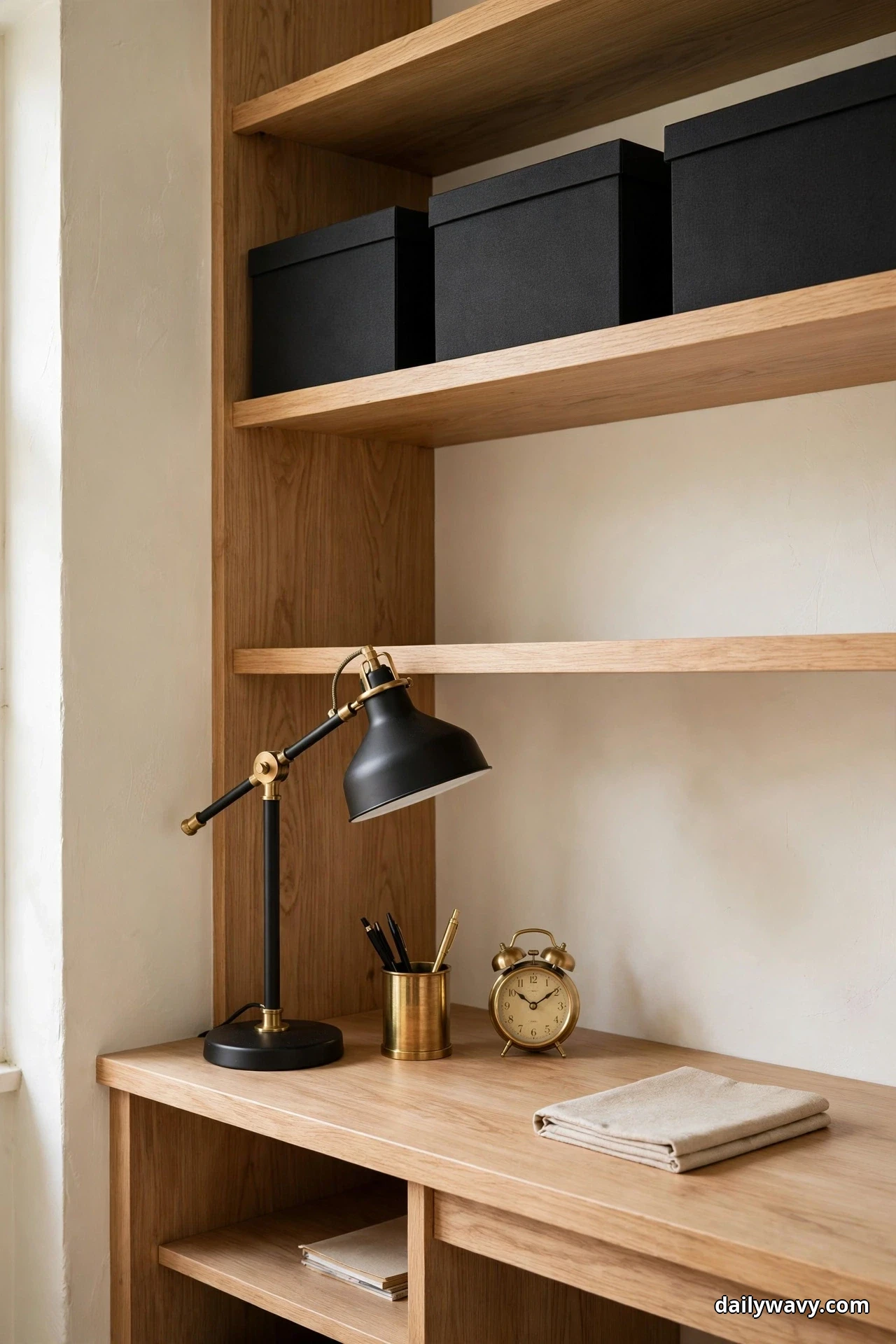
In a space this small, every object is on display, which means every color is on display too. Limiting accessories to two colors, layered over warm neutrals, is what makes a closet office look designed rather than improvised. Think matte black with brass, or sage with natural wood, repeated across the lamp, the organizers, and the small trappings on the shelves.
What to measure: nothing, this one is about editing. Gather every accessory you planned for the closet, spread them on the bed, and remove everything that does not fit the two colors. If you are left with fewer than a handful of items, the palette is working.
How to do it: pick the two colors from things you already own or genuinely need, a lamp, a storage box, a pen cup, then repeat each color at least twice so the repetition reads as intentional. Keep the desk surface itself mostly clear; the palette shows up in the vertical spaces, the shelf edges and the wall, where it adds warmth without stealing work area.
Good to know: restraint is not sterility. One small personal object, a framed photo, a plant cutting in water, keeps the space feeling like yours. Just make sure it earns its place in the palette or it becomes the clutter you just edited out.
Frequently Asked Questions
How deep does a closet need to be for a desk?
A standard reach-in closet at about 24 inches deep works with a desk surface 20 to 22 inches deep, which fits a laptop, a separate keyboard, and a task light. Shallower closets, under 20 inches, can still work for a laptop-only setup with a wall-mounted fold-down surface, but legroom gets tight, so test sitting there before committing.
My closet has no window and no light. What should I do?
Add light before furniture. A plug-in wall sconce, an LED bar under the shelf above the desk, or a clamp task lamp all work without an electrician. Aim for light that washes the desk surface rather than shining in your eyes, and choose a warm-to-neutral color temperature so the small space feels inviting.
Should I keep the closet doors on or take them off?
Keep them if you love the disappearing-office trick; bifold or sliding doors hide everything at day’s end. Remove them or replace them with a curtain if the doors eat swing space in the room or make the closet feel airless. There is no wrong answer, only the tradeoff between concealment and airflow.
How do I keep cables safe and tidy in such a small space?
Run one power strip to the desk from the nearest outlet, keep it off the floor in a ventilated box or clipped under the desk, and use short cables sized to the actual distances. Never daisy-chain multiple strips, and never run cables under a rug or through a doorway where they get pinched.
Will my laptop overheat in a closed closet?
It can get warm. Laptops vent heat, and a small enclosed space traps it. Work with the door open or ajar during long sessions, keep vents unblocked by raising the laptop on a stand, and give the machine a break from enclosed charging overnight. If the closet feels noticeably warm, it is telling you to open the door.
Can I build a closet office in a rental without drilling?
Yes. Tension rods hold curtains, freestanding desks and bookcases need no wall fixing at low heights, adhesive cable clips manage cords, and plug-in lighting avoids wiring entirely. Anchor anything tall and tippy, like a bookcase, since most leases and common sense agree that safety hardware is worth it.
A Small Room That Works As Hard As You Do
A closet office succeeds on honesty: honest measurements, honest light, honest cable routing, and a chair you can actually sit in. Start with the stand and the separate keyboard, add the closed box for chargers, and let the two-color palette pull it all together. Each idea here respects the real constraints of a reach-in closet, so the result feels like a proper work area rather than a desk squeezed into storage.
If this project has you rethinking other tight corners, the Home & Decor collection is full of small-space thinking, from entryways to bathrooms. Measure twice, keep the door’s disappearing trick for the end of the day, and enjoy the most efficient office in the house.