14 Laundry Room Countertop Ideas for a More Useful Laundry Space
The laundry room countertop is the hardest-working surface in the house. It folds, it sorts, it holds the detergent basket,…
The laundry room countertop is the hardest-working surface in the house. It folds, it sorts, it holds the detergent basket, the lost sock, and the stain stick that has lived there since spring. Most of ours are buried under clutter and doing half their job. This guide turns that surface into a genuinely useful station with fourteen ideas you can recreate in a real room. You will learn what to measure, what materials actually hold up, and how to style it without losing a single inch of function. Every idea keeps the washer and dryer doors swinging freely and the detergent stored safely. Here is how to make the countertop earn its keep.
In This Guide:
- A Vertical Organizer On An Unused Wall
- A Slim Basket For Clean Cloths
- A Small Framed Print Away From Moisture
- A Neutral Palette With One Accent Color
- A Labeled Repair Or Stain-Treatment Bin
- A Compact Ironing-Tool Storage Spot
- A Basket For Ready-To-Return Laundry
- An Open Landing Space For Folded Items
- A Shallow Shelf For Daily Supplies
- A Labeled Basket For Each Sorting Category
- A Hanging Rail For Air-Drying
- A Fold-Flat Drying Solution
- A Narrow Rolling Caddy
- A Washable Runner Clear Of Doors
The Laundry Room Countertop Rules Before You Start
Every idea below assumes the same ground rules, so set them first and the rest gets easy.
Measure the countertop before you shop. Most laundry countertops over front-load machines run 27 to 30 inches deep, enough to cover the machines with hose room behind them, and as wide as the machine pair. Note the exact width and depth, the distance from the countertop to the bottom of any upper cabinets or shelves, and the location of the dryer vent and water shutoff valves. Anything you place or hang must leave those alone.
Keep appliance doors swinging. Front-load washer and dryer doors need a clear swing of roughly 24 to 28 inches in front of the machines. Nothing on the countertop or floor should force you to squeeze past, and nothing should sit on the machines themselves if it blocks the door handles. These countertop ideas assume front-load machines; a top-loader needs its lid free to swing fully open, so give it a hinged or lift-off surface instead of a fixed counter. Front-loaders also vibrate on the spin cycle, so keep glass jars and anything heavy back from the countertop edge, where vibration can walk them off.
Preserve service clearances and ventilation. Do not cover access panels, crowd the dryer vent, or push storage against a vent hood. Laundry rooms generate lint and humidity, so air needs to move. Detergent and chemicals stay in their original containers, or in containers you label clearly with the contents and warnings. If you have children in the house, pods and liquids go in a latched cabinet, not on the open counter.
Renters stay reversible. Every idea here works with screws in studs for homeowners, and each one has a damage-free version: tension rods, freestanding organizers, removable adhesive hooks, or lean-to shelves. If your lease forbids drilling, you lose nothing.
Pick materials that survive the room. Humidity, occasional splashes, and warm air from the dryer rule out bare MDF and unsealed particleboard. Sealed wood, powder-coated metal, solid plastic, and washable fabric hold up. Anything fabric near the countertop should be machine washable, because lint and detergent dust settle on everything.
With those rules in place, here are the fourteen ideas in the order that makes a laundry space genuinely more useful.
1. A Vertical Organizer On An Unused Wall
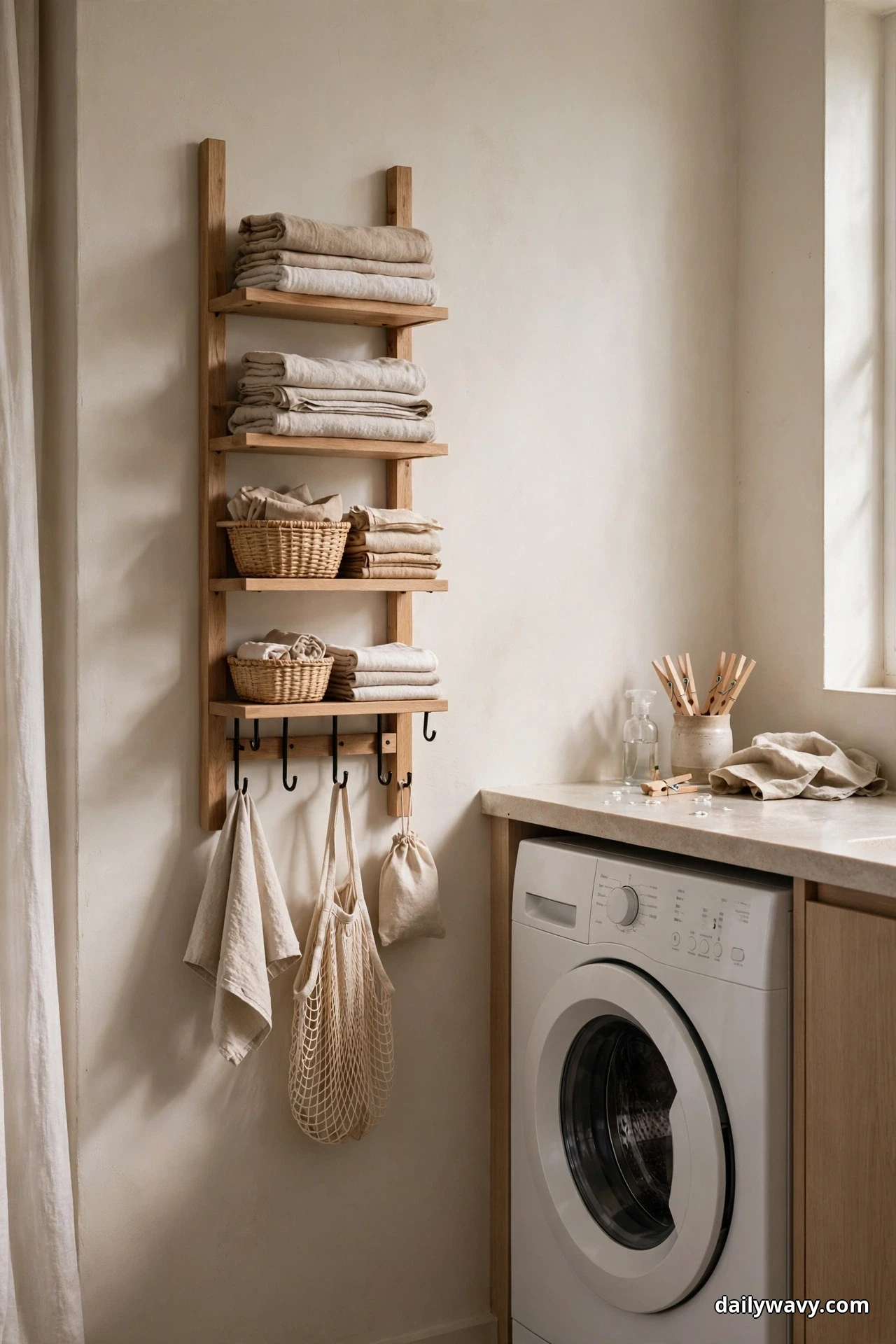
Every laundry room has one dead wall: the narrow strip beside the machines, the patch above the folding counter, the side nobody looks at. A vertical organizer turns that forgotten space into the hardest worker in the room. Think a wall-mounted unit with small shelves and sturdy hooks, holding folded linens, a lint roller, and the stain brush right where your hands are.
Measure the wall section first: height, width, and how far the organizer can stick out without blocking a door swing or a walkway. Most unused strips are 12 to 24 inches wide, and a 4 to 6 inch deep organizer keeps the profile slim. Look for powder-coated steel or sealed wood, because both shrug off humidity. Mount into studs with screws if you own the home. Renters can use a tall freestanding shelf tower or a tension-pole organizer that braces between floor and ceiling with no holes.
Place it at countertop height or just above, so you can grab supplies without stepping away from the folding surface. The lower-cost version is a pair of strong removable adhesive hooks plus one small floating shelf on removable brackets, which still gives you the vertical layer without a full unit. Keep anything with small parts or sharp tools (scissors, pins) above the reach of children, and leave the dryer vent zone completely clear.
2. A Slim Basket For Clean Cloths
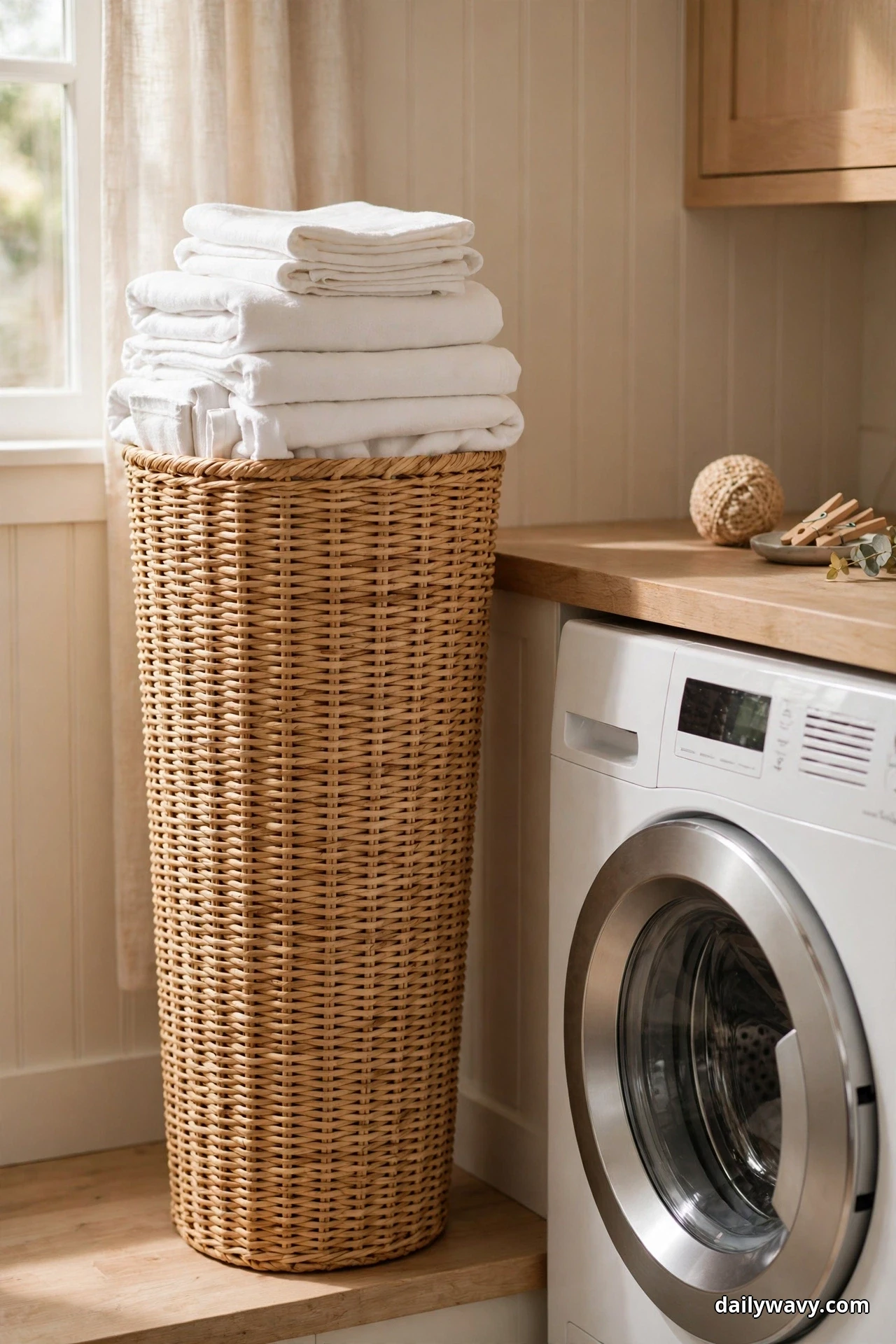
Clean cloths need a home between the dryer and the shelf, and a slim basket is the simplest version. Microfiber cloths, hand towels, and the good rags you reserve for dusting all fold small, so the basket itself can stay narrow and tall rather than wide and shallow. That shape fits the dead strip between the machine and the wall, or the end of the countertop where a wide basket would eat folding space.
Measure your chosen spot and pick a basket roughly 8 to 12 inches wide. Woven seagrass or cotton rope looks warm and lets air circulate, which matters because cloths go in slightly warm from the dryer. A plastic liner is unnecessary, but if you want structure, choose a basket with a removable fabric liner you can machine wash. Fold cloths in thirds so they stand upright like files; you will see every cloth at a glance and reach the one you want without unfolding the stack.
The budget version is any tall narrow basket from a discount store, and the real upgrade is choosing washable materials only. Avoid lidded baskets for cloths you use daily, because the lid becomes one more thing to set down with full hands. This basket earns its countertop real estate by sitting exactly where clean cloths land.
3. A Small Framed Print Away From Moisture
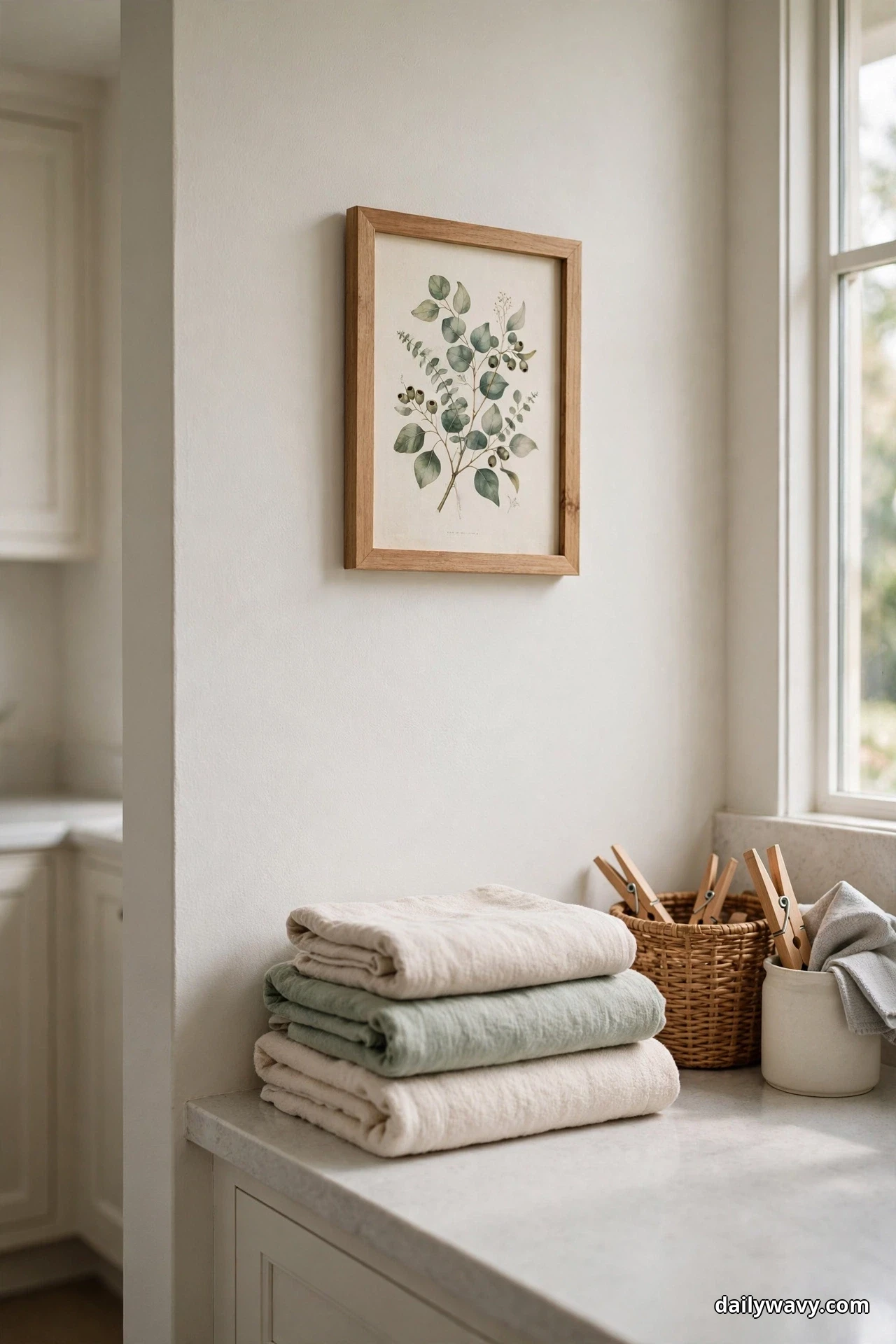
Laundry rooms get decorated last, if ever, and a single small framed print changes the feeling of the whole space. The trick is placement: moisture is the enemy of paper and cheap frames, so the print goes on a dry wall area, never directly above the washer where steam rises, and never beside a utility sink where splashes land.
Choose a spot at least a few feet from the machines, ideally the wall you face while folding. Keep the frame small, 5 by 7 or 8 by 10 inches, so it reads as an accent rather than a gallery. Sealed frames with acrylic glazing handle humidity better than open mats or bare canvas. If you own the home, one nail does it. Renters can use a single removable adhesive strip rated for the frame weight.
Botanical prints, vintage laundry advertisements, or a simple line drawing all suit the room. The lower-cost version is a postcard or a page from a calendar in a thrift-store frame. One print is enough; this room does not need a wall collage. The payoff is real, though: a room that feels considered is a room you will keep tidy.
4. A Neutral Palette With One Accent Color
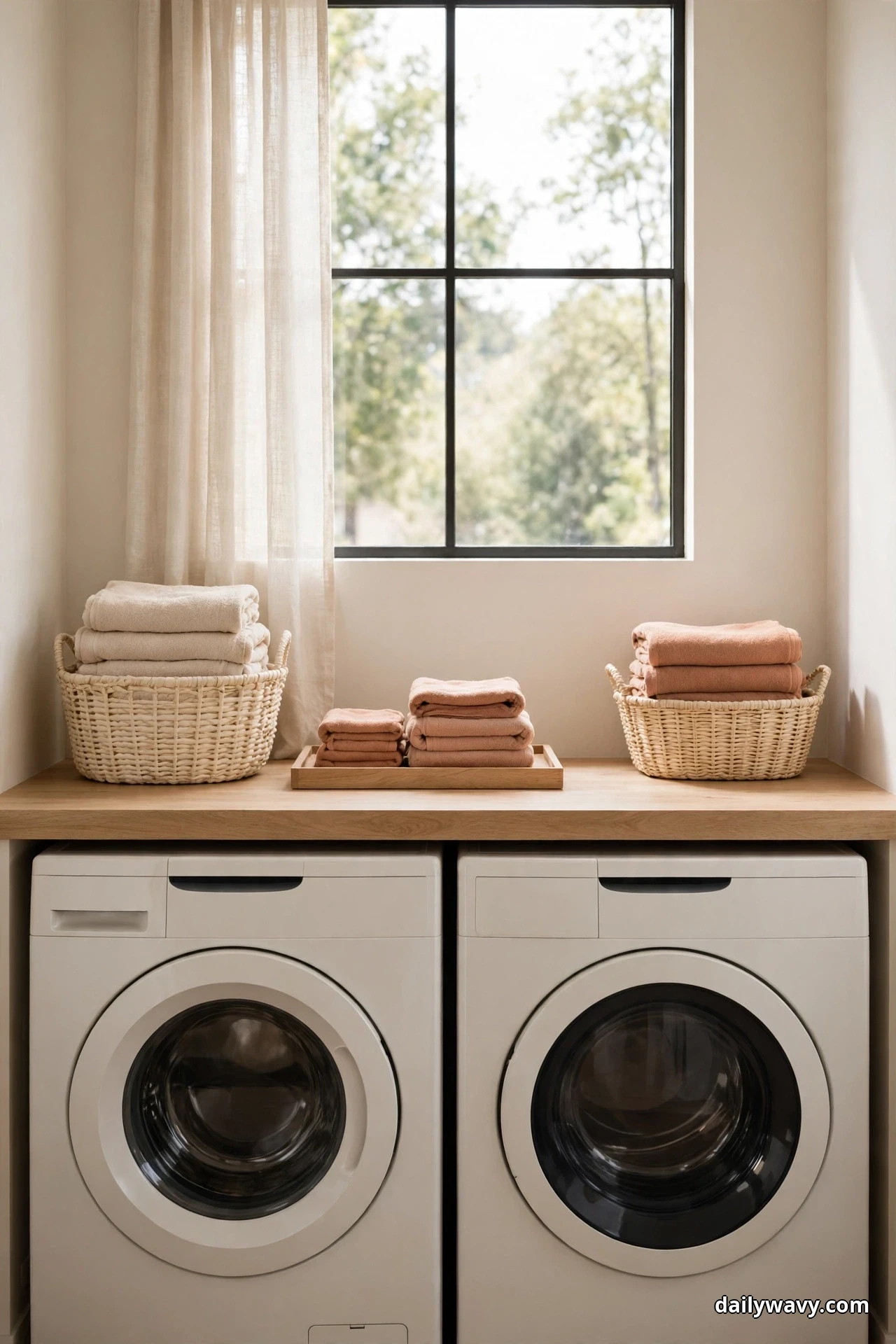
A laundry room calms down fast when the palette does. Warm neutrals, cream, beige, light wood, soft gray, make a small utility room feel bigger and cleaner, and they hide lint better than dark colors or stark white. The styling move is to pick one accent color and repeat it in exactly two or three small doses.
Start with what you already own. White or cream baskets and towels are the base. Then choose your accent: sage green, soft terracotta, or dusty blue all work in a laundry room and photograph beautifully. Put the accent in a folded towel stack, one basket, and maybe a small plant pot. That is the whole formula. Everything else stays neutral.
Measure nothing for this idea; it is about editing. Pull everything off the countertop, sort into keep, relocate, and discard, and put back only what belongs. Replace mismatched plastic bottles by decanting detergent into one or two matching pump bottles or dispensers, labeled clearly. The budget version costs nothing but an hour of sorting. The upgrade is matching baskets in your base neutral, bought one size, so the shelf reads as one calm system instead of a yard sale.
5. A Labeled Repair Or Stain-Treatment Bin
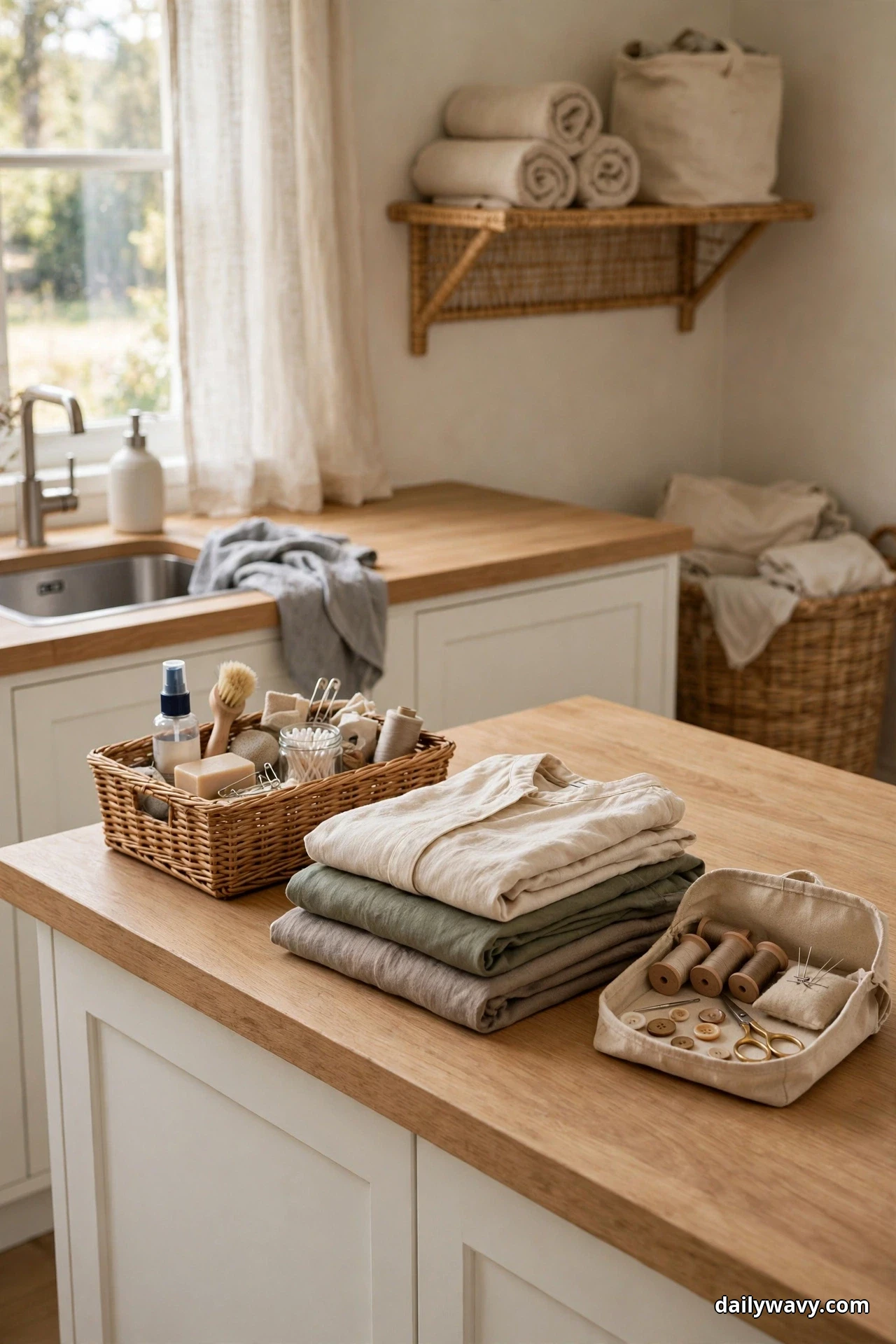
Stains get treated fast or not at all, and the reason most of us skip it is that the stain stick lives somewhere inconvenient. A small dedicated bin on the countertop fixes that. It holds your stain remover, a soft brush, a white cloth for blotting, and the little sewing kit for the button that pops off at the worst moment.
Pick a bin that fits the countertop depth, usually 10 to 14 inches long and under 8 inches wide, so it tucks to one end without stealing folding space. A sturdy lidded box or an open caddy both work; the lid keeps dust off, the open caddy is faster with wet hands. Label it clearly, either with a small adhesive label or a hang tag, so everyone in the house knows what it is and actually uses it.
Keep chemicals in their original packaging inside the bin, and never mix products. The bin lives on the countertop, but bleach and anything with strong fumes stay in a closed cabinet away from heat sources. The budget version is a shoebox you label with a marker. The upgrade is a latching caddy with a handle, so you can carry the whole kit to the stain instead of the other way around.
6. A Compact Ironing-Tool Storage Spot
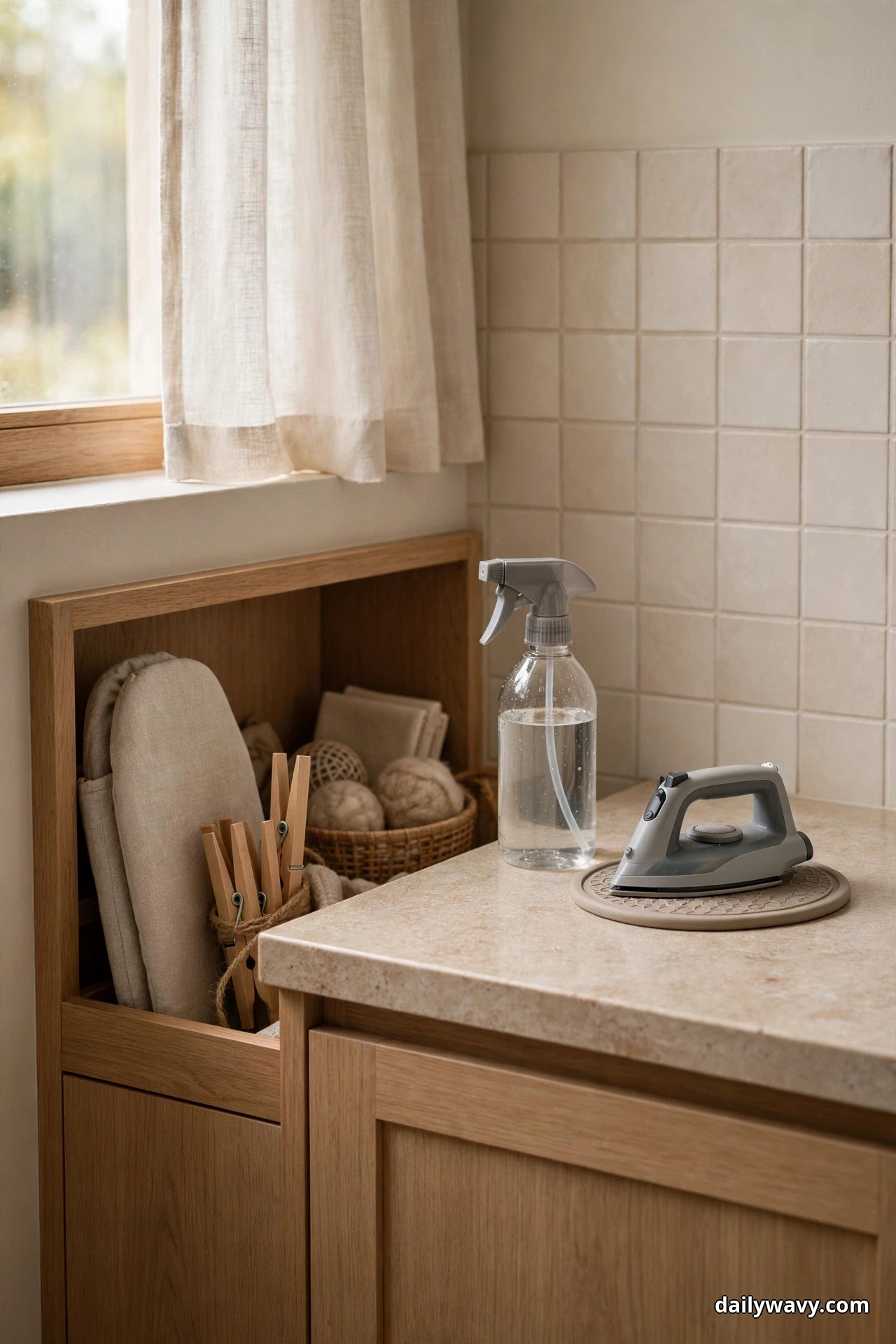
Not every laundry room fits an ironing board, but almost every laundry room needs the iron and its accessories somewhere sensible. A compact storage spot on or beside the countertop keeps the iron, a spray bottle, and a sleeve board within reach without dedicating half the room to pressing.
Measure first: an iron needs a heat-safe rest, and the whole setup should sit on a stable surface away from the countertop edge. A silicone iron rest pad or a small heat-resistant mat protects the countertop. Store the iron upright once it has cooled completely, never laid flat on a hot soleplate. Keep the cord wrapped loosely; tight wrapping strains the cord over time. Route the cord so it never drapes across a wet stretch of counter, and plug the iron into a GFCI-protected outlet where the room has one, especially near a utility sink.
If you own your home, a wall-mounted iron holder on the side of a cabinet is ideal and costs little. Renters can use a countertop caddy or a heat-safe basket that holds the iron upright. The lower-cost version is a folded cotton towel as padding under a cooled iron in its caddy, never as a rest for a hot soleplate; get the proper silicone pad as soon as you can. Empty the water reservoir after each use if your water is hard, and never leave a hot iron unattended. Small space, real safety rules, no compromise.
7. A Basket For Ready-To-Return Laundry
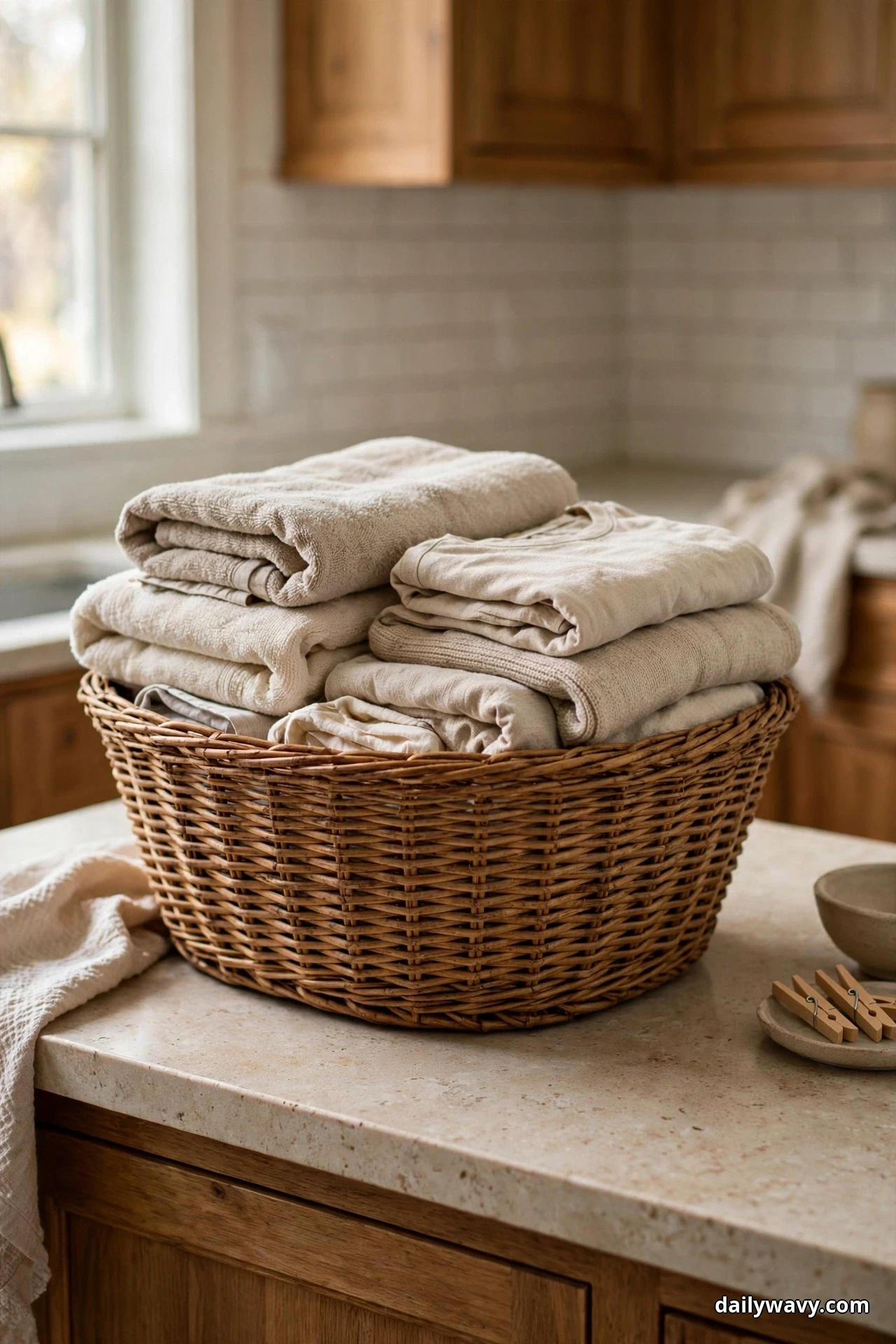
Clean laundry stalls in the laundry room because there is no system for getting it out. A dedicated basket for folded items that are ready to return to closets and drawers closes the loop. It is the basket you carry upstairs, not the basket that lives in the room forever.
Size it to the household: one person needs a medium basket, a family of four needs a large one or two mediums. A basket with handles is non-negotiable, because this basket travels. Woven or fabric baskets are light and look good on the countertop; hard plastic is fine and wipes clean. Place it at the end of the countertop nearest the door, so grabbing it on your way out is the natural move.
The system that makes it work: folded items go in the basket immediately, and the basket leaves the room at least once a day. The budget version is the laundry basket you already own, reassigned to this one job. If clean clothes keep piling on the countertop instead, the basket is too small or too far from the door. Move it closer and the habit follows.
8. An Open Landing Space For Folded Items
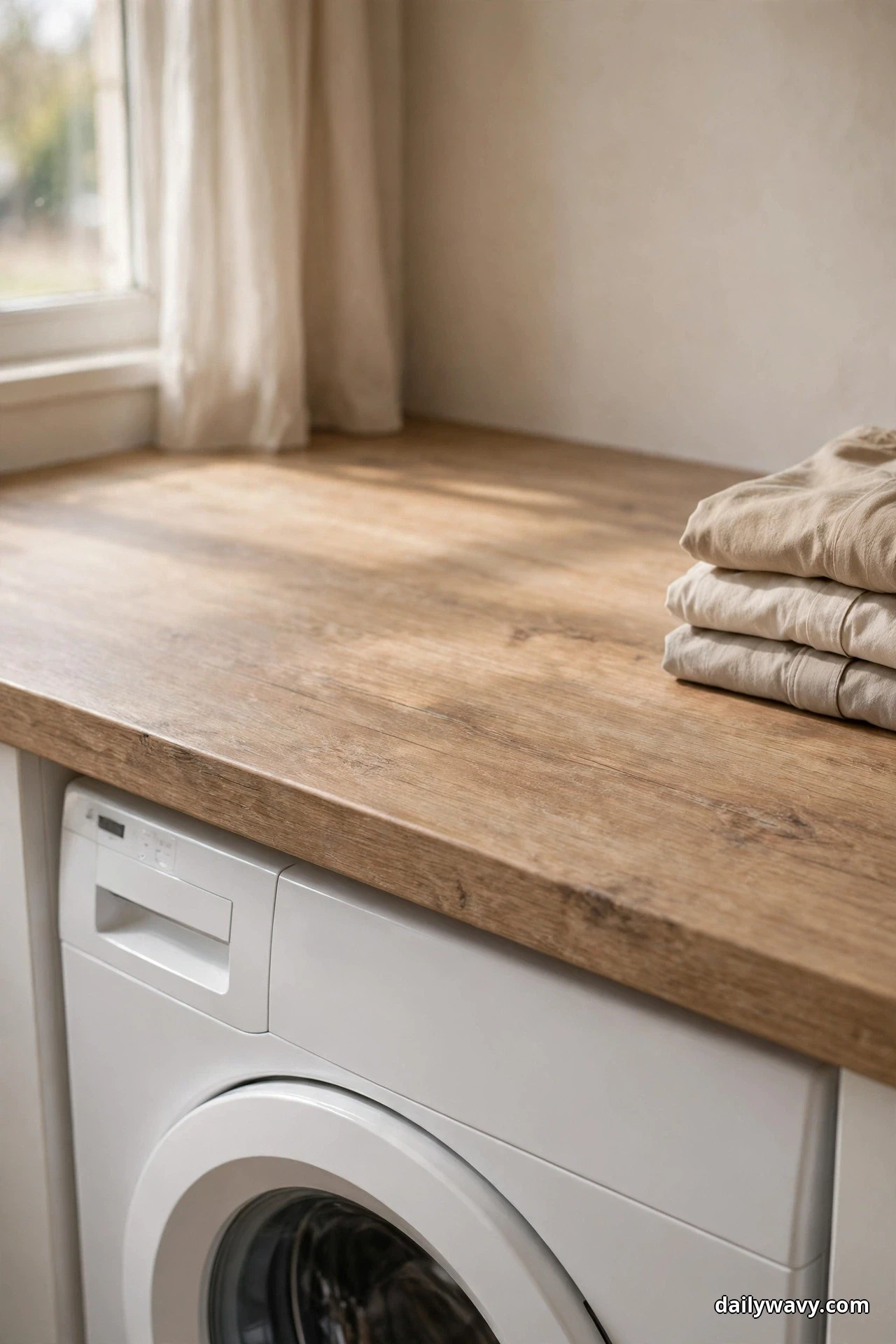
The most useful idea on this list is also the simplest: leave part of the countertop empty. A clear landing space of at least 24 inches wide is where folding actually happens, where the grocery bag of delicates lands, where you sort the load that just came out of the dryer. Every other idea on this list exists to protect this space.
This is a discipline idea, not a purchase. Measure your countertop and mark the folding zone mentally: everything else, baskets, bins, the repair kit, lives at the ends or on the wall. If the countertop is narrow, the landing space gets priority and storage goes vertical on the wall organizer from idea one.
The lower-cost version is free, which is the point. The reason laundry rooms feel chaotic is rarely a lack of storage; it is a lack of clear surface. Defend one open stretch and the whole room starts working. Wipe it down weekly with a damp cloth, because detergent dust and lint settle fastest on the surfaces you use most.
9. A Shallow Shelf For Daily Supplies
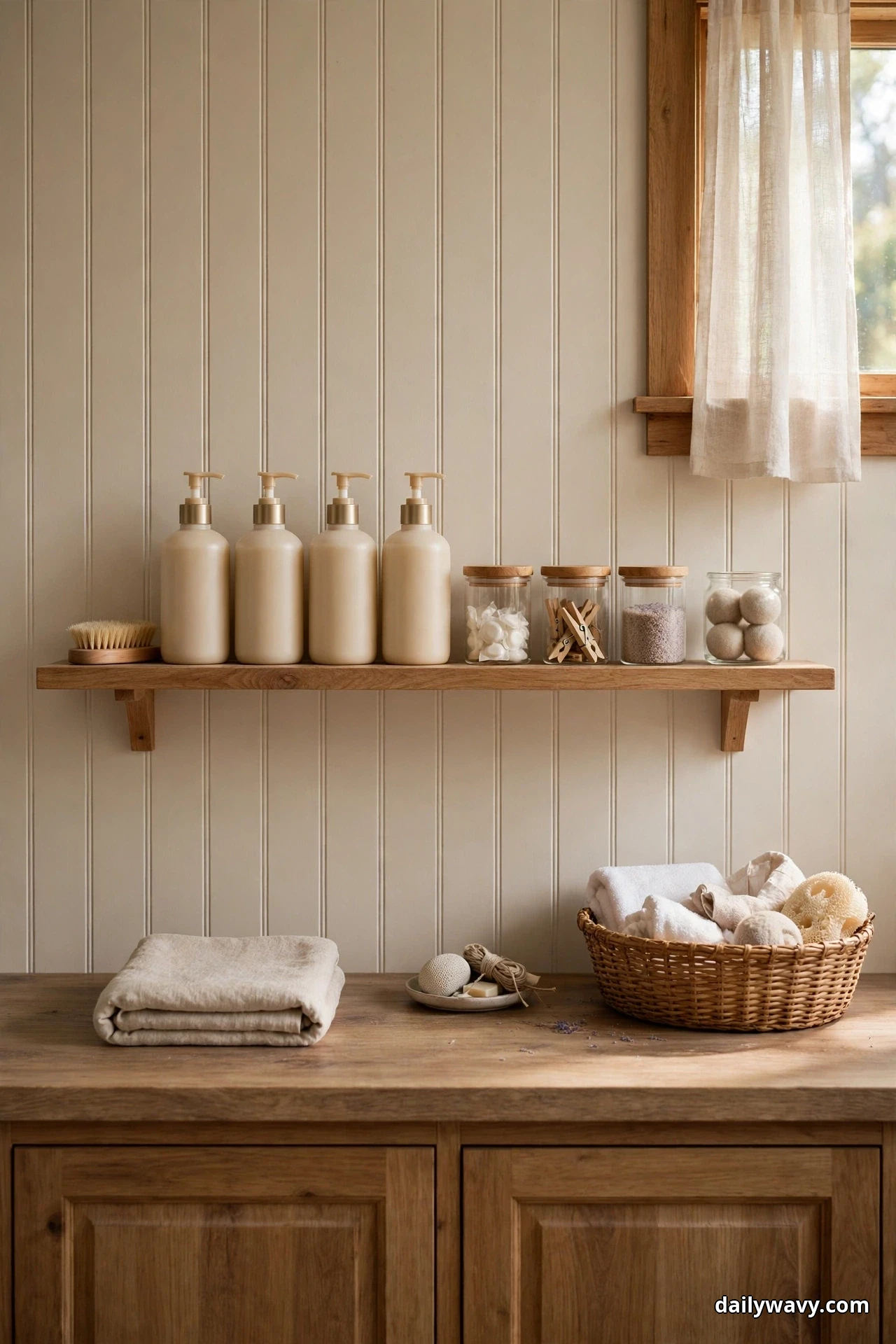
Daily supplies, detergent, softener, the stain spray you reach for every load, belong at arm height, not buried in a cabinet. A shallow shelf above the countertop keeps them visible and reachable without eating a single inch of folding surface.
Measure the wall above the countertop: most gaps between counter and upper cabinets run 18 to 24 inches, and a shelf 6 to 8 inches deep holds bottles without jutting into your forehead space. Mount into studs for a permanent shelf, or use a sturdy removable adhesive shelf system rated for the weight if you rent. Keep the shelf at least 18 inches above the countertop so tall detergent bottles clear it.
Decant into matching pump bottles or dispensers to cut visual clutter, and label every container with its contents. Original safety labels matter, so keep the original packaging stored in a cabinet for reference, or photograph the label and keep the photo on your phone. The budget version is one narrow picture ledge from a home store. Never store bleach directly above the washer lid where a drip could fall into a load, and keep everything out of reach of small children.
10. A Labeled Basket For Each Sorting Category
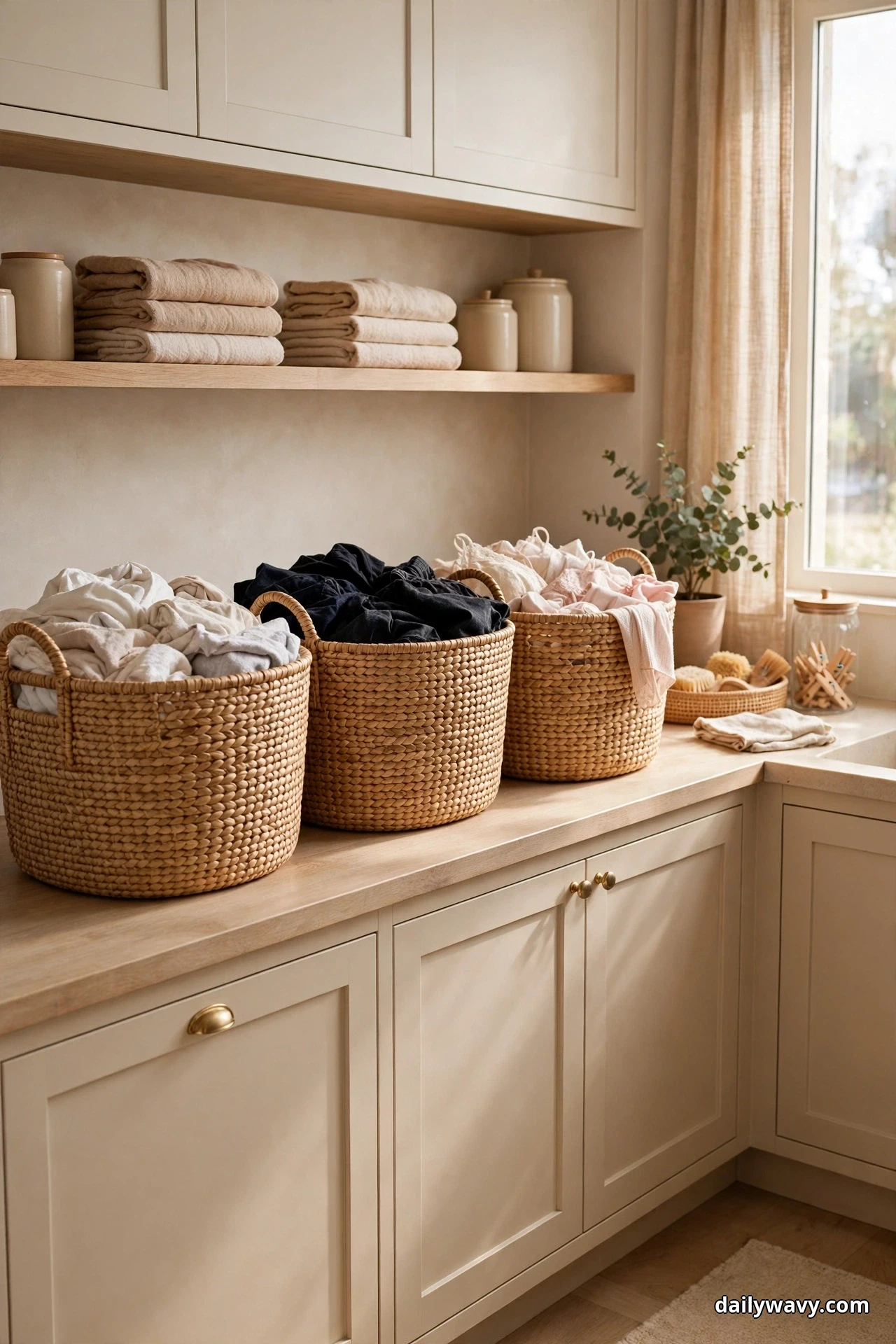
Sorting happens at the countertop, so the sorting system should live there. A row of labeled baskets, one per category, turns the countertop into a sorting station instead of a pile. Lights, darks, delicates, and towels cover most households; add a fifth for rags and cleaning cloths if you need it.
Choose baskets that fit your countertop depth with room to spare in front for folding. Matching baskets in one material read as calm and intentional; the labels do the real work. Use clear adhesive labels, clip-on tags, or a label maker. Labels go on the front face at eye level, large enough to read while holding an armful of clothes.
Measure the total width before buying: four 12-inch baskets need 48 inches plus small gaps. If the countertop is shorter, stack two baskets on a small riser or move one category to the wall organizer. The budget version is cardboard boxes covered in contact paper with handwritten labels. Washable baskets beat cardboard long term in a humid room. This system pays off every single laundry day, because sorting stops being a decision and becomes a reflex.
11. A Hanging Rail For Air-Drying
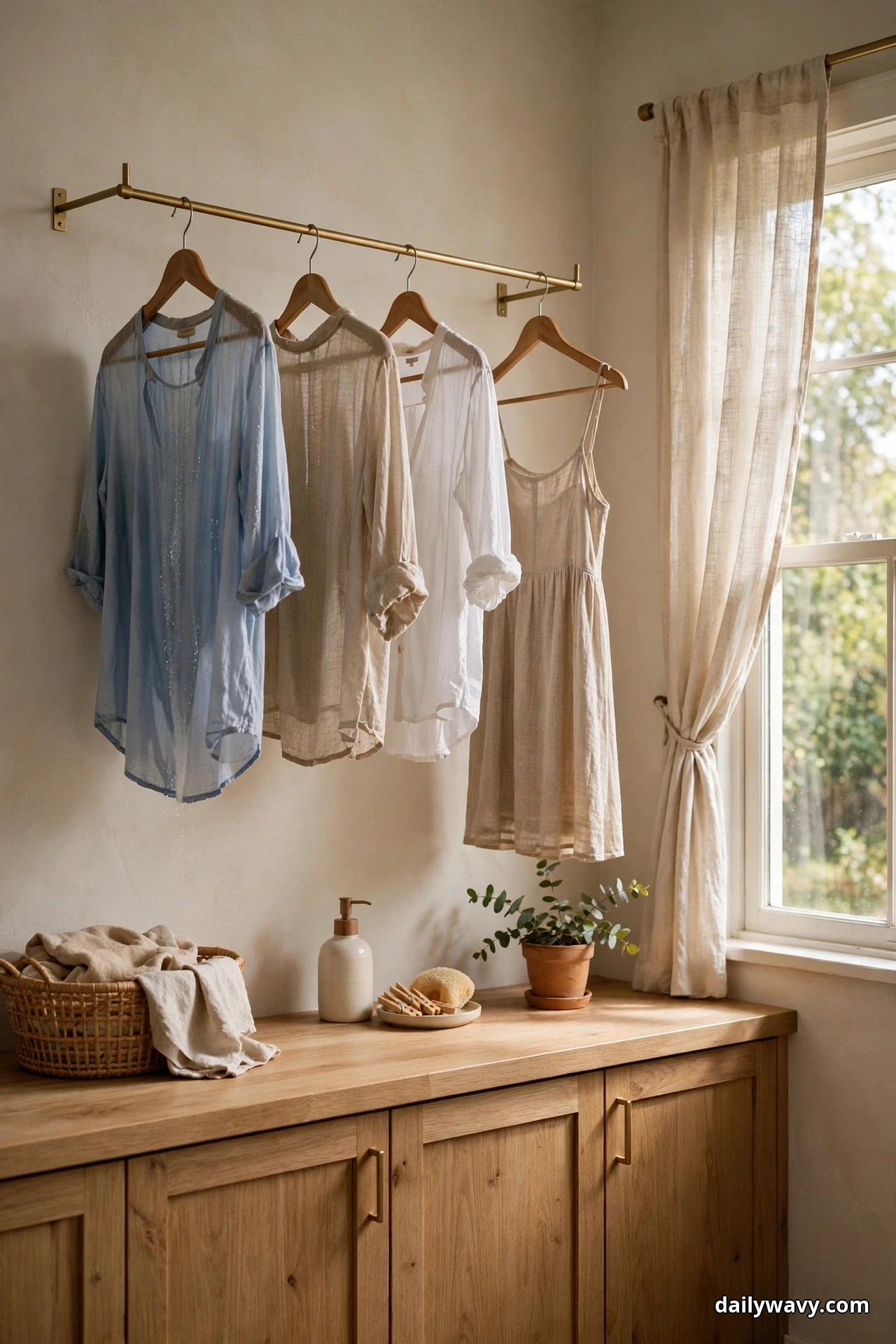
Delicates, activewear, and anything you refuse to put in the dryer need a drying spot, and a wall-mounted hanging rail above the countertop is the tidiest answer. Wet clothes drip, so the rail belongs over the countertop or a washable floor area, never over finished wood floors or carpet you care about.
Measure the wall length and choose a rail 24 to 36 inches wide for most rooms. A simple wooden dowel on brackets, a wall-mounted valet rod that pulls out, or a retractable line all work. Mount into studs; a rail full of wet jeans is heavier than it looks. Hang items with space between them so air circulates, and keep the rail clear of the dryer vent so warm exhaust does not blow directly onto damp clothes.
Renters can use a tension rod braced inside a door frame or a freestanding garment rack tucked beside the machines. The lower-cost version is a shower curtain tension rod across an alcove. Empty the rail when things are dry; a rail that becomes permanent storage stops being useful. Pair it with the washable runner from idea fourteen and drips stop being a worry.
12. A Fold-Flat Drying Solution
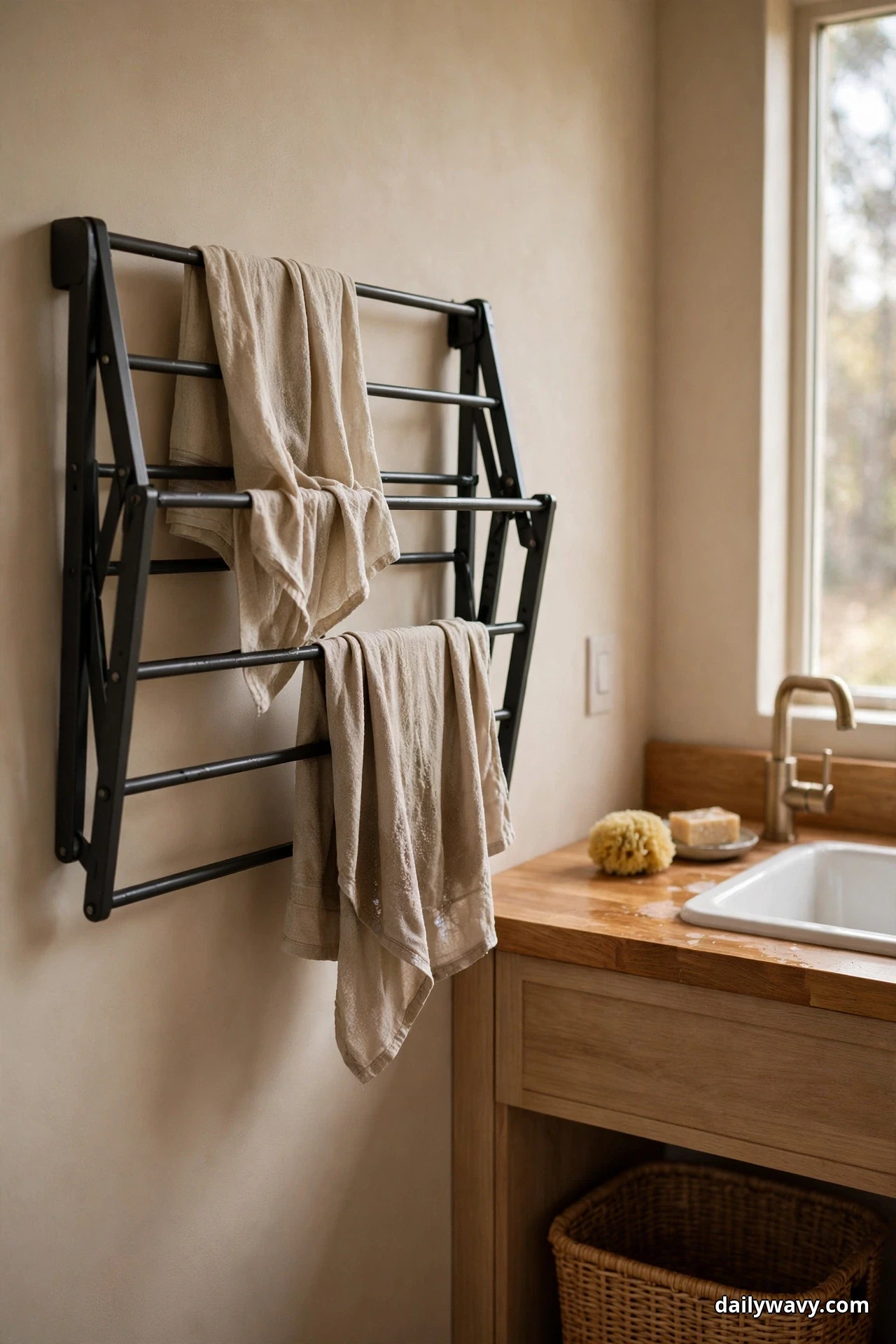
When floor space is tight, a fold-flat drying rack gives you full drying capacity that disappears when the load is done. Wall-mounted accordion racks or pull-down rails fold to a couple of inches deep against the wall, which means the laundry room keeps its walkway clear on non-laundry days.
Measure the wall where it will mount and the swing or pull-down clearance in front of it. Most fold-flat racks need a wall section 24 to 30 inches wide. Mount into studs with the provided hardware; these racks carry real weight when loaded with wet towels. Place it where drips land on tile or a washable runner, not on bare wood.
The renter version is a freestanding folding rack that sets up over the bathtub or in front of the machines and folds flat for storage behind a door. The budget upgrade is replacing a wobbly old rack rather than buying new: tighten the joints and it often works like new. Whatever style you choose, the rule is the same as the hanging rail: air-dry over washable surfaces, and fold it away when the clothes come down.
13. A Narrow Rolling Caddy
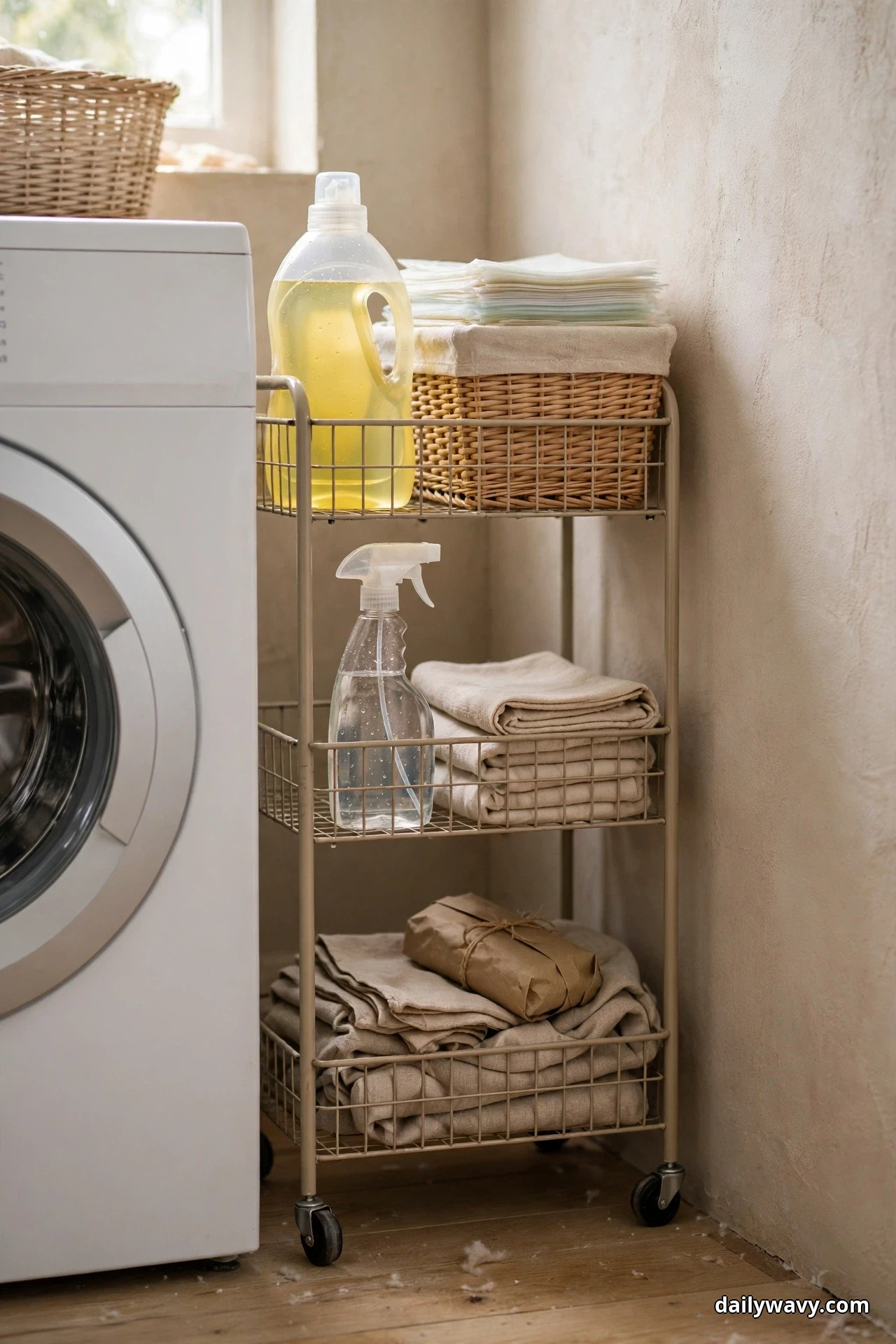
The gap between the washer and the wall is usually 4 to 8 inches of wasted space. A narrow rolling caddy slides into it and holds the supplies you reach for mid-load: dryer sheets, stain wipes, the mesh bags, spare hangers. Because it rolls out, nothing gets lost in the back of a deep cabinet.
Measure the gap before you buy; caddies come in 4, 6, and 8 inch widths, and a caddy that wedges too tight will scuff the machine. Look for one with a handle and smooth-rolling casters, in plastic or coated metal that wipes clean. Load heavier items on the bottom tier so it does not tip when you pull it out one-handed.
Keep the caddy clear of the dryer vent and any water supply lines, and never force it into a gap that is too narrow. The budget version is a tall narrow basket you slide in and out by hand. This is the smallest idea on the list and one of the most satisfying, because it converts literally dead space into working storage.
14. A Washable Runner Clear Of Doors
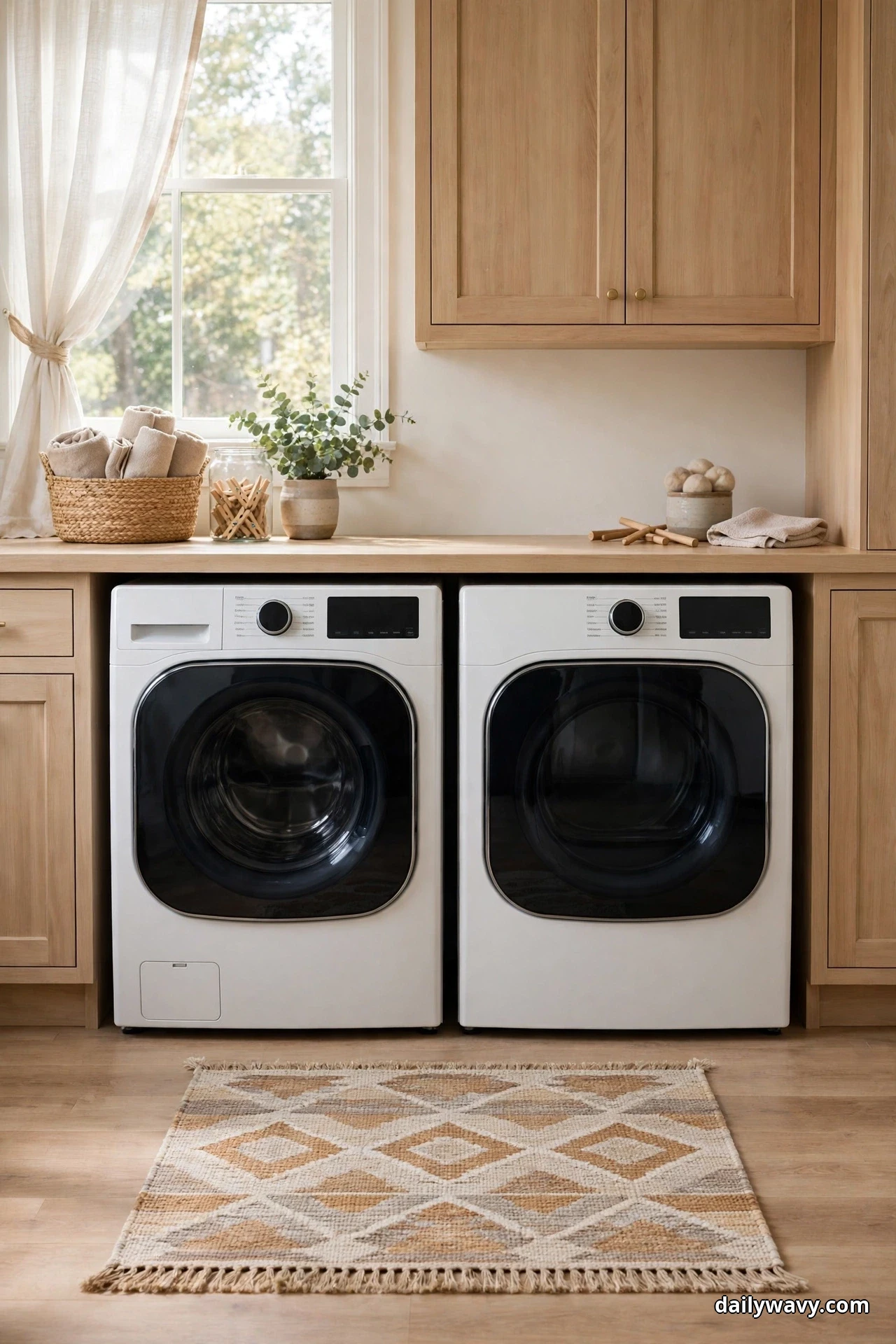
Laundry room floors take abuse: drips from the washer, lint, the occasional detergent spill, and wet feet. A washable runner protects the floor and softens a hard utility room, as long as it stays clear of the appliance doors. Measure the door swing first, then choose a runner that stops short of it, because a rug bunched under a washer door is a tripping hazard and a mold risk.
Look for low-pile rugs labeled machine washable, in a size that fits the walkway: 2 by 6 feet suits most galley laundry rooms. Cotton and synthetic flat-weaves both wash well; avoid thick pile that traps lint and takes days to dry. A rug pad underneath keeps it from sliding on tile, and the pad should be washable or moisture-resistant too.
Place the runner along the main walking path, not wall to wall, so you can lift it easily for washing. The budget version is an outdoor rug, which is built for moisture and hoses clean. Wash it monthly, or whenever it starts to smell like a laundry room. One runner, kept clear of every door swing, finishes the room.
Frequently Asked Questions
How deep should a laundry room countertop be?
For a countertop over front-load machines, 27 to 30 inches deep covers the machines and their hoses and gives a usable folding surface. Anything shallower leaves the machine fronts sticking out past the counter edge and feels cramped for folding a full load.
What can I safely store above the washer and dryer?
Light daily supplies on a shallow shelf work well: detergent in pump bottles, dryer sheets, stain spray. Keep it to items you use every load, nothing heavy enough to hurt if it falls, and nothing that blocks the dryer vent. Bleach and strong chemicals belong in a closed cabinet, not on open shelves above the machines.
Is it safe to keep detergent on the countertop?
Yes, with two rules. Keep detergent in its original container or a clearly labeled dispenser, and if children are in the house, store pods and liquids in a latched cabinet instead of the open counter. Never transfer chemicals into food containers, and keep the original labels for reference.
What are the best renter-friendly options if I cannot drill?
Tension rods for hanging, freestanding shelf towers, removable adhesive hooks and shelves rated for the weight, rolling caddies, and lean-to organizers all work with zero holes. Choose the damage-free version of each idea in this guide and you lose almost nothing.
How do I keep the countertop clear for folding?
Defend one open stretch of at least 24 inches as the folding zone, and move everything else to the wall, the shelf, or the ends of the counter. A basket for ready-to-return laundry (idea seven) keeps clean clothes moving out instead of piling up. The system matters more than the storage.
What countertop material holds up best in a laundry room?
Sealed butcher block, laminate, and solid surface all handle humidity and occasional splashes well. Avoid bare MDF and unsealed particleboard, which swell with moisture. Whatever you have, a silicone mat under the detergent bottles catches the drips that slowly damage finishes.
The Takeaway
A useful laundry room is not a bigger laundry room. It is the same square footage with every surface assigned a job: the wall holds the organizer, the shelf holds the daily supplies, the caddy fills the dead gap, and the countertop itself stays clear enough to fold. Start with the open landing space, because that single habit changes the room more than any purchase. Then add the pieces that match your household, one at a time, measuring before you buy and keeping every appliance door swinging free.
If you love this kind of practical organization, our small pantry organization ideas use the same measure-first logic in the kitchen, and the small bathroom storage guide solves the same puzzle in a tighter room. For the room next door, the Home and Decor collection has the full library. Fourteen ideas, one afternoon of sorting, and a countertop that finally earns its keep.
Pin these ideas for your next laundry day, then come back and tell us which one changed your routine.