18 Entryway Console Table Styling Ideas for a Welcoming First Impression
The entryway is the first thing you see when you come home and the last thing a guest notices on…
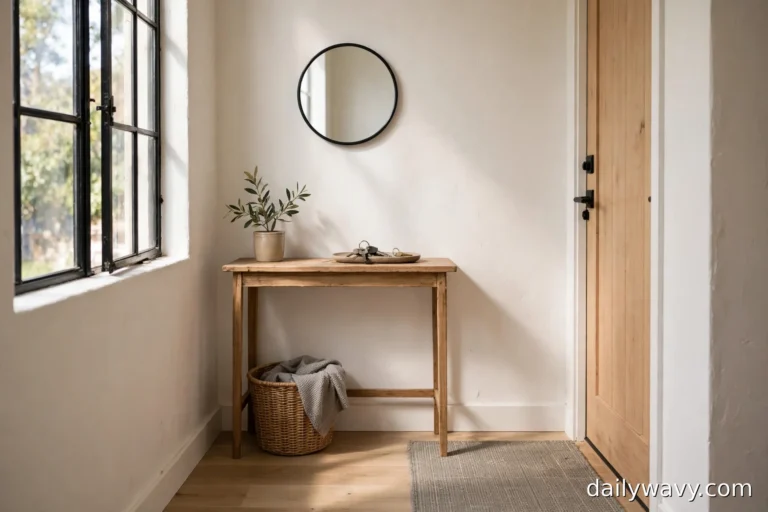
The entryway is the first thing you see when you come home and the last thing a guest notices on the way in, yet it usually gets about ten square feet and zero planning. A console table changes that completely. It becomes the landing zone for keys and mail, the spot for a lamp that greets you at night, and the one surface that can make a narrow hall feel finished instead of forgotten. This guide walks through 18 styling ideas built around a console table, each one sized for a real entryway, workable on a realistic budget, and designed so the whole thing feels welcoming the moment you walk in.
In This Guide:
- A Vertical Storage Arrangement
- A Small Plant Outside The Traffic Path
- A Basket For Outgoing Items
- A Designated Mail-Sorting Tray
- A Repeated Hardware Finish
- A Shallow Decorative Bowl
- A Simple Coat Rail With Clear Spacing
- A Folded Blanket On A Bench Corner
- A Narrow Tray For Keys
- A Basket Tucked Beneath A Bench
- A Mirror Over A Shallow Surface
- A Durable Mat At The Door
- A Compact Closed Shoe Cabinet
- A Single Wall Hook For A Daily Bag
- A Small Lamp On A Safe Surface
- A Slim Upright Umbrella Holder
- A Lidded Box For Small Essentials
- A Framed Print Beside The Door
The Entryway Console Table Rules Before You Start
Before you move a single thing, measure. Stand in the doorway with the door fully open and check its swing: many entry doors need 30 to 36 inches of clear arc, and your console table must sit outside it. Then map the walkway. Aim for at least 36 inches of clear passage from the door into the room, more if someone comes through with groceries or a stroller, and never let the styling narrow the path below 30 inches. A standard console table is 12 to 16 inches deep, which means most entries can fit one along the wall without pinching the path. Write down the wall length too, because a 48-inch console in a 60-inch alcove looks generous, while a 60-inch console in the same spot looks crammed.
None of these ideas assumes you have a mudroom. Every one works with a simple wall near the front door, a table, and a few well-chosen pieces. The goal is a landing zone: one place where the day-to-day things live, styled so it reads as a composed corner rather than a pile. Keep the console table as the focal element and let the other pieces support it. Resist the urge to use every idea at once. Three or four done well will always look better than ten crowded together, and a clear surface is the whole point.
1. A Vertical Storage Arrangement
Start with what goes up, not what sits down. A vertical storage arrangement uses the wall above and beside the console table instead of competing for its surface. Think of a tall, narrow bookcase or a set of wall-mounted shelves stacked at the end of the table, roughly 12 inches deep and 60 to 72 inches tall. This keeps floor space open while giving you real storage for things that otherwise drift: a spare umbrella, the dog leash, a small stack of reusable shopping bags.
Place the tall piece at one end of the console rather than centered over it. That asymmetry looks intentional and keeps the walkway side clear. Leave at least 4 inches between the tall piece and the door frame so nothing catches. To build it, anchor any tall furniture to a wall stud with the included anti-tip hardware, set heavier items on the lower shelves, and keep the top shelf within a comfortable reach of about 72 inches. Budget around 80 to 150 dollars for a simple narrow bookcase, or under 50 for a pair of sturdy wood shelves with brackets. The payoff is immediate: the console surface stays clear for styling while the storage does the quiet work beside it.

2. A Small Plant Outside The Traffic Path
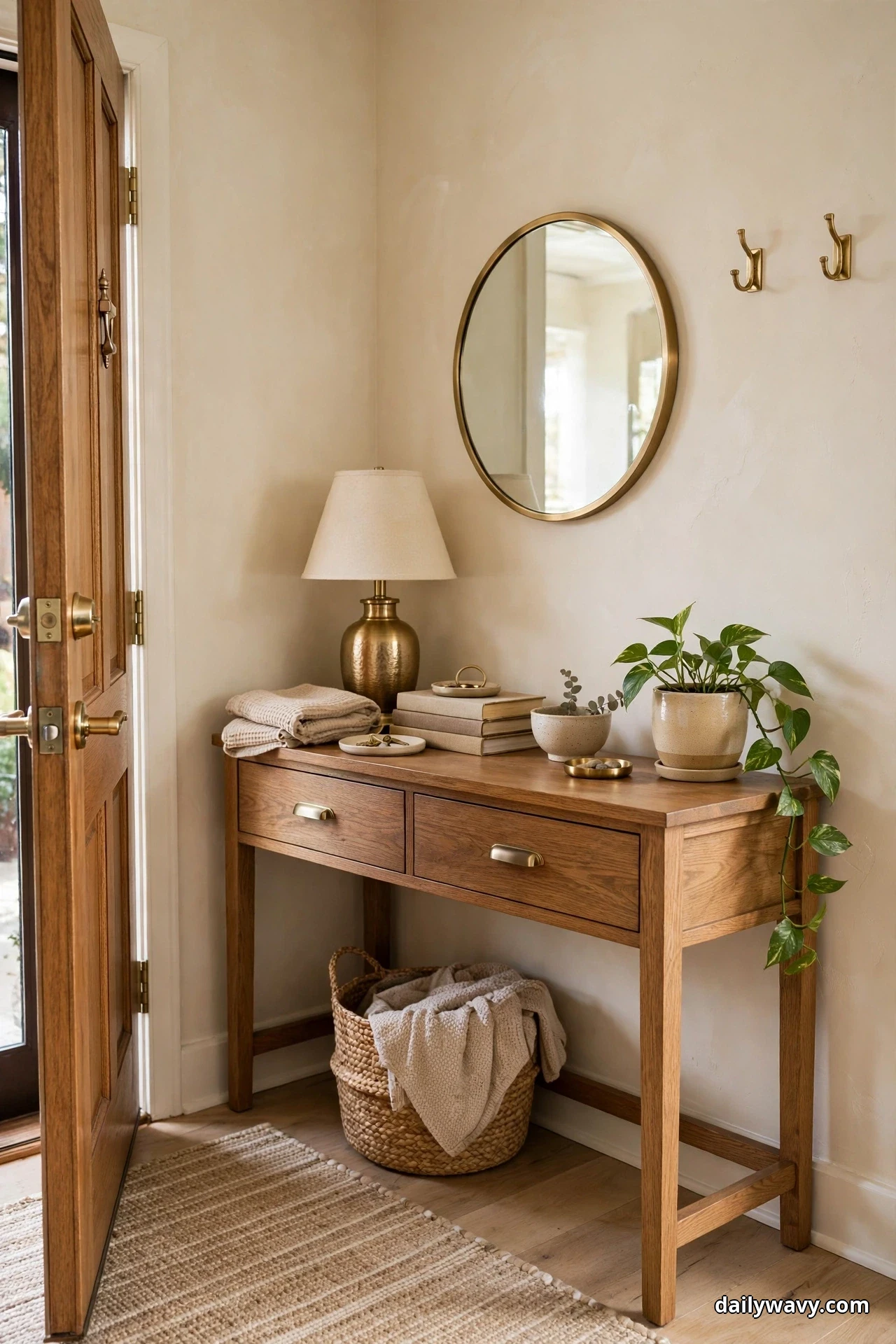
One living thing changes an entryway more than any object. A small plant, kept outside the traffic path, brings color and softness to a corner that is usually all hard surfaces. A pothos, ZZ plant, or snake plant in a 6-inch pot works well here, since all three tolerate the lower light of a typical hallway and forgive an occasional missed watering. Set the plant at the far end of the console table, away from the door swing, or on the floor in the corner where the wall meets the table.
The key detail is placement. The traffic path runs from the door to the next room, usually a straight 30-inch corridor, and anything with leaves belongs at least 6 inches outside it. That way a grocery bag swinging past never clips the foliage. Water with about half a cup once the top inch of soil is dry, which for these plants is roughly every one to two weeks. A small nursery pot slipped inside a ceramic cachepot costs 15 to 30 dollars total, no drainage tray needed if you empty the cachepot after watering. Check the spot once a month for dropped leaves and dust, and rotate the pot a quarter turn so it grows evenly.
3. A Basket For Outgoing Items
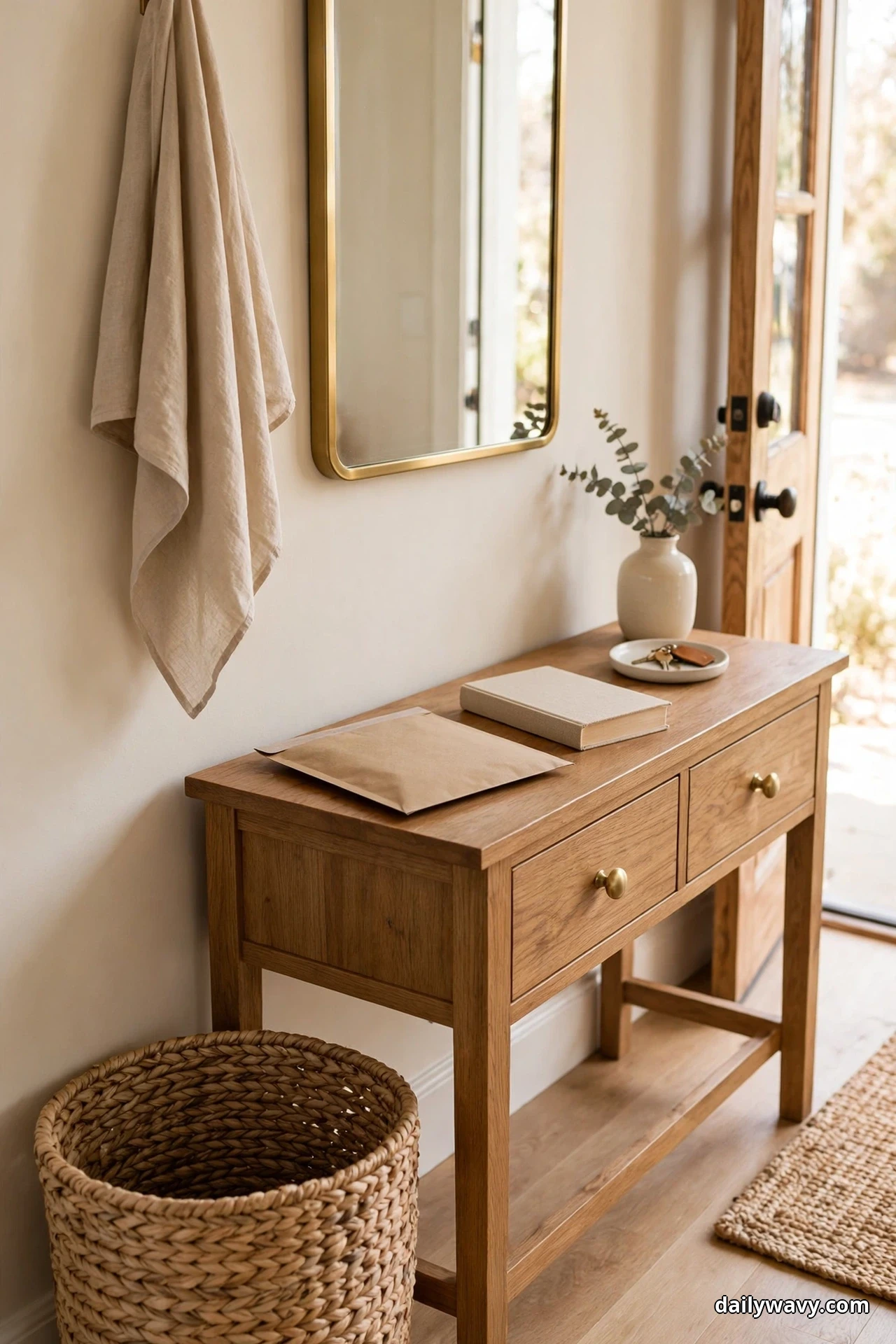
Every household has a staging area whether it admits it or not: returns to post, a library book, the borrowed baking pan. A basket for outgoing items gives that pile a home on or beside the console table, so it looks like a plan instead of clutter. Choose a basket about 12 inches wide and 8 inches deep, big enough for a paperback and a padded mailer, small enough to fit on the lower shelf of the console or tucked beside it.
Label the basket mentally, not physically. This is the outgoing box, and the household rule is simple: anything that needs to leave the house goes in, and the person leaving grabs the contents on the way out. A woven seagrass or cotton-rope basket in a warm neutral costs 20 to 40 dollars and reads as decor even when empty. Keep it off the main walkway and away from the door swing so nothing topples when the door opens. Empty it every evening as part of your coming-home routine. The first time you actually remember the return because it was waiting by the door, the basket pays for itself.
4. A Designated Mail-Sorting Tray
Mail is the fastest clutter generator in the house, and it always lands in the entryway. A designated mail-sorting tray breaks the cycle. Pick a tray roughly 10 by 13 inches, deep enough to hold a week of letters, and place it at the end of the console table opposite the plant. The system is two zones: incoming mail goes in the tray, and once a week you sort it into keep, act, or recycle. Nothing else is allowed to live there.
Stacking or tiered trays work best, giving you two or three layers in the same footprint. A simple metal or wood tray costs 15 to 35 dollars. To make it stick, pair the tray with a small recycling basket within arm’s reach so junk mail never has an excuse to stay. Sort on a fixed day, like Sunday evening, and the tray resets to nearly empty each week. This is not about being tidy for the sake of it. An entryway without a paper drift genuinely feels calmer, and you will stop losing bills under sofa cushions.

5. A Repeated Hardware Finish
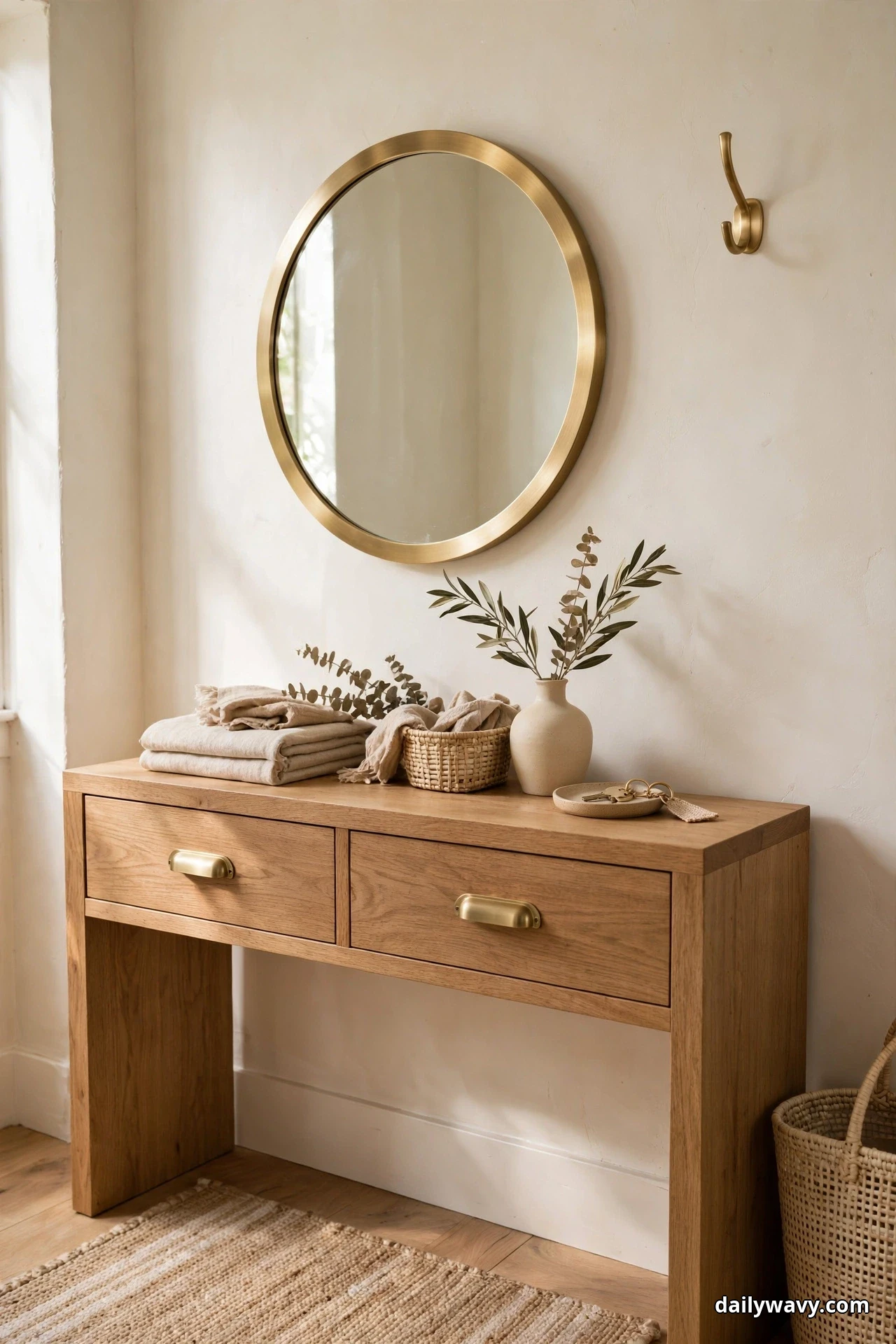
This is the stylist’s trick that costs nothing extra. Choose one hardware finish and repeat it at least three times across the entryway. Brushed brass drawer pulls on the console, a brass-framed mirror above it, and a brass umbrella stand in the corner read as a deliberate scheme. Black hooks, a black lamp base, and a black picture frame do the same thing. The repetition is what makes it look designed instead of assembled.
If you already own pieces in mixed finishes, you do not need to replace them. A 12-dollar can of spray paint in a satin metal finish can unify small items like tray handles, hook plates, and lamp bases in one afternoon. Scuff the metal lightly with fine sandpaper, apply two thin coats outdoors, and let each coat dry the time the can specifies. Limit yourself to one dominant finish and one supporting finish at most. More than two starts to look busy again. This small discipline is the difference between a console table that looks styled and one that looks shopped.
6. A Shallow Decorative Bowl
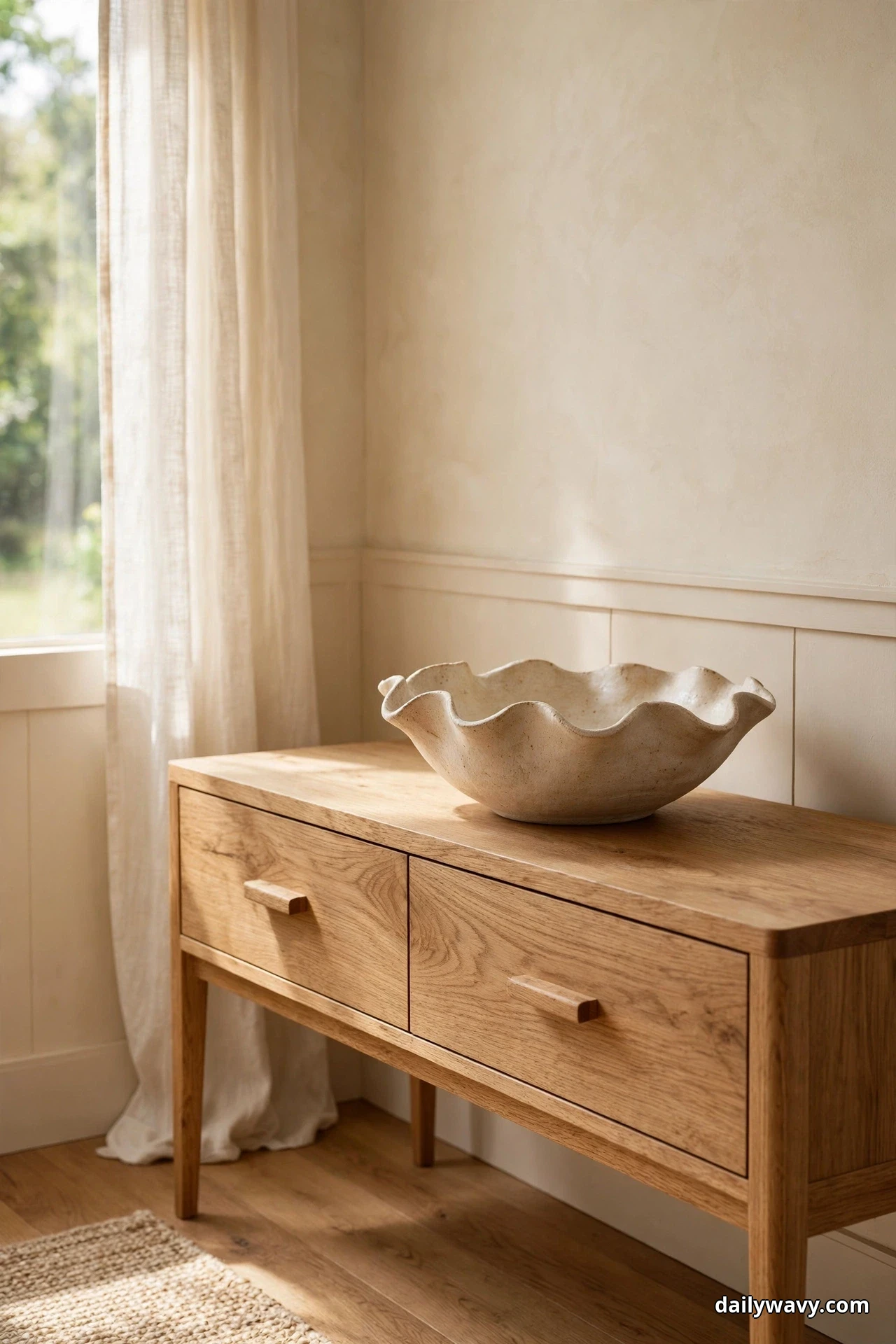
A shallow decorative bowl is the visual exhale on a styled console. It sits low, about 2 to 3 inches tall and 10 to 12 inches across, and it gives the eye a place to rest among taller pieces like a lamp and a stack of books. Ceramic, turned wood, or travertine all work in warm neutrals. You can leave it empty as a sculptural piece, or hold a few small things loosely: a set of spare keys for guests, a couple of polished stones, nothing more.
Place the bowl slightly off-center on the console, roughly a third of the way from one end. That offset keeps the arrangement from looking symmetrical and stiff. If it holds items, choose things with a similar tone so it reads as a collection, not a junk drawer without a drawer. A handmade-look ceramic bowl costs 25 to 50 dollars; turned wood runs a bit more. Dust it when you dust the table, and resist filling it. The moment a bowl becomes storage, it stops being the quiet focal point it was meant to be.
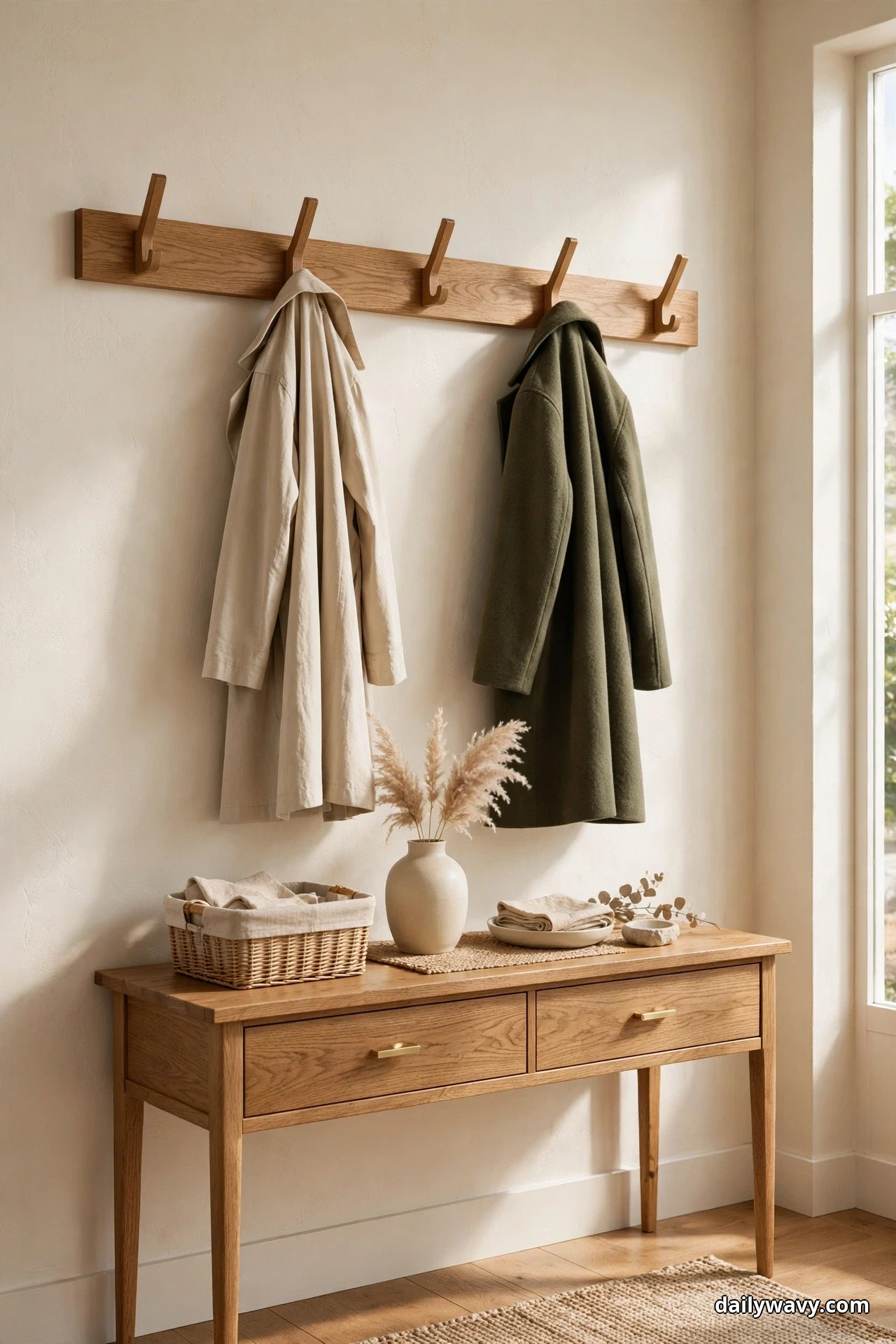
7. A Simple Coat Rail With Clear Spacing
Coats that drape over the console table are the enemy of a welcoming entry. A simple coat rail on the wall, with clear spacing between hooks, keeps jackets where they belong and off the styling. Mount a rail with four or five hooks at about 65 inches high, which works for most adults and keeps hems above the console surface. The critical detail is spacing: leave 8 to 10 inches between hooks so coats do not bunch into one lump.
Screw the rail into wall studs or use proper drywall anchors rated for the load, because two wet winter coats weigh more than you think. A solid oak or walnut rail with metal hooks costs 30 to 60 dollars. If the entry is tight, a single row of individual hooks works just as well and lets you follow an irregular wall. Limit the rail to current-season coats. The moment out-of-season jackets colonize it, move them to a closet and the entry breathes again.
8. A Folded Blanket On A Bench Corner
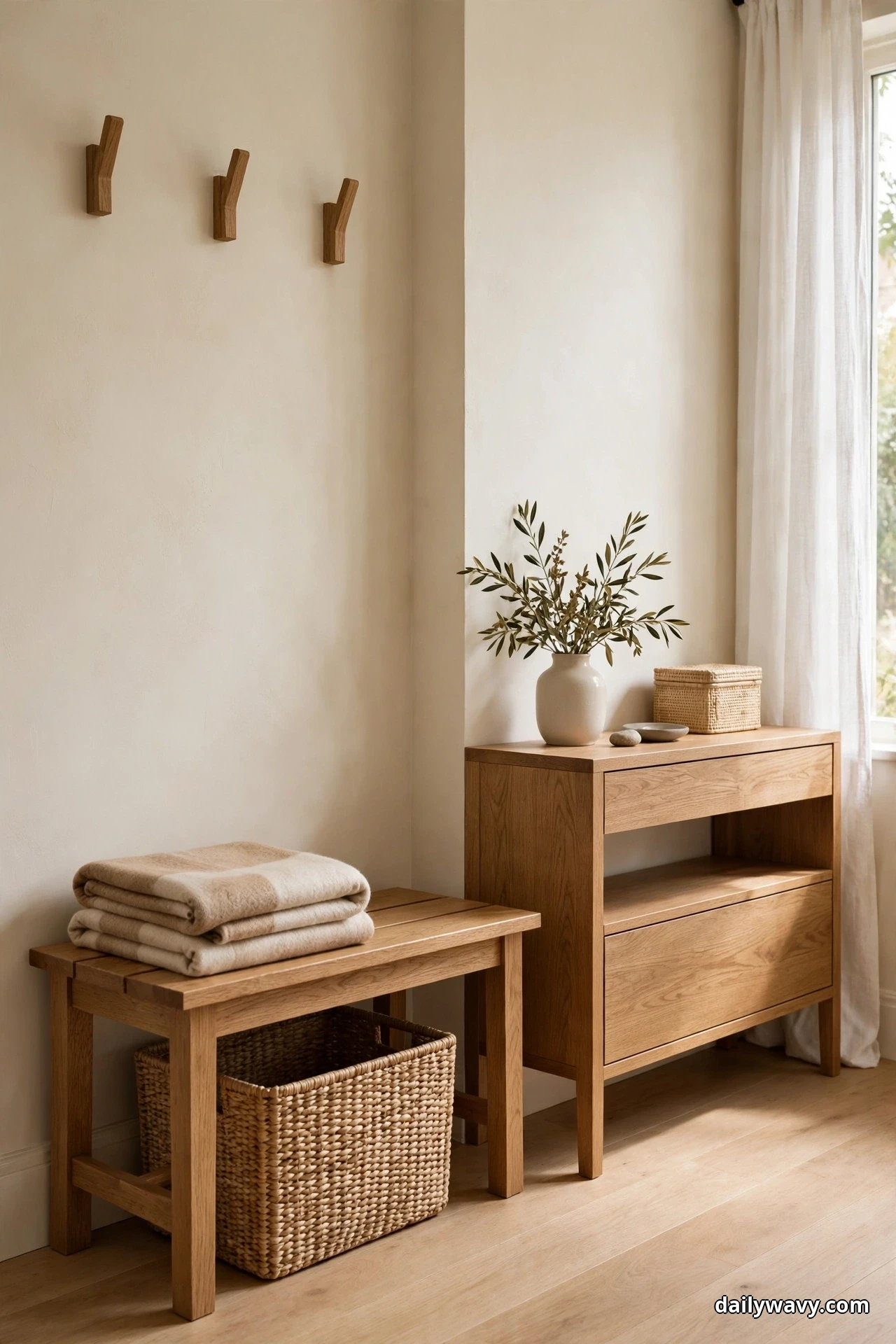
If your entry has room for a small bench beside the console table, a folded blanket on one corner does double duty. It softens the hard lines of wood and metal, and it is genuinely useful for wrapping a chilly guest or cushioning a quick sit-down while tying shoes. Choose a throw in a warm neutral, folded twice to roughly 18 by 12 inches, and lay it on the corner of the bench farthest from the door.
The fold matters. A neat rectangle reads as styled; a crumpled throw reads as laundry. Fold lengthwise twice, then in thirds, and smooth the top layer. A washable cotton or wool-blend throw costs 30 to 60 dollars, and machine-washable is non-negotiable for anything near a front door. Pair it with the basket idea from earlier: when the bench corner holds the blanket, the basket beneath can hold shoes. Two ideas, one footprint, and the corner suddenly feels like the most comfortable seat in the entry.
9. A Narrow Tray For Keys
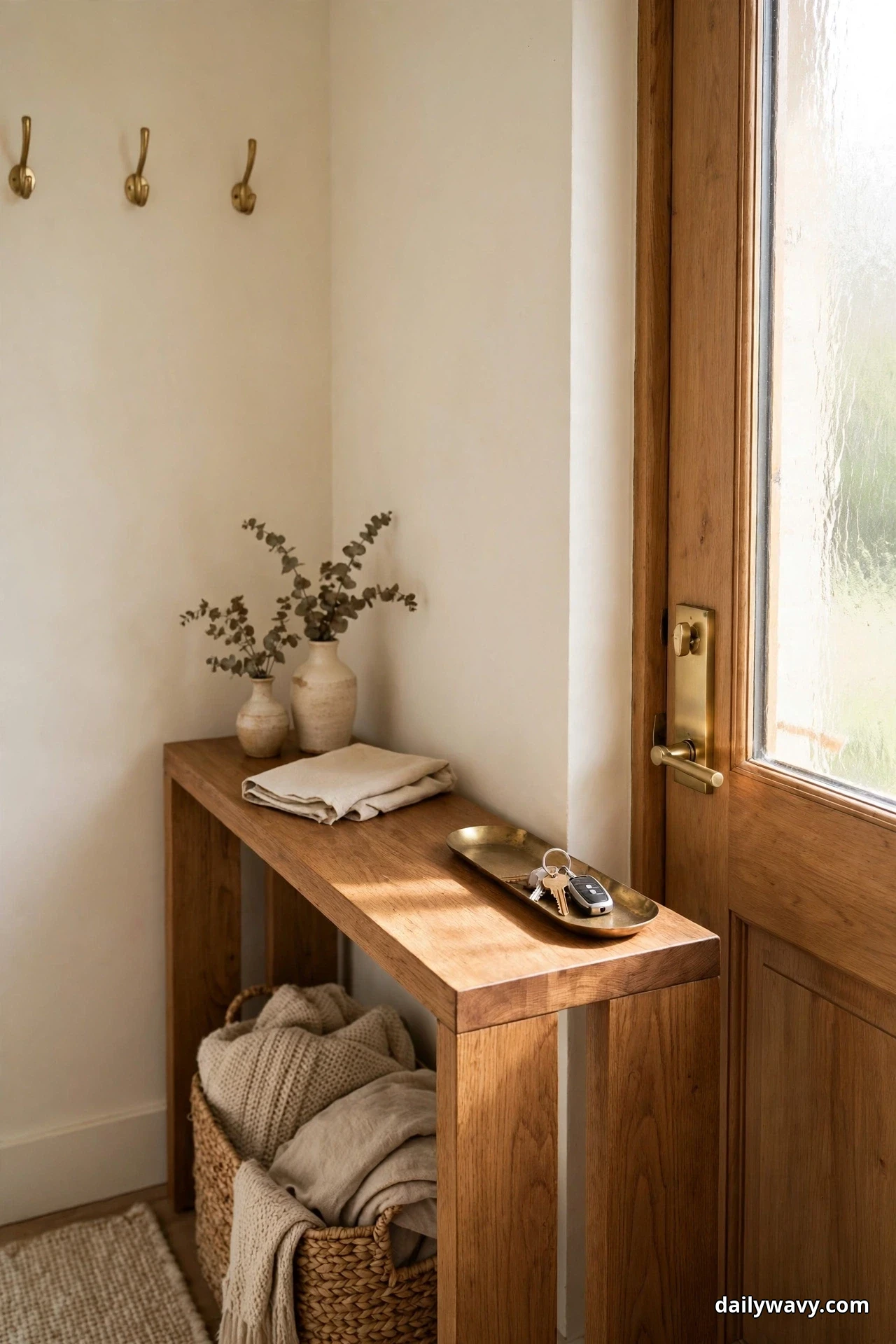
Keys have no business being loose on a styled surface. A narrow tray, roughly 8 inches long and 3 to 4 inches wide, turns the daily key drop into a ritual instead of a scatter. It fits at the end of the console table without stealing space from the lamp or the bowl, and because it is narrow, it signals that only keys live there. No mail, no sunglasses, no pocket lint.
Brass, leather, or lacquered wood trays all sit comfortably in a warm-neutral entry. Expect to spend 15 to 30 dollars. Place it on the side of the console nearest the door, so the first thing you do when you arrive is set the keys down. The habit forms in about a week. Once it does, you will notice something else: you stop patting your pockets in a panic before leaving, because the keys are always in the tray. Small systems, repeated daily, are what make an entryway feel calm.
10. A Basket Tucked Beneath A Bench
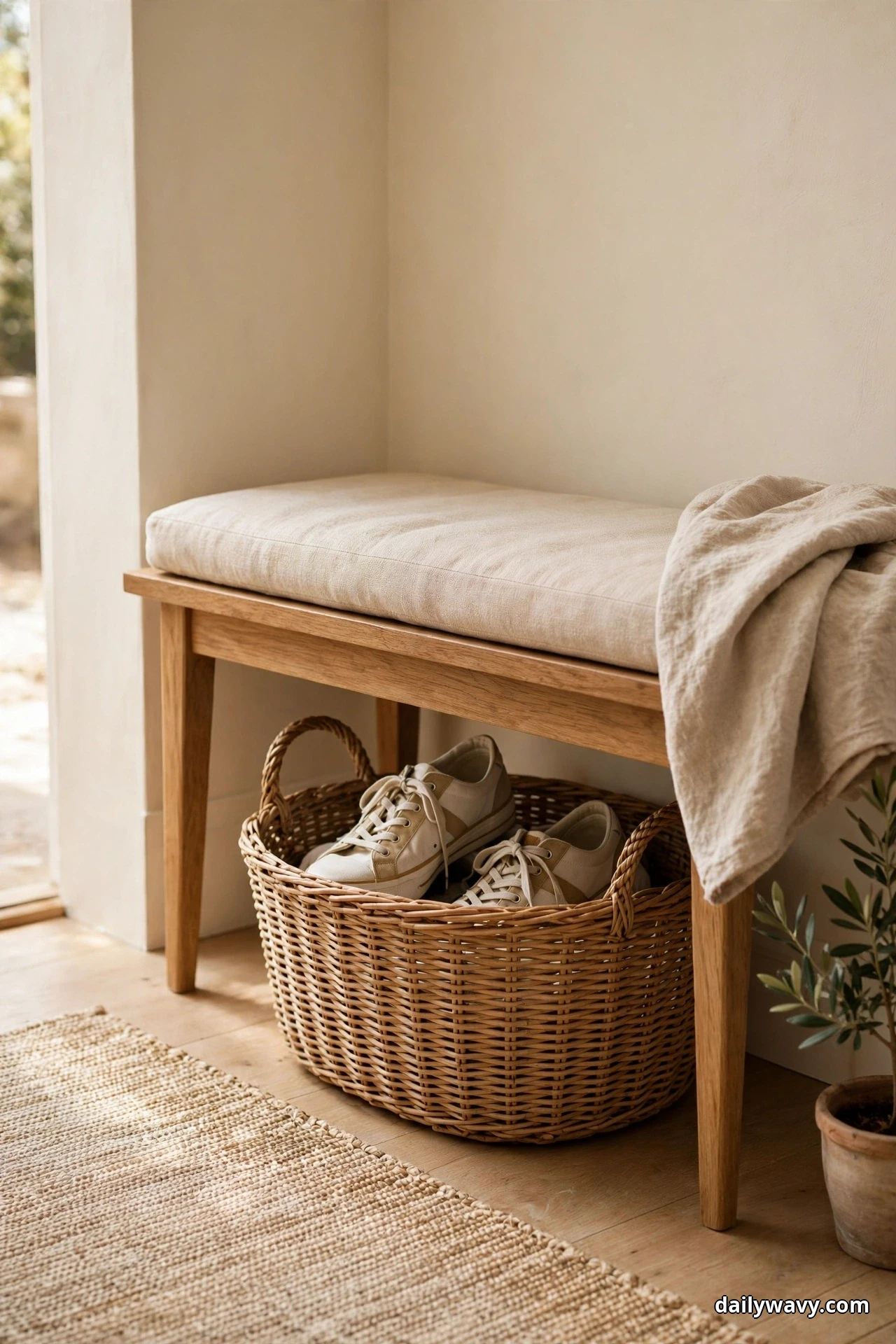
The space under a bench is easy to waste. A basket tucked beneath it puts that space to work without adding visual clutter, since the bench itself hides most of the basket from view. This is the spot for shoes you grab often, a pair of slippers for guests, or the reusable bags that otherwise live on the floor. Measure the clearance under the bench first: most benches offer 10 to 14 inches of height, so a low, wide basket about 8 inches tall fits with room to slide.
Choose a basket with handles so it pulls out like a drawer. Woven baskets in natural fibers cost 25 to 45 dollars for this size. Keep one basket per bench, not two, so the space reads as organized rather than packed. Line it mentally with categories: his shoes, her shoes, guest slippers. The rule is that the floor in front of the bench stays empty, because an entryway with a clear floor looks twice as large and takes half the time to sweep.
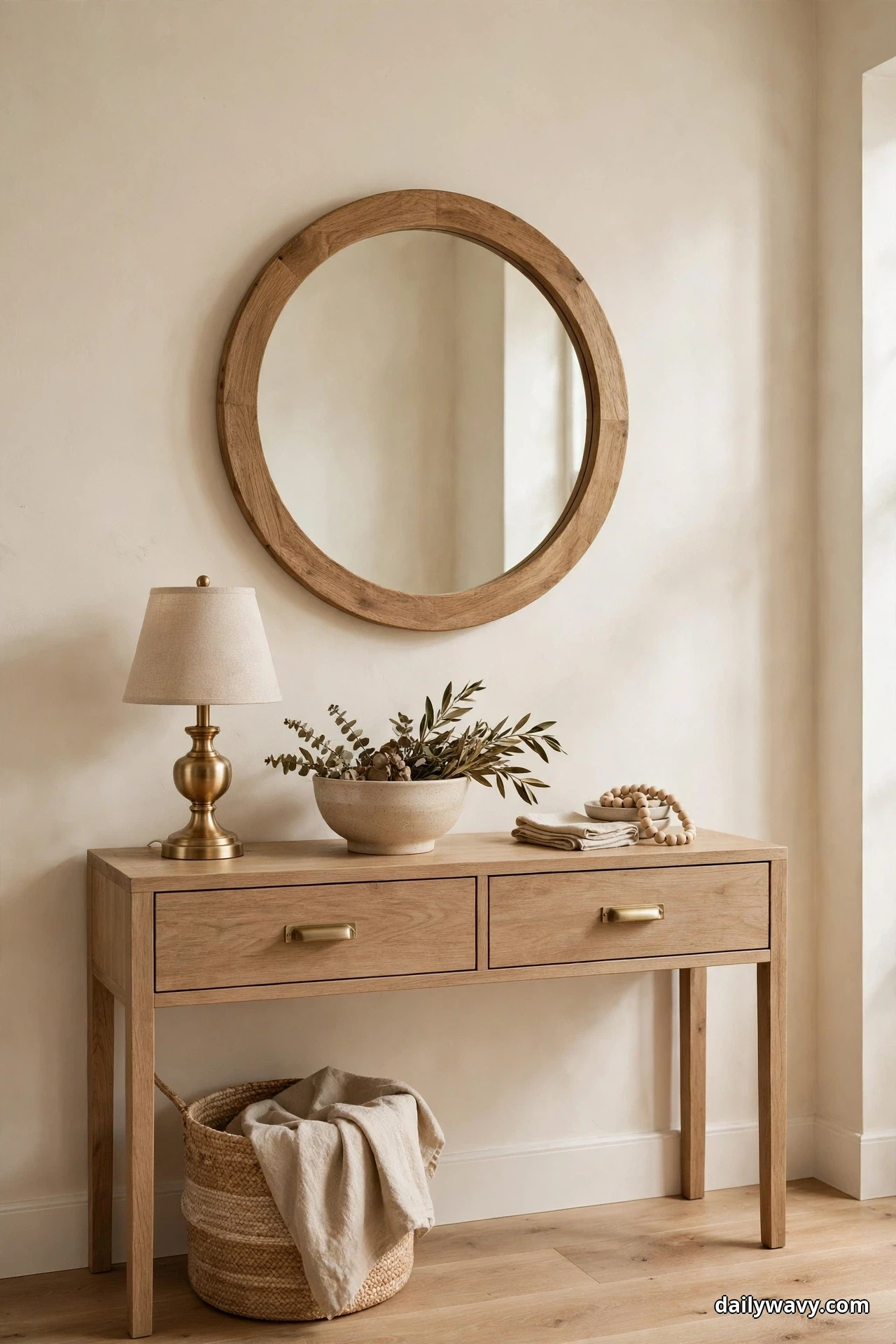
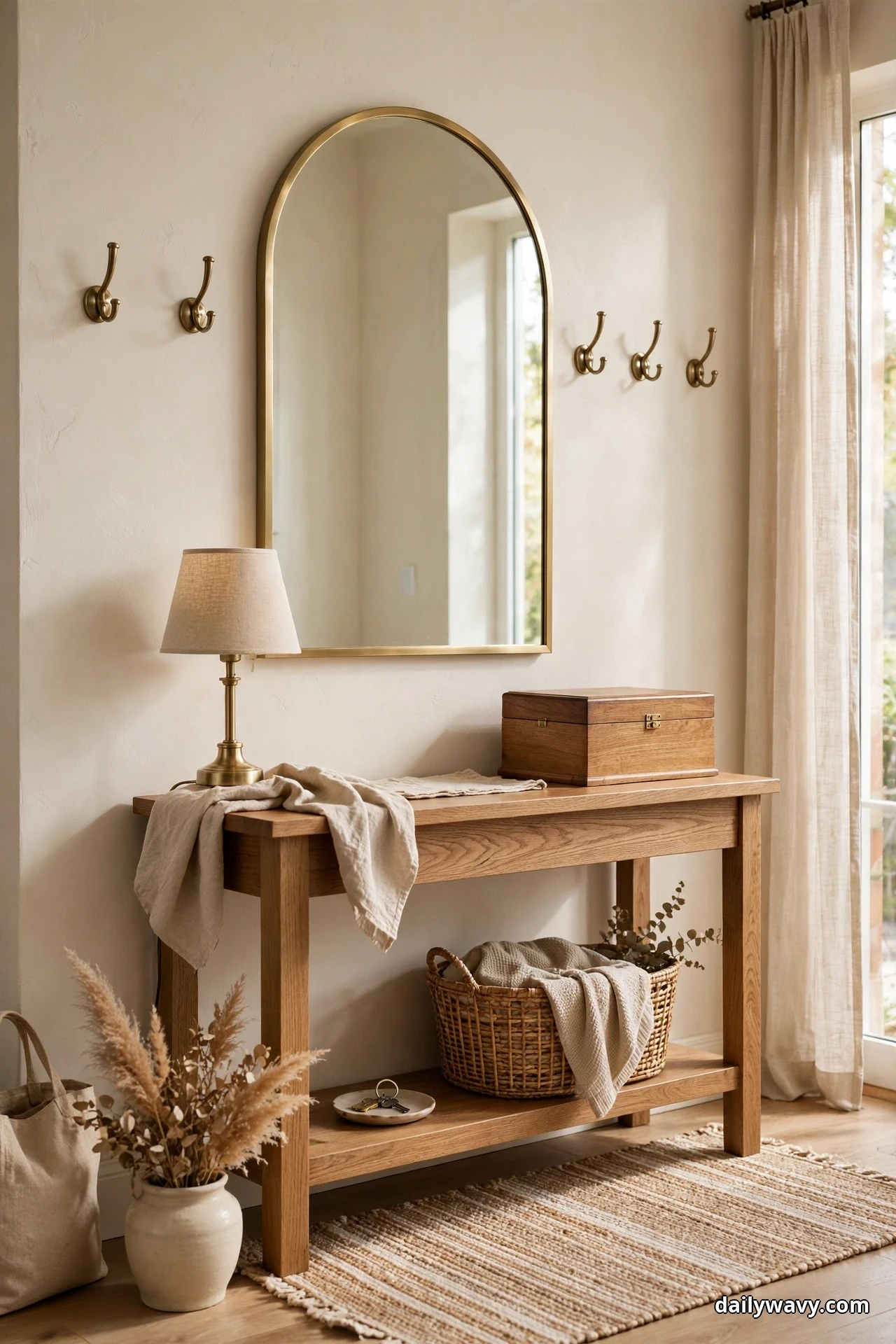
11. A Mirror Over A Shallow Surface
A mirror over a shallow console table is the classic pairing for good reason. It doubles the light in a windowless entry, lets you check your coat before leaving, and makes a narrow hall feel wider. The sizing rule is simple: the mirror should be about two-thirds the width of the console table. On a 48-inch console, a 32-inch round or rectangular mirror sits perfectly centered, hung so its center is around 57 to 60 inches from the floor.
Hang it on a proper wall hook or cleat, not an adhesive strip, since even a small mirror is heavy enough to matter. A round wood-framed mirror in this size costs 50 to 100 dollars. Keep the console surface shallow beneath it, no deeper than 14 inches, so nobody has to lean over the table to use the mirror. And keep the finish consistent with your repeated hardware finish from earlier: if the hooks are brass, a brass-framed mirror ties the whole wall together. The last-look check becomes automatic, and guests appreciate it too.
12. A Durable Mat At The Door
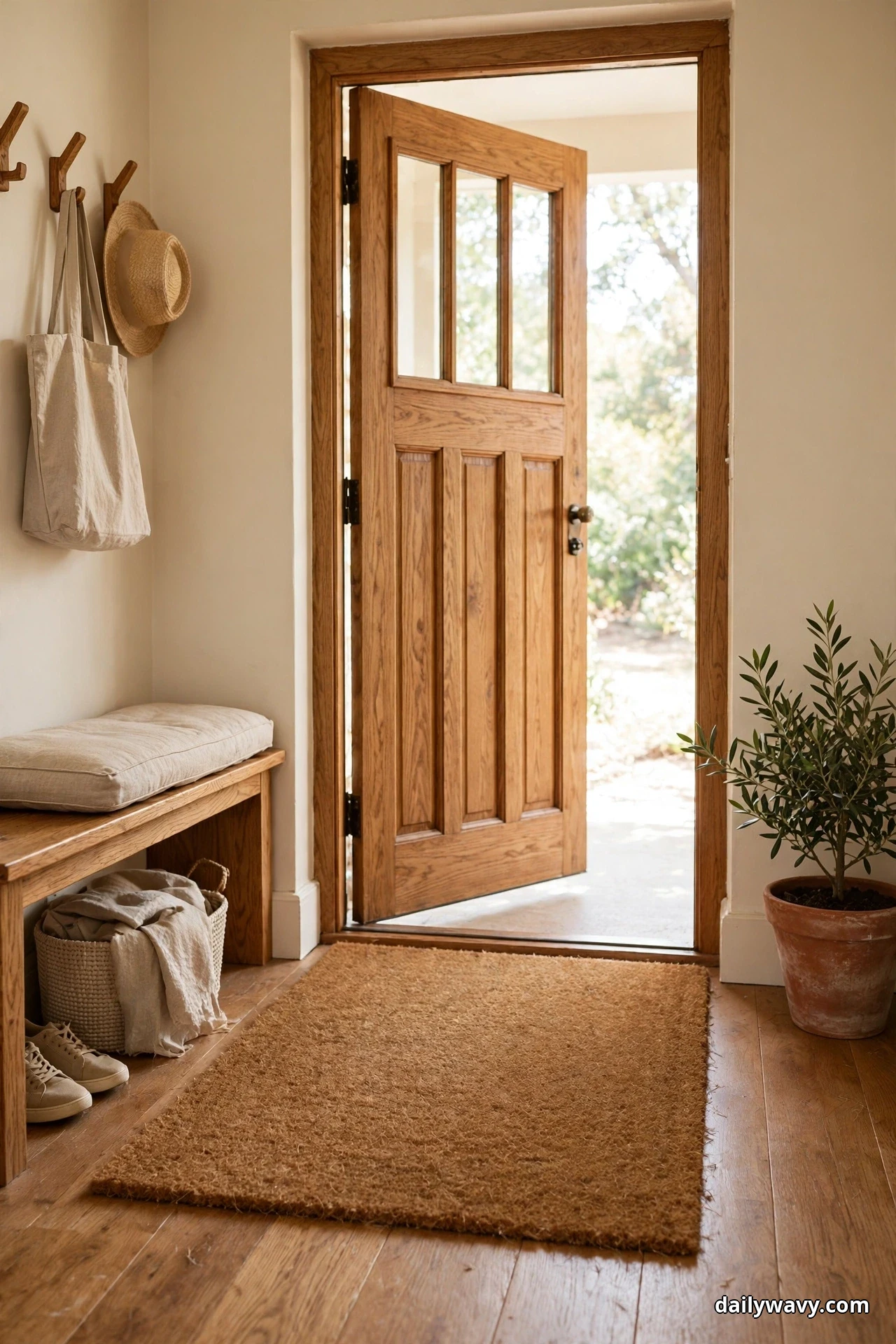
Everything else in this guide sits above the floor. This one protects it. A durable mat at the door catches the grit, water, and slush that would otherwise walk straight across your entry. Size it to the door: the mat should be at least as wide as the door leaf, about 36 inches, and 24 inches deep so both feet land on it. Place it inside the door if the entry is covered, outside as well if the porch is exposed.
Coir, rubber-backed low-pile, and washable cotton runners all handle entry duty. A quality coir mat costs 25 to 40 dollars and lasts years; washable runners run 40 to 70 and can go straight in the machine. Shake or vacuum the mat weekly, because a full mat stops trapping dirt and starts spreading it. This is the least glamorous idea on the list and possibly the most practical. A clean floor makes every styled surface above it look better, and it is the first thing that tells a visitor this entry is cared for.
13. A Compact Closed Shoe Cabinet
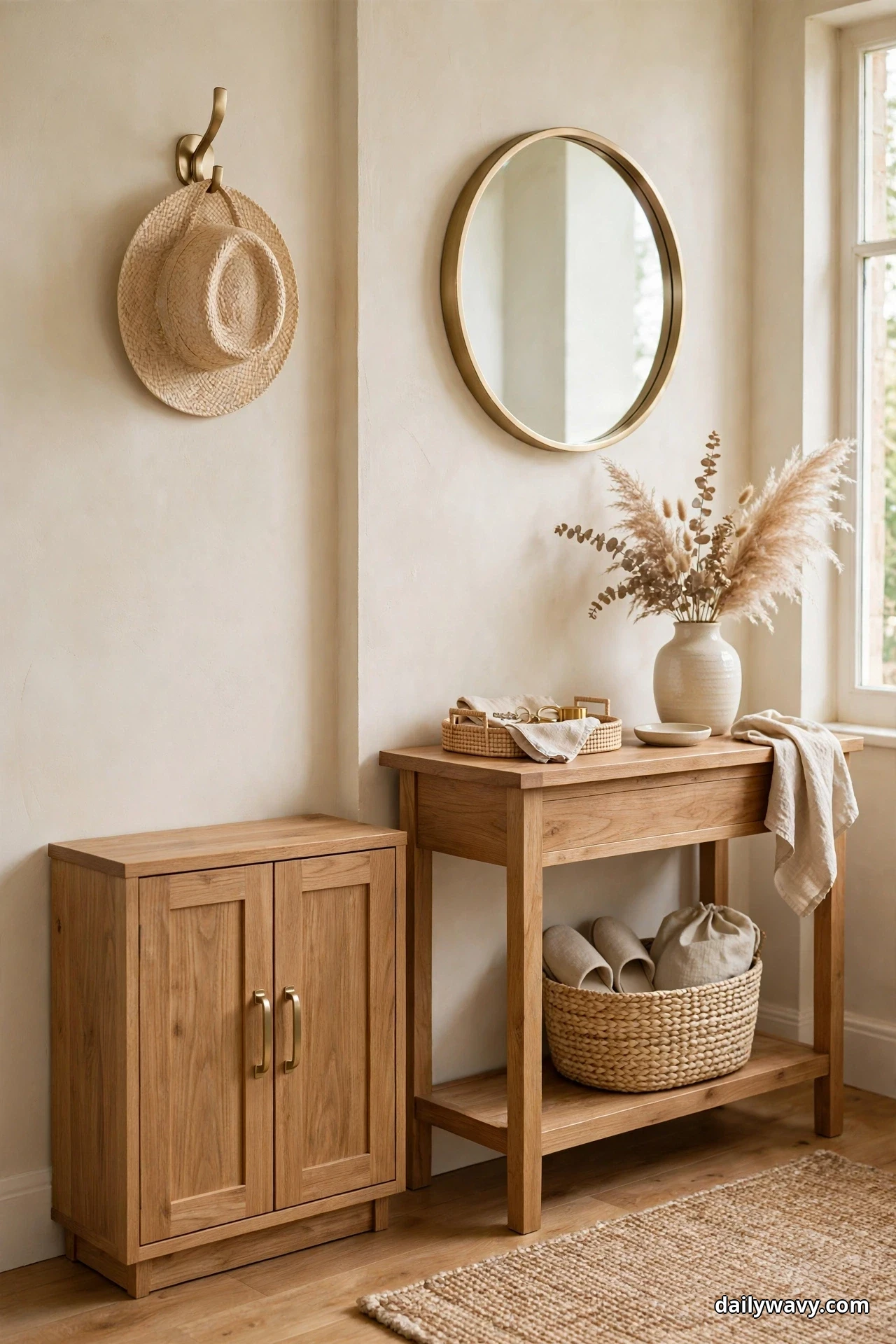
Open shoe racks look fine in a catalog and chaotic in a real entry. A compact closed shoe cabinet, about 24 inches wide and 12 inches deep with two or three tilt-out compartments, holds 6 to 9 pairs of daily shoes behind doors that keep the visual noise away. It works as an overflow station next to the console table or, in a wider entry, as the console itself with a styled top.
The closed part is the whole idea. Shoes are visually busy, all different shapes and colors, and hiding them is what separates a calm entry from a cluttered one. Ventilation matters with closed storage: look for a cabinet with a small gap at the back or drill a few discreet holes, and never store wet shoes inside. A basic two-compartment unit costs 40 to 80 dollars. Assign each household member one compartment and enforce it gently. The console table stays styled, the shoes disappear, and the entry stops smelling like a locker room.
14. A Single Wall Hook For A Daily Bag
One hook, one bag, zero hunting. A single wall hook for the daily bag is the smallest idea on this list and one of the most used. Mount it at about 60 inches high on the wall beside the console table, or on the side of a tall storage piece, within arm’s reach of the door. It holds the tote, work bag, or diaper bag you grab every morning, and because there is only one hook, it can never become a tangle of four.
Choose a hook rated for at least 15 pounds, anchored into a stud or with a heavy-duty drywall anchor. A solid brass or matte-black single hook costs 8 to 20 dollars. The discipline is the point: this hook is for the bag in active rotation, not for every bag you own. When the bag changes with the season, the hook stays and the routine stays. Guests notice this detail more than almost anything else, because it tells them exactly where things belong in your entry.

15. A Small Lamp On A Safe Surface
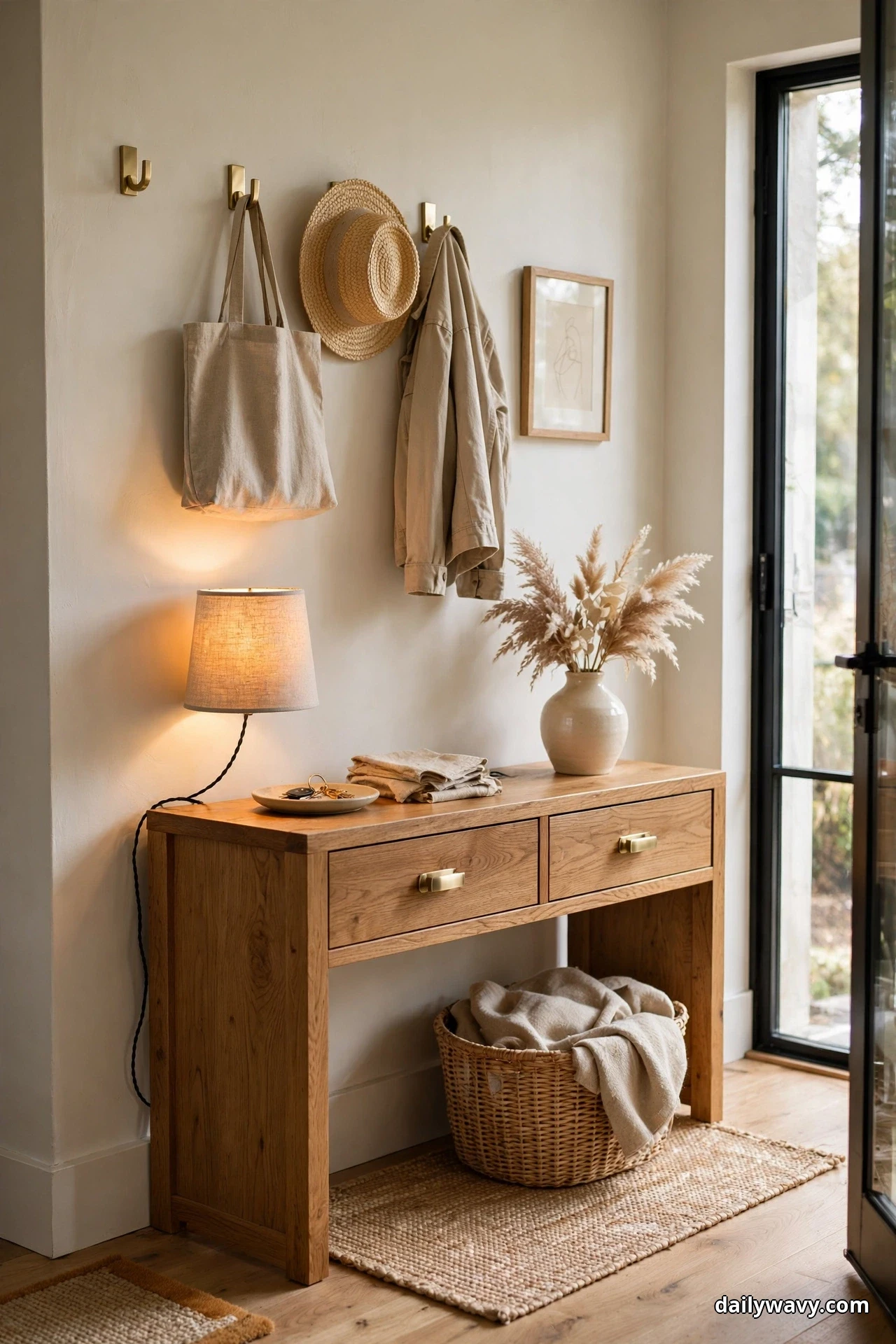
An entryway lamp is the difference between coming home to a dark box and coming home to a welcome. A small lamp, 12 to 16 inches tall with a shade about 8 inches across, sits on the console table and throws warm light at exactly the height you need to see keys, mail, and faces. Put it on a timer or a smart plug set to dusk, so the entry glows before you arrive.
The safe-surface part matters. Keep the lamp base at least 6 inches from the table edge and away from the door swing, with the cord routed behind the table and secured so nobody snags it. A compact ceramic or linen-shade lamp costs 30 to 60 dollars, and an LED bulb in a warm 2700K keeps it efficient enough to leave on a timer every evening. If the console holds a mirror, place the lamp to one side so its reflection doubles the glow. This is the one idea that changes how the entry feels at night, which is half of every day.
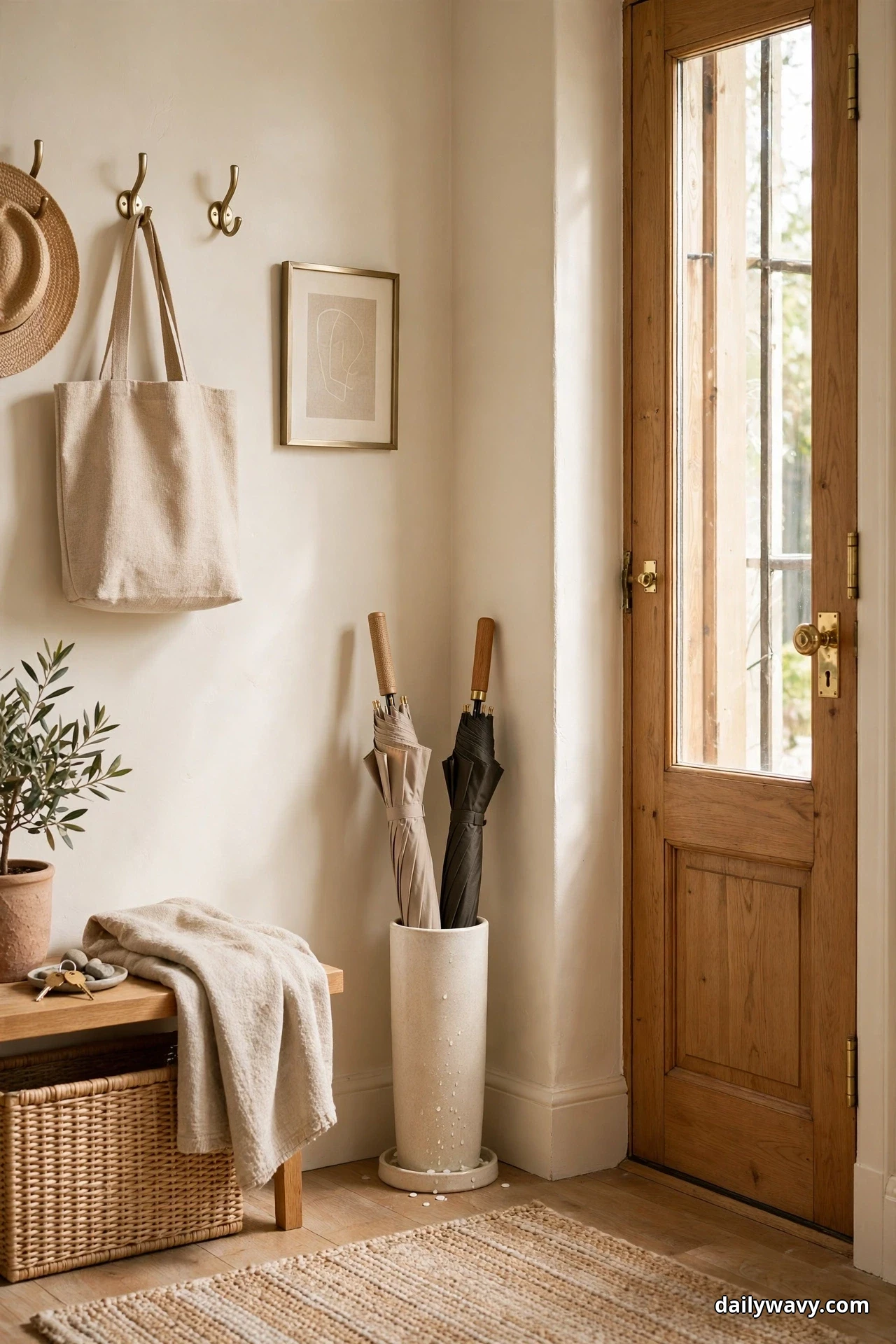
16. A Slim Upright Umbrella Holder
Wet umbrellas on the floor are a puddle waiting to happen. A slim upright umbrella holder, about 8 inches in diameter and 18 inches tall, corrals them into one vertical footprint in the corner by the door. Drip trays or a removable base make cleanup easy: lift, empty, done. This is strictly for the corner outside the door swing, where it never blocks the path.
Ceramic, metal, or weighted fabric holders cost 25 to 50 dollars. Keep it to the umbrellas in active use, two or three at most. A holder stuffed with six is a closet, not an entry solution. If you live somewhere rainy, this piece earns its place eight months a year; if rain is rare, the same slim profile works for a walking stick or a folded market tote. Either way, the floor stays dry and the console table never becomes an umbrella rack.
17. A Lidded Box For Small Essentials
Every entry collects small things with no home: spare change, a lip balm, the garage remote, a spare house key for the sitter. A lidded box for small essentials, roughly 8 by 5 inches, sits on the console table and swallows all of it. The lid is the styling trick. An open dish shows clutter; a closed box shows a handsome object. Choose wood, lacquer, or woven seagrass in a tone that matches the room.
Put the box at the opposite end from the lamp so the console reads balanced. Inside, you can add a small divider or just let the contents settle. It costs 20 to 40 dollars for something well made. Empty it once a month, because even a lidded box accumulates mysteries. What you are really buying is permission to be untidy in exactly one place, which is what keeps the rest of the entry looking effortless.
18. A Framed Print Beside The Door
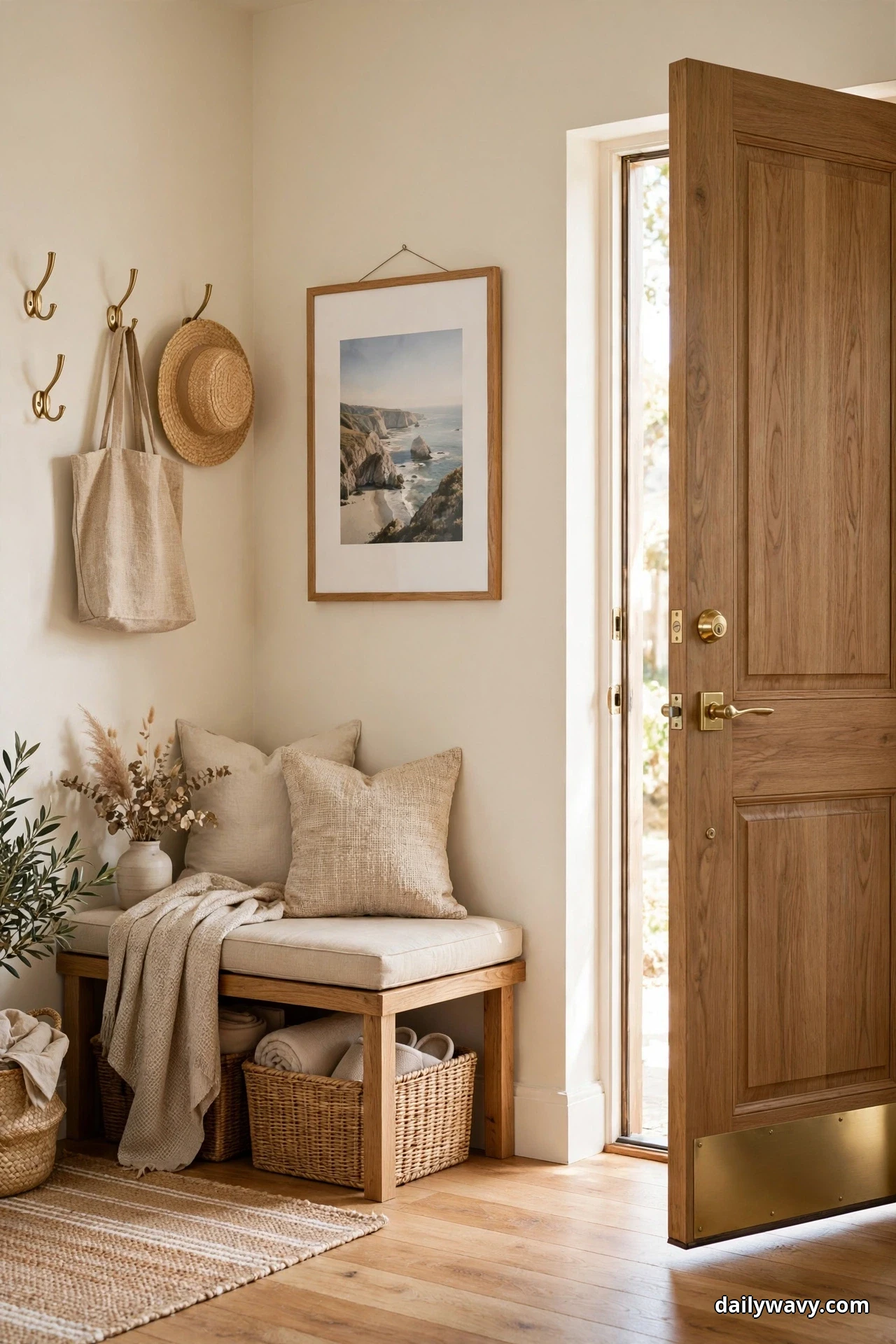
The finishing touch is personal. A framed print beside the door, roughly 11 by 14 inches with a simple frame, gives the entry the one thing styling alone cannot: a sense of who lives there. A travel photo, a botanical print, a piece of the kids’ art in a real frame. Hang it at eye level, center around 57 to 60 inches, on the wall section beside the door or above the outgoing basket.
Keep the frame finish consistent with the hardware finish you repeated earlier, and keep the matting generous, at least 2 inches, so the print breathes. A ready-made frame in this size costs 15 to 30 dollars; printing a photo you already love costs a few dollars more. This is the last idea because it goes in last, after the systems are working and the surfaces are styled. It is also the one guests remember. Systems make an entry work. A print makes it yours.
Frequently Asked Questions
How deep should an entryway console table be?
Most entries work best with a console 12 to 16 inches deep. That gives you a real surface for a lamp, a tray, and a bowl without eating into the walkway. Anything deeper than 16 inches starts to pinch a standard 36-inch passage, and anything shallower than 10 inches struggles to hold a lamp base safely. Measure your walkway first and subtract the 36 inches of clear passage you need to keep: what remains is your maximum depth.
What do I put on a console table so it still looks styled with daily use?
Think in three zones: one tall item (lamp or vase), one low wide item (bowl or tray), and one flat stack (two books). That is the whole formula. Daily items like keys and mail get their own trays, which keeps them contained. Leave about a third of the surface visibly empty. An empty stretch of tabletop reads as calm and makes the styled parts look intentional.
My entryway is tiny. Can I still use these ideas?
Yes, and a small entry actually benefits more. Choose the landing-zone ideas first: the key tray, the mail tray, the single wall hook, and the mirror. Skip the bench and the shoe cabinet if the floor space is not there. A 30-inch console with four of these ideas will feel more finished than a bare 60-inch wall. The measuring rules in the primer still apply, just on a smaller scale.
How do I stop the console table from becoming a dumping ground?
Give every category of item a container with a lid or a boundary: keys in the tray, mail in the sorter, small things in the lidded box, outgoing items in the basket. Then enforce one rule: flat surfaces are for styled pieces only, and anything else goes in its container. A two-minute nightly reset, dropping stray items into their homes, keeps the system running with almost no effort.
What is the best height for a console table?
Standard console tables run 30 to 34 inches tall, which works for most entries. Match it roughly to the height of any nearby furniture, like a bench or the bottom of a window sill, so the sightlines stay comfortable. If you are styling around a tall mirror, a 32 to 34 inch console puts the mirror center right at the 57 to 60 inch eye-level mark.
Should the entryway match the rest of the house?
It should relate, not match. Repeat one or two things from the adjacent room, a wood tone or a metal finish, so the entry feels connected. But entries earn their own small personality: a bolder print, a warmer lamp, a color you would not commit to in the living room. The repeated hardware finish idea above is the easiest way to tie it all together.
The Takeaway
A welcoming entry is not about square footage or a big budget. It is about giving the first and last room of your day the same thought you give the rest of the house. Measure the door swing and the walkway, choose the console table as your anchor, and build out from there with a few ideas that fit your space and your routine. The small entryway decor guide goes deeper on compact entries specifically, and if your hall pinches at the corners, the narrow living room layout ideas translate well to tight passages. For more rooms done in the same calm, practical spirit, browse the Home and Decor collection and the small bedroom with a queen bed ideas for small-space thinking that works everywhere.
Start with the landing zone, add the light, and hang the print that makes it yours. The door will open on something that feels finished, every single time.