
15 Front Porch Seating Ideas for a Welcoming Entrance
The front porch is the handshake of your home. It is the first thing guests touch and the last thing…
The front porch is the handshake of your home. It is the first thing guests touch and the last thing neighbors notice, and it sets the tone for everything inside. A welcoming entrance does not require a renovation or a big budget. It comes from a few deliberate choices: somewhere to sit, something green, one color repeated, and a walking route that stays clear. This guide rounds up fifteen seating-focused ideas you can actually recreate, from a low basket of outdoor-safe essentials to a compact bench sized for a narrow stoop. Each one covers what to measure, a lower-cost way in, and the materials or placement behind it. Pick the one your porch is missing and start there.
In This Guide
- A Low Basket With Outdoor-Safe Contents
- A Repeated Metal Finish
- A Single Accent Color
- A Hanging Decoration Secured Appropriately
- A Short Row Of Small Pots
- A Simple Door-Side Wall Accent
- A Compact Chair Angled Toward The Garden
- A Textured Outdoor Runner
- A Small Watering-Can Vignette
- A Planter With Local Seasonal Foliage
- A Clear Landing Area At The Entrance
- A Pair Of Proportionate Planters
- A Single Compact Bench
- A Layered Mat With Safe Flat Edges
- A Small Seasonal Wreath
The Front Porch Seating Rules Before You Start
Before you buy a single thing, take five measurements and make three decisions. First, measure the walking route. Keep a clear 36-inch path from the steps to the door, and never let furniture, planters, or decor narrow it. Second, measure the door swing. Anything near the door has to survive the door opening fully, so swing the door wide and mark the arc on the floor. Third, measure your seating zone. A single chair needs roughly a 30 by 30 inch footprint plus legroom, and a bench needs its depth plus 18 inches in front for knees.
Then the decisions. Everything you put on the porch must be outdoor-rated or weather-tolerant: rain, sun, and wind will find every weakness. Secure anything light enough to blow away, either by weight or by fastening. And keep the palette restrained. Warm neutrals with one accent color read as calm and intentional, while five colors read as clutter. For styling continuity once you step inside, our small entryway decor ideas carry the same welcome through the front door.
1. A Low Basket With Outdoor-Safe Contents
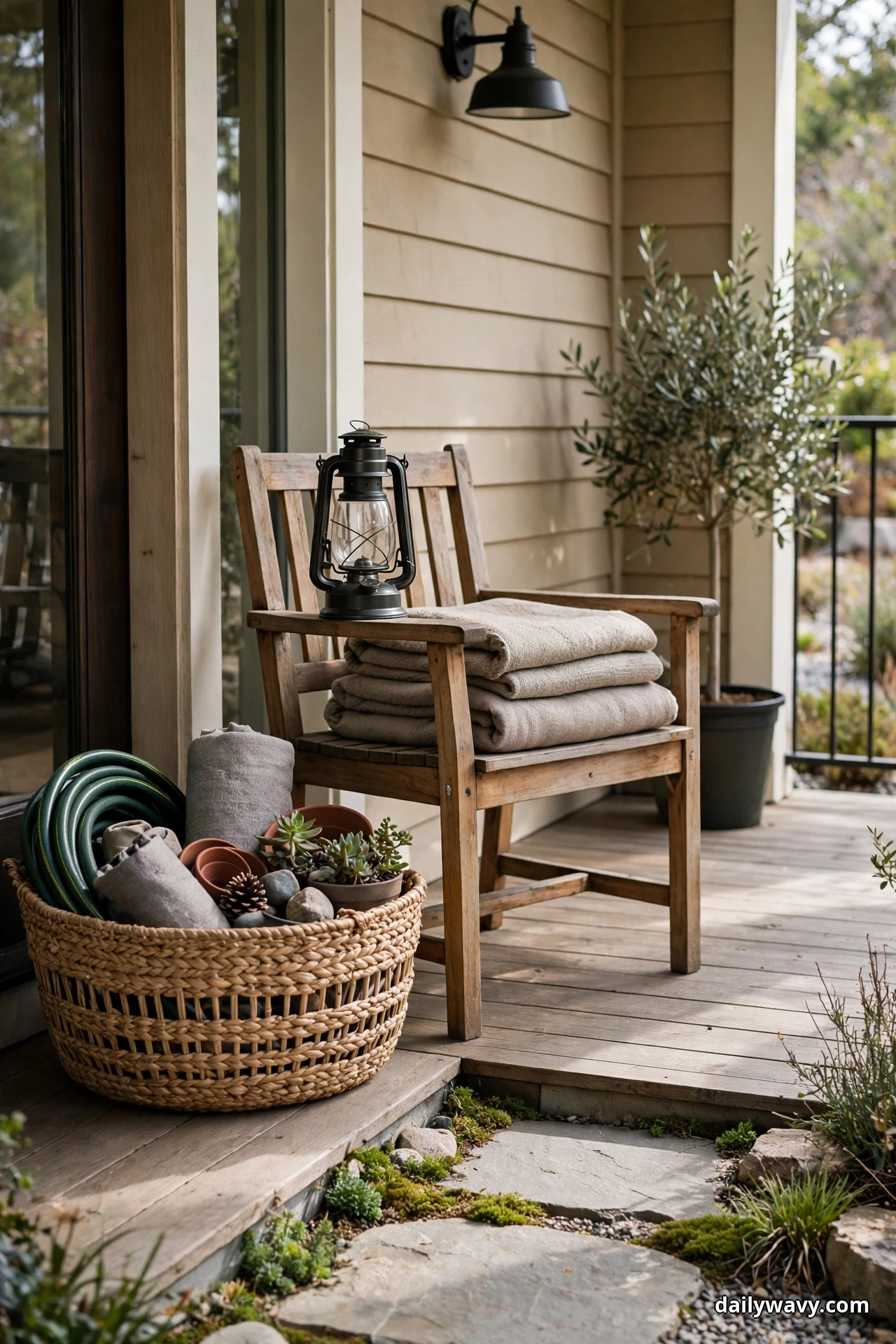
Every welcoming porch has a spot for the things you reach for on the way in and out. A low, sturdy basket tucked beside the seating does that job without looking like storage. Fill it with folded outdoor-rated throws for chilly evenings, a lantern, and whatever your porch life needs, like garden gloves or a stack of coasters. The contents stay weather-safe, the basket keeps them corralled, and the whole thing reads as styling rather than utility.
The look is an open-weave basket, about 18 to 22 inches wide, in seagrass, rattan, or weather-safe poly-resin. Set it within arm’s reach of the chair, on the side away from the walking route. Keep it low, roughly the height of the chair seat, so it visually anchors the seating instead of competing with it.
What to measure: the basket footprint against your clear 36-inch path. If the porch is narrow, a tall slim basket works, but it must not tip, so test it on a windy day before committing.
Lower-cost swap: use a laundry or market basket you already own and slip it into service for the season. If it is natural fiber, keep it under the roof overhang so it dries between rains.
For general storage thinking that applies beyond the porch, our small pantry organization ideas use the same grouping logic indoors.
2. A Repeated Metal Finish

Nothing pulls a porch together faster than repetition. When the lantern, the planter stands, the house numbers, and the door handle all share one metal finish, the eye reads the whole porch as one deliberate composition. It is the cheapest form of cohesion there is, because you do not add anything, you just edit what is already there.
The look is three or more small items in a single finish: powder-coated black, aged bronze, or brushed nickel. Black is the safest choice against warm neutrals because it grounds every other material. Space the repeated pieces across the porch rather than clustering them, so the finish leads the eye from the steps to the door.
What to measure: count your existing metal pieces and note their finishes. You need at least three in the same finish for the repetition to register; two just looks like a coincidence.
Lower-cost swap: one can of outdoor-rated spray paint in your chosen finish. Clean, prime, and repaint your existing lanterns, brackets, and house numbers instead of replacing them.
3. A Single Accent Color
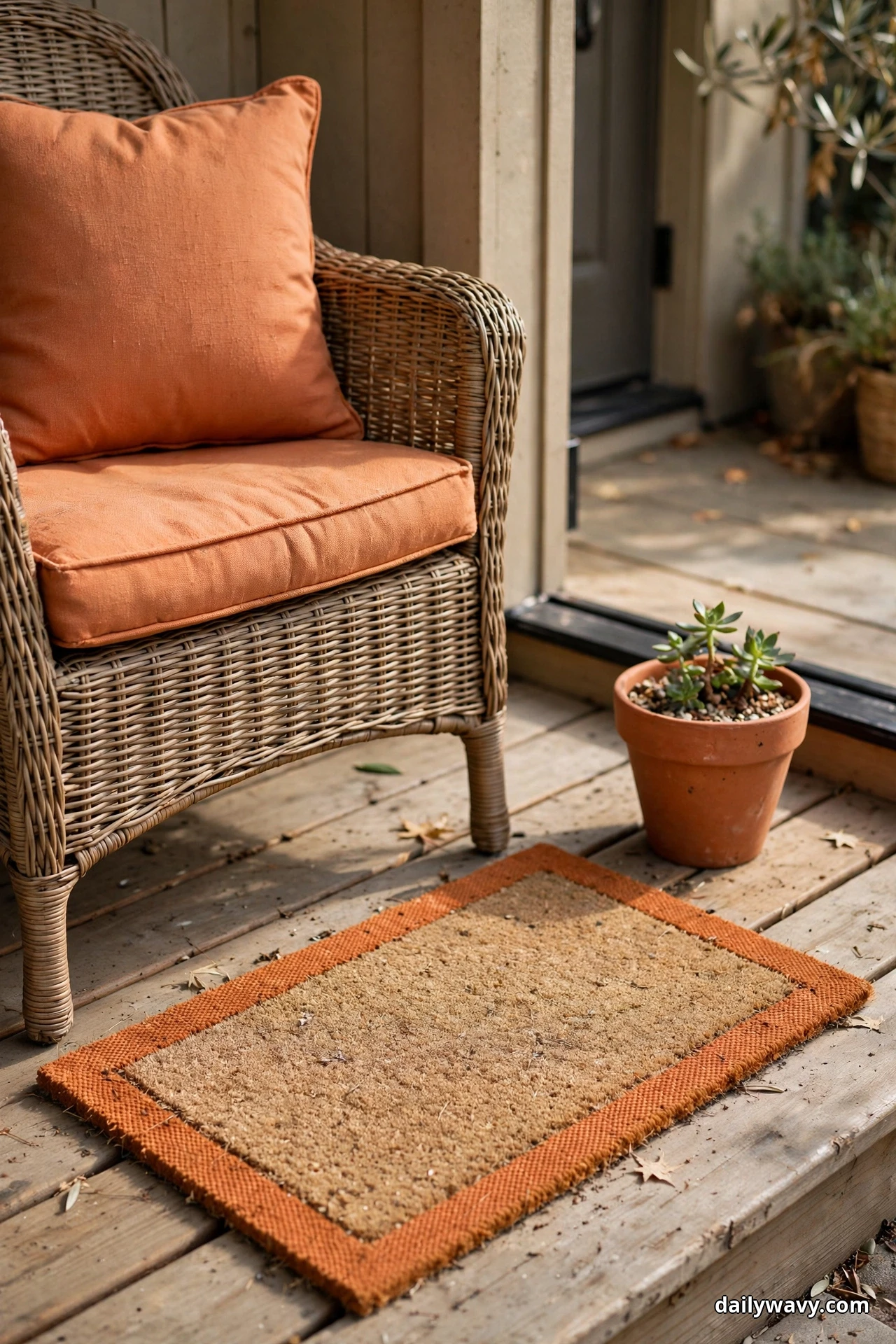
A porch styled entirely in neutrals can feel finished but forgettable. One accent color, used three times, gives it a memory. Terracotta, deep green, or a dusty blue all sit comfortably against warm neutrals without shouting. The trick is discipline: the accent appears on the cushion, the mat border, and one planter, and nowhere else.
The look starts with the base palette of creams, woods, and blacks, then adds the accent in small doses. A cushion on the chair, the border of the doormat, and a single painted pot are enough. Each instance should be visible from the street, because the accent is what makes the porch readable from the sidewalk.
What to measure: nothing structural, but step back to the curb and check the balance. If the accent dominates from the street, pull one instance back. If it disappears, add one more.
Lower-cost swap: one quart of outdoor paint. A single painted pot plus a cushion cover in a matching tone costs less than a takeout dinner and transforms the whole porch.
4. A Hanging Decoration Secured Appropriately
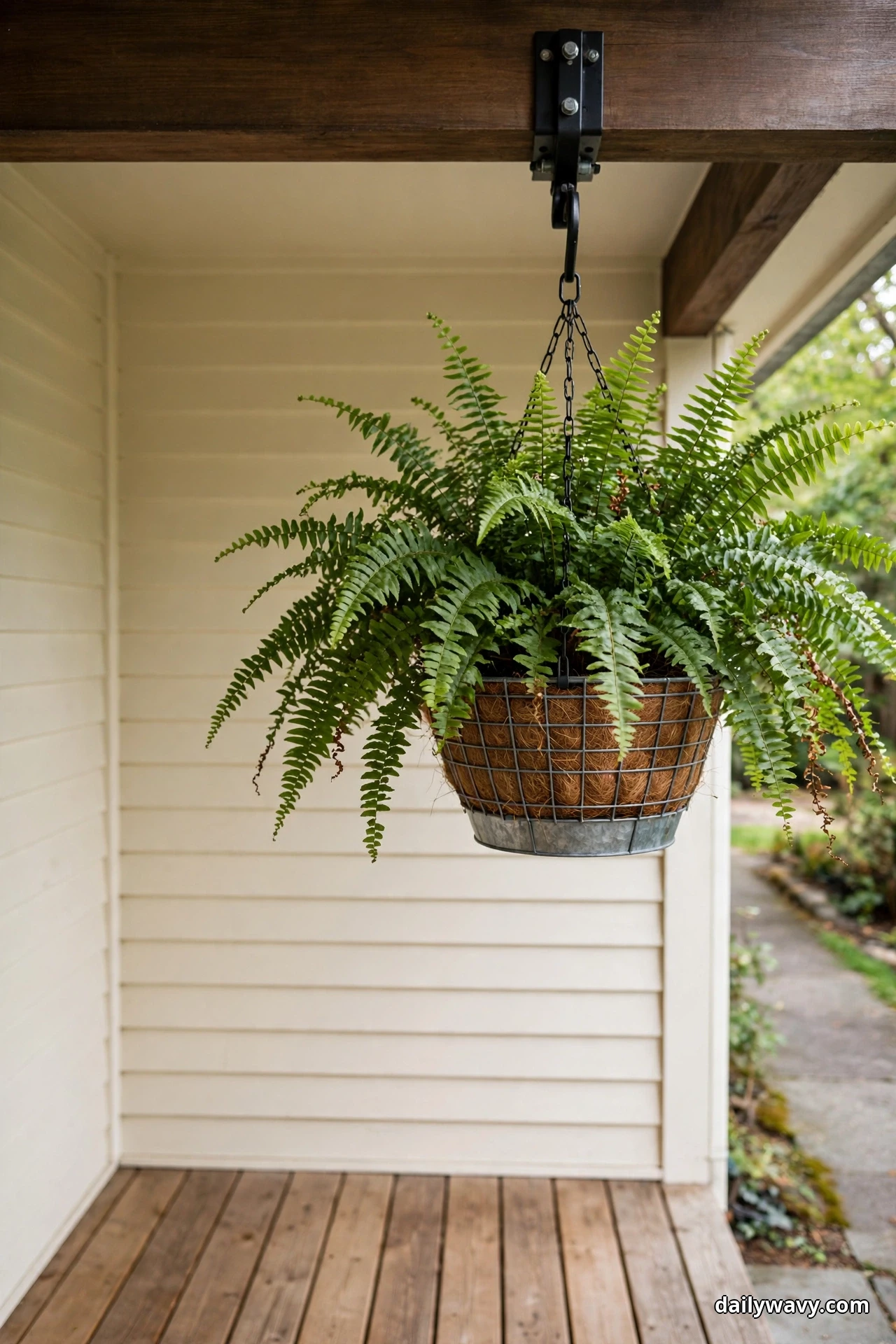
A hanging fern or lantern draws the eye upward and fills the dead air under the porch ceiling, which is often the most neglected zone of the whole entrance. But hanging anything outdoors is a safety item first and a styling item second. The right hardware makes it both.
The look is a single hanging element, a Boston fern in a lined metal basket, a glass lantern, or a wooden bead garland, suspended from a ceiling hook or beam bracket. Hang it to the side of the walking route, never over it, and keep the bottom at least 7 feet above the porch floor so nobody walks into it.
What to measure: the weight of the item, wet. A watered fern can weigh twice its dry weight, so choose a hook rated for at least three times what you expect. Drill into a beam or joist, never into soffit boards alone, and use a hook with a locking arm so wind cannot lift it off.
Lower-cost swap: a simple black ceiling hook and a nursery fern in a plastic pot slipped inside a nicer hanging basket. The basket is what shows.
5. A Short Row Of Small Pots
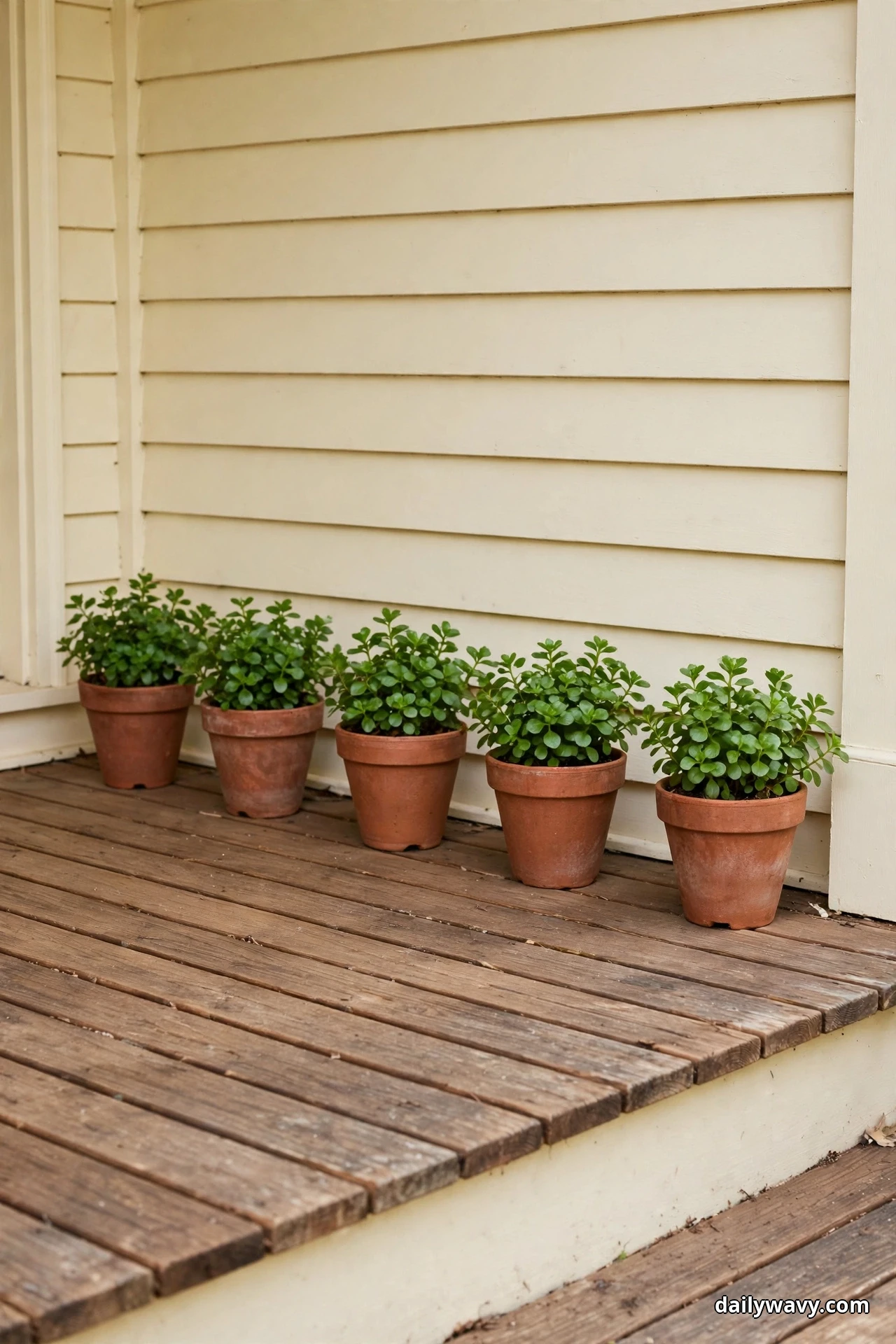
A row of small pots along the porch edge works like a low hedge: it defines the boundary, softens the hardscape, and gives the seating area a backdrop. The restraint is what makes it work. Three to five pots, all the same material, all roughly the same size, all with similar greenery. Uniformity reads as calm; variety reads as clutter.
The look is terracotta or concrete pots, 6 to 10 inches in diameter, lined along the porch edge or stair cheek with even spacing. Fill them with one plant type repeated, like boxwood balls, ornamental grasses, or seasonal annuals, so the row reads as a single gesture rather than five separate decisions.
What to measure: the available edge length. Space pots with roughly one pot-width between them, and keep the whole row off the walking route. Pots near steps need extra attention to stability, so use saucers with grip or place them where a foot cannot catch them.
Lower-cost swap: nursery pots slipped into matching cachepots. The plants cost the same either way, and the cachepots give you the uniform look without buying five ceramic planters.
6. A Simple Door-Side Wall Accent
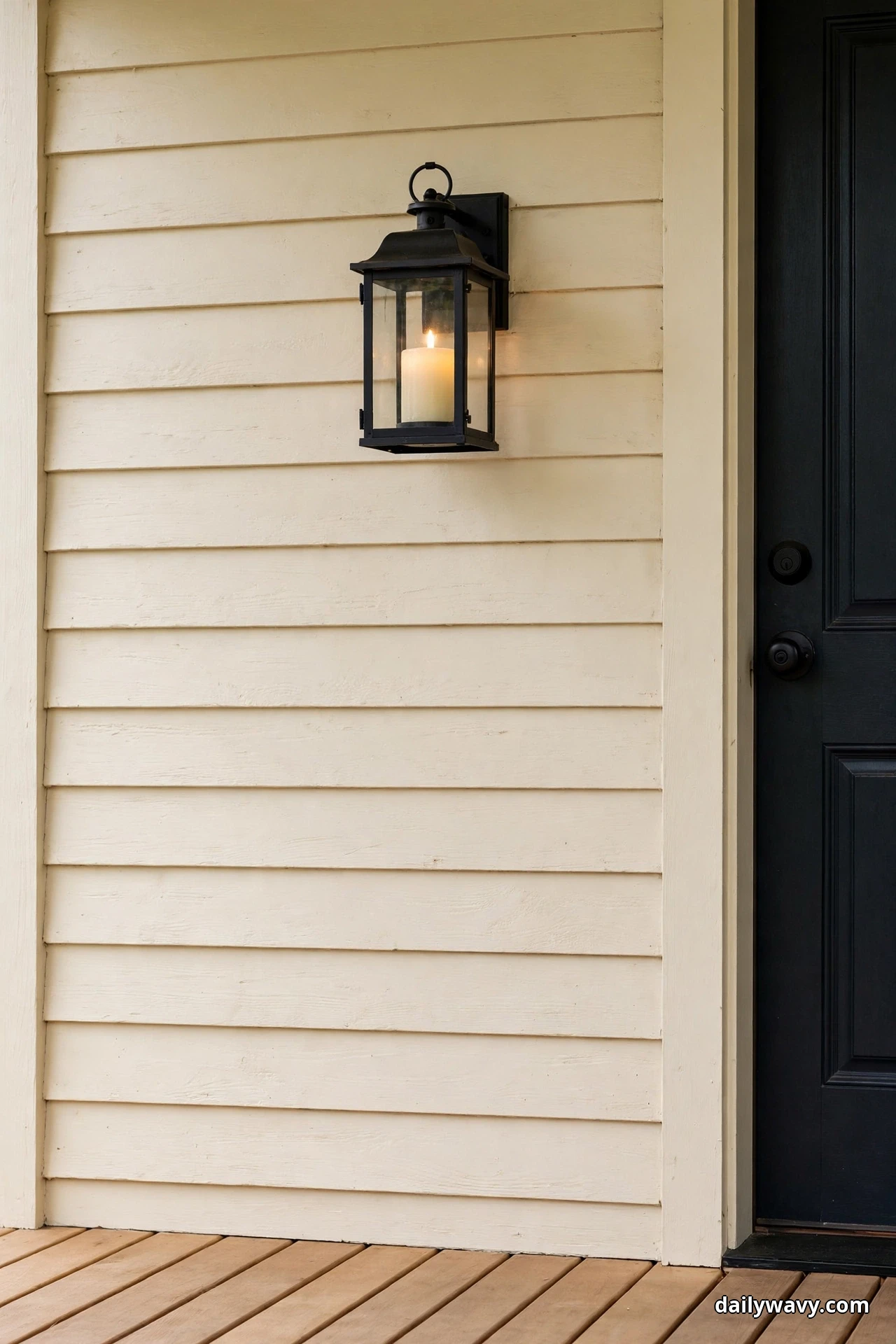
The wall beside the door is free real estate. A simple lantern, a small shelf, or a house number plaque mounted there adds character without touching the floor, which matters on a narrow porch where every inch of floor space has to earn its keep. Wall accents also sit at eye level, so they register immediately when someone walks up.
The look is one restrained piece, not a gallery. A black metal lantern with a battery candle, a slim wooden shelf holding a single potted plant, or a plaque in the same metal finish you are repeating elsewhere. Mount it 60 to 66 inches from the porch floor so it sits at natural eye level.
What to measure: the wall width beside the door and the door swing. The accent must clear the open door by at least 2 inches, and it should not block the view from the peephole or the reach to the doorbell.
Lower-cost swap: a painted wooden sign or a secondhand lantern refreshed with outdoor spray paint. One wall piece is a ten-dollar project.
7. A Compact Chair Angled Toward The Garden
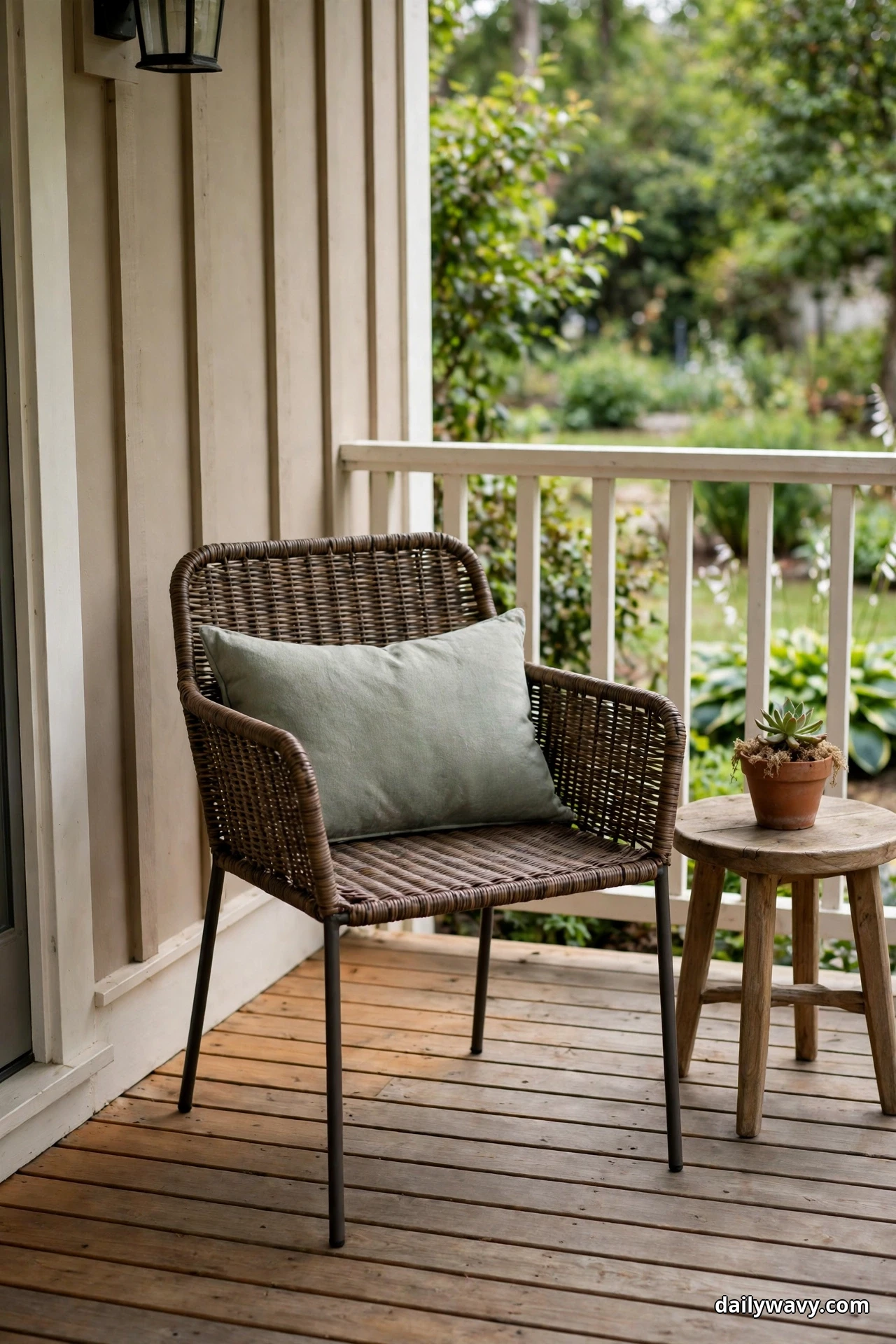
One chair, angled toward the garden instead of squared to the door, changes the whole feeling of a porch. It says someone sits here and watches the street, which is exactly the welcome you want to project. The angle matters more than the chair: 30 to 45 degrees off the house wall feels relaxed and intentional, while squared-up feels like a waiting room.
The look is a compact outdoor chair, an Adirondack, a bistro chair, or a deep-seat lounge chair in an outdoor-rated material. Add one cushion in your accent color and a small side table within arm’s reach. One chair is enough on a narrow porch; two chairs belong only where the depth allows them without crowding the walking route.
What to measure: the chair footprint, roughly 28 by 30 inches, plus swing space if it rocks or swivels. Angle it so the seat faces the view you want to highlight, and confirm the door still swings fully clear.
Lower-cost swap: a secondhand wooden chair sanded and painted with exterior paint, plus an outdoor-rated cushion. Thrift stores are full of porch-ready chairs.
8. A Textured Outdoor Runner
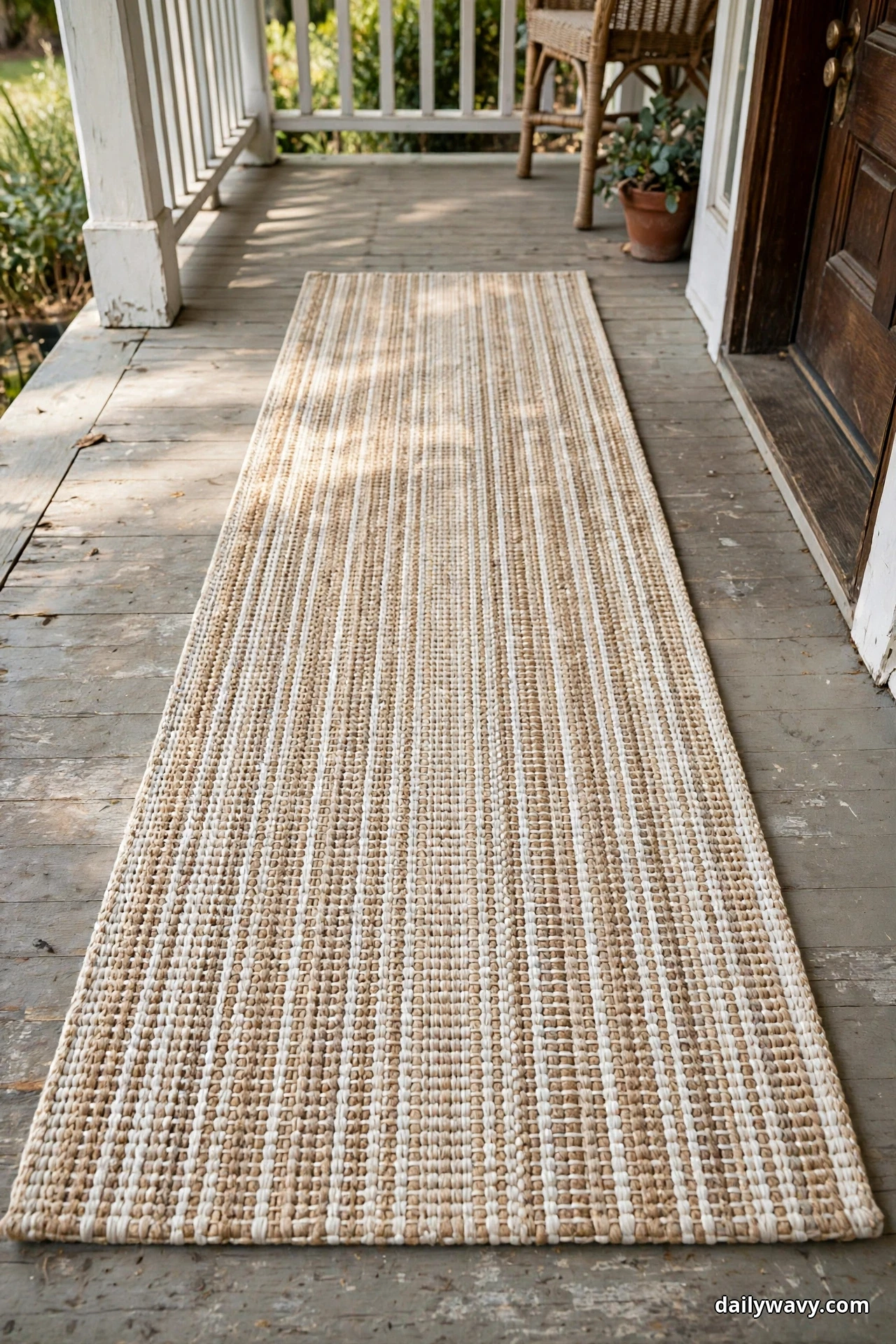
A runner does two jobs at once: it defines the seating zone so the porch reads as a room, and it softens the hardscape underfoot. Texture is what keeps it from looking flat. A polypropylene runner with a woven or ribbed texture gives you the look of natural fiber with the weather tolerance a porch demands.
The look is a flat outdoor runner, 2 to 3 feet wide, running from the steps toward the door or along the seating wall. Keep the pattern quiet, a stripe, a rib, or a tonal weave, in warm neutrals that match the porch. The runner should lie perfectly flat with no curled edges, because anything that catches a toe fails the safety test.
What to measure: the porch width. The runner should be 12 to 18 inches narrower than the porch on each side, leaving a border of bare floor. For the length, cover the seating zone without running under the door swing.
Lower-cost swap: a flat-weave polypropylene rug in the closest size you can find. Outdoor rugs go on deep discount at the end of every summer season.
9. A Small Watering-Can Vignette

Some of the best porch styling is also useful. A galvanized watering can beside a small pot and a lantern makes a vignette that looks styled and actually waters the plants. It is the kind of detail guests notice without quite knowing why the porch feels cared for.
The look is a metal watering can, galvanized or powder-coated, grouped with one small potted plant and a low lantern on a step, a bench end, or a corner of the porch. Keep the group tight, within a 24-inch square, so it reads as one composition. Odd numbers and varied heights are what make a vignette work.
What to measure: only the corner or step it sits on. The watering can must be stable where it stands, full or empty, and it should not block the walking route or the door swing.
Lower-cost swap: a thrifted watering can with a coat of outdoor spray paint. Even a dented one looks intentional once it is one color.
10. A Planter With Local Seasonal Foliage
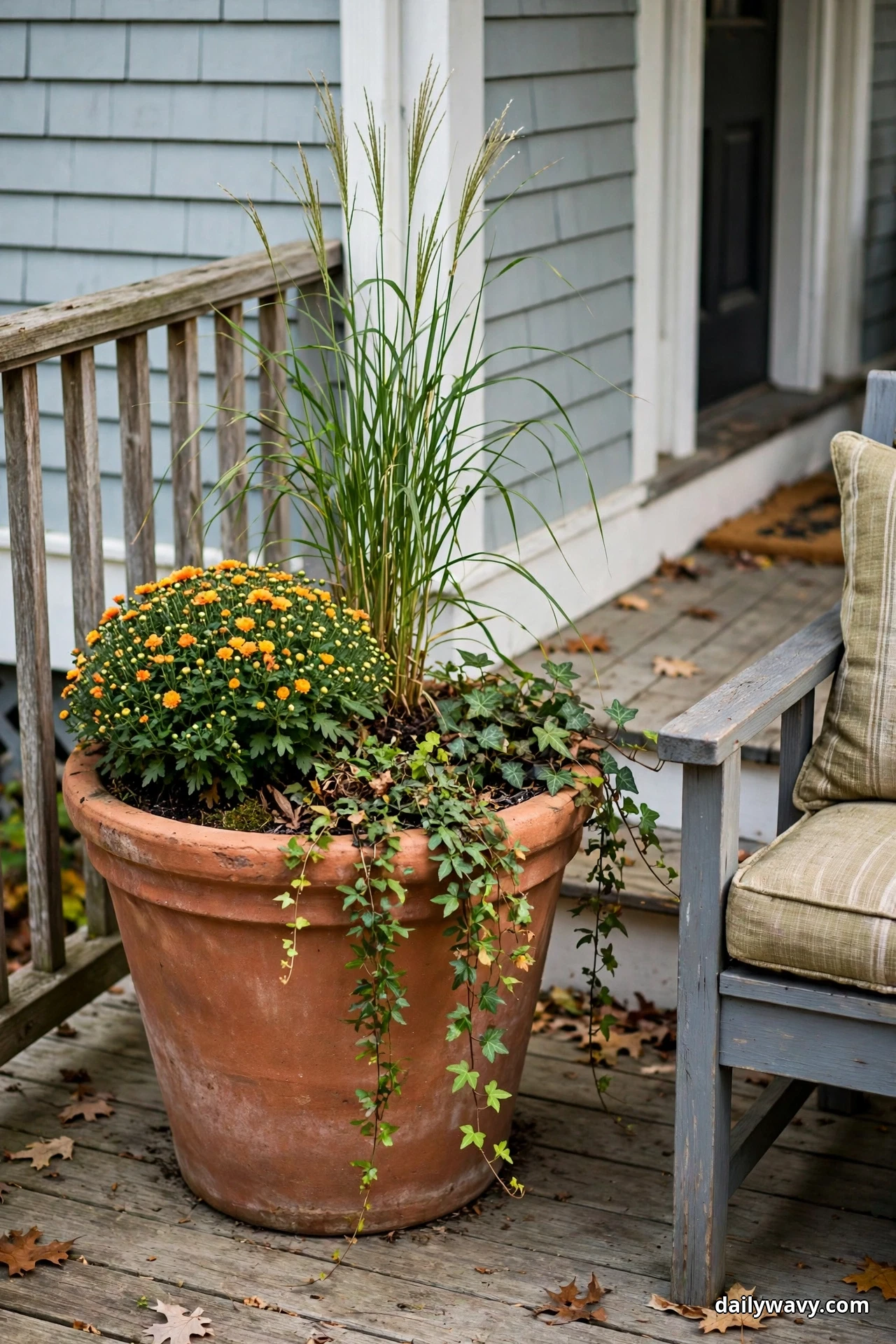
One generous planter with plants that actually thrive in your area beats three small pots of struggling imports. Local, seasonal foliage looks fuller, needs less fussing, and changes with the year, which keeps the porch feeling alive rather than frozen. Choose what the nursery down the road is selling in quantity: that is your clue about what grows well nearby.
The look is a single planter, 16 to 20 inches in diameter, in terracotta, concrete, or glazed ceramic, filled with a mix of one upright plant, one mounding plant, and one trailing plant. The classic thriller, filler, spiller formula exists because it works. Set it where it gets the light its tag requires.
What to measure: the planter location against sun and rain. Full-sun plants in a shaded porch will sulk, and no drainage will kill anything faster than neglect. Every outdoor planter needs drainage holes.
Lower-cost swap: one big planter instead of several small ones. A single statement pot costs less than a collection and looks more expensive.
11. A Clear Landing Area At The Entrance
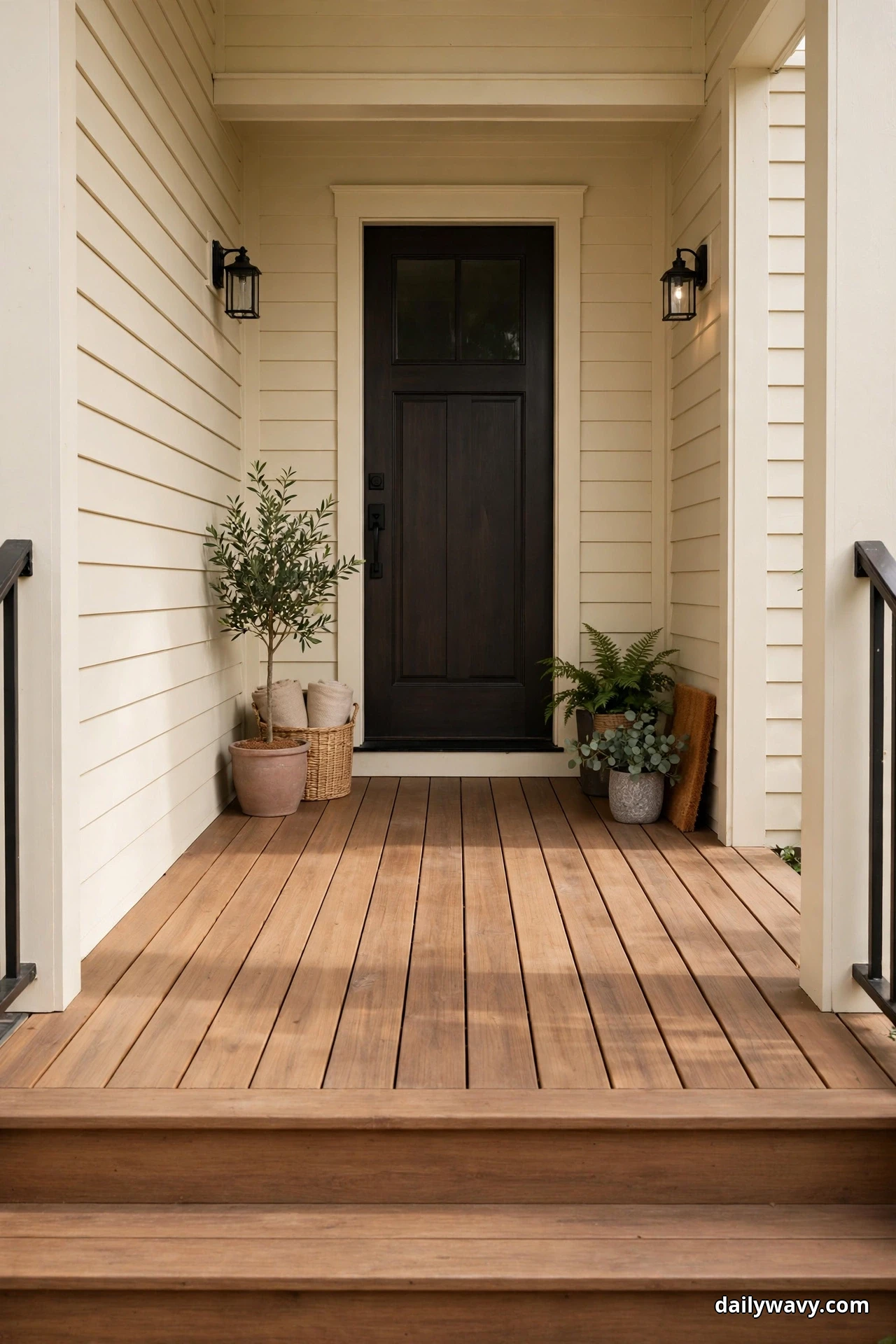
This idea costs nothing and improves every porch: keep the landing area in front of the door completely clear. No pots, no baskets, no shoes, no welcome mat stacked on another mat. A clear landing is safer, it photographs better, and it makes the entrance feel larger than it is. All the styling goes to the sides.
The look is restraint. The zone from the steps to the door, at least 36 by 36 inches, stays empty. Decor lives along the walls and the porch edges, never in the path someone walks carrying groceries in the rain.
What to measure: the door swing plus the step width. The clear zone must cover the full arc of the open door and the natural two steps everyone takes after crossing the threshold. For narrow porches, our narrow living room layout ideas use the same keep-it-clear discipline indoors.
Lower-cost swap: free. Walk out with a trash bag, move everything that sits in the landing zone, and do not put it back.
12. A Pair Of Proportionate Planters
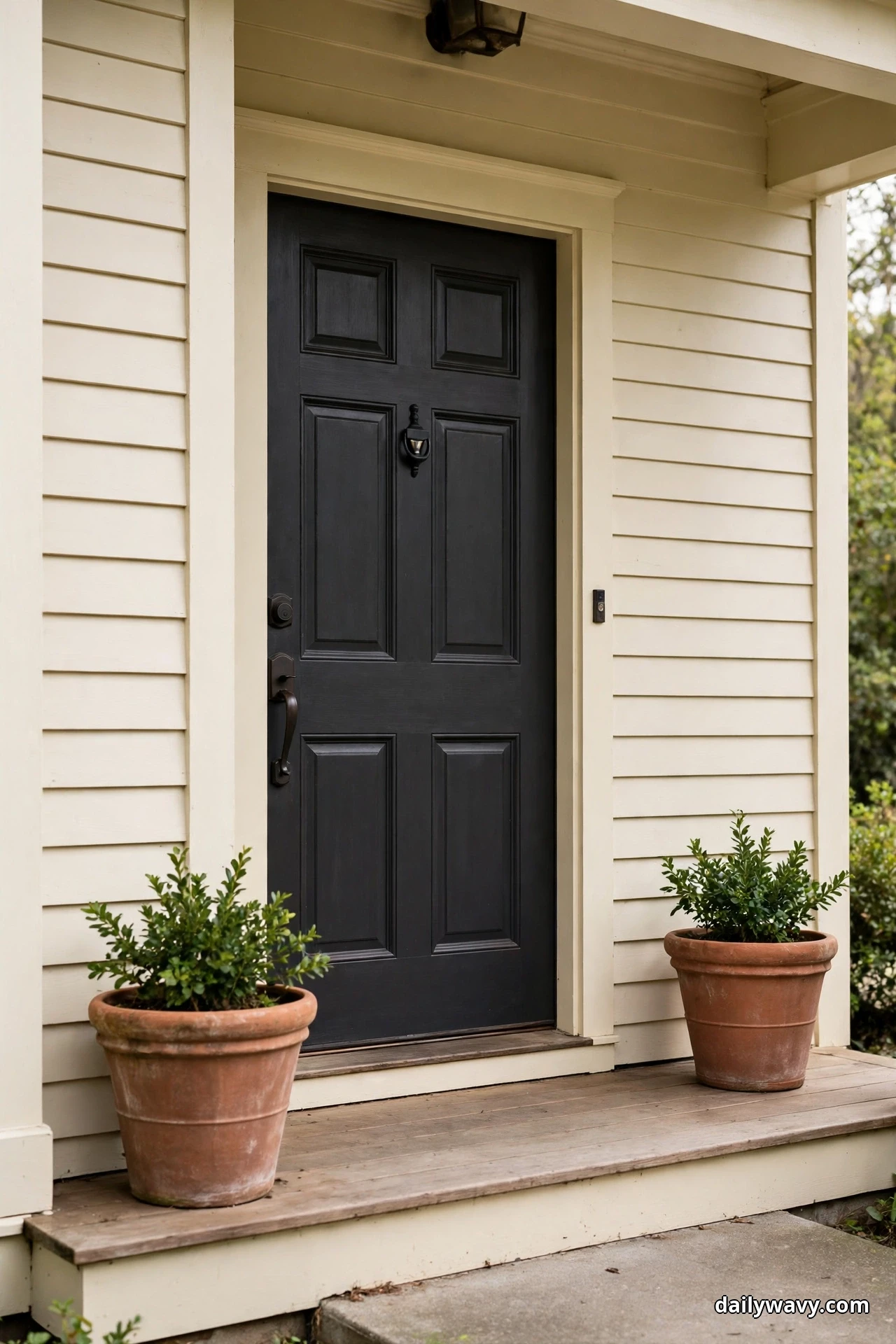
Flanking planters are the classic entrance move because symmetry signals welcome. The secret is proportion. Planters that are too small look apologetic, and planters that are too big eat the walkway. Each planter should be roughly one quarter to one third the width of the door, and tall enough that the greenery inside reaches at least halfway up the door.
The look is two identical planters, one on each side of the door, in terracotta, concrete, or a glazed finish that matches the house trim. Fill them with the same planting, boxwood, grasses, or seasonal color, so the symmetry holds. Keep them off the walking route by pulling them toward the house wall or the porch edge.
What to measure: the door width and the available floor space on each side. A 36-inch door wants planters around 9 to 12 inches wide. Anything wider will crowd a standard stoop.
Lower-cost swap: terracotta. It is the cheapest planter material, it ages beautifully, and two matching terracotta pots with simple greenery look more expensive than they are.
13. A Single Compact Bench
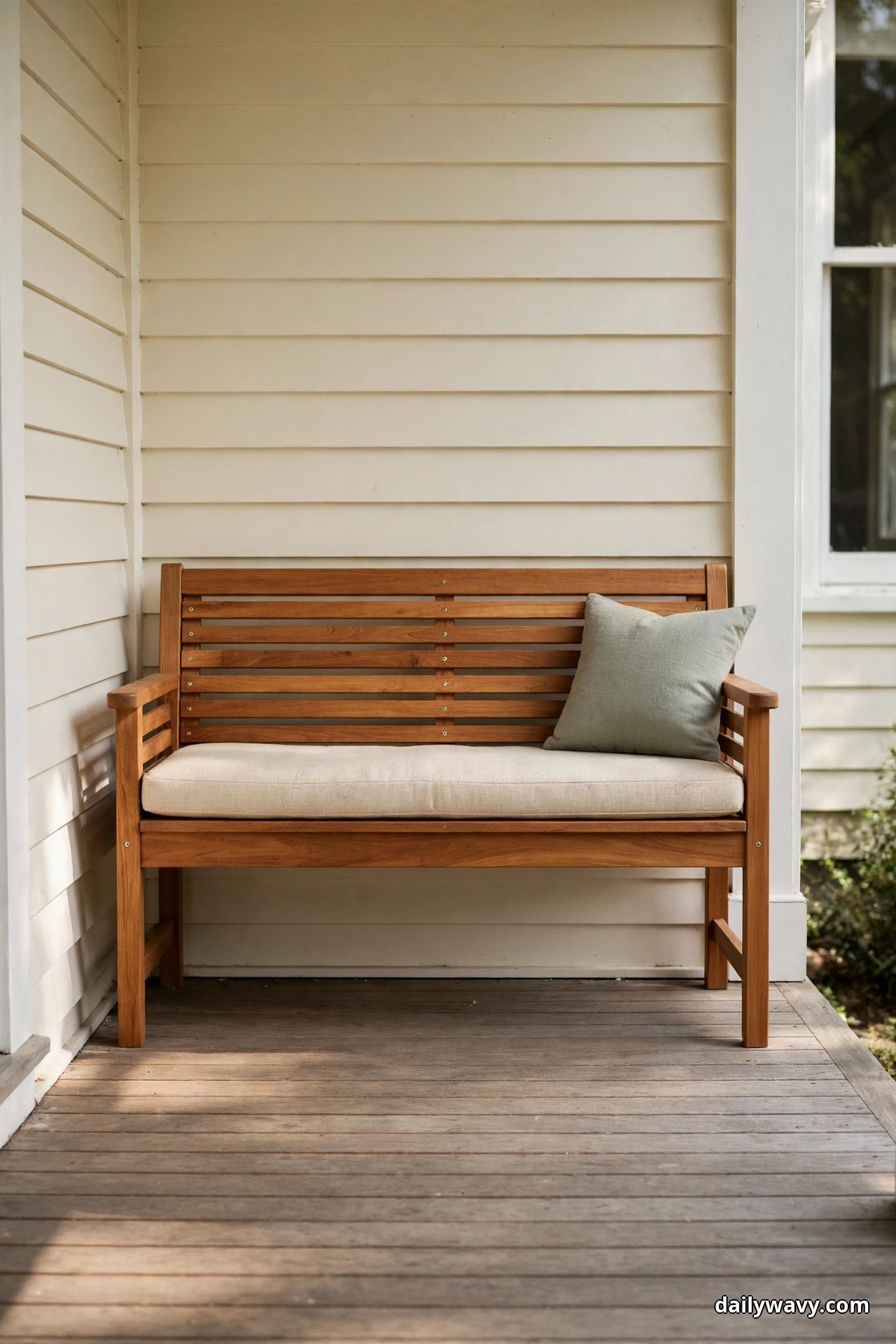
A bench is the most seating you can fit on a narrow porch. One compact bench against the wall gives guests a place to sit while they wait, a spot to set bags, and a surface for a cushion and a pillow, all without blocking the walk. The key word is compact: a bench that fits the porch looks intentional, while a bench that fills it looks stuck.
The look is a bench 36 to 42 inches long and 16 to 18 inches deep, in teak, cedar, or powder-coated metal, pushed against the house wall. One outdoor cushion in a neutral and one pillow in your accent color are enough. Leave the ends clear so the bench does not feel wedged in.
What to measure: the wall length and the porch depth. The bench plus 18 inches of knee room in front must still leave your 36-inch walking route intact. On a truly narrow porch, the bench goes under a window, never in front of the door.
Lower-cost swap: a secondhand wooden bench with exterior paint and a washable outdoor cushion. The paint color can carry your accent.
14. A Layered Mat With Safe Flat Edges

Layering a coir mat over a larger flat outdoor rug is the designer trick that makes a doorway look finished in about thirty seconds. The larger rug adds color and softness, the coir mat does the actual scraping, and the combination frames the door. The non-negotiable part is the edges: both layers must lie dead flat, because a curled corner on a threshold is a trip hazard.
The look is a coir doormat, roughly 18 by 30 inches, centered on a flat outdoor rug that extends about 6 inches beyond the mat on every side. The rug can carry a pattern or your accent color; the coir mat stays plain so the layering reads clean. Both pieces should be thin and flexible enough to sit flat under the door swing.
What to measure: the door swing and the threshold height. The layered stack must clear the bottom of the door with room to spare, or the door will drag. If the clearance is tight, skip the rug layer and use the coir mat alone.
Lower-cost swap: keep your existing coir mat and add one flat outdoor rug beneath it. The rug is the only purchase, and it doubles the visual impact.
15. A Small Seasonal Wreath
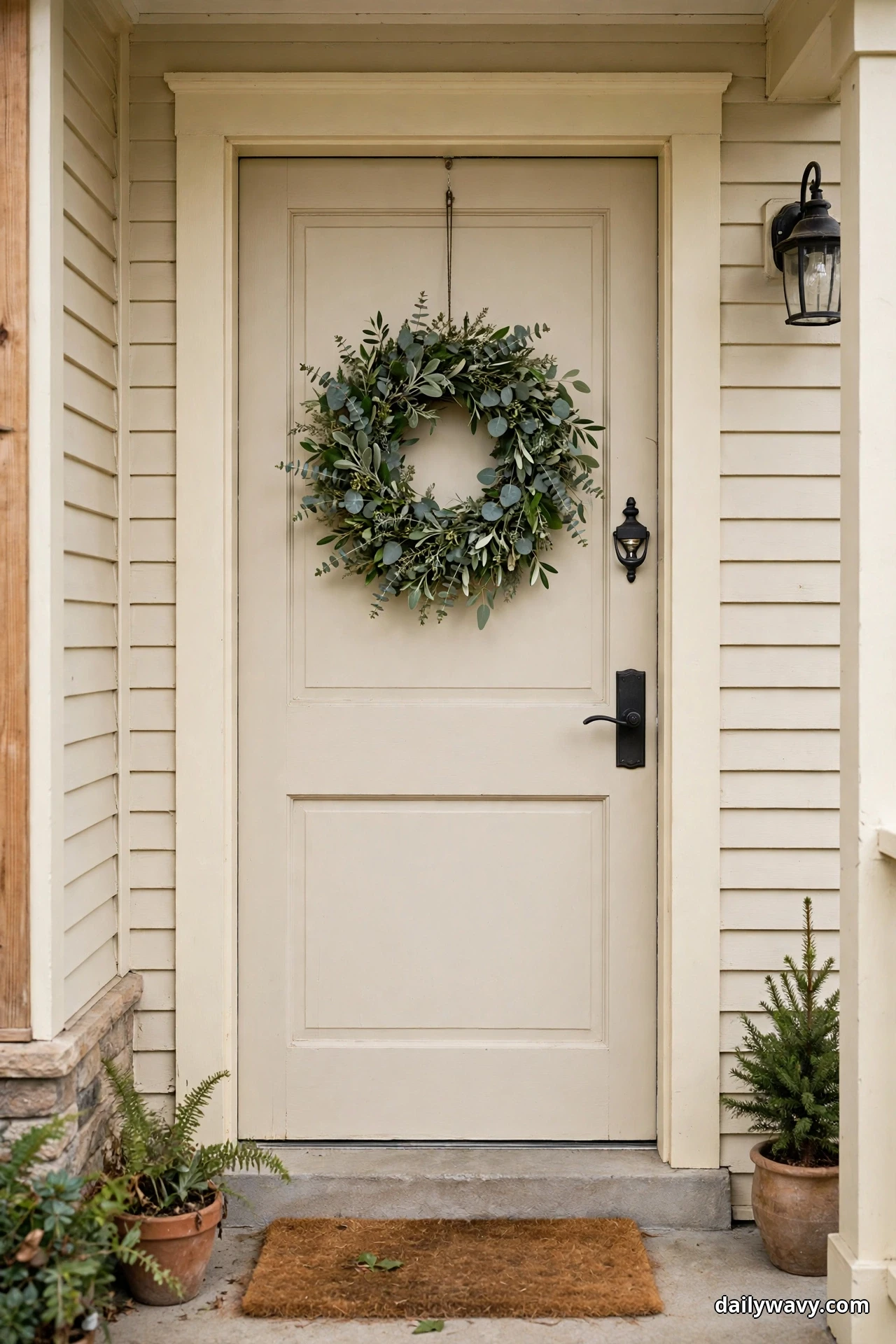
A wreath is the period at the end of the entrance sentence. It hangs at eye level, it changes with the seasons, and it tells visitors the house is cared for before they even knock. Small and fresh beats large and dusty: a modest wreath with real greenery always outshines an oversized artificial one that has seen three summers.
The look is a wreath 20 to 24 inches across on a standard 36-inch door, hung from a simple hook or ribbon so it centers at eye level. Use seasonal greenery, eucalyptus, magnolia leaves, dried grasses, or whatever is fresh at your local nursery. Swap it with the seasons and the entrance never looks tired.
What to measure: the door width and the clearance for the door knocker and handle. The wreath should sit clear of both, and the hanger must hold it flat against the door so wind does not bang it around.
Lower-cost swap: a plain grapevine wreath base you refresh each season with cuttings from the yard or the nursery discount bin. One base, endless wreaths.
Frequently Asked Questions
What materials should front porch seating be made from?
Look for outdoor-rated materials: powder-coated aluminum or steel, teak, cedar, or poly lumber. Wicker and rattan are fine if they are specifically rated for outdoor use. Anything upholstered should use outdoor fabric, and natural-fiber baskets belong under the roof overhang where they can dry between rains.
How do I keep porch decor from blowing away?
Weight is your friend. Choose planters with real heft, use lanterns with a low center of gravity, and secure hanging items with rated hooks into beams or joists. Lightweight pieces like wreaths and mats need secure hangers or non-slip backings. If your porch catches the wind, test every new piece on a breezy day before you trust it.
How much space does a porch chair really need?
Plan on a 30 by 30 inch footprint for one chair plus room to pull it out, and keep a clear 36-inch walking route from the steps to the door at all times. If the chair forces you to squeeze past, the porch is over-furnished.
What is the best rug for a front porch?
A flat polypropylene outdoor rug. It handles rain, hoses off clean, and lies flat with no curled edges. Keep edges thin and flat so the door clears them and nobody trips.
How can I style a very narrow porch?
Go vertical and keep the floor clear. One compact bench under a window, a door-side wall accent, flanking planters pulled tight to the walls, and a layered mat at the door. Skip the chair and the basket until the width allows them.
Can I leave cushions outside all the time?
Only if they are made with outdoor-rated fabric and quick-dry foam. Even then, bring them in during heavy storms and store them over winter. A lidded storage bench or a deck box keeps them handy and dry.
Bringing It All Together
A welcoming entrance is not fifteen projects. It is two or three ideas your porch is missing, done well. Most porches need somewhere to sit, which the compact chair or the bench solves. Most need something green, which the planters and the row of small pots handle. And every porch benefits from editing: the clear landing area, the single accent color, and the repeated metal finish cost almost nothing and change everything.
Start with the idea that fixes your biggest annoyance. If the porch feels cluttered, clear the landing and pick one accent color. If it feels empty, add the bench and the pair of planters. Measure the walking route once, buy outdoor-rated pieces, secure everything the wind can reach, and let the porch do what it does best: make people glad they came to the door.
When the inside of the entrance needs the same attention, our small entryway decor ideas pick up where the porch leaves off. And for the next project on your list, browse the full Home and Decor collection.