14 Mid-Century Living Room Ideas to Make the Style Your Own
Mid-century style has a way of making a room feel settled without making it feel serious. Clean lines, honest wood,…
Mid-century style has a way of making a room feel settled without making it feel serious. Clean lines, honest wood, tapered legs, and a few warm accents do most of the work. This roundup gives you fourteen ideas you can actually pull off, each one a real room or detail photographed for reference. Work through them one at a time, measure before you buy, and you can bring that genuine, calm 1960s warmth into your own living room this weekend.
In This Guide
- Paired Lamps Beside a Balanced Sofa
- Layered Rug Beneath a Nesting Table
- Vintage Cabinet Used as a Focal Point
- Soft Ottoman Replacing a Sharp Table
- Window Seat With Tailored Cushions
- A Floor Lamp Beside a Book Stack
- A Large Plant in a Simple Pot
- Two Small Tables Instead of One Large Table
- An Upholstered Bench Against the Wall
- A Narrow Console Behind the Sofa
- A Sculptural Pendant Over the Seating
- Low Coffee Table With Layered Textiles
- Conversation Seating Around a Wool Rug
- Wood Console With a Ceramic Lamp
The Mid-Century Rules Before You Rearrange Anything
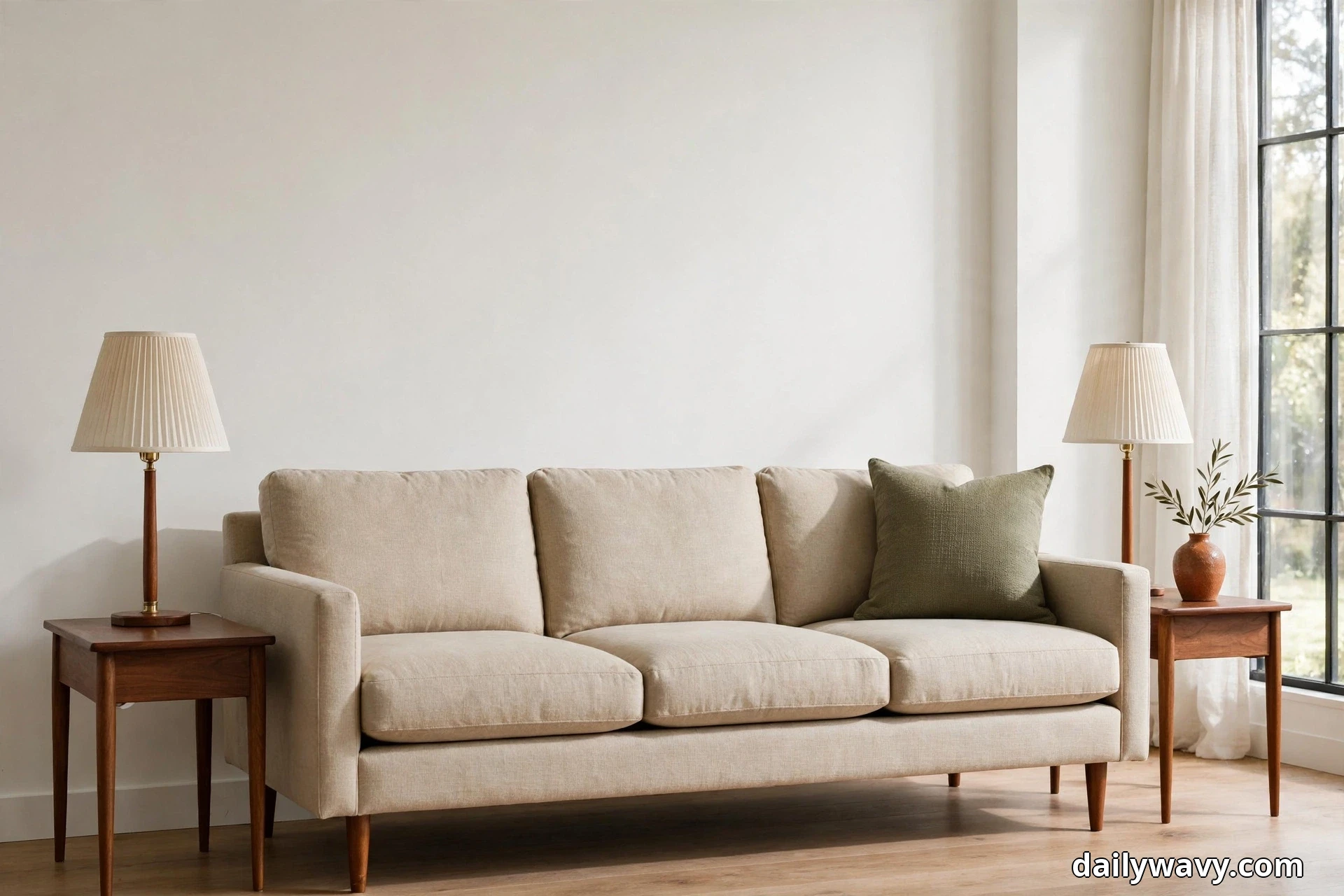
Before you move a single piece, learn the three decisions that make mid-century rooms work. First, the palette stays small. Pick a warm wood tone (walnut is the classic, but teak and stained oak read the same way), one neutral for big upholstery (cream, oatmeal, warm gray), and one or two muted accents (olive, rust, mustard, dusty teal). That is the whole room. A fifth color usually fights the calm.
Second, let the legs show. Mid-century furniture sits on slim tapered legs that lift each piece off the floor. That air gap is what makes even a small room feel larger. When you shop, flip the photo over in your mind: if a sofa skirt or a bulky base hides the floor, it will not give you this look.
Third, measure and keep negative space. A sofa needs about 30 inches of walking clearance in front of it and 14 to 18 inches between sofa and coffee table. Tape the footprint on the floor with painter’s tape before anything gets delivered. If your room is long and narrow, our narrow living room layout ideas show how to keep these same rules working in a tricky footprint.
Lighting is the quiet fourth rule. Warm bulbs (2700K to 3000K on the box) keep wood tones honeyed instead of gray. Aim for three pools of light in the room: one overhead or pendant, one at sofa level, one at reading level.
1. Paired Lamps Beside a Balanced Sofa
There is nothing louder in a living room than symmetry done right. Two matching table lamps, one on each end of a low balanced sofa, frame the seating the way a frame steadies a photograph. Keep the lampshades simple (drum or tapered linen) and the bases heavy enough to anchor each end. The pairing reads calm because the eye knows exactly where to rest.
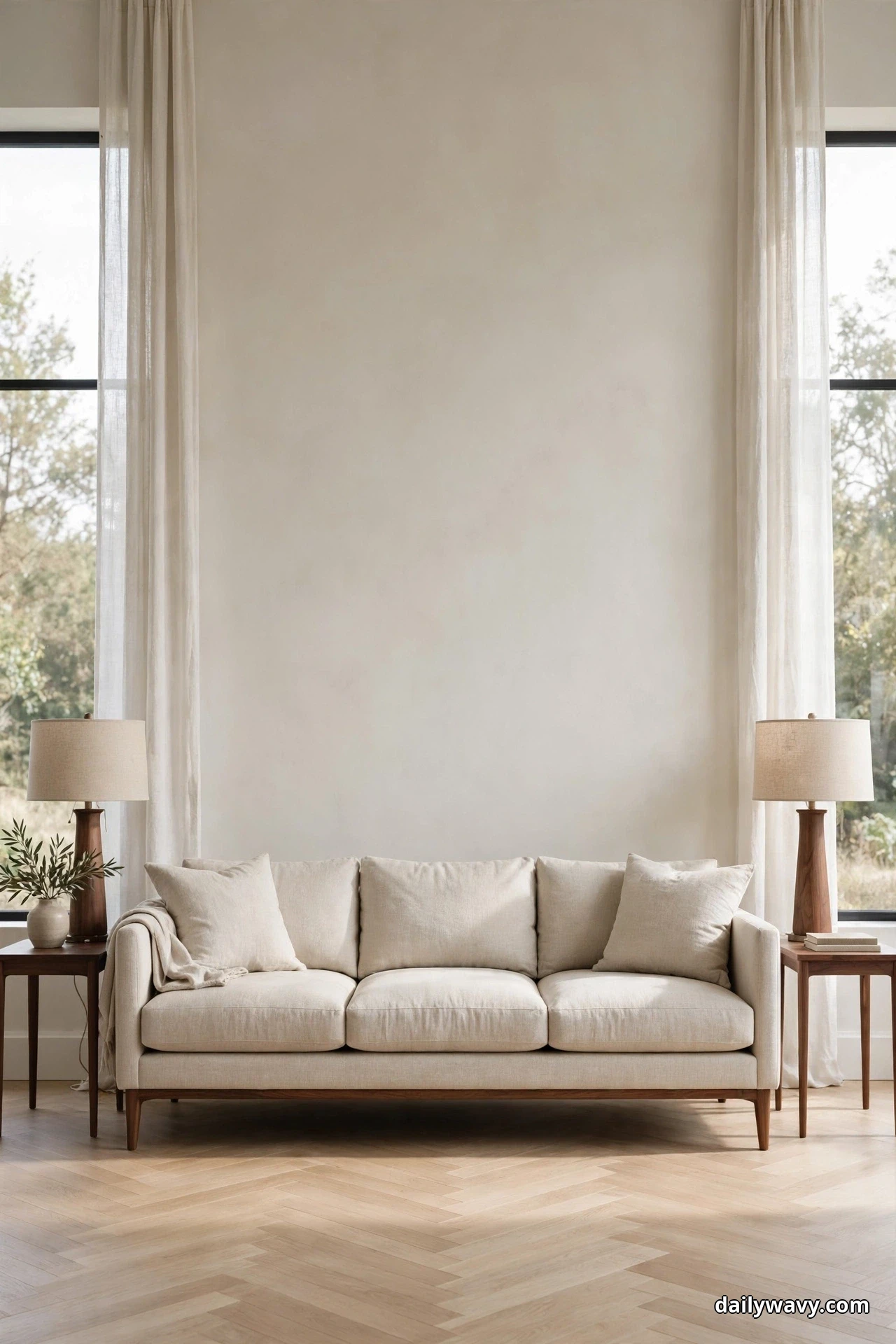
The look: A straight, low-profile sofa in a solid neutral, roughly 78 to 86 inches wide, with two matching lamps on slim end tables. Lamp shades should sit so the bottom of the shade is about eye level when you are seated, roughly 40 to 48 inches off the floor. Walnut or brass lamp bases repeat the room’s wood and metal story.
What to measure: The end tables should be within 2 inches of the sofa arm height. Measure lamp height before buying; a 26 to 28 inch table lamp is the safe zone for a standard sofa.
Effort and budget: An afternoon project if the sofa is already there. Lower-cost alternative: thrift two mismatched lamps and fit them with identical new shades and the same warm bulbs. From three feet away, nobody will know.
2. Layered Rug Beneath a Nesting Table
Layering rugs sounds like a trick until you try it. A flat-weave base rug (jute or low-pile wool) with a smaller, richer patterned rug on top gives a plain seating area instant depth, and the nesting table tucks neatly into the layers. The nesting set is the hero here: two or three walnut tables that slide together or pull apart when you need a side table anywhere.
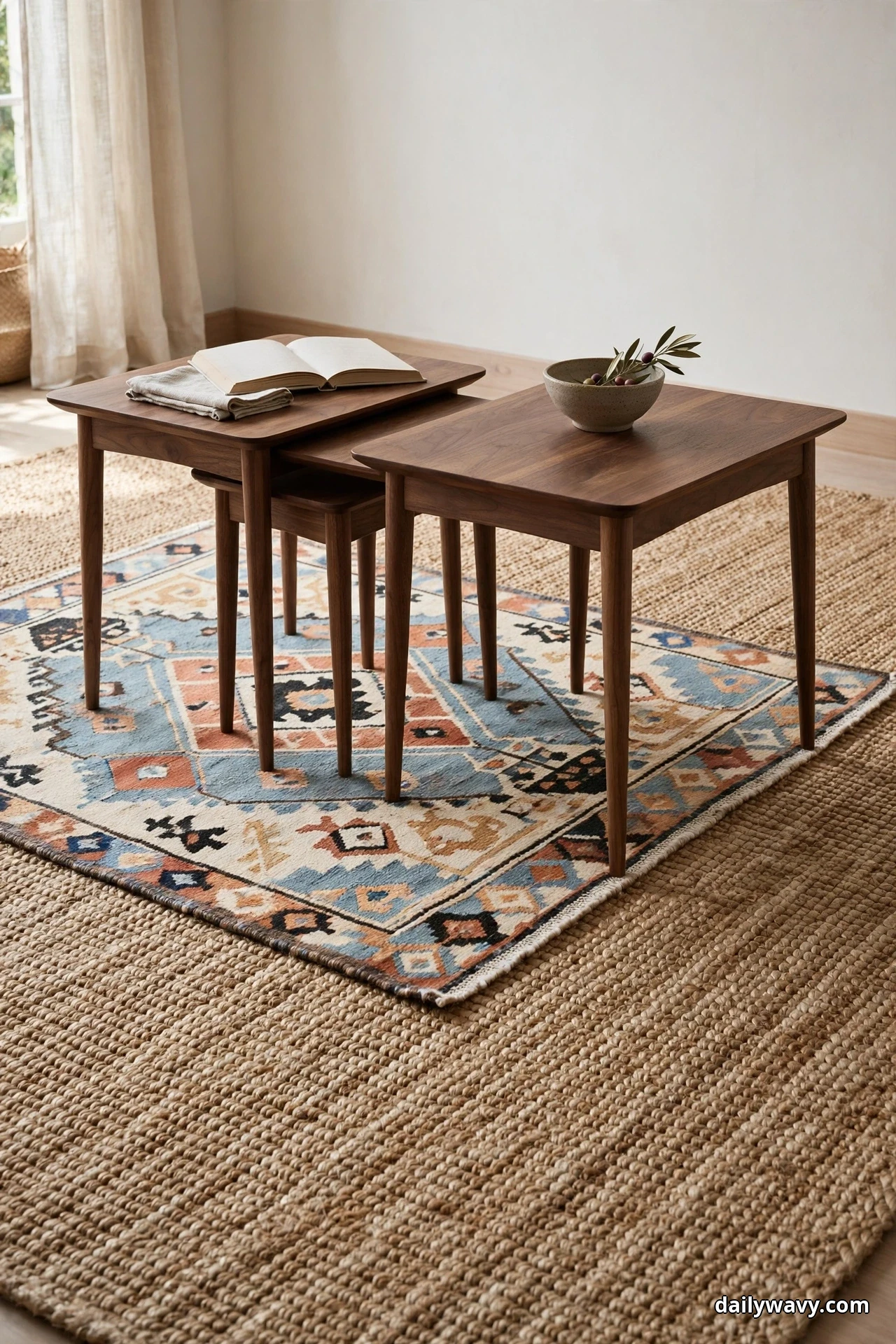
The look: Base rug large enough to catch the front legs of the sofa and chairs (an 8×10 foot rug suits most living rooms), with a 5×7 foot patterned rug centered on it. The nesting tables, medium walnut with tapered legs, sit on the top layer at a height of 20 to 24 inches.
What to measure: Leave at least 12 inches of the base rug showing on all sides of the top rug. Rug pads under both layers stop everything from sliding on hardwood.
Effort and budget: A weekend, mostly spent unrolling and adjusting. Lower-cost alternative: a secondhand flat-weave as the base and one vintage patterned rug on top. Nesting tables turn up constantly at thrift stores.
3. Vintage Cabinet Used as a Focal Point
Every mid-century living room deserves one piece with a past. A walnut credenza or low cabinet with sliding doors gives the room its center of gravity and hides the clutter modern life keeps producing. Style the top lightly: a stack of books, one ceramic vase, one small sculptural object. The cabinet does the talking; the styling just listens.
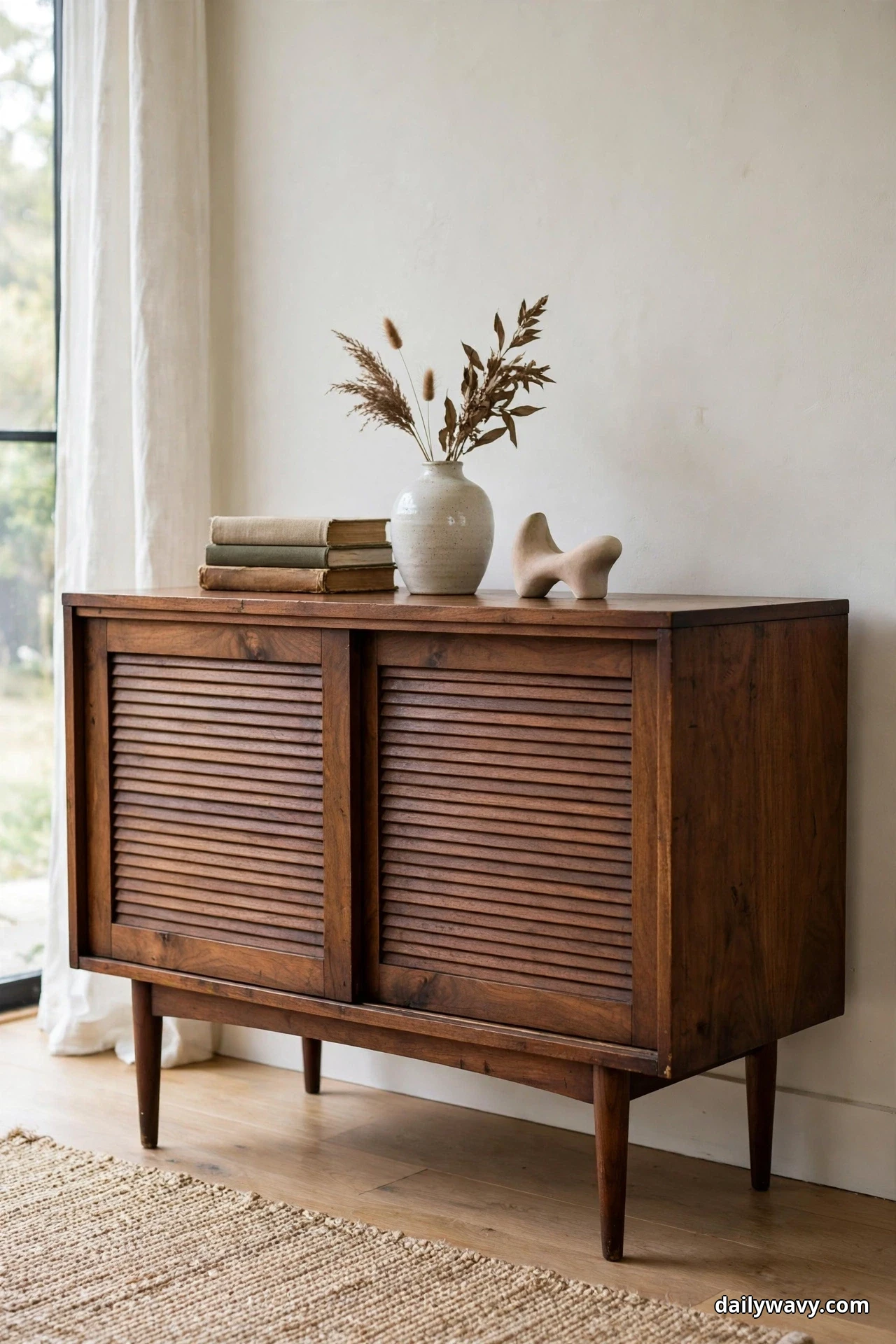
The look: A low cabinet, 60 to 72 inches wide and 28 to 32 inches tall, in walnut or teak. Keep it 3 to 4 inches off the wall and centered on the longest open stretch you have. Tapered legs keep it light; sliding doors keep it quiet.
What to measure: Measure the wall run and leave 6 to 10 inches of breathing room on each side. Check door clearance on sliding doors before loading the interior.
Effort and budget: A week of patient thrifting or one committed weekend restoring a find. Lower-cost alternative: a plain low dresser painted or refinished in a warm walnut stain, with the top styled the same way.
4. Soft Ottoman Replacing a Sharp Table
If the coffee table’s corners keep winning fights with small shins, retire it. A large round ottoman in a nubby fabric (bouclé, performance linen, or a tight weave) fills the center of the seating with something soft, sit-able, and kid-friendly. Add a tray on top and it becomes a table again when you need one.
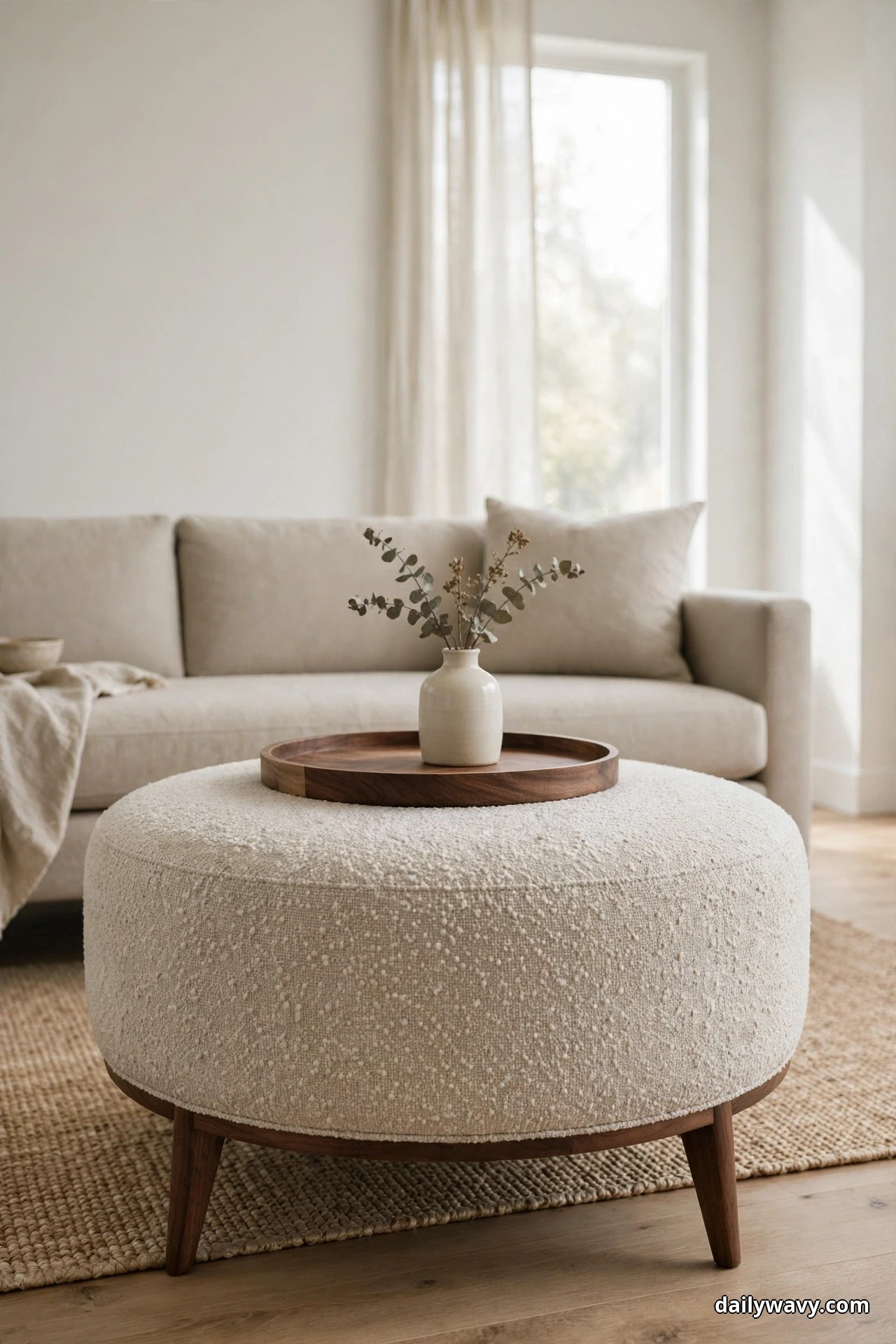
The look: A round or drum ottoman, 30 to 38 inches across and about the same height as the sofa seat (17 to 19 inches). Tapered wooden legs keep it in the mid-century family. One big round tray in walnut or brass sits on top for drinks.
What to measure: Keep the same 14 to 18 inches between ottoman and sofa as you would a coffee table. The tray should be roughly half the ottoman’s diameter.
Effort and budget: One delivery and an afternoon of styling. Lower-cost alternative: slipcover an old round coffee table in a washable fabric, or buy the ottoman in a neutral and change the look with the tray and throws.
5. Window Seat With Tailored Cushions
A window seat is the quietest luxury in a living room. Built along the window wall, it turns dead space into the best seat in the house. The key word is tailored: box cushions in a firm foam with a washable cover, piped edges, and a seat depth of 20 to 22 inches. Anything puffier slides toward beach-house and away from mid-century.
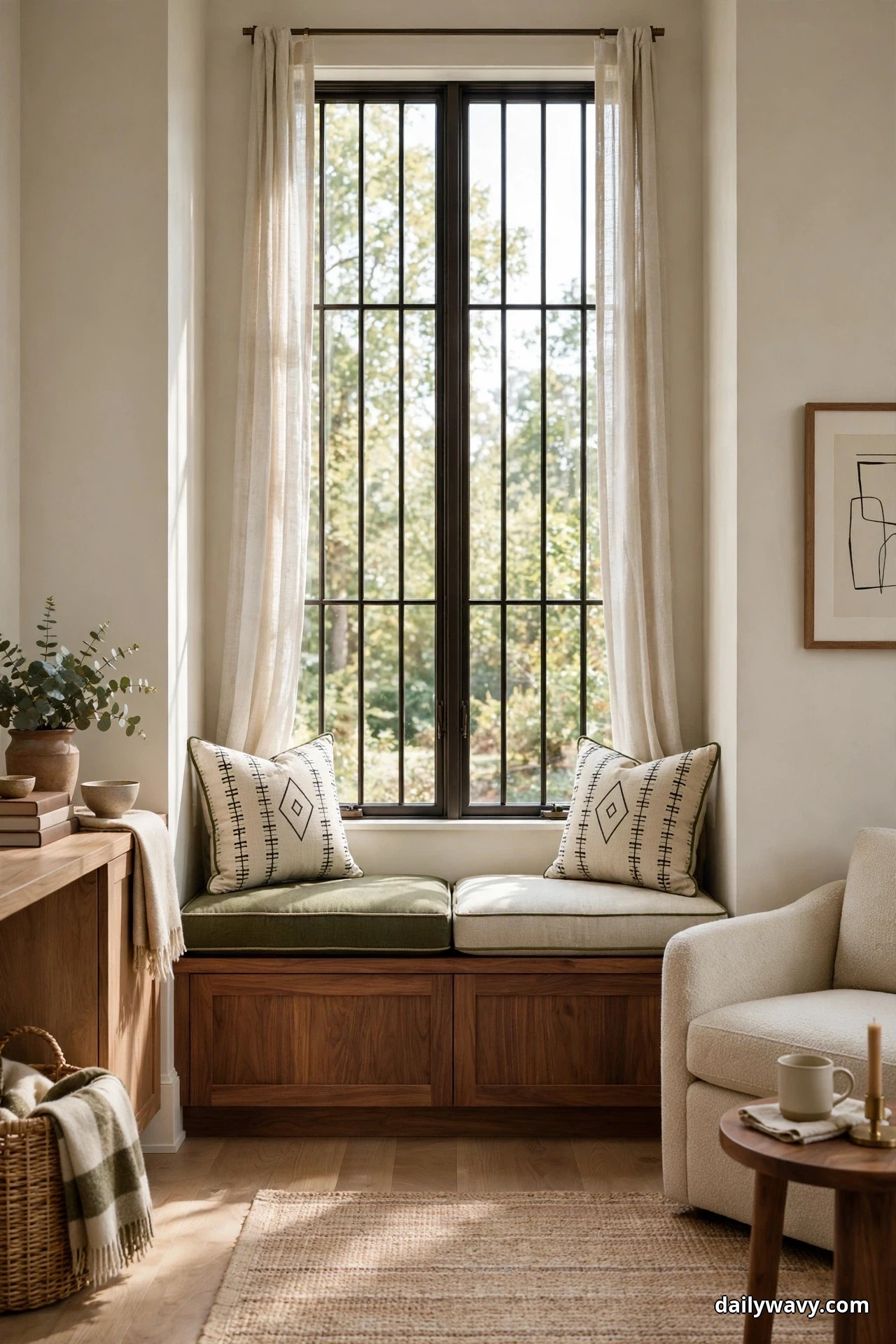
The look: A low built-in or freestanding bench under the window, walnut base or painted in a warm neutral, topped with tailored box cushions in olive, rust, or oatmeal. Two or three lumbar pillows in a simple geometric print finish it. Keep the walnut trim thin so the window stays the star.
What to measure: Seat height should land at 17 to 19 inches including the cushion. Measure window width and let the seat span the full run, wall to wall, for the built-in look.
Effort and budget: A solid weekend for a carpenter-built base, or a one-day project using a freestanding bench with custom cushion covers. Lower-cost alternative: two low bookcases laid end to end with a single tailored cushion on top.
6. A Floor Lamp Beside a Book Stack
Reading corners are built from exactly two things: the right light and the right place to set a drink. A floor lamp with a fabric drum shade beside a small stack of books gives you both. The stack can be a side table made of books (yes, really) or a real table with books stacked on it. Either way, the lamp should throw warm light down onto the seat, not across the room.
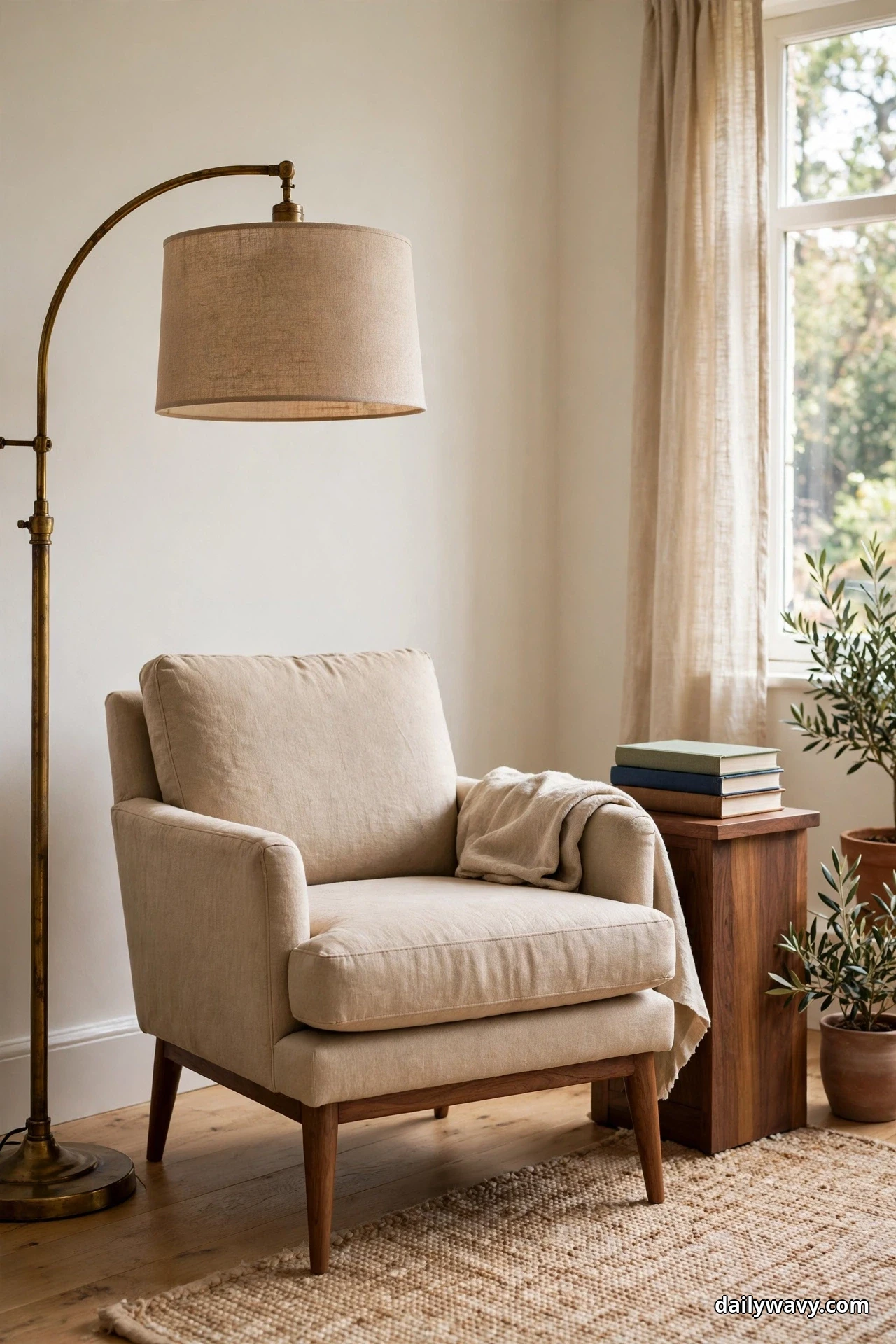
The look: An arc or tripod floor lamp, 60 to 68 inches tall, in brass, walnut, or black metal with a linen shade. Beside it, a side table 22 to 26 inches tall holding a stack of 4 to 6 books. A walnut side table with a drawer repeats the room’s wood and hides the reading glasses.
What to measure: The lamp shade’s bottom should sit a few inches above the reader’s shoulder when seated. Leave 6 to 8 inches between the chair arm and the table edge.
Effort and budget: An evening project. Lower-cost alternative: one good floor lamp from a discount store plus a stack of the books you already own, bound with a leather strap for the deliberate look.
7. A Large Plant in a Simple Pot
Mid-century rooms love greenery, but they hate fuss. One large plant (an olive tree, a fiddle-leaf fig, or a tall snake plant) in the plainest pot you own does more than a shelf of small succulents. The rule is scale: the plant should be at least two-thirds the height of the nearest furniture, so it reads as architecture, not decoration.
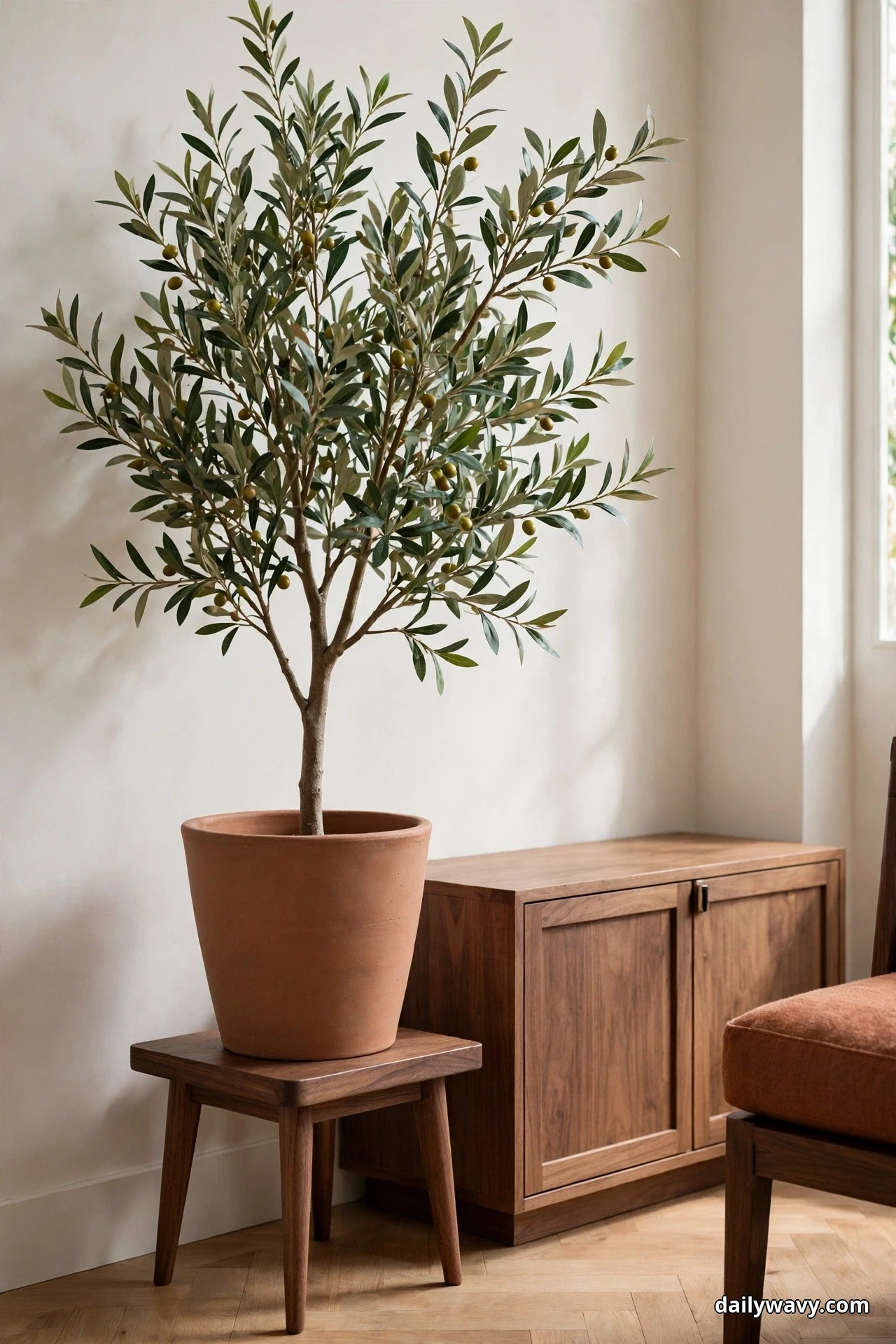
The look: One statement plant, 4 to 6 feet tall, in a simple matte ceramic or terracotta pot about one-third the plant’s height. Place it where it catches daylight, ideally near a window, and let the pot sit directly on the floor or on a short walnut plant stand with tapered legs.
What to measure: Check your ceiling height and the plant’s mature size before buying. Pot diameter should be roughly half the plant’s spread so the plant never looks top-heavy.
Effort and budget: A plant-shop trip and an afternoon. Lower-cost alternative: a tall snake plant in a plain pot. It tolerates low light, forgives neglect, and costs a fraction of an olive tree.
8. Two Small Tables Instead of One Large Table
Big end tables swallow small seating arrangements. Two petite tables, one on each side of a chair or flanking the sofa’s far end, give you the same surface in a shape that breathes. They are also the easiest way to add mid-century character fast: two walnut C-tables or drum side tables change the room’s mood in minutes.
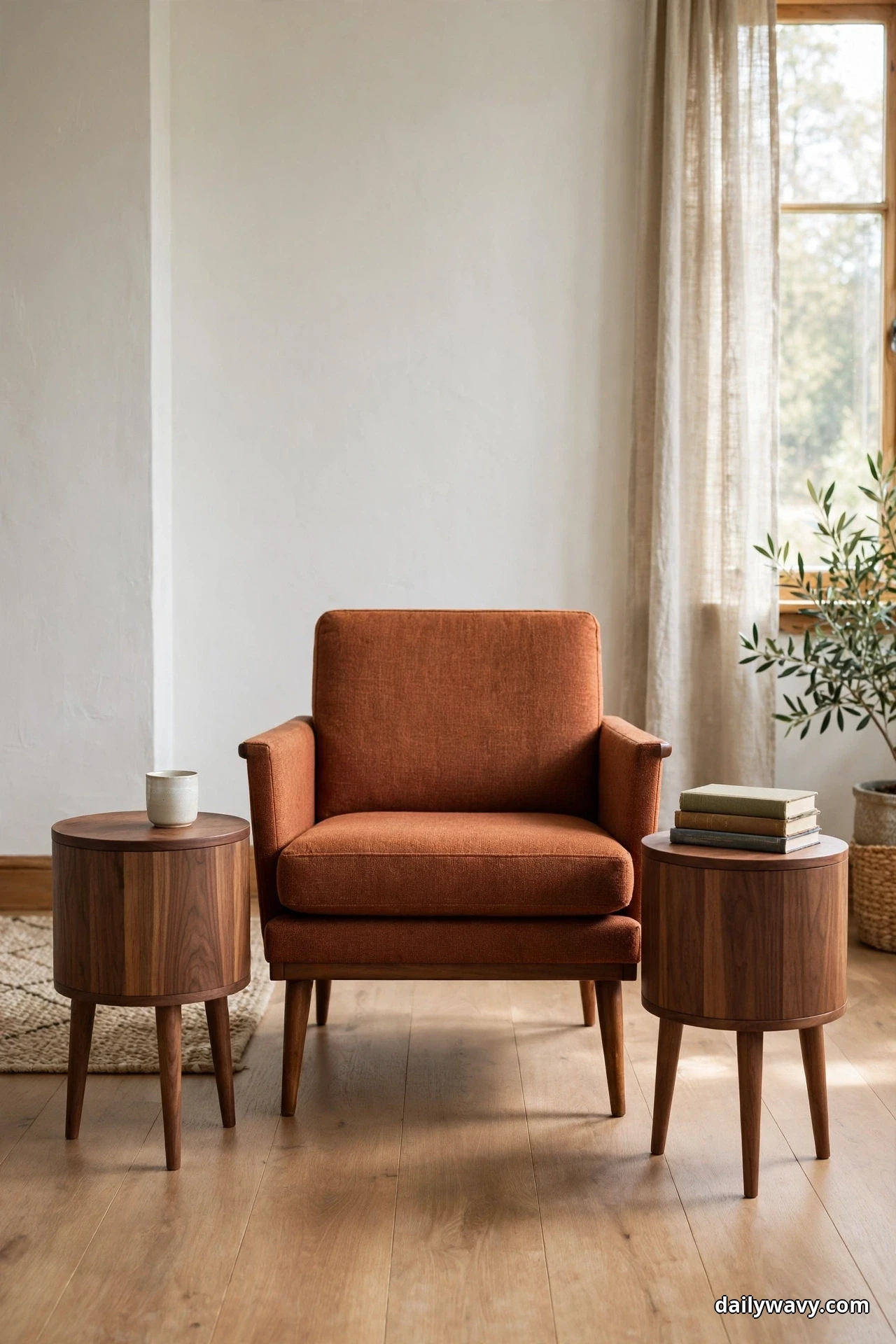
The look: Two matching or near-matching side tables, 18 to 22 inches across and 20 to 24 inches tall, placed on either side of an accent chair or together at the sofa’s end. Walnut tops with tapered legs tie them to the rest of the room.
What to measure: Table height should be within 2 inches of the chair or sofa arm. Keep 4 to 6 inches of space between the two tables if they sit side by side.
Effort and budget: A weekend of thrift hunting or one online order. Lower-cost alternative: two wooden plant stands or bar stools in the right height range, stained to a matching walnut tone.
9. An Upholstered Bench Against the Wall
The wall behind a floating sofa or along the room’s long run is often dead space. A low upholstered bench fills it with something useful: extra seating, a place for throw pillows, a landing spot for the laptop. Keep the fabric plain and the legs tapered, and it becomes the quiet piece everyone ends up sitting on.
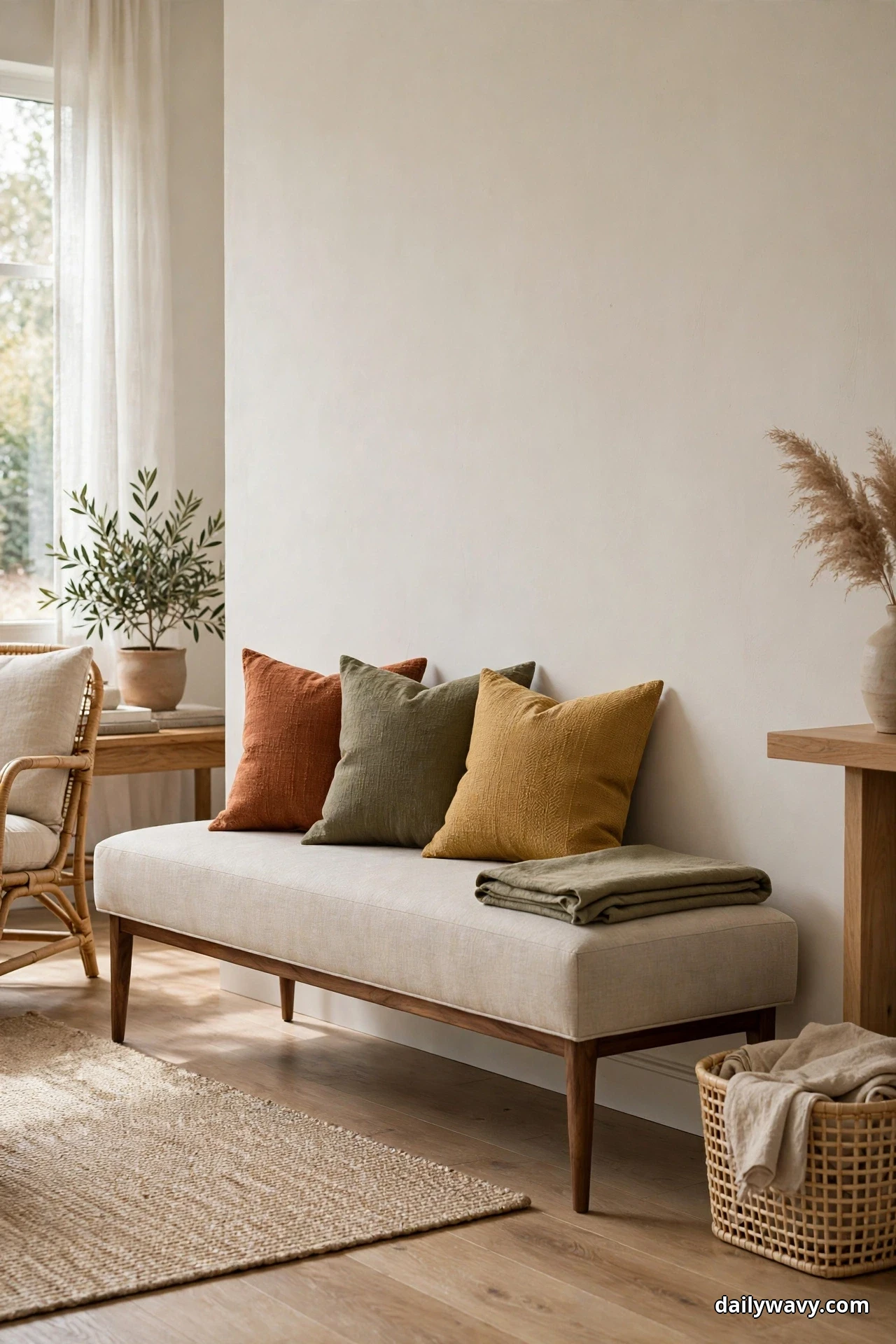
The look: A bench 48 to 60 inches long, 16 to 18 inches deep, with a seat height of 17 to 19 inches. Upholster it (or buy it) in a warm neutral that matches the sofa’s fabric family. Three or four pillows in muted rust, olive, or mustard make it inviting. Benches pull double duty in other rooms too; our small entryway decor ideas show the same piece working hard by the front door.
What to measure: Leave 30 inches of walkway in front of the bench. If it goes behind a floating sofa, keep 10 to 12 inches between the sofa back and the bench.
Effort and budget: One delivery and an afternoon of pillow arranging. Lower-cost alternative: a plain wooden bench with a long box cushion on top and tapered legs added underneath.
10. A Narrow Console Behind the Sofa
When the sofa floats in the middle of the room, its back needs company. A narrow console table (10 to 12 inches deep) set right behind it finishes the arrangement from every angle and gives you a landing strip for a lamp, books, and the TV remote. It is the piece that makes a floating sofa look intentional instead of accidental.
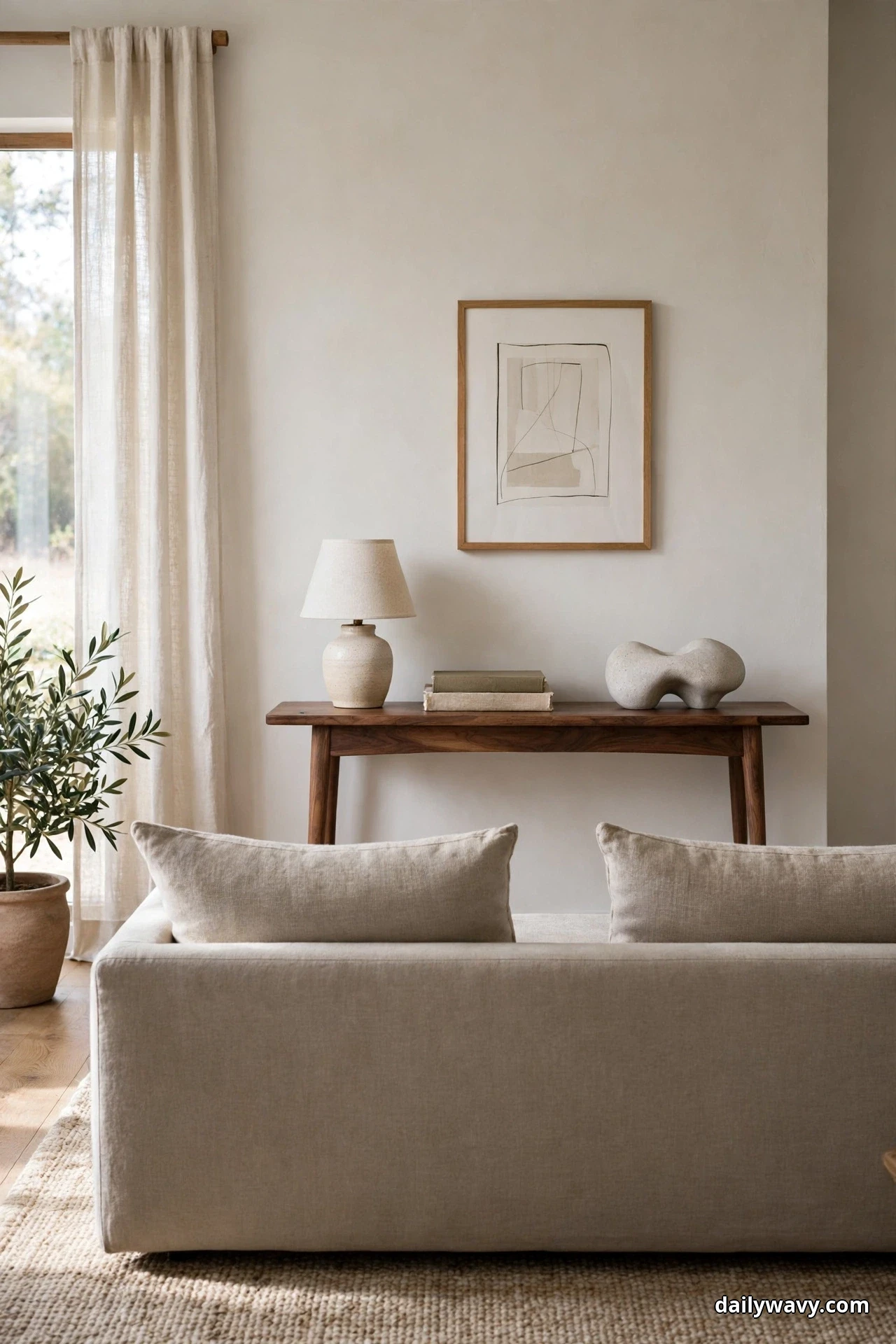
The look: A walnut console, 48 to 60 inches long and no more than 12 inches deep, in the same height range as the sofa back (about 30 to 34 inches). Style it with one small lamp, a stack of two or three books, and a single low object. Less is more here because the back of the sofa is visible.
What to measure: The console should be at least 6 inches shorter than the sofa is long, so it stays inside the sofa’s silhouette. Keep 2 to 3 inches between the console and the sofa back.
Effort and budget: A weekend project including styling. Lower-cost alternative: a narrow bookshelf laid on its side, or two small wall shelves mounted at console height behind the sofa.
11. A Sculptural Pendant Over the Seating
Mid-century lighting was never shy. One sculptural pendant, hung low over the seating area, becomes the room’s jewelry. Think a starburst chandelier, a sputnik-style fixture, or a single oversized paper lantern. Keep everything else simple so the pendant gets the stage. The trick is height: low enough to feel intimate, high enough that nobody ducks.
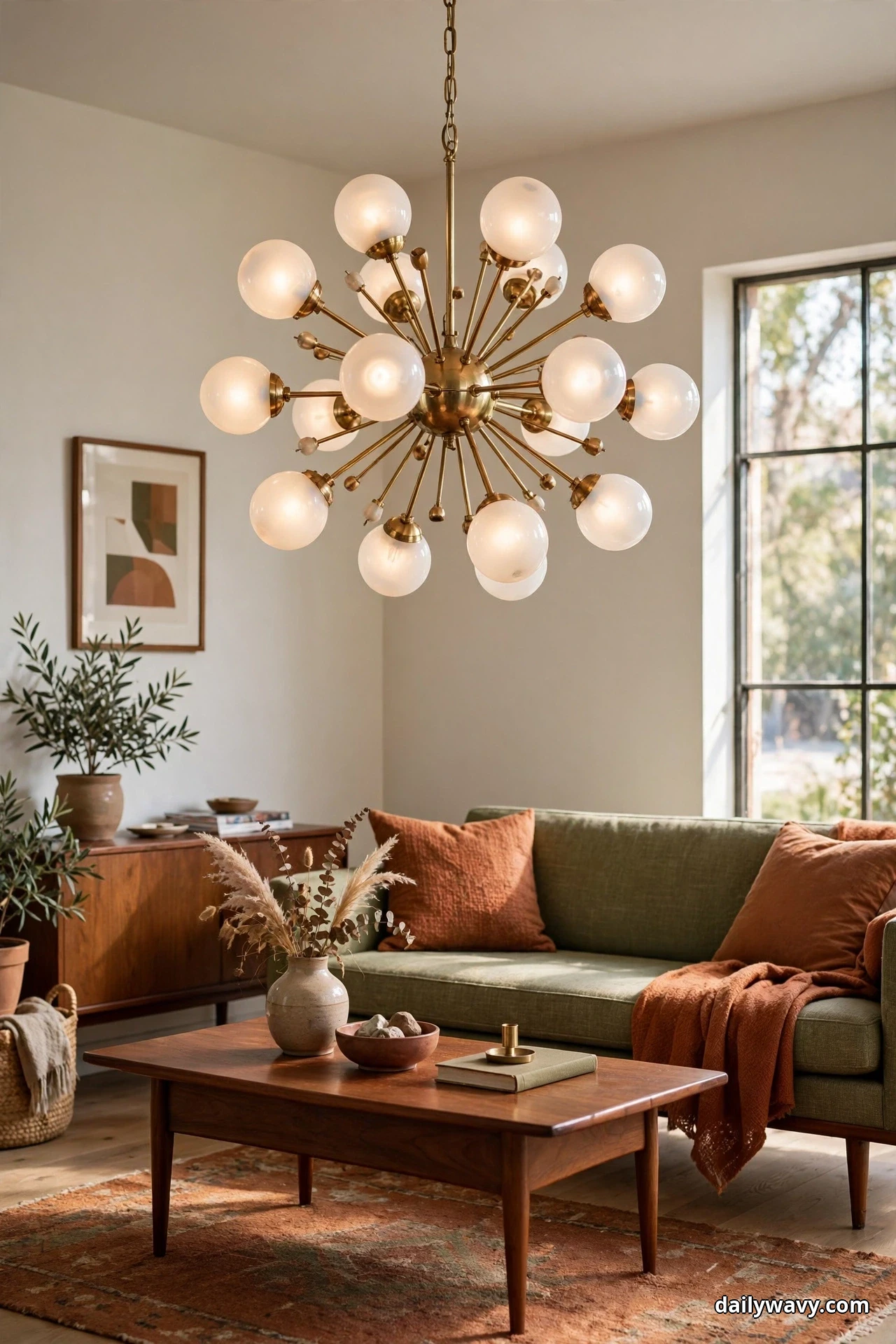
The look: One statement pendant, 24 to 36 inches across, hung so its bottom sits 60 to 66 inches off the floor above the seating zone. Brass or black metal with opal glass reads unmistakably mid-century; warm 2700K bulbs keep it inviting.
What to measure: Measure from the floor to the fixture’s lowest point, not just the ceiling. In rooms with 8-foot ceilings, a semi-flush or close-hang design works better than a long drop.
Effort and budget: An hour if a ceiling box already exists; call an electrician if you need a new one. Lower-cost alternative: a paper lantern on a plug-in swag cord, hung from a ceiling hook. The silhouette is right and the price is tiny.
12. Low Coffee Table With Layered Textiles
A low walnut coffee table is the mid-century workhorse, but it earns its place when it carries texture. Layer a thin runner or a folded throw across it, add a small stack of art books, and top it with one ceramic object. The textiles soften the wood’s lines and give you color you can change with the seasons.
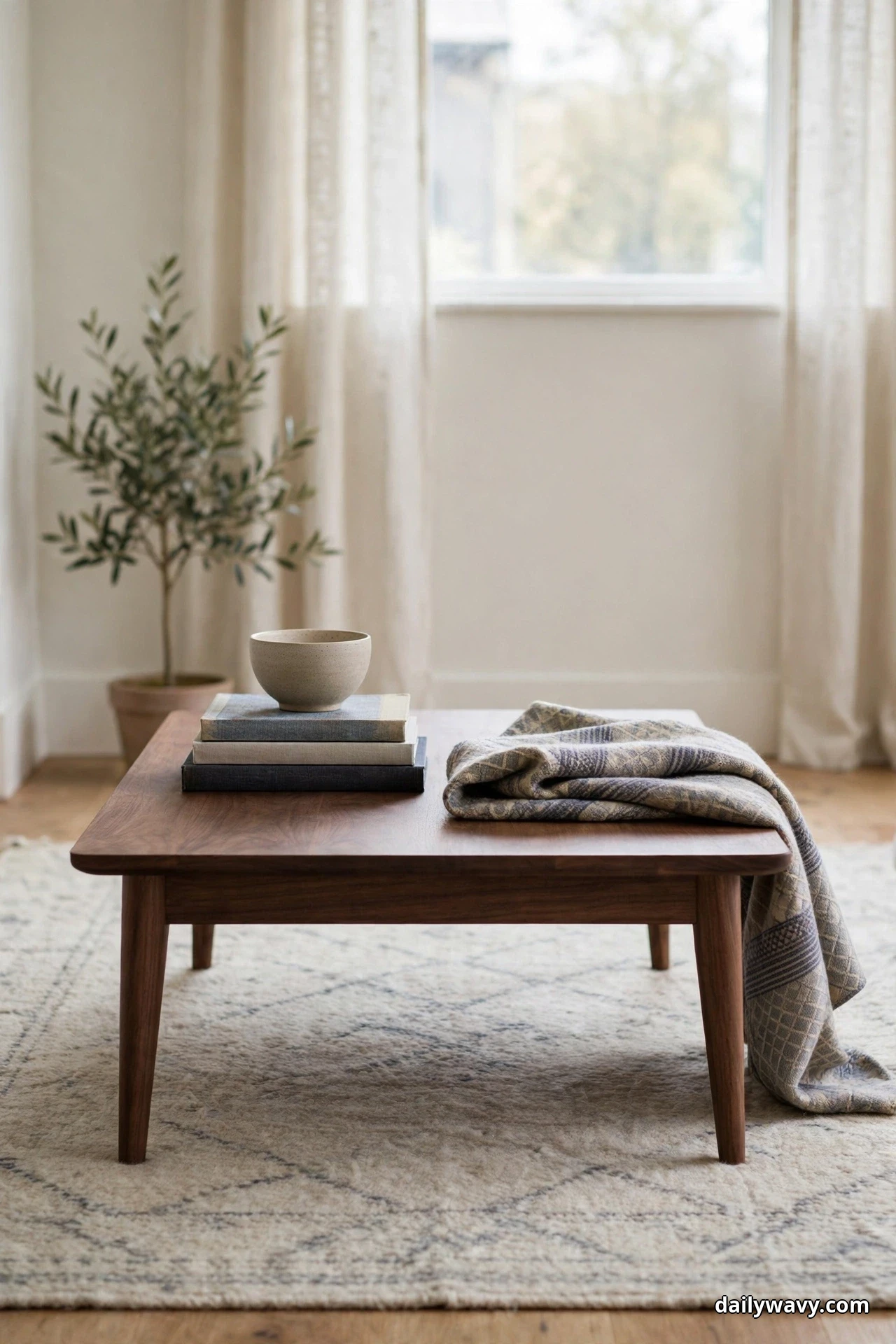
The look: A rectangular coffee table, 44 to 52 inches long and only 14 to 16 inches tall, in walnut with tapered legs. A runner or folded throw in a muted pattern crosses one end; books and one object fill the rest. Keep the center clear enough for the tray when guests arrive.
What to measure: The tabletop should sit close to the sofa seat height, no more than about 2 inches below it, for the right sightline. Runner should overhang 6 to 8 inches on each short end, not drag on the floor.
Effort and budget: An afternoon of styling with pieces you likely own. Lower-cost alternative: a secondhand low table with a good refinishing, dressed with a folded thrifted wool blanket as the runner.
13. Conversation Seating Around a Wool Rug
The purest mid-century arrangement is two chairs facing each other (or facing the sofa) over one honest wool rug, close enough to talk without raising your voice. No TV dictating the layout, no chair pushed against a wall. The rug defines the conversation zone; everything else just follows.
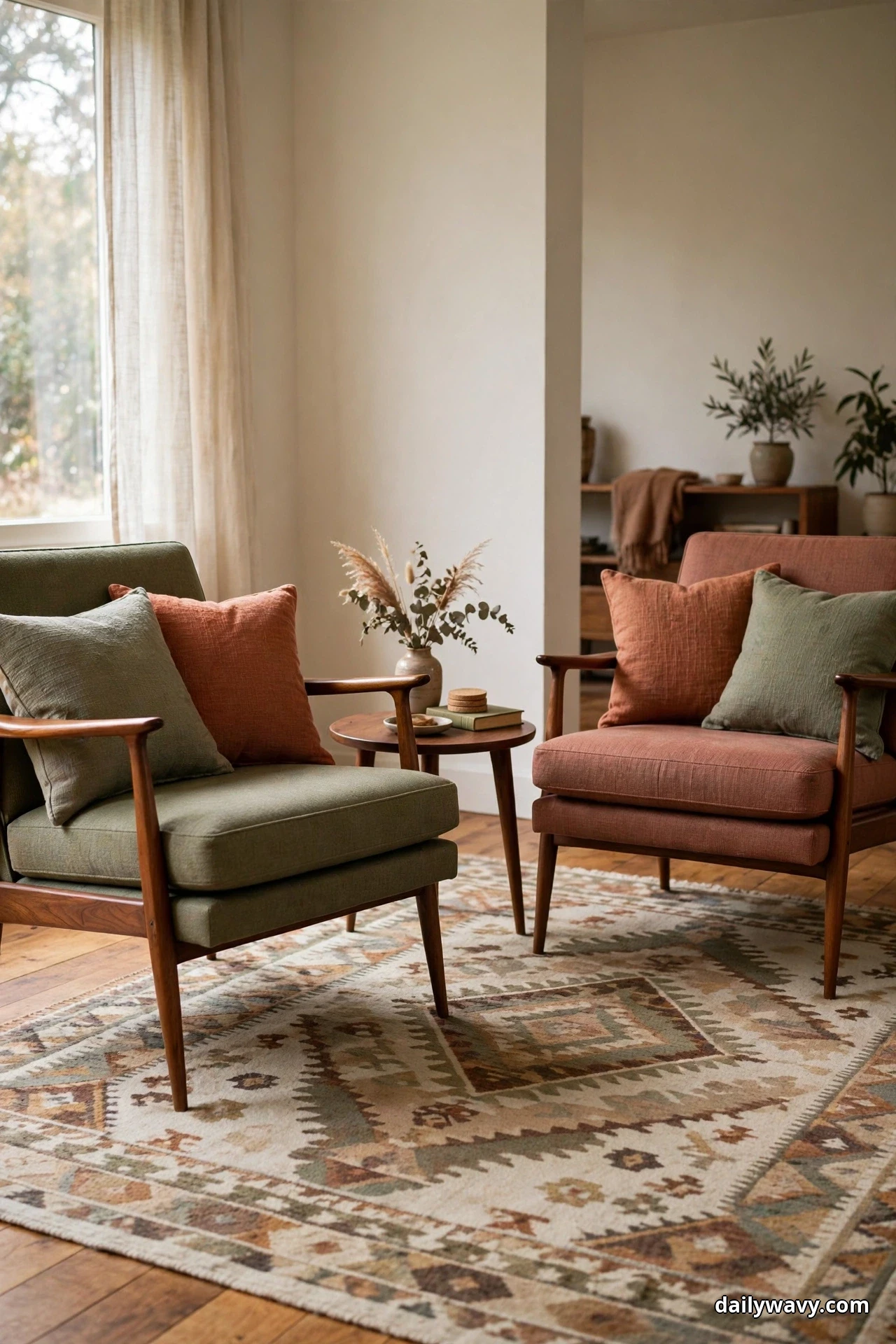
The look: Two armchairs with tapered wooden legs angled slightly toward each other, 6 to 8 feet apart, on a 5×8 or 8×10 foot wool rug. The rug’s front edge catches all four chair legs. One small side table between the chairs holds the drinks.
What to measure: Seat-to-seat distance should let two people converse comfortably, 6 to 8 feet, not across a ballroom. The rug should extend at least 12 inches past the chairs on each side.
Effort and budget: A morning of furniture moving and one rug decision. Lower-cost alternative: a flat-weave cotton rug instead of wool. It will not last as long, but it gives you the same geometry at a fraction of the price.
14. Wood Console With a Ceramic Lamp
The last idea is the smallest and maybe the most useful: a slim walnut console, against the room’s quietest wall, topped with a single ceramic lamp. It fills the awkward stretch of wall every living room seems to have, and it adds a pool of warm light exactly where the room needs one. One lamp, one stack of books, done.
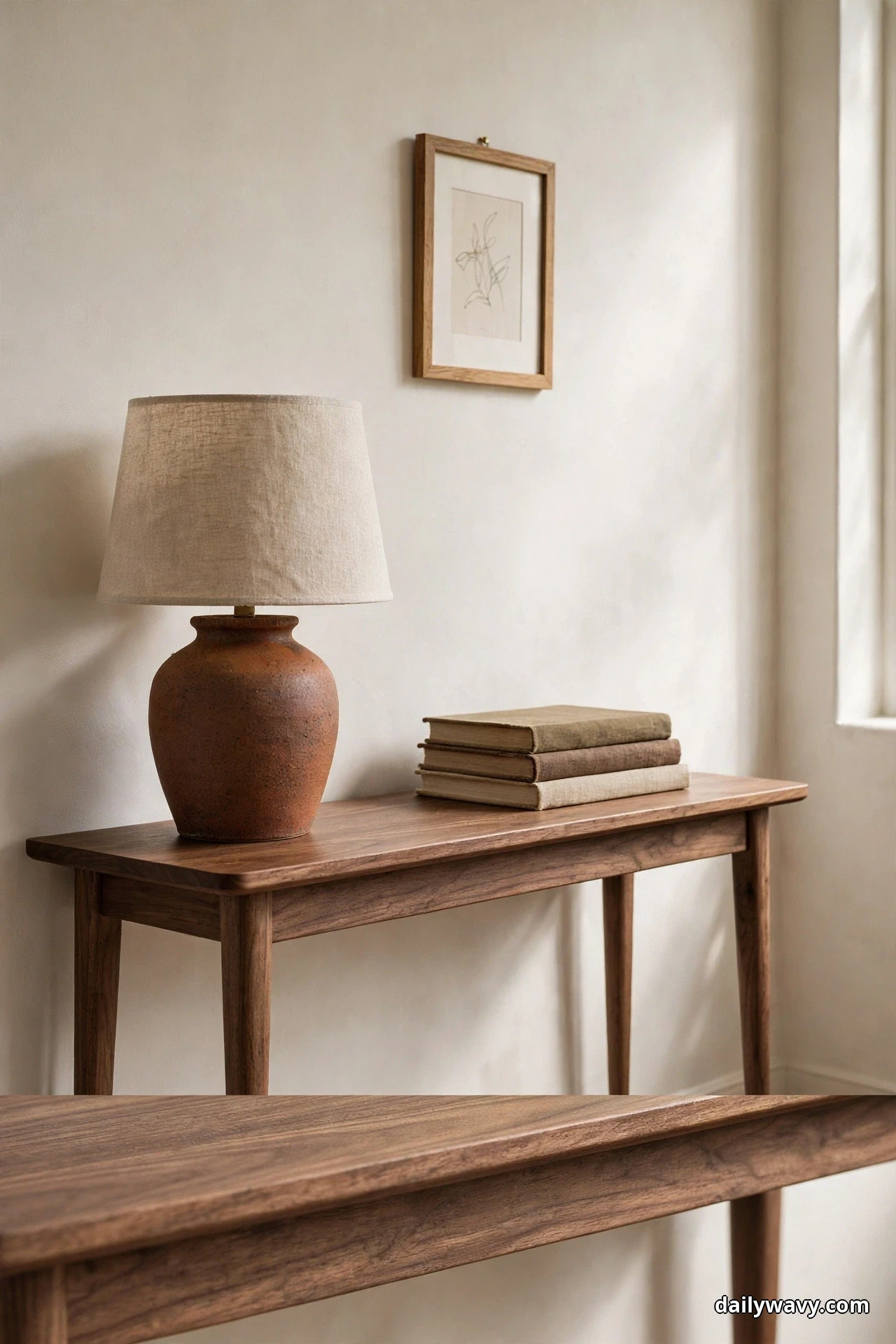
The look: A console 36 to 48 inches long, 10 to 12 inches deep, in walnut with tapered legs. A ceramic table lamp (22 to 26 inches tall) in a solid muted glaze sits off-center, with two or three books stacked beside it. Keep the wall above it empty or hang one small framed print.
What to measure: Keep the lamp base at least 4 inches inside each end of the console so nothing feels perched. Shade bottom at 42 to 48 inches off the floor lights the wall softly.
Effort and budget: A weekend of hunting for the right lamp, an evening of styling. Lower-cost alternative: any solid-color ceramic lamp from a discount store in the right shape; the glaze color matters more than the maker.
Mid-Century Living Room FAQs
How much does a mid-century living room cost to pull together?
It depends on how much you already own. A thrifted room can come together for $300 to $800 in pieces and paint; buying new reproductions for a full room usually runs $2,000 to $5,000. Start with lighting and textiles, which change the room fastest for the least money.
Does mid-century style work in a small living room?
It works especially well. Slim tapered legs, low profiles, and open space underneath furniture keep small rooms feeling airy. Skip the bulky credenza and choose the narrow console, two small tables, and the soft ottoman from this list.
Can I mix mid-century with my existing modern or traditional pieces?
Yes, with one rule: keep the wood tones in the same family. A walnut mid-century chair can sit beside a modern sofa if both share warm undertones. Mixing works when the palette agrees; it fails when each piece fights for a different decade.
What should I avoid when styling mid-century?
Avoid matching sets (the room should look collected, not delivered), avoid more than two accent colors, and avoid covering the legs. Slipcovered bases and bulky recliners undo the style faster than anything else.
What is the best lighting for a mid-century living room?
Warm bulbs at 2700K to 3000K, three pools of light (overhead or pendant, sofa level, reading level), and dimmers where possible. Mid-century rooms were designed for warm lamplight, not cold overhead glare.
Where do I find real mid-century pieces on a budget?
Thrift stores, estate sales, and secondhand marketplaces are the classic sources. Look for solid wood, dovetailed drawers, and tapered legs. Reproduction stores fill the gaps for lighting and textiles, where the vintage market runs thin.
The Style Is the Restraint
Mid-century was never about owning the right objects. It was about owning fewer of them and choosing each one well. Pick two or three ideas from this list, live with them for a month, and add the next one only when the room asks for it. That slow layering is exactly how the original rooms came together, and it is why they still look calm sixty years later.
If the living room is only the start of your plans, the small bedroom with a queen bed ideas bring the same measure-first approach to the bedroom, starting with the bed’s footprint and the walkways around it, and the full Home and Decor collection keeps the style consistent across every room.