16 Scandinavian Bathroom Decor Ideas with Practical Finishing Touches
A Scandinavian bathroom earns its calm honestly. Light wood, soft gray, cream, clean forms, and nothing that does not serve…
A Scandinavian bathroom earns its calm honestly. Light wood, soft gray, cream, clean forms, and nothing that does not serve a purpose. The look is forgiving if you respect two things: materials that can live with steam and water, and a layout where every item has a reason to be there. These sixteen ideas work at any budget. Each one includes exactly how to recreate it and a cheaper way to get the same feeling, plus the measurements that matter wherever something has to fit. Start with one corner, then let the quiet spread.
In This Guide:
- A Modest Wall Shelf Outside Splashes
- A Small Vase With One Stem
- A Repeated Metal Finish In Accessories
- A Low Storage Cabinet
- A Neatly Folded Hand-Towel Grouping
- A Patterned Fabric Accent
- A Simple Wall-Color Focal Area
- A Basket For Rolled Clean Towels
- A Restrained Towel Palette
- A Framed Moisture-Appropriate Print
- A Simple Countertop Tray
- A Compact Plant Suitable For The Actual Light
- A Textured Washable Bath Mat
- A Consistent Set Of Containers
- A Mirror With A Style-Matched Frame
- A Small Freestanding Stool
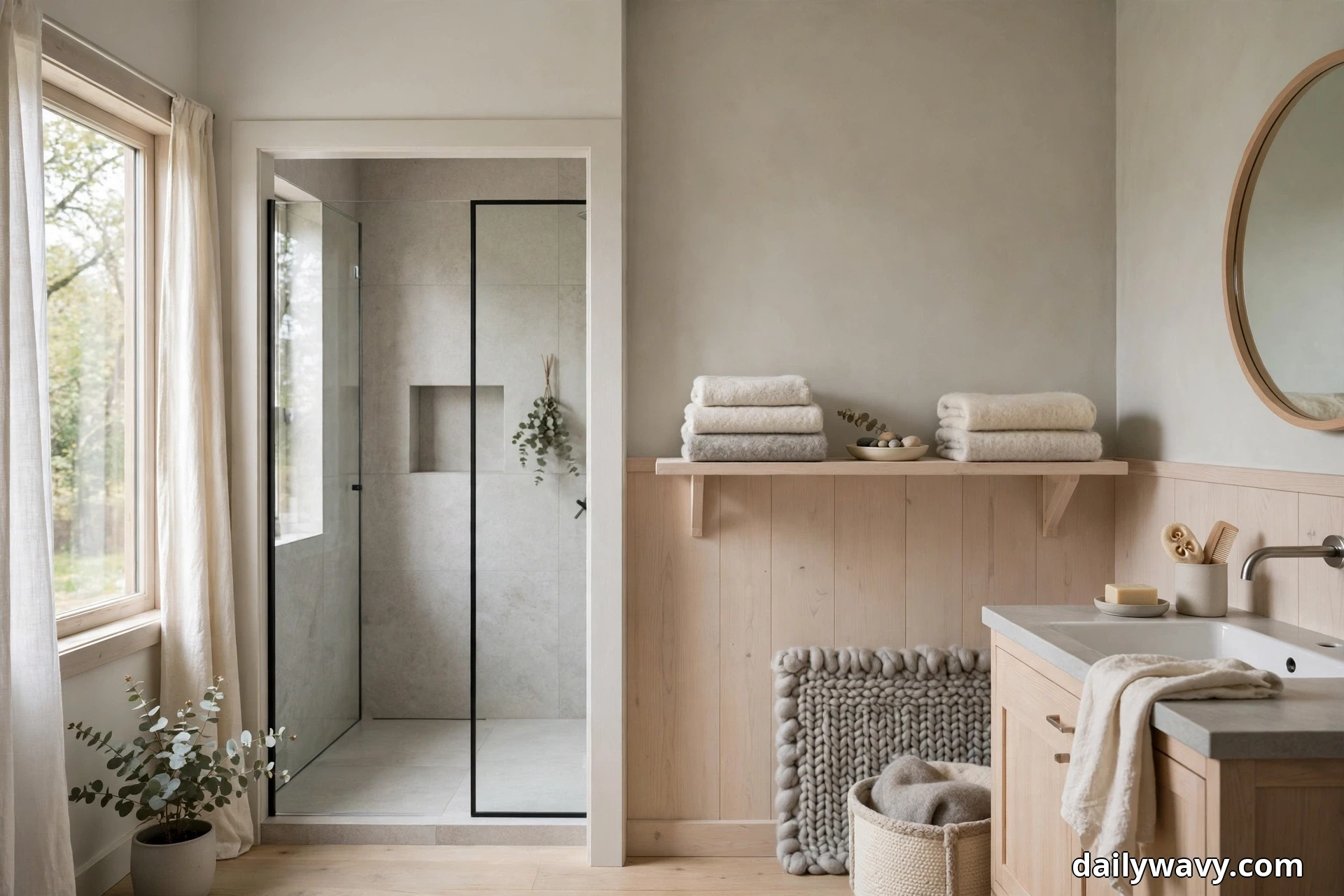
The Scandinavian Bathroom Rules Before You Start
Before you buy anything, work with the room you actually have. Scandinavian style rewards restraint, so every choice here follows the same logic: keep it useful, keep it moisture-tolerant, and repeat a small set of materials so the room reads as one calm idea instead of a collection of purchases.
First, map the water zones. The shower, tub, and sink splash area are the wet zones. Wood that is not sealed, paper products, and anything that swells or stains should live outside those zones. A shelf above a sink in the splash arc is fine for a sealed ceramic; the same shelf is the wrong home for an open stack of linens. If you are not sure a material can take humidity, the honest answer is to move it somewhere drier.
Second, limit the palette. Pick three: a light wood tone, one soft neutral for walls and large textiles (cream, warm gray, pale greige), and one quiet accent you repeat (black metal, muted sage, soft charcoal). When towels, containers, and furniture all pull from the same three, even a small bathroom looks composed.
Third, measure before you shop. Note wall lengths where shelves or cabinets will go, the height of the mirror from the sink, and how far doors and cabinet fronts swing. Most of the ideas below take under an hour and cost less than a dinner out, especially if you use the lower-cost alternatives listed with each one.
Finally, keep electrics away from water. Plug-in diffusers, candles with real flames, and corded accessories do not belong beside the sink or tub. If a brief tells you to keep electrics away from water, treat it as a rule, not a suggestion.
1. A Modest Wall Shelf Outside Splashes
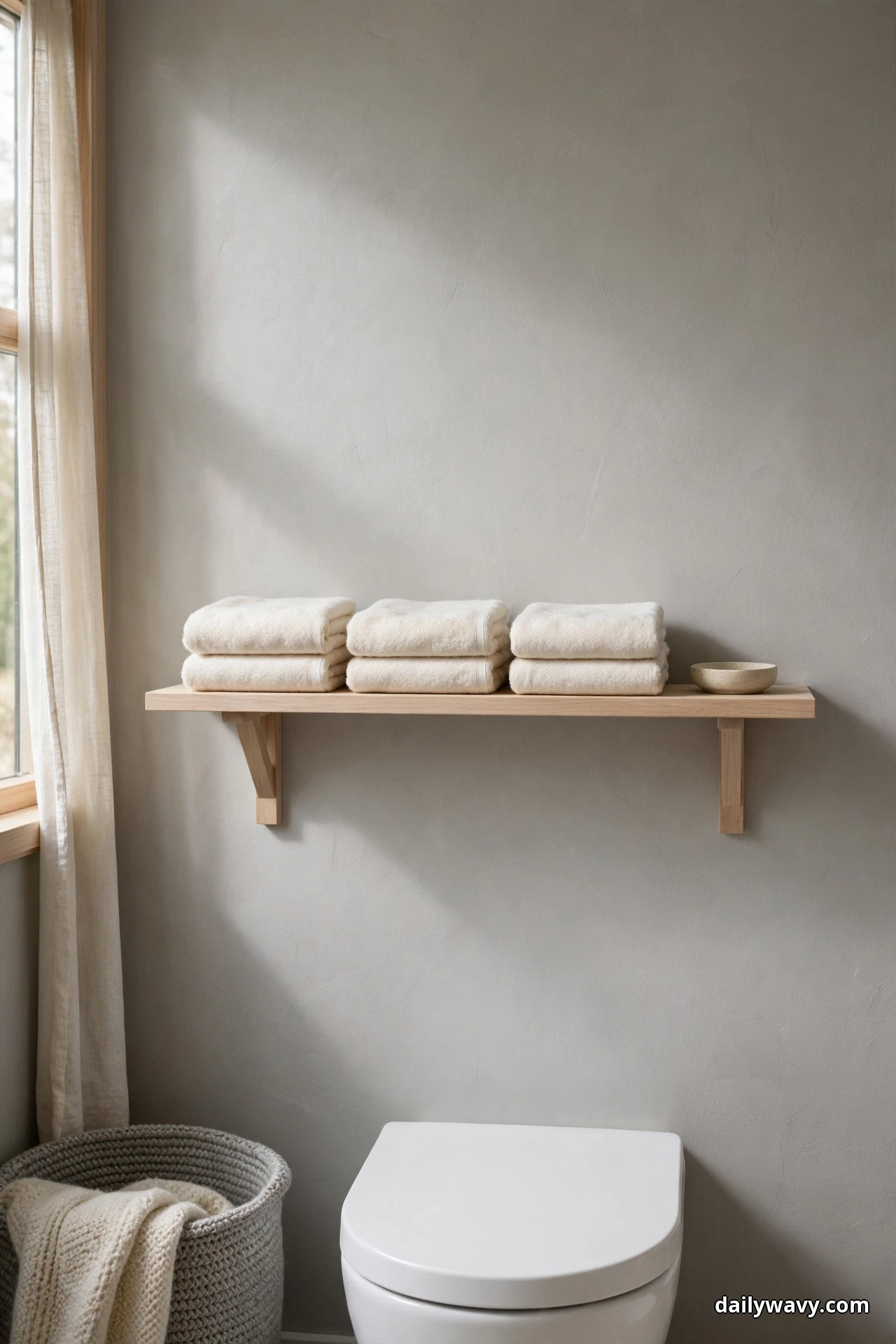
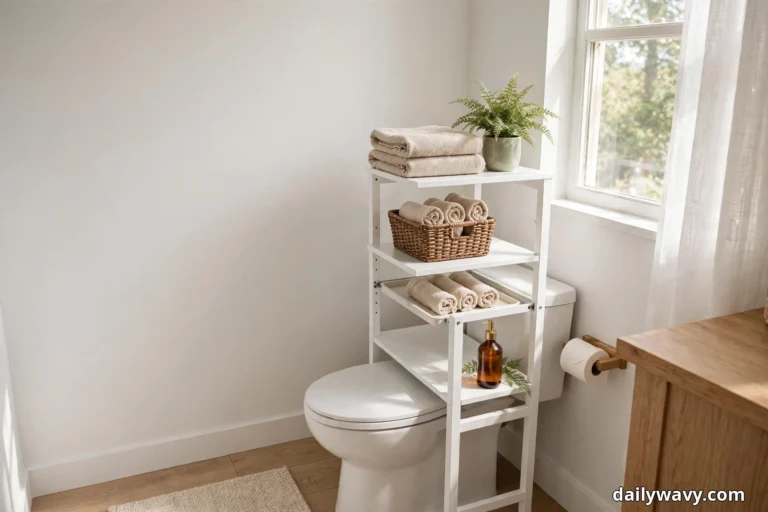
A single modest shelf does the work of three open boxes when you place it where steam and spray cannot reach it. Picture one light-wood board, roughly 24 inches wide and 6 inches deep, holding three or four folded towels and a small ceramic dish. Nothing stacked too tall, nothing crowding the edges. The shelf reads as calm storage because it is small enough to stay tidy.
To recreate it, choose a wall at least 18 inches from the nearest splash point, ideally over the toilet or on a dry stretch of wall. Measure the available width and subtract 4 inches for breathing room on each side. Use solid brackets rated for at least 15 pounds; most folding towel loads come in well under that, but the margin matters on tile and drywall. Hang the shelf at about 60 inches from the floor so folded towels sit within easy reach. A pre-finished oak or birch shelf with hidden brackets takes about 30 minutes to mount with a drill, level, and wall anchors. A realistic lower-cost alternative is a painted pine board from a hardware store, sanded smooth and sealed with two coats of water-based polyurethane for around a third of the price.
2. A Small Vase With One Stem
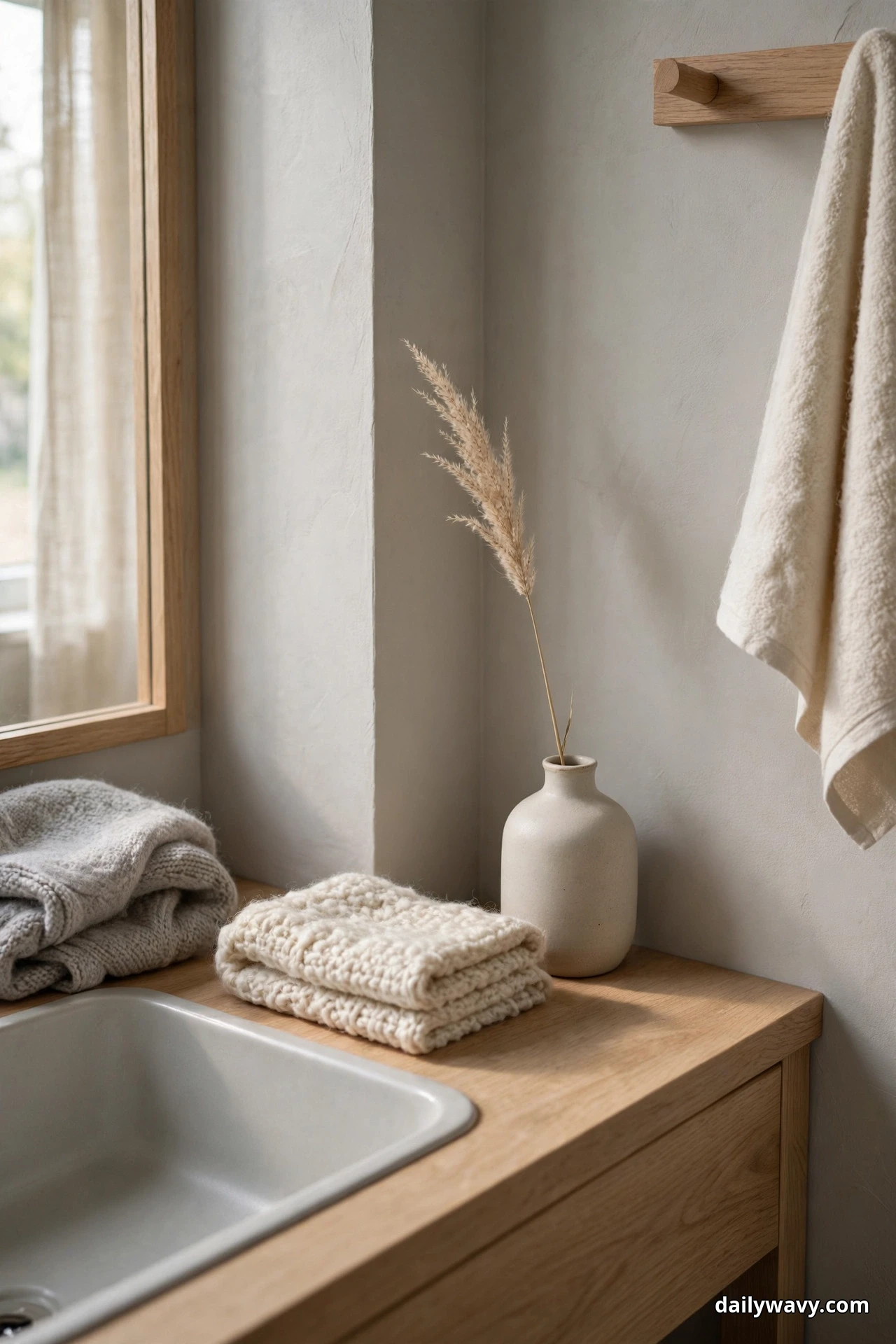
One stem in a small vase says more about calm than a whole bouquet. The single stem keeps the scale honest next to a sink, and because there is almost no water and no dropping petals, it stays fresh-looking with barely any care. In a Scandinavian bathroom the vase itself should be simple: matte ceramic, clear glass, or light stoneware, about 4 to 6 inches tall.
Place it where it will not be knocked, such as the back corner of the counter or on the shelf from idea one. Use a real stem, a branch of eucalyptus, a dried grass plume, or a single tulip, all of which last well in bathroom humidity. Change the water every three or four days if you use a fresh stem. Effort is nearly zero, and a vase this size costs very little. The lower-cost version is a thrifted glass jar with one cutting from a houseplant. Keep the arrangement small enough that it never crowds the faucet handles.
3. A Repeated Metal Finish In Accessories
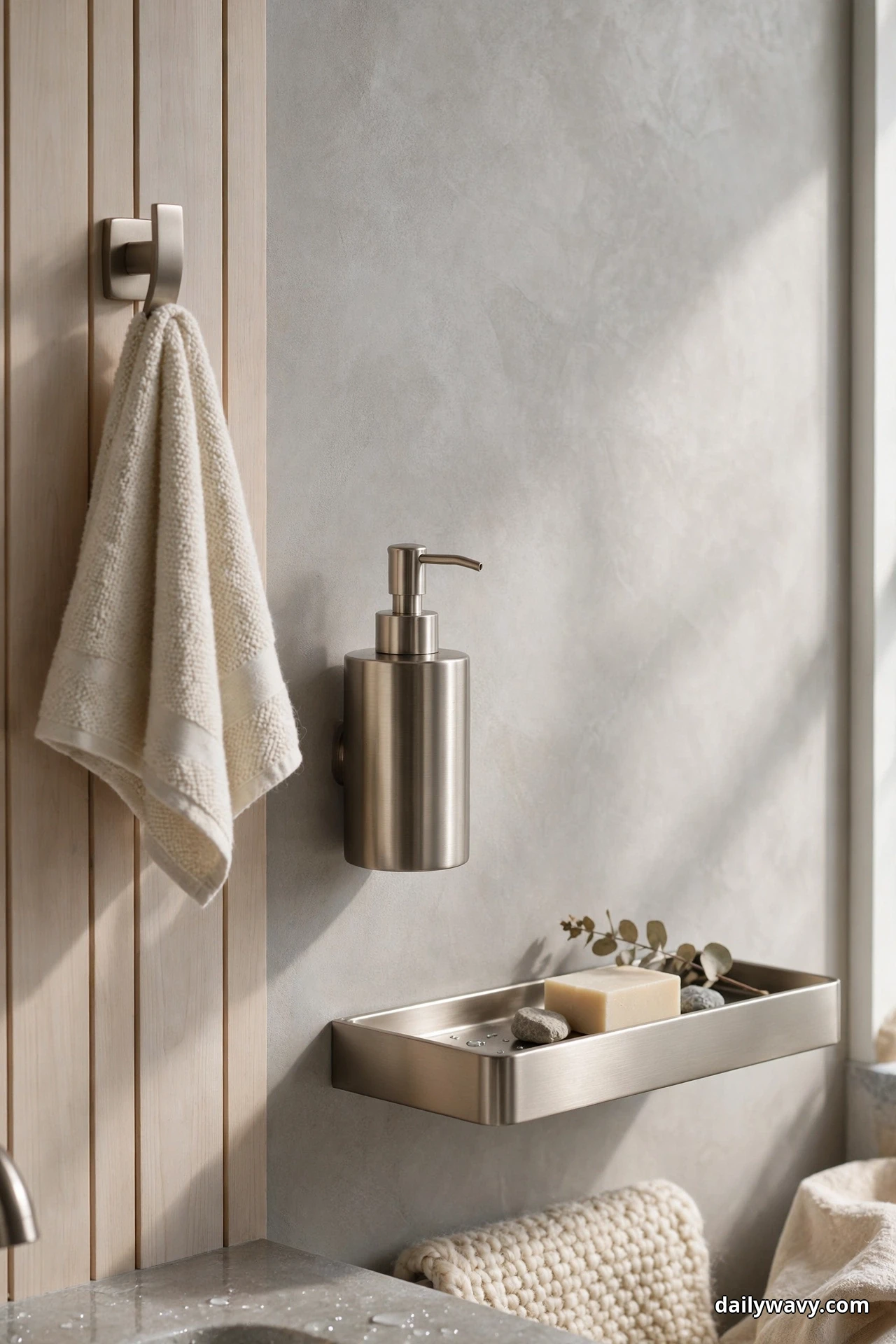
Scandinavian rooms feel finished when the small metals match. A brushed nickel faucet paired with brushed nickel hooks, a black-framed mirror paired with black tray edges, a brass soap dispenser echoed in a brass shelf bracket. The repetition is subtle, but your eye reads it as intention.
Pick one finish and apply it to three to five small items: the towel hook, the mirror edge, the soap dispenser, the tray handles, the cabinet pulls. Do not mix polished chrome with matte black in the same sightline; the contrast reads as accidental in a small room. Stainless and brushed finishes handle humidity best and wipe clean with a damp cloth, so they are the safest choice near the sink. Swapping accessories is a one-afternoon project, and most matching sets of hooks, dispenser, and tray cost under fifty dollars total. The lower-cost path is spray paint in a satin metal finish, applied to existing plastic or wood accessories after a light sanding. Two thin coats look convincing and survive bathroom air if you let each coat cure fully.
4. A Low Storage Cabinet
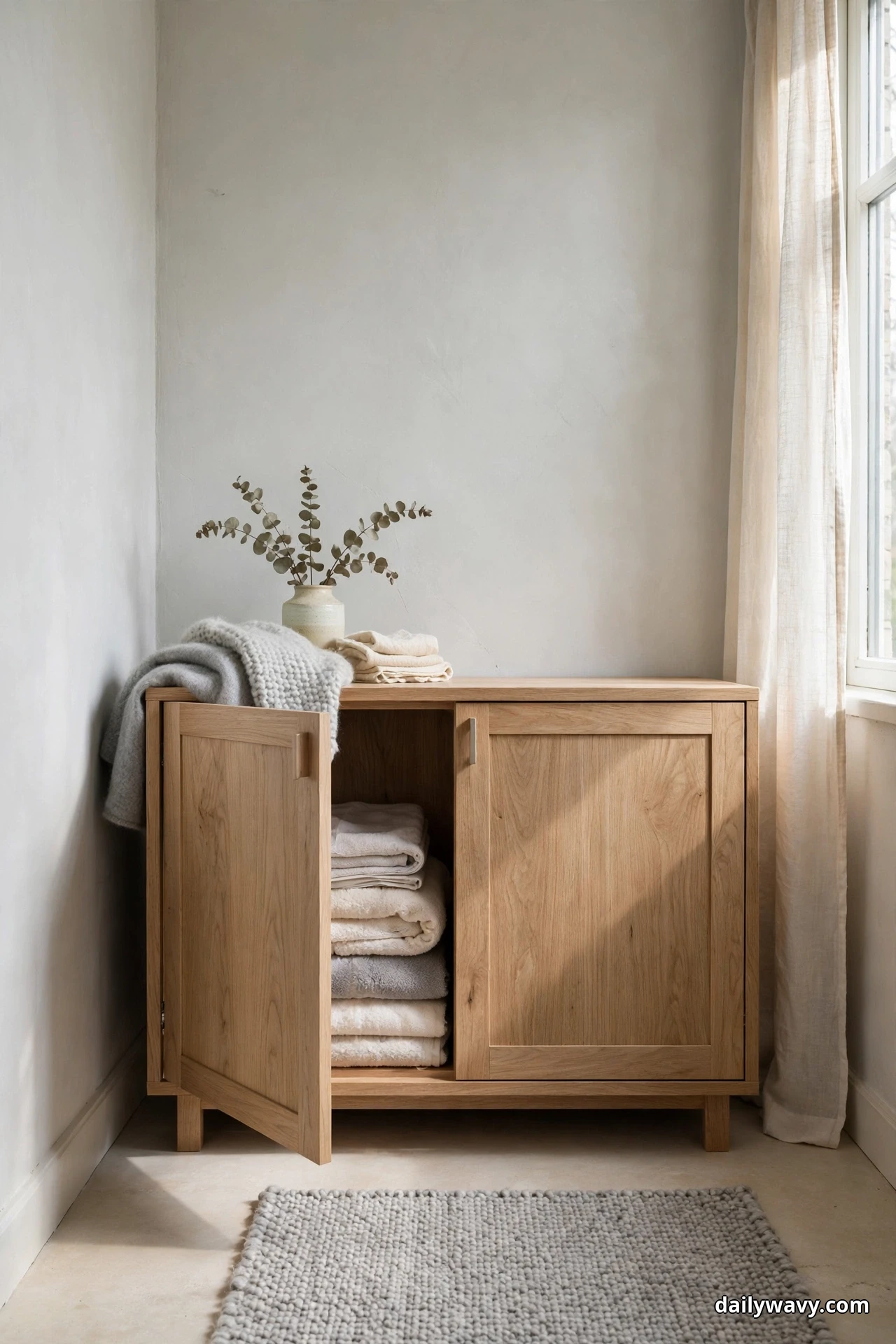
A low cabinet gives a small bathroom real storage without the visual weight of a tall tower. Look for a unit about 28 to 32 inches wide, 16 to 18 inches deep, and no more than 30 inches tall, in light oak or a pale painted finish. Set it against the driest wall, where it can hold folded towels, spare toilet paper, and cleaning supplies behind closed doors. The closed doors matter; they keep the calm surface and hide the everyday clutter that makes a bathroom feel busy.
Measure the floor space first, including the swing of the bathroom door and any drawers below the sink. Leave at least 24 inches of clear walkway in front of the cabinet. Anchor it to the wall with the included anti-tip hardware, which takes ten minutes and prevents any wobble on tile floors. A solid light-wood cabinet is a weekend-level purchase, but the lower-cost alternative is a secondhand dresser, cut no lower than you need it and repainted in a moisture-tolerant eggshell paint. Add simple cup pulls in your repeated metal finish and the piece looks built for the room.
5. A Neatly Folded Hand-Towel Grouping
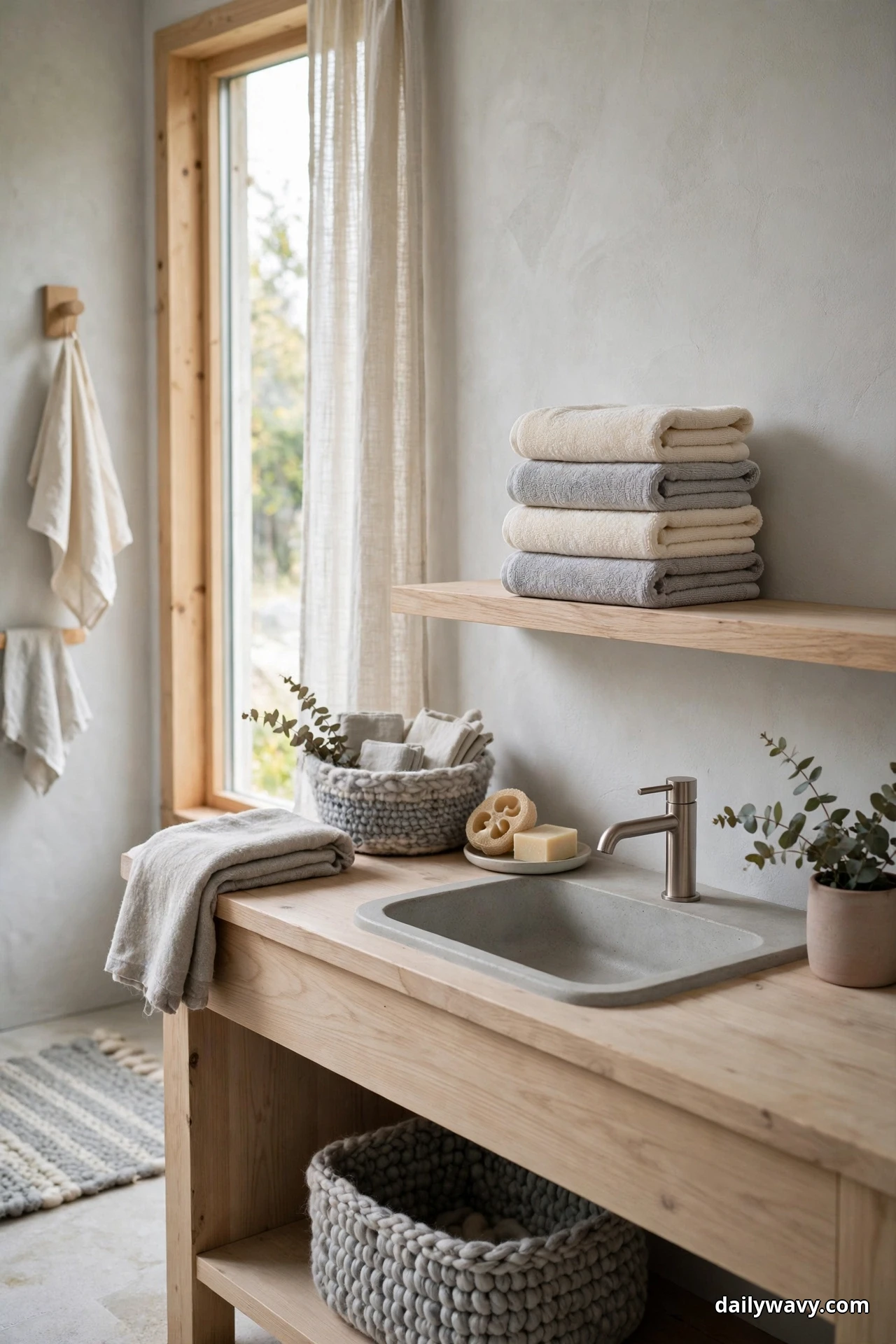
Folding is free, and in a Scandinavian bathroom it is half the decor. Take four to six hand towels in your restrained palette and fold each into thirds, then in half, so every towel shows the same finished edge. Stack them on the shelf or cabinet with the folded edges facing out. The uniformity does something visual: separate towels stop looking like laundry and start looking like a display.
Use cotton or cotton-linen blends, which hold a crisp fold better than plush terry. Wash new towels two or three times before the first display fold; they soften and stop shedding lint. Refold the stack once a week, or whenever someone grabs from the middle. The lower-cost version of this idea is simply doing it with the towels you already own, swapping any clashing colors to a guest room. If you want to buy, two or three neutral hand towels in a matching set usually cost less than a single candle.
6. A Patterned Fabric Accent
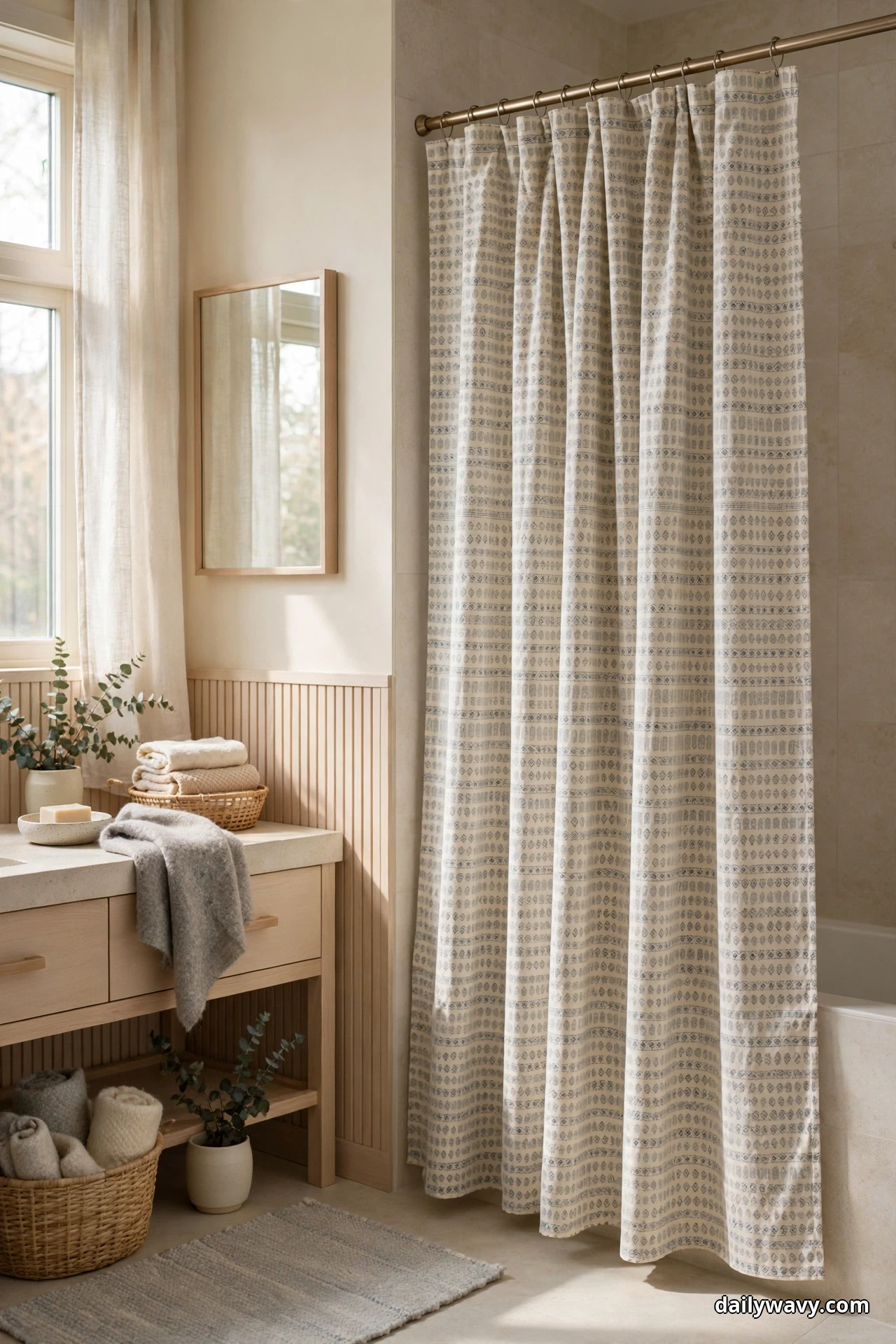
One patterned fabric is all a Scandinavian bathroom needs, and one is enough to keep the room from feeling clinical. The pattern should be quiet: a small stripe, a faint grid, a soft geometric repeat in gray on cream or cream on pale sage. Use it on the shower curtain, a window covering, or a single fabric bin. Everywhere else stays solid.
The shower curtain is the most common choice because it covers the largest surface. Choose a cotton or linen-blend curtain with a fabric liner rather than a printed plastic one; it hangs better and survives washing. Measure the rod width and buy a curtain about 20 percent wider so it gathers instead of pulling flat. The effort is one wash and one hang. The lower-cost alternative is a solid cream curtain, which costs the least, paired with a patterned fabric bin on the floor for the single hit of pattern. If the bathroom has no window, the patterned accent works just as well on the curtain alone.
7. A Simple Wall-Color Focal Area
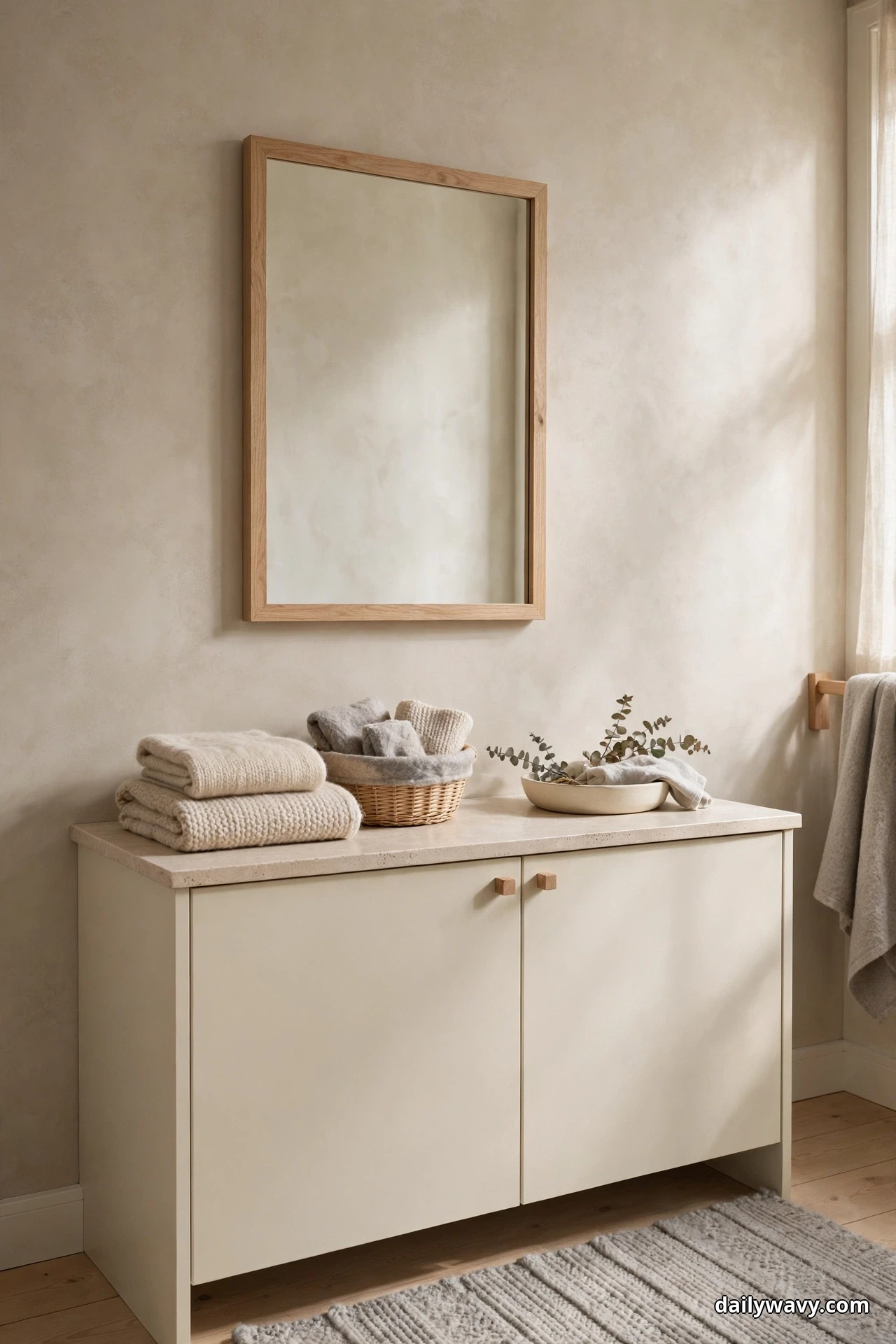
Instead of an accent wall in a bold color, paint one quiet focal area: the wall behind the mirror, the inside of an alcove, or the wall the door faces when you walk in. A soft greige, pale warm gray, or muted sage at about 75 percent lightness gives depth without drama. It photographs beautifully and makes white fixtures look intentional rather than default.
Choose a bathroom-rated paint with a satin or eggshell sheen, which resists moisture far better than flat finishes. One gallon covers a typical focal wall with two coats, and the job takes an afternoon including taping. Ventilate well and let the room dry for a full day before showering in it. The lower-cost alternative is painting only a wainscot-height band, about 36 inches up from the floor, behind the sink; you use a quart instead of a gallon and get most of the effect. Do not use ordinary wallpaper in place of paint in a bathroom unless the product is explicitly rated for high-humidity rooms; most standard wallpaper is not waterproof.
8. A Basket For Rolled Clean Towels
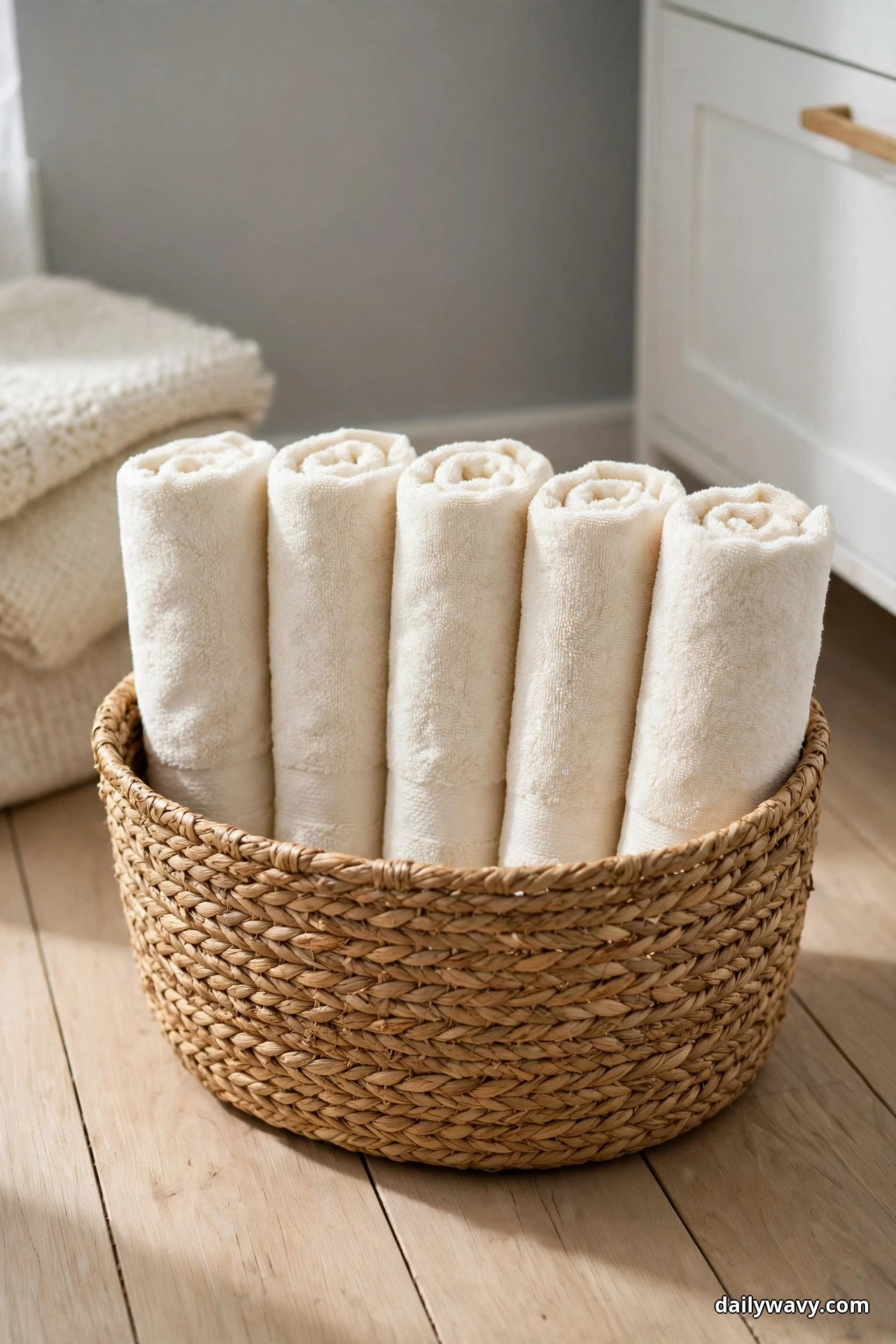
Rolled towels in an open basket solve the guest-towel problem and look like a spa without trying. Choose a basket about 12 inches wide and 14 inches tall, in seagrass, rattan, or light woven cotton, and roll five or six bath towels tightly so they stand upright. Set it on the floor beside the vanity or on the low cabinet from idea four, wherever the dry floor stays dry.
Roll each towel by folding it in half lengthwise first, then rolling from one short end; the rolls hold their shape and show the finished edge. Keep the basket at least a foot from the shower door to avoid overspray. The basket itself is the only cost, and woven baskets in this size are widely available for modest prices. The lower-cost version is a laundry basket you already own, lined with a cream cloth napkin so the rolls do not snag. Refresh the rolls monthly so the bottom towels do not sit compressed.
9. A Restrained Towel Palette
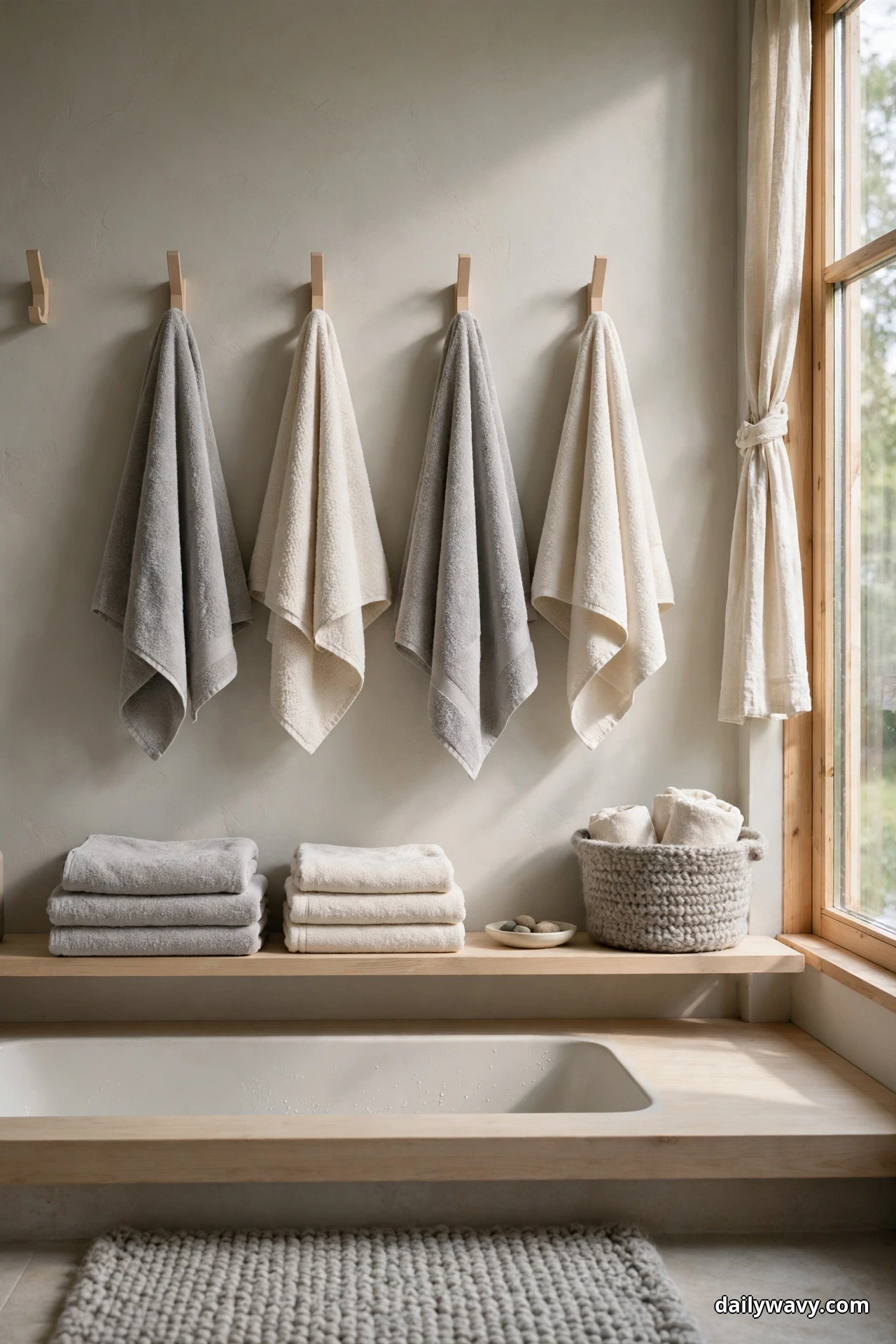
This is the quiet twin of the folded-towel idea, applied to everything fabric in the room. Choose two towel colors, both from your neutral palette, and retire the rest to other rooms. A common pairing is cream bath towels with soft gray hand towels, or all-cream with one gray bath mat as the only contrast. When every textile agrees, the bathroom instantly looks twice as designed.
If you are buying new, cotton towels in the 500 to 600 GSM range feel substantial without taking forever to dry, which matters in a humid room. Hang bath towels on hooks with at least 4 inches between them so air circulates; towels that cannot dry fully develop a musty smell no styling can fix. The effort is a single laundry sort and a donation bag. The lower-cost version costs nothing at all: keep the two best colors you already own and move the rest out.
10. A Framed Moisture-Appropriate Print
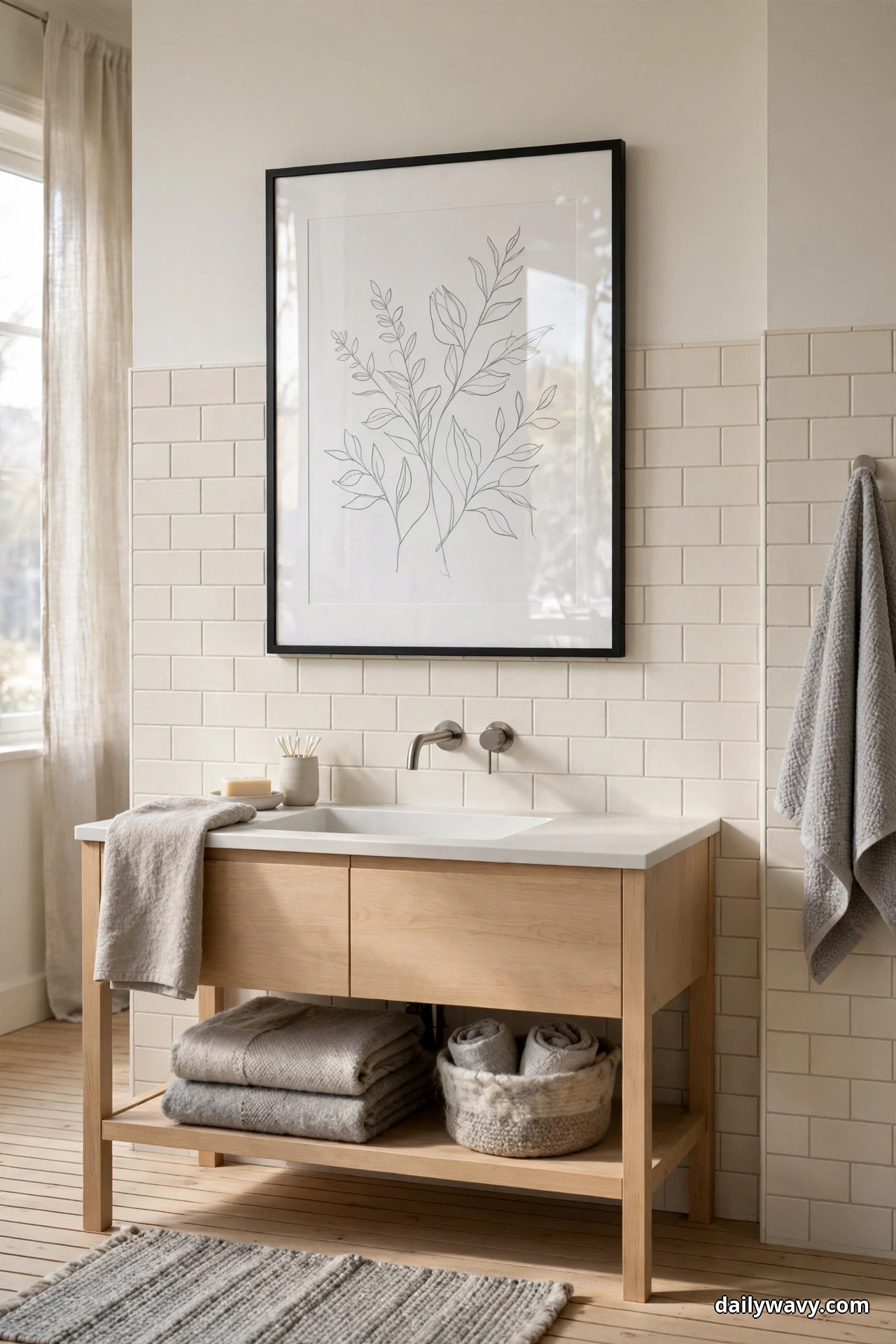
Bathroom art needs to survive steam, so the frame and the print both matter. Choose a simple black or light-wood frame with acrylic glazing rather than real glass; acrylic is lighter, safer if it ever falls, and resists the condensation that can fog glass from behind. The print itself should be a giclee or laser print on heavy paper, or better, a print made for humid rooms. Abstract botanical lines, a simple coastline, or a typographic piece all sit well in the Scandinavian palette.
Hang the frame on a dry wall, never inside the shower zone and never directly over a tub where steam rises in a column. A piece around 11 by 14 inches suits most bathrooms; hang it so its center sits about 57 inches from the floor. Use a proper hook, not an adhesive strip, because humidity loosens adhesives over time. The lower-cost alternative is a page from a large art book, trimmed and framed in an inexpensive document frame with acrylic front. It looks curated for the price of the frame.
11. A Simple Countertop Tray
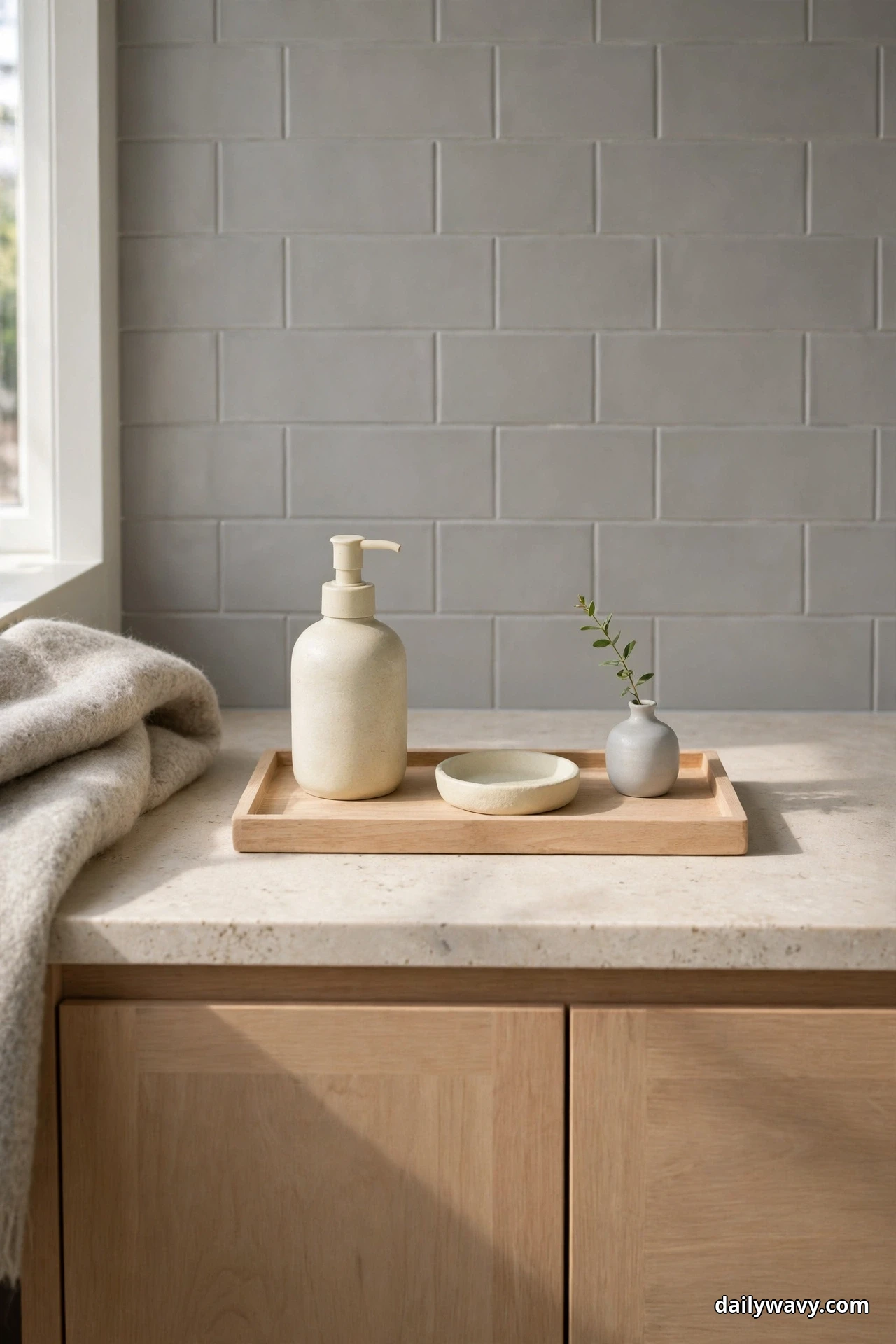
A tray turns a scattered countertop into a composed one. Choose a tray about 12 by 8 inches in light wood, stone, or your repeated metal finish, with a small lip so items do not slide. Group the daily essentials on it: the soap dispenser, a small dish for rings, and perhaps the single-stem vase. Everything else goes inside the cabinet.
The rule is that the tray holds three to five items, never more. Corral the toothbrush holder and the hand soap on the tray and move the rest; a bathroom counter with one tidy zone reads as designed, while the same items spread loose read as clutter. Wipe the tray weekly, since water rings show on wood quickly; a tray with a sealed or stone surface needs less care. A simple tray costs little, and the lower-cost version is a shallow baking sheet or cutting board you already own, which works just as well as a corral.
12. A Compact Plant Suitable For The Actual Light
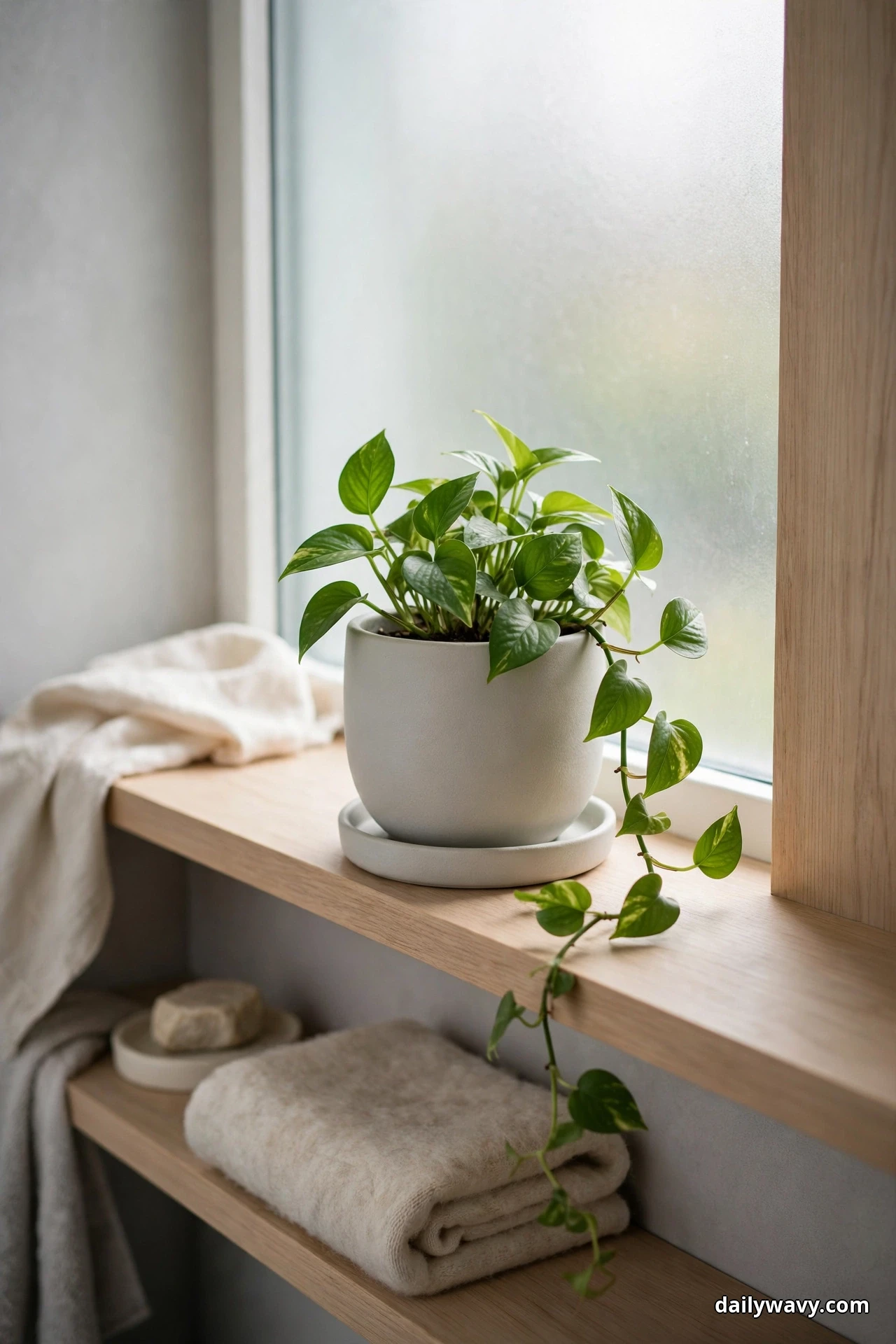
A plant brings the Scandinavian bathroom to life, but only if it matches the light you actually have. North-facing or frosted windows suit a pothos, a snake plant, or a ZZ plant, all of which tolerate low light and humidity. A bright window can host a small fern or a parlor palm. Buy the plant for the window, not for the photograph you saw online.
Choose a compact pot, 4 to 6 inches, in ceramic or stoneware, with a saucer to protect wood and stone surfaces. Place it where drips land on tile or the tray, and never where it blocks the mirror or the faucet. Watering needs are modest; check the soil weekly and water only when the top inch is dry, since bathroom humidity slows evaporation. The lower-cost alternative is a cutting from a friend’s pothos rooted in water, moved to soil after a few weeks. Skip large floor plants in small bathrooms; they crowd the walkway and get splashed.
13. A Textured Washable Bath Mat
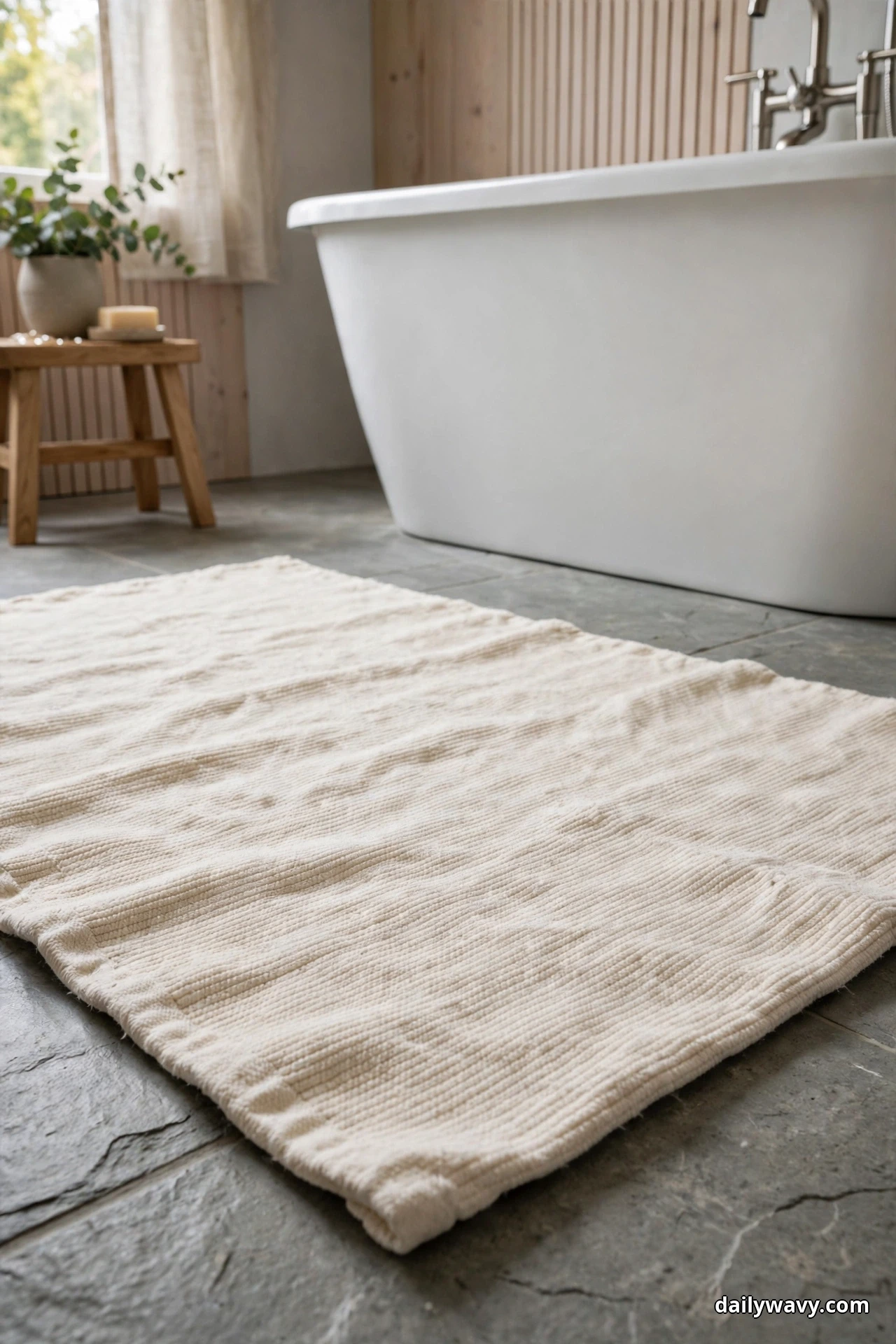
The bath mat is the one textile allowed to make a statement, and texture is the right kind of statement. Look for a flat-weave cotton or a low-pile washable mat in cream or soft gray, about 20 by 32 inches for a standard tub front. A subtle ribbed or waffle texture adds the Scandinavian material interest without a loud pattern.
Choose a mat that is genuinely machine washable and dryable, with a non-slip backing or a rug pad under it so it cannot slide on wet tile; many decorative mats are not washable, and a bathroom mat that cannot be washed becomes a problem within months. Wash it every one to two weeks on warm with the towels. If the floor is cold tile, a slightly thicker cotton mat feels better underfoot than a thin one, and it still dries between showers if the bathroom ventilates well. The lower-cost alternative is a folded flat-weave cotton rug from a discount store, hemmed to size. Either way, replace the mat when the backing cracks or it stops lying flat.
14. A Consistent Set Of Containers
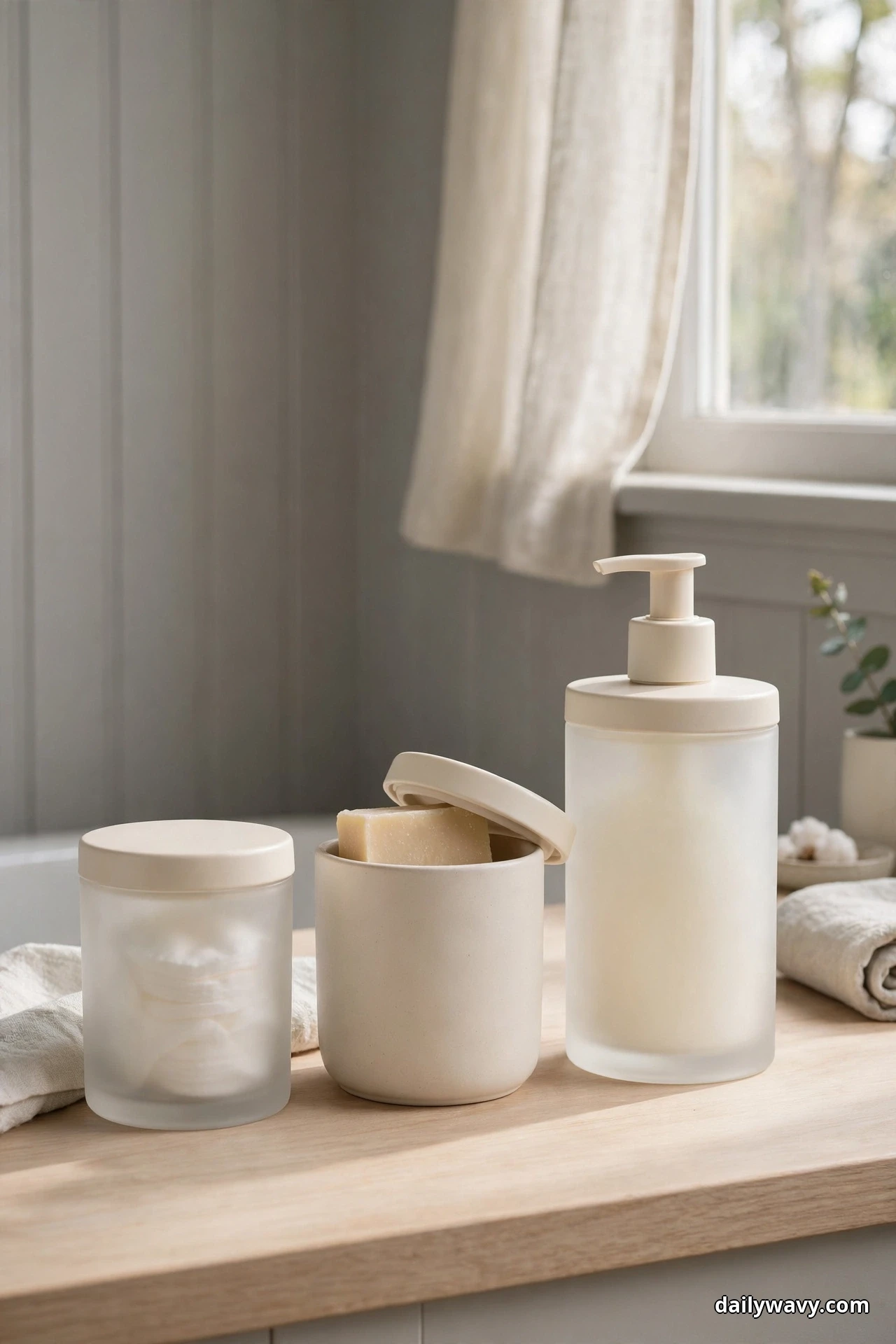
Decanting the everyday bottles into a matching set is the fastest way to calm a bathroom. Choose three to five containers in one material, frosted glass, matte ceramic, or light stoneware, in graduated sizes for soap, lotion, cotton pads, and bath salts. Matching lids and a shared shape make even a crowded counter look orderly.
Label the pump bottles only if two liquids look alike; otherwise the shapes do the work. Keep the original refills under the sink so the counter holds only the working set. Wash the containers monthly, since soap residue builds up around pumps. A starter set of matching dispensers and jars is an easy one-time purchase, and the lower-cost version is a set of identical glass jars with simple wood or bamboo lids, which look Scandinavian at a fraction of the price. Do not decant anything with safety instructions you need to keep, like medicated products; leave those in their original packaging.
15. A Mirror With A Style-Matched Frame
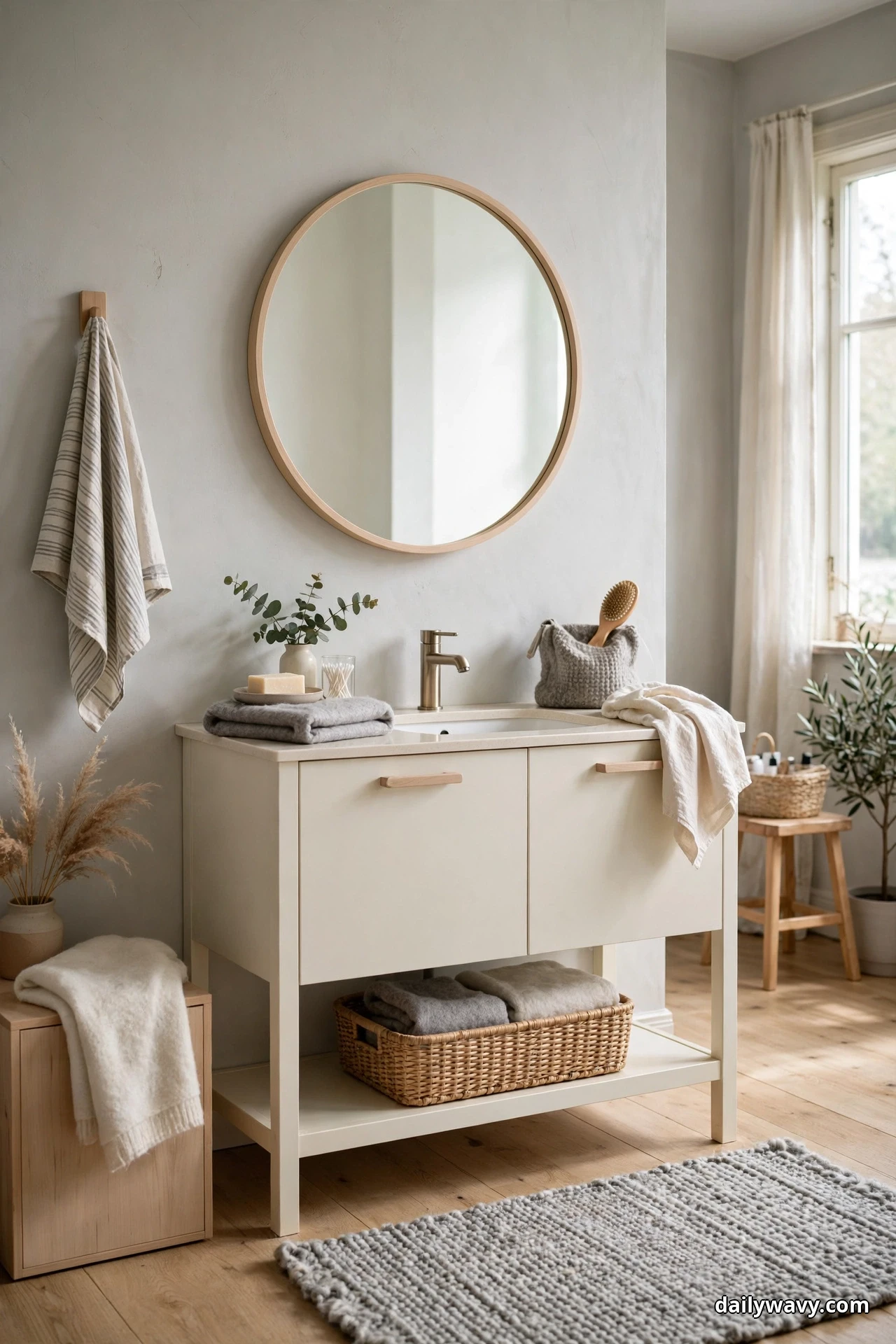
The mirror is the largest reflective surface in the room, so its frame sets the tone. A thin light-wood frame or a slim black frame, matched to your repeated metal finish, ties the mirror into the rest of the design instead of leaving it as a leftover from the builder. Round mirrors soften a boxy bathroom; rectangular ones suit long vanities.
Size the mirror to the vanity: about 4 to 6 inches narrower than the vanity top on each side is a reliable proportion, and the bottom edge should sit 5 to 10 inches above the faucet. Hang it with proper anchors, because mirrors are heavy and bathroom walls are often tile over backer board. If the existing mirror is glued to the wall, frame it in place with thin trim molding cut to size; the project takes an hour and avoids the risky removal. The lower-cost alternative is exactly that: trim the mirror you have instead of buying a new one. Keep the frame thin so it never reads as heavy.
16. A Small Freestanding Stool
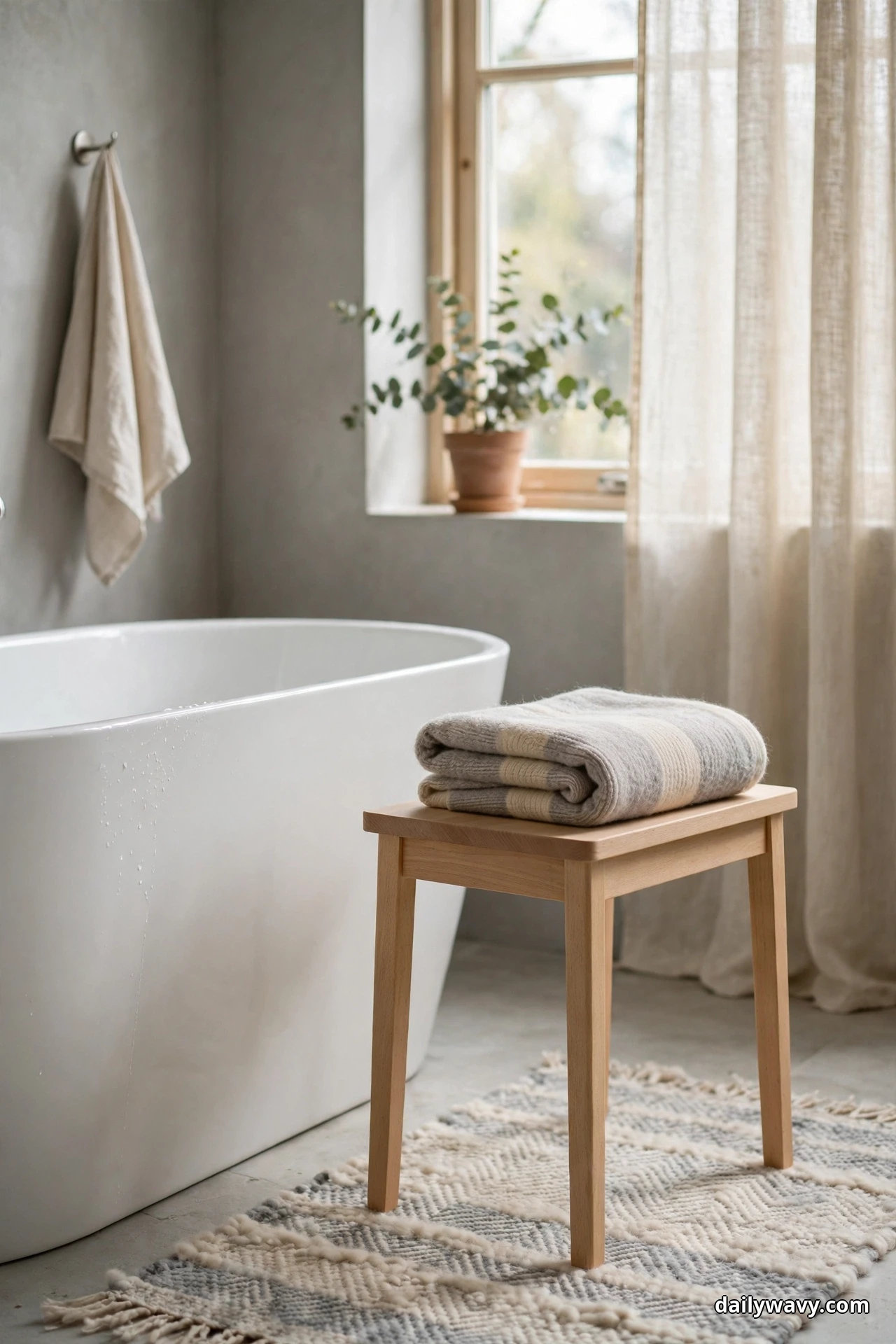
A small stool is the most flexible piece a bathroom can own. In light wood or molded beech, about 17 to 18 inches tall, it works as a side table beside the tub, a plant stand, a towel perch, or a step for reaching the high shelf. Scandinavian design loves objects with more than one job, and a stool is the purest example.
Choose a stool rated for at least 200 pounds if anyone will sit or step on it, and check that the legs sit flat on tile; a wobbling stool in a wet room is a hazard, not decor. Keep it out of the direct shower spray, since even sealed wood lasts longer when it dries between uses. A simple beech stool is an affordable classic, and the lower-cost alternative is a sturdy wooden step stool from a hardware store, sanded and sealed. Place it where it is useful every day, not where it only looks good in a photograph.
Frequently Asked Questions
How do I keep a Scandinavian bathroom from feeling cold or bare?
Warm it with texture, not color. Layered textiles, light wood, and one living plant add the warmth that minimalism can miss. If the room still feels stark, add a second fabric texture, a waffle blanket over the tub edge or a woven basket, rather than adding more objects.
What materials actually survive bathroom humidity?
Sealed wood, ceramic, stone, glass, stainless steel, and quality bath textiles all handle steam well. Avoid unsealed raw wood, standard wallpaper, and paper-based products in wet zones. When in doubt, keep the questionable material at least a few feet from the shower and sink, and ventilate the room after every shower.
Can I do this style in a rental without drilling?
Yes. Use leaning shelves, freestanding cabinets, tension-rod curtains, and adhesive-free over-door hooks rated for tile. The tray, basket, textiles, and plant ideas need no drilling at all, and a framed print can rest on a shelf instead of hanging.
How much should I budget for the whole look?
Most of these ideas cost little. A full refresh using the lower-cost alternatives across eight to ten ideas typically lands between one hundred and three hundred dollars, with paint and a cabinet as the biggest items. Start with textiles and the tray, which change the room most per dollar.
Do I need to replace my fixtures to get this look?
No. Matching the small accessories to each other matters more than matching them to the faucet. If the faucet is chrome and you prefer black accessories, the room still reads as calm as long as the accessories agree with each other. Replace fixtures only during a planned renovation.
How do I keep it looking this tidy day to day?
Give everything a home and keep surfaces mostly clear. The tray, the basket, and the cabinet each hold a category, so the daily reset is a two-minute job: items back on the tray, towels refolded, plant checked. Scandinavian calm is a habit more than a purchase.
The Takeaway
A Scandinavian bathroom is not about buying Scandinavian things. It is about fewer things, honest materials, and finishes that respect water. Pick the ideas that fit your room and your budget, measure once, and place each piece where it can actually live with steam. If you want more small-space thinking, our small bathroom storage ideas pair naturally with this guide, our narrow living room layout guide applies the same measure-first discipline to another tight room, and the Home and Decor collection has the full room-by-room library. Save the ideas you love, pin the rest, and let the quiet do the work.
Pin these ideas for your next refresh, then start with the shelf. One calm corner has a way of spreading.