10 Bedside Stool Styling Ideas with Space for Your Essentials
A bedside stool is the quiet workhorse of a bedroom. It holds your book, your water, your glasses, all in…
A bedside stool is the quiet workhorse of a bedroom. It holds your book, your water, your glasses, all in a footprint barely wider than a dinner plate. That small surface is why styling it well matters: every inch is visible, every object earns its place, and a thoughtful arrangement makes the side of the bed feel calm.
These ten bedside stool styling ideas are built for real life, not showroom photos. Each leaves room for what you reach for at night, a glass of water, a lamp you can switch on half asleep, and nothing you must shove aside to find your phone. Save the ones that suit your space, and pick the look that makes mornings start easier.
In This Guide:
- A Single Sculptural Accent
- A Framed Photograph With A Short Vase
- A Charging Area With Tidy Cable Routing
- A Tray Holding A Notebook And Pen
- A Pair Of Balanced Objects Of Different Heights
- A Soft Fabric Mat Beneath Essentials
- A Small Mirror With A Ceramic Vessel
- A Narrow Upright Book Arrangement
- A Shaded Lamp Beside A Small Tray
- One Flower Stem In A Low Vase
The Bedside Stool Rules Before You Start
Before you style anything, get the practical bones right. A bedside stool only works when it sits at the right height and stays reachable in the dark.
Match the height to your mattress. Measure from the floor to the top of your mattress, then choose or adjust a stool whose top surface sits within about two inches of that number, ideally level or a touch higher. If your mattress top is 25 inches off the floor, a 24 to 26 inch stool keeps water and glasses within an easy reach instead of a blind fumble.
Respect the real surface width. Most bedside stools offer 12 to 18 inches of usable top. Measure yours. If it is 14 inches across, plan for a single lamp base of about 6 inches plus one small tray or stack, and nothing else. Leaving half the surface clear is not emptiness, it is the whole point.
Plan your reach. You should be able to touch every object on the stool without sitting up. Sit on the edge of your bed, extend your arm, and mark the farthest point your fingertips reach comfortably. Keep nightly essentials, water, phone, glasses, inside that zone. Anything decorative can live at the back edge.
Handle glare and cables from the start. A bare bulb next to a pillow throws harsh light in your eyes. Pick a shade that hides the bulb from your line of sight when you lie down, and route any lamp or charger cord down the back leg with adhesive cable clips so it never drapes across the floor. If you are using a tall bookcase or shelving unit beside the stool, anchor it to the wall with the hardware it came with, since a top-heavy piece next to the bed is a genuine hazard.
1. A Single Sculptural Accent
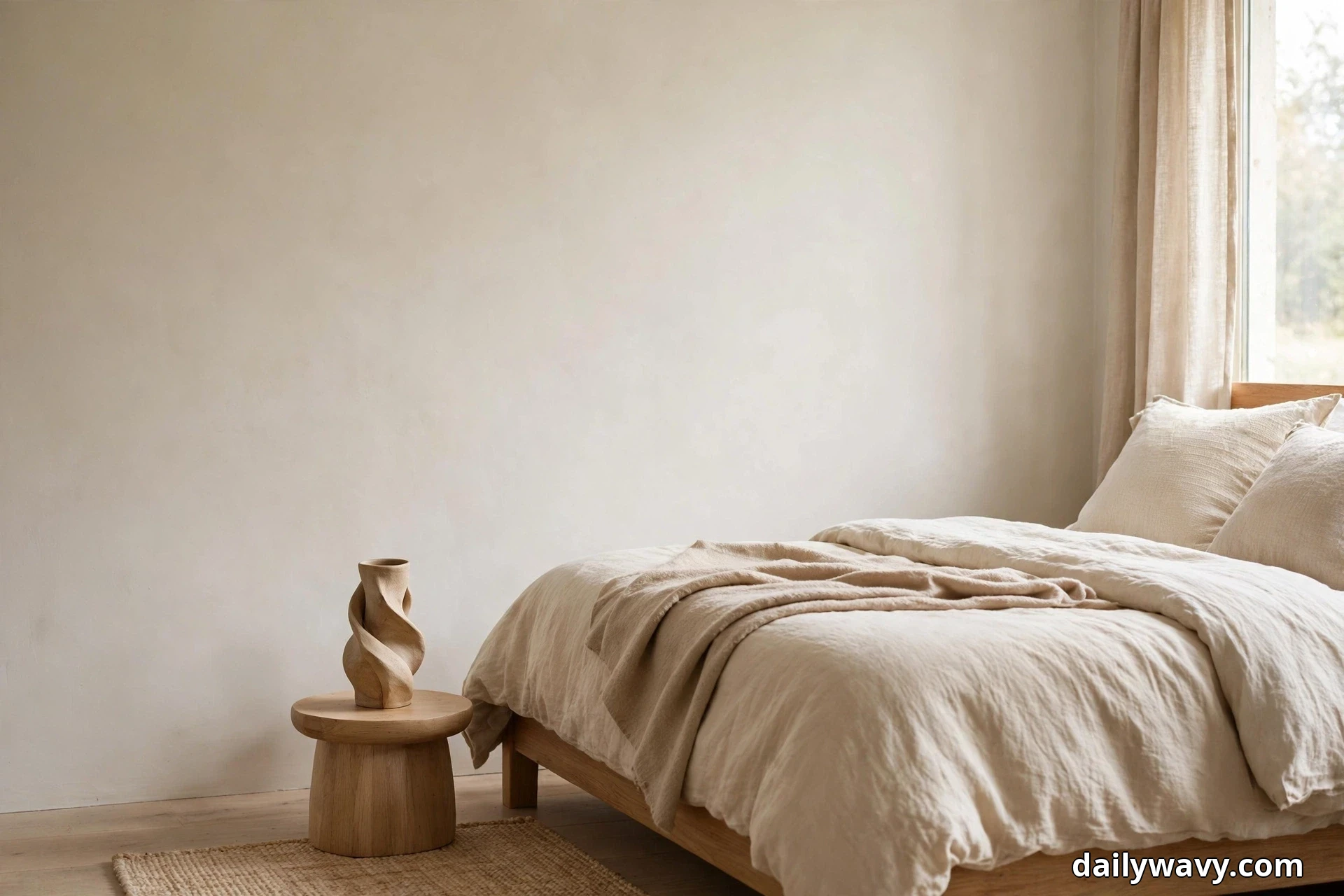
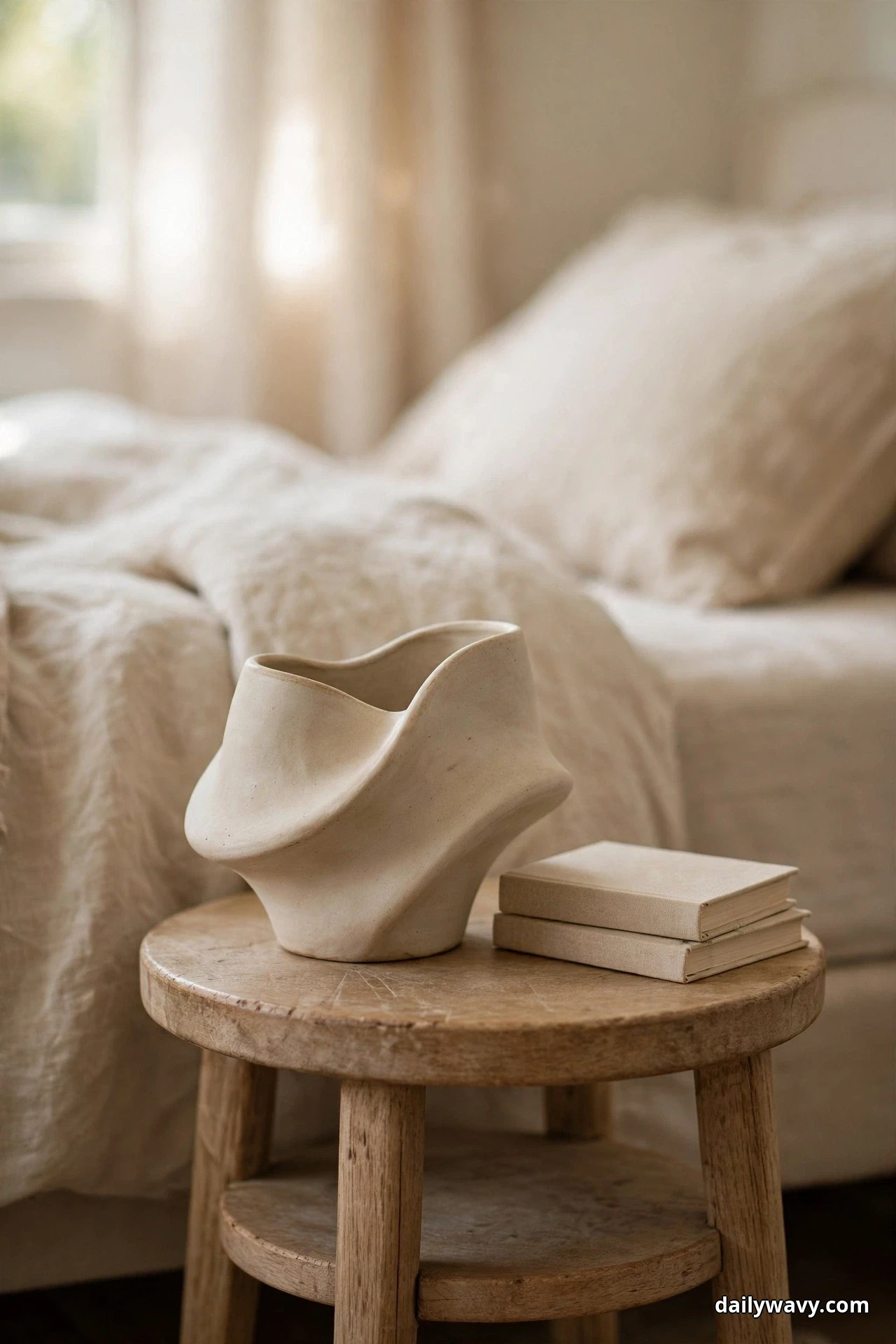
Sometimes one object does the whole job. A single sculptural accent, a twisted ceramic vessel, a carved wooden form, a small stone piece with an interesting silhouette, gives the stool a clear focal point while keeping nearly the entire surface free. The eye lands, rests, and moves on, which is exactly the mood you want at bedtime.
How to pull it together: Start by measuring the stool top. On a 14 inch surface, an object 6 to 8 inches tall and 4 to 5 inches wide leaves plenty of room for a water glass and your phone at the front edge. Set the accent at the back corner, roughly 2 inches from each edge, angled so its most interesting side faces the bed. Keep it in a material that echoes something else in the room, ceramic that matches a lamp base, wood that picks up the bed frame, so it feels chosen rather than random.
Effort and budget: This is the easiest idea on the list. A small handmade-look ceramic vessel runs about $18 to $40 at home goods stores. For a lower-cost version, a smooth river stone or a piece of driftwood from a nature walk costs nothing and looks just as intentional on a small surface.
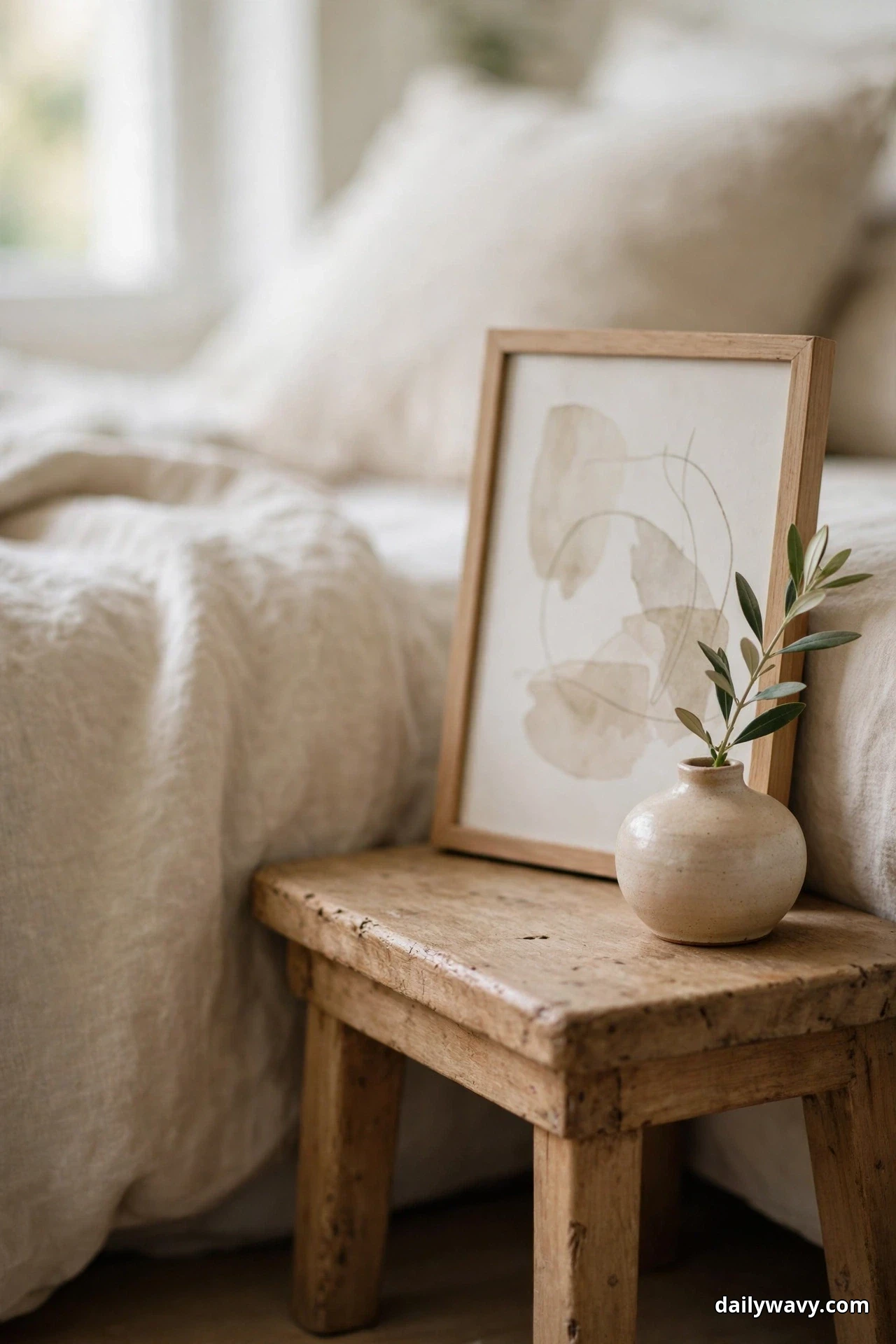
2. A Framed Photograph With A Short Vase
A framed photograph makes a bedside stool feel personal instead of staged, and pairing it with a short vase keeps the grouping from reading as a bare picture propped on a table. The photograph gives you height at the back, the vase gives you softness at the front, and together they occupy one corner so the rest of the surface stays useful.
How to pull it together: Use a frame no larger than 5 by 7 inches so it does not dominate a compact top. Lean it against the wall or stand it on a small easel at the back edge, tilted about 10 degrees back so it catches light. In front of it, place a short vase, 3 to 4 inches tall, with a single stem of greenery or a dried bloom. Measure the combined footprint and keep it inside a 6 inch square at the back corner. The low vase in front means you can still see the whole photograph.
Effort and budget: A simple wood or brass frame costs $10 to $25, and a small bud vase another $8 to $15. For a lower-cost version, print a favorite photo at a drugstore for under $2 and use a short drinking glass as the vase.
3. A Charging Area With Tidy Cable Routing
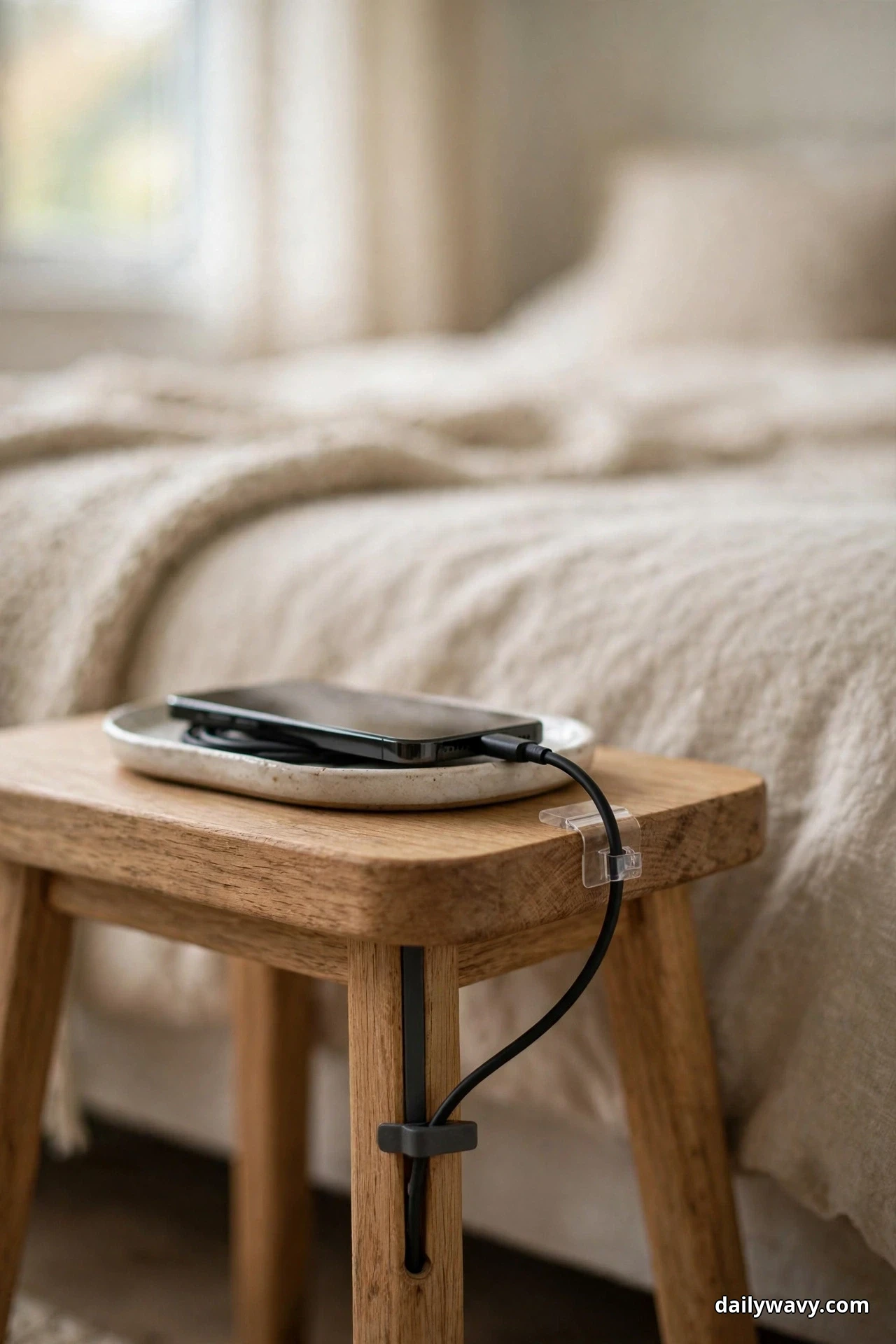
The charging corner is where bedside stools usually fail. A phone, a cable, maybe a watch, all sprawling across the surface and tangling with the lamp cord. A deliberate charging area fixes this with almost no effort: one small tray, one short cable, and the cord routed out of sight.
How to pull it together: Dedicate the back corner of the stool, the side nearest the wall outlet, to charging. Set a small ceramic or leather tray, about 5 by 7 inches, and place the phone and a charging cable on it. Use a 1 to 3 foot cable rather than a 6 foot one so there is no slack to manage. Run the cable down the back leg of the stool with two or three adhesive cable clips, spaced about 8 inches apart, and plug it into a power strip behind the stool or bed rather than a visible wall outlet. Everything charges, nothing sprawls.
Effort and budget: A small tray runs $12 to $25, adhesive cable clips about $6 for a pack, and a short charging cable $8 to $12. For a lower-cost version, use a small saucer or plate you already own as the tray.
4. A Tray Holding A Notebook And Pen
If you are someone who thinks of things at 11 pm, a notebook and pen within reach is worth more than any decoration. Corral them on a small tray and they read as intentional styling instead of clutter, while staying exactly where you need them.
How to pull it together: Choose a tray that fits the stool with room to spare, about 8 by 10 inches on a 14 inch surface. A wood, rattan, or linen-covered tray keeps the look warm. Lay a closed notebook, roughly A5 or 5 by 8 inches, flat on the tray with a pen across it or tucked in a pocket. Set the tray at the back edge or to the side, angled slightly, and leave the front half of the stool completely clear for water and glasses. The tray boundary is the trick: everything stays inside it, so nothing migrates.
Effort and budget: A small decorative tray costs $12 to $30, a nice notebook $10 to $18. For a lower-cost version, use a baking sheet from the kitchen or a cutting board you already own as the tray.

5. A Pair Of Balanced Objects Of Different Heights
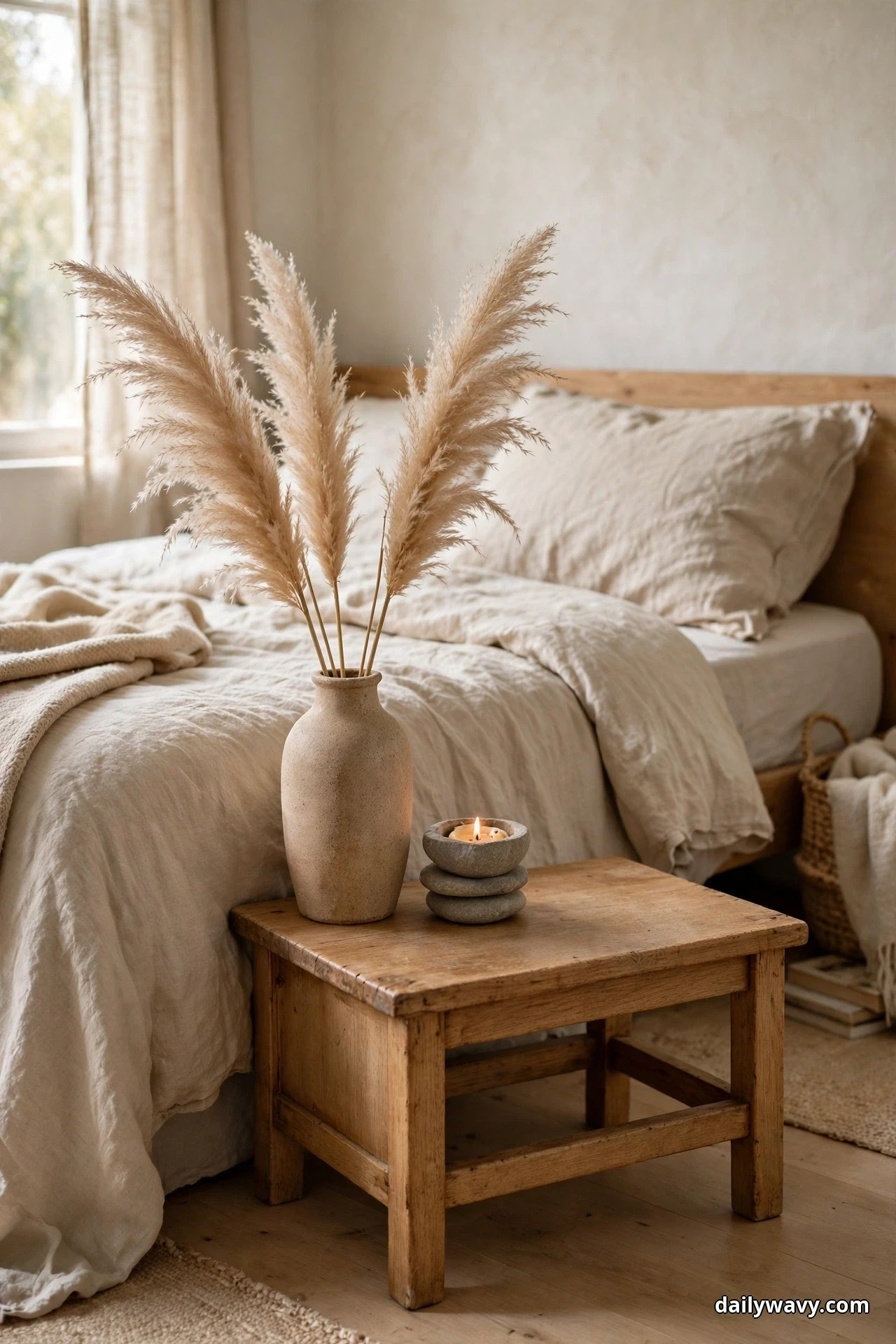
Pairs work beautifully on small surfaces because the eye reads them as one composition instead of two competing items. The rule is simple: one tall, one short, and enough contrast in shape or material that they look deliberate together rather than accidentally matched.
How to pull it together: Measure your stool top and plan the pair to occupy a band about 6 inches deep along the back edge. The tall object should be 10 to 14 inches, a vase with pampas grass or a slim flameless candle. The short object should be 3 to 5 inches, a stacked stone bowl, a small dish, a squat flameless candle. Place the tall piece at the back corner and the short piece 3 to 4 inches in front of it, slightly off-center. Keep both in materials that appear elsewhere in the room, ceramic, wood, brass, so the pair feels connected to the space.
Effort and budget: A medium ceramic vase runs $15 to $35, a small stone or ceramic bowl $8 to $18. For a lower-cost version, use a tall glass bottle with a branch of eucalyptus and a small kitchen ramekin as the low piece.
6. A Soft Fabric Mat Beneath Essentials
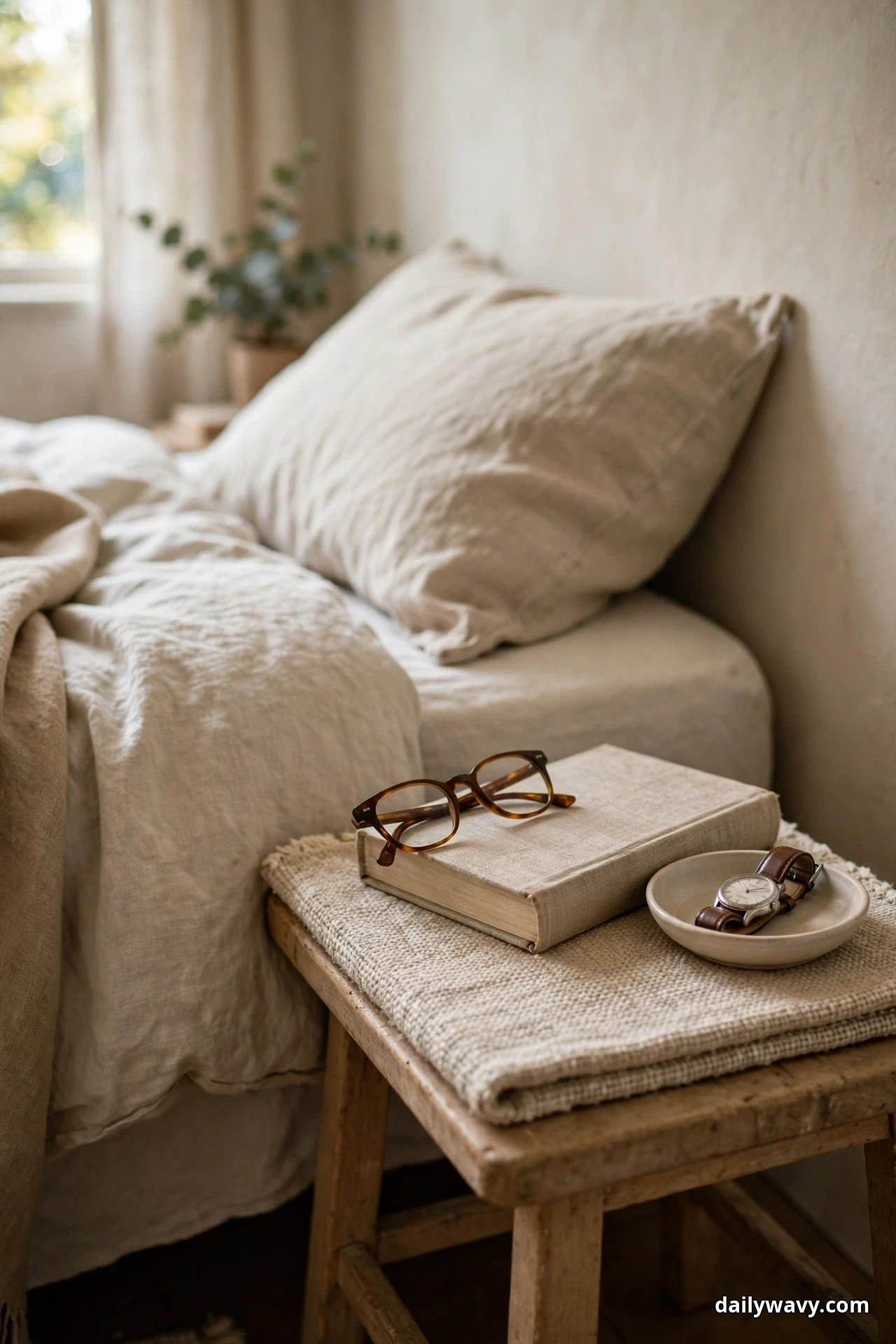
A fabric mat does three quiet jobs at once. It protects the stool top from water rings, it keeps small objects from sliding, and it turns a random scatter of nightly items into one composed zone. It is the easiest upgrade on this list and one of the most practical.
How to pull it together: Cut or buy a mat that covers the working area without hanging over the edge, about 10 by 10 inches on most stools. A woven cotton, linen, or felt mat in a warm neutral works well and is easy to wash. Place it slightly off-center toward the bed, then arrange your essentials on it: reading glasses, a book, a small dish for a watch or jewelry. The mat edge becomes the boundary, so when you set something down at night it lands in the zone automatically. Machine-wash the mat every couple of weeks, since it collects dust and hand cream residue.
Effort and budget: Small woven mats and placemats run $8 to $20. For a lower-cost version, fold a linen napkin or a bandana you already own.
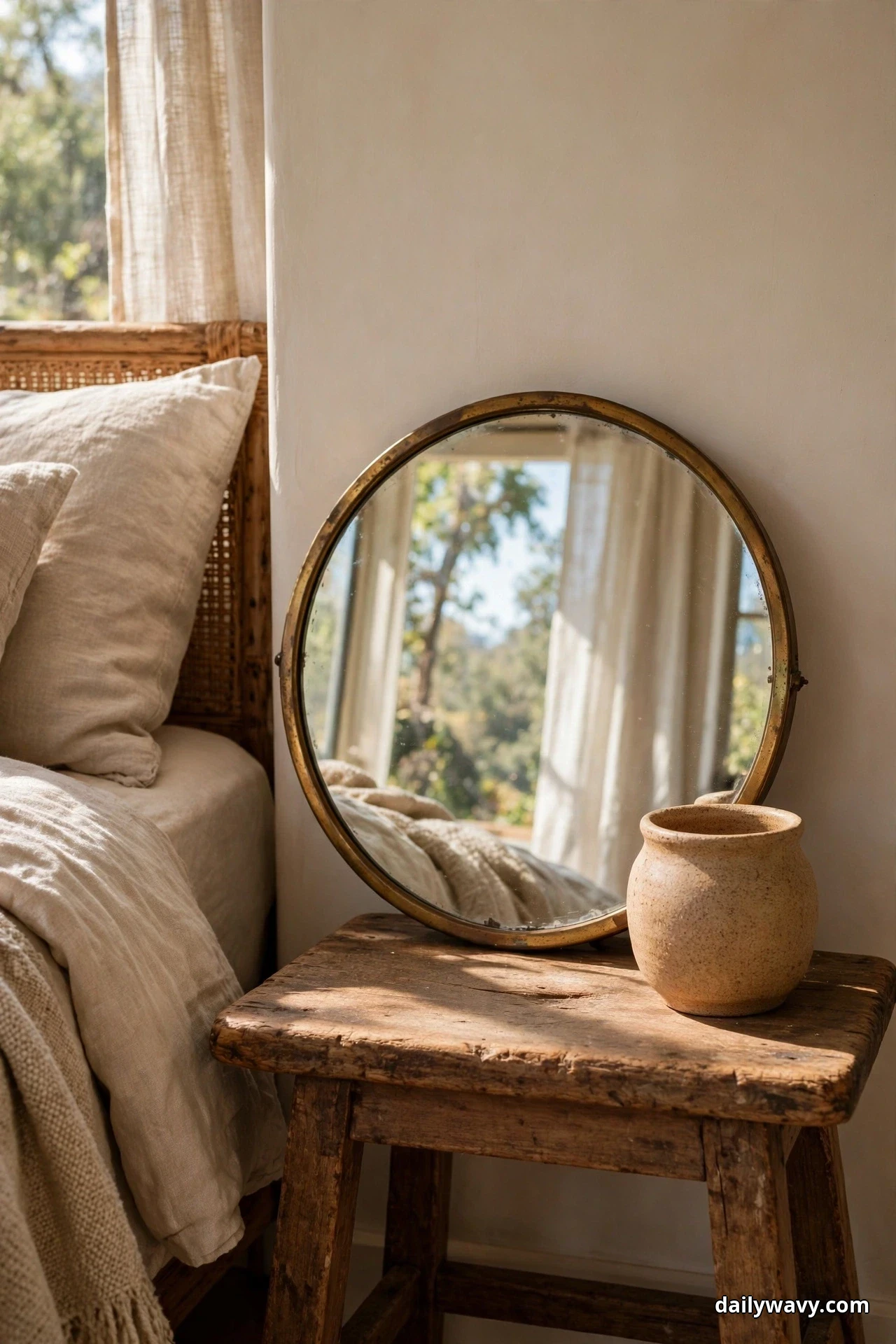
7. A Small Mirror With A Ceramic Vessel
A small mirror on a bedside stool is a lovely trick in a dark bedroom. It catches lamplight and window light and throws a little of it back into the room, and it doubles the visual presence of whatever sits beside it. Paired with a ceramic vessel, it looks collected and thoughtful rather than fussy.
How to pull it together: Use a mirror 6 to 8 inches across, round or arched, in a brass or wood frame, standing on its own base or leaning against the wall at the back edge. Tilt it so it reflects something pleasant, a window, a plant, not the ceiling. Beside it, set a short ceramic vessel, 4 to 6 inches tall, with or without a stem. Keep the mirror at the back and the vessel in front and to one side, so the reflection stays visible from the bed. Wipe the mirror weekly with a damp microfiber cloth, since bedroom dust shows fast on glass.
Effort and budget: A small standing mirror costs $15 to $30, a ceramic vessel $12 to $25. For a lower-cost version, lean a small thrifted mirror against the wall instead of buying a standing one.
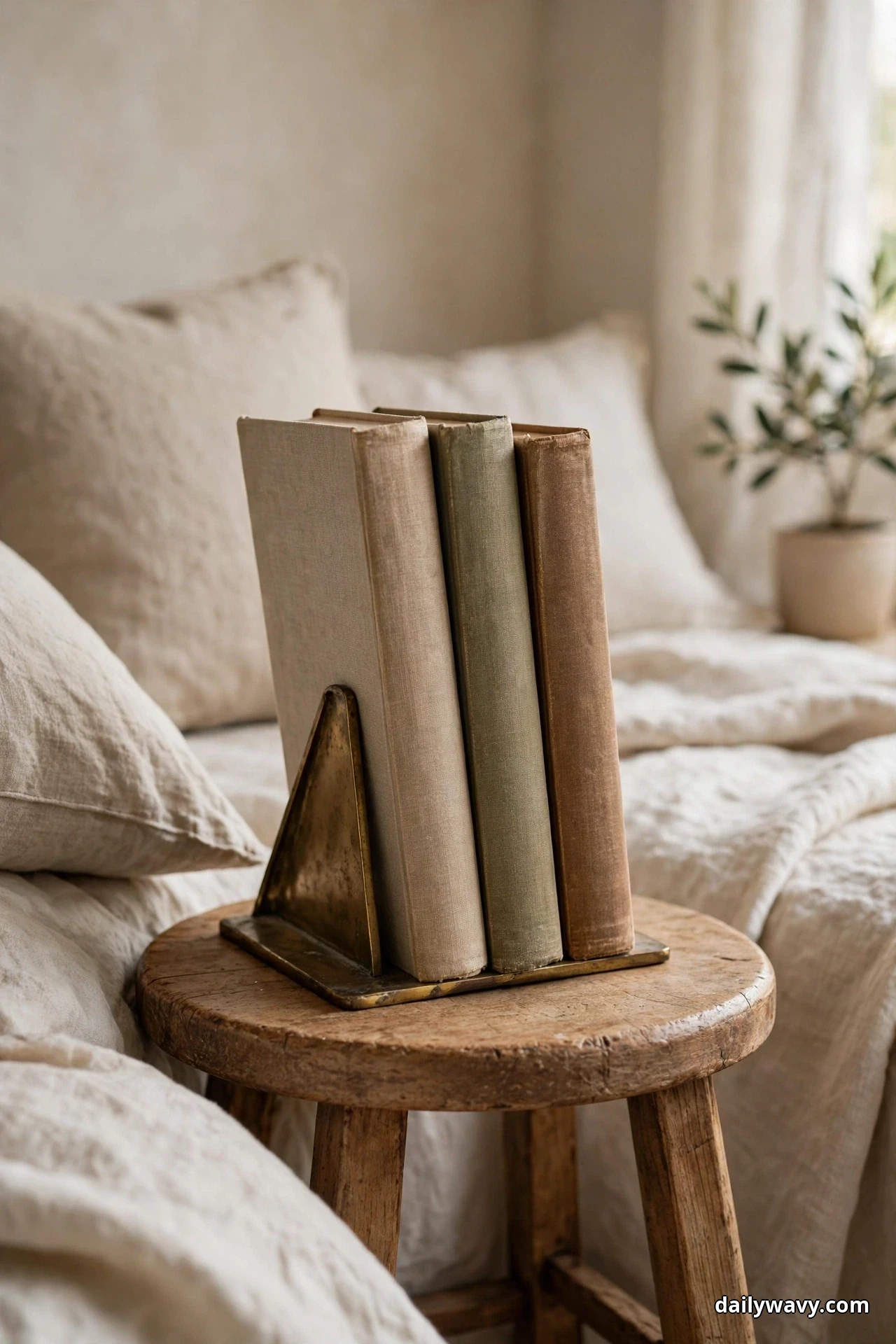
8. A Narrow Upright Book Arrangement
For readers, the bedside stool is a library in miniature. A narrow upright row of books looks wonderful and keeps the current read at hand, but it needs a bookend or holder, because a leaning stack on a small surface always ends up on the floor.
How to pull it together: Limit the row to 3 to 5 books, standing upright in a small brass or wood bookend, or a purpose-made book holder about 4 inches wide. Place the arrangement at the back edge or along one side, spines facing the bed so you can read the titles. Keep the total width under 8 inches. Put the book you are reading now at the front of the row or flat on top. If the stool top is under 13 inches wide, skip this idea or use only 2 to 3 slim volumes, since books are the fastest way to eat a small surface.
Effort and budget: A pair of simple bookends costs $12 to $25. For a lower-cost version, use a heavy stone or a brick wrapped in linen as a bookend.
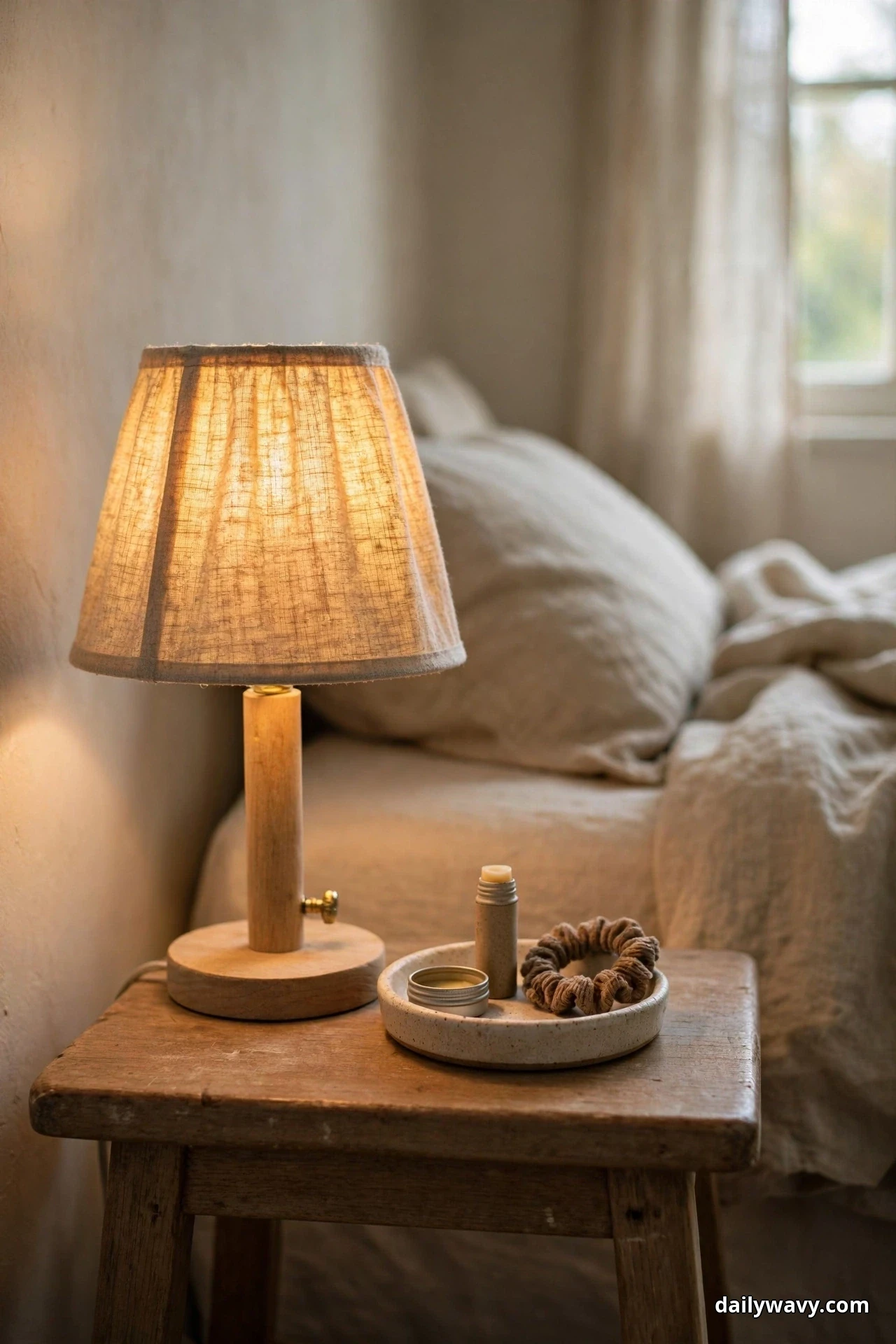
9. A Shaded Lamp Beside A Small Tray
A shaded lamp is the anchor of most bedside stools, and it deserves a proper pairing. A small tray beside the lamp base gives the remaining essentials, lip balm, a hair tie, earplugs, a single home, instead of drifting around the lamp in a dusty ring.
How to pull it together: Measure the lamp base first. On a 14 inch stool, a lamp with a 6 inch base leaves an 8 inch strip for the tray. Choose a tray 5 to 7 inches across and set it beside the lamp, not in front, so you can reach the lamp switch without knocking things over. Pick a shade that hides the bulb from your sightline when you lie down: hold the shade at the stool height and check from pillow level before you commit. Use a warm bulb, 2700K, and keep the wattage modest, since a small shade close to the bed gets hot with high-wattage bulbs.
Effort and budget: A small table lamp with a fabric shade runs $25 to $60, a tiny tray $8 to $15. For a lower-cost version, keep your existing lamp and add only the tray.
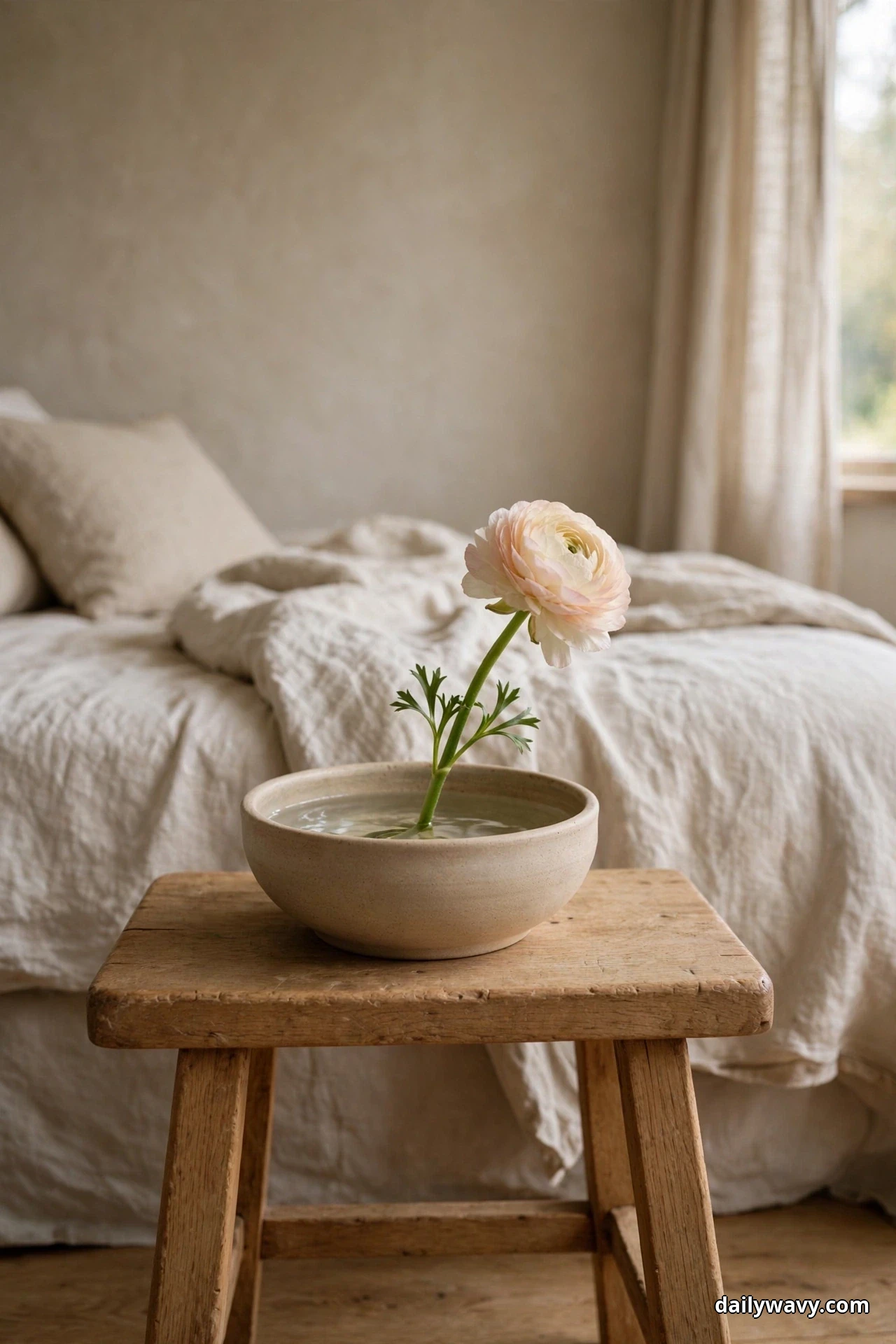
10. One Flower Stem In A Low Vase
One stem is all a bedside stool needs from the flower world. A single fresh flower in a low vase adds life and color without claiming surface area, and it costs almost nothing if you cut it from the garden. It is the finishing touch that makes the whole arrangement feel cared for.
How to pull it together: Use a low, wide vase, 3 to 4 inches tall, so the flower sits at 6 to 8 inches total height and never blocks your view or gets knocked over. Fill it two-thirds with water and change the water every two days. Place the vase at the front corner or beside the lamp, wherever you will see it when you wake up. Choose sturdy stems that last, ranunculus, peonies, carnations, or a single rose, and trim the stem at an angle before it goes in. A low vase also means less spill risk if you bump the stool in the dark.
Effort and budget: A low ceramic bud vase costs $8 to $18, a single grocery-store stem $2 to $5. For a lower-cost version, use a short tumbler or a small jar as the vase.
Frequently Asked Questions
What size bedside stool should I get for a queen bed?
For a queen or king, a stool 14 to 20 inches wide and 22 to 28 inches tall usually works, with the top landing level with or just above your mattress. In a small room, go narrower rather than shorter: a 12 inch stool at the right height beats a wide one that blocks the walkway.
How do I keep my bedside stool from getting cluttered?
Give everything a boundary. A tray, a mat, or a small dish creates a zone, and objects inside zones stay put while objects without zones drift. Once a week, clear the whole surface and put back only what belongs. If you want more ideas for keeping small surfaces tidy, our small pantry organization guide uses labeled baskets and shelf zones to do the same job in a different room.
What should I keep on my bedside stool every night?
Water, a lamp you can reach without sitting up, and your glasses if you wear them. Everything else is optional. A phone charger is practical if the cable is routed tidily down the back leg. Books, a notebook, and a small dish for jewelry are the next most useful items.
Can a bedside stool replace a nightstand?
Yes, as long as it is the right height and stable. A stool works best for minimalists, because there is no drawer to hide clutter in. If you need storage, pair the stool with a wall-mounted shelf above it or a small basket underneath. For ideas that pair well with small bedrooms, see our small bedroom with a queen bed roundup.
How do I style a very narrow bedside stool?
Think vertical and single-file. One tall thin object at the back, like a slim vase, plus one flat item at the front, like a book or a mat. Skip pairs and trays that need width. A wall-mounted light above the stool frees the entire surface, which is the single best upgrade for a stool under 12 inches wide.
Is it safe to put a lamp on a small stool?
Yes, if the lamp base is stable and the shade clears anything flammable. Keep the shade at least 6 inches from bedding or curtains, use an LED bulb that runs cool, and route the cord down the back leg with clips so it cannot be snagged. If the stool wobbles at all, fix that first: a lamp on an unsteady base is the one arrangement to avoid.
The Takeaway
A bedside stool asks for less, not more. Pick one idea from this list, give every object a clear boundary, and leave half the surface empty on purpose. That breathing room is what turns a cluttered side table into the calmest corner of the bedroom. If you are refreshing the whole room, our narrow living room layout guide covers the same small-space thinking for another tricky room, and the Home and Decor collection has the full library waiting.
Start tonight. Clear the stool completely, then put back only what earns its place. You will feel the difference the first morning you reach for your water and find it exactly where your hand expects it.