20 Staircase Gallery Wall Ideas with Layouts You Can Recreate
A staircase wall is the most underused piece of real estate in a home. It runs through two floors, catches…
A staircase wall is the most underused piece of real estate in a home. It runs through two floors, catches light from windows you forgot you had, and gets seen every single day. Still, most people leave it bare because the slope makes hanging art feel complicated. It does not have to be. These twenty layouts give you exact spacing, a simple template method, and realistic costs, so you can turn that diagonal blank into the part of the house guests actually remember.
In This Guide
- An Arrangement Following The Wall Shape
- A Subtle Tonal Grouping
- A Vintage-And-Modern Mix
- A Repeated Shape With Varied Textures
- A Corner-Spanning Arrangement
- A Paired Composition With Generous Space
- A Layered Display On A Secure Ledge
- A Narrow Grouping Beside A Doorway
- A Single Oversized Focal Item
- A Small Grouping Over A Bench
- A Composition Anchored To Furniture Width
- A Balanced Grid Of Similar Sizes
- A Loose Asymmetrical Cluster
- One Central Piece With Smaller Companions
- A Vertical Arrangement In A Narrow Area
- A Horizontal Row Above Furniture
- A Restrained Two-Color Composition
- A Mixed-Size Arrangement With Shared Spacing
- A Low Arrangement Aligned To A Nearby Surface
- A Group Unified By One Frame Finish
The Staircase Gallery Wall Rules Before You Start
Before any frame goes up, learn the three rules that separate a gallery wall from a cluttered one. First, spacing: keep a consistent two inches between frames. It is the single most forgiving measurement in decorating, close enough to read as one composition, wide enough that nothing looks cramped. Second, the template method: trace every frame onto kraft paper or newspaper, cut the shapes out, and tape them to the wall. Live with the paper for a day. Moving tape is free; patching extra nail holes is not.
Third, the staircase slope: hang frames so their centers rise step by step with the stairs, but keep every single frame level. Your eye reads level frames against a sloped line as intentional. Tilted frames against a sloped wall just look wrong. On a landing, use the standard gallery height: the center of the arrangement at 57 to 60 inches from the floor.
Two practical cautions. If you rent, check your wall type and your lease before driving nails into plaster or masonry, and choose picture-hanging strips or small screws per what the surface and the lease allow. Heavy frames always need a stud or a proper wall anchor, never just a nail in drywall. And if a layout uses a picture ledge, mount it into studs with screws rated for the combined weight of ledge plus frames, because a ledge full of art falling off a stair wall is a genuine safety hazard. For more on styling the rooms these walls connect to, our small entryway decor guide covers the spaces right at the bottom of the stairs.
1. An Arrangement Following The Wall Shape

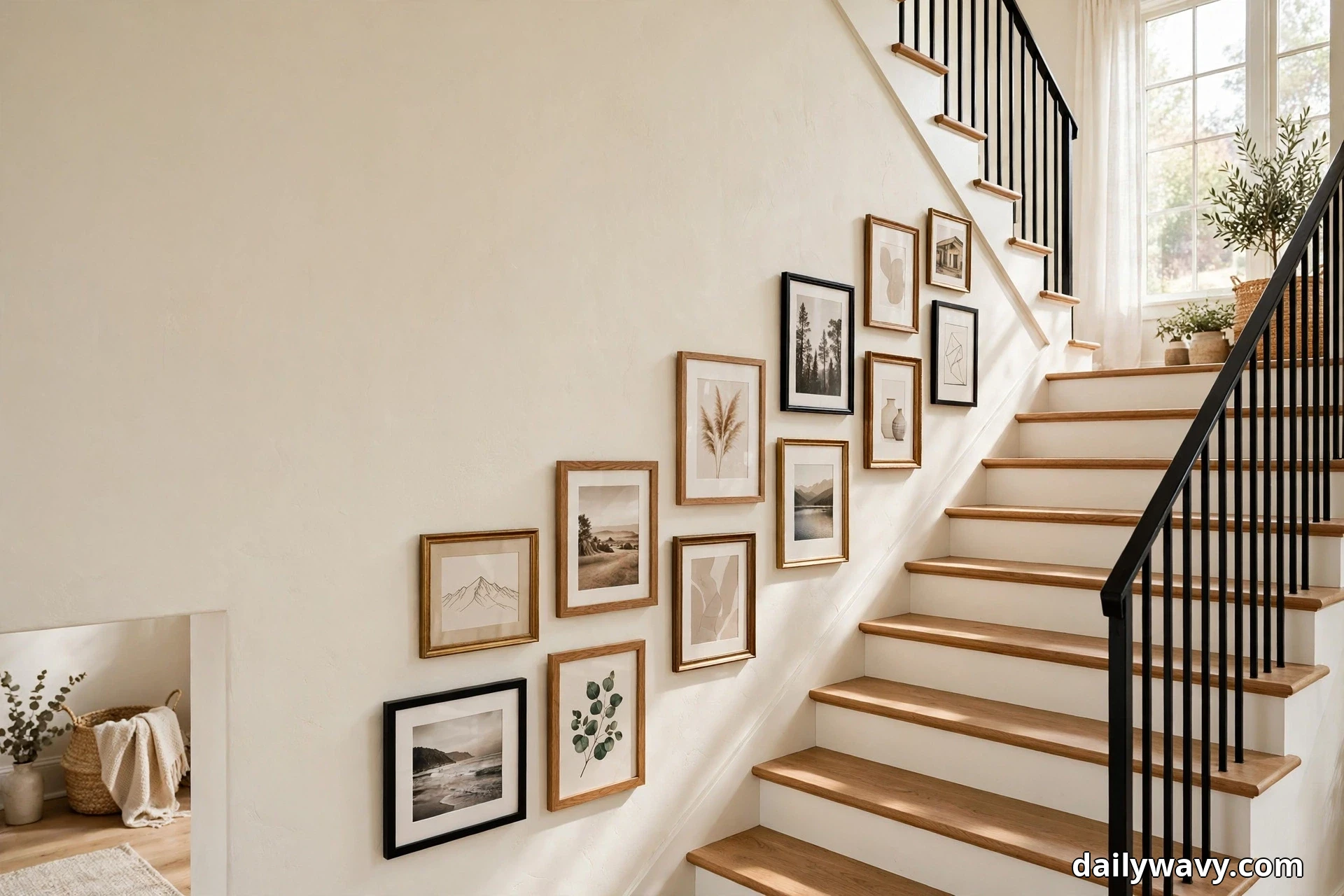
This is the classic staircase gallery wall for a reason: the frames climb with the stairs, and the whole thing looks like it grew there. Measure the wall run first, from the baseboard at the bottom step to where the wall meets the landing. Mark a diagonal line with painter’s tape about 60 inches up from each stair tread nose, and keep every frame center on or near that line.
Use six to ten mixed frames in black, oak, and brass. Black-and-white photography, simple sketches, and one small mirror keep it personal. Placement is simple: start at the bottom, hang the first frame center at 60 inches above the lowest tread, then step each next frame up one stair height as you climb. The total cost runs $60 to $120 if you buy frames new, or under $30 with thrifted frames. A lower-cost swap: print your own photos at a drugstore in 8×10 and use identical black frames from a discount store.
2. A Subtle Tonal Grouping

When the staircase already has strong architecture, a tonal grouping keeps the wall calm instead of competing. Choose art in one color family, creams, beiges, and soft sands, and frames that nearly disappear: thin cream or pale wood.
Measure a rough rectangle on the wall, about 4 feet wide by 5 feet tall, rising with the stairs. Inside it, cluster five to seven slim frames with one and a half inches between them, tighter than usual, so the group reads as one soft block of texture. Matte the prints generously; wide mats are what make tonal groupings look expensive. New frames and printed abstracts run $80 to $150 total. The budget version is simpler: photograph textured surfaces you like, plaster, linen, sand, print them in sepia, and frame them all in the same white frames.
3. A Vintage-And-Modern Mix
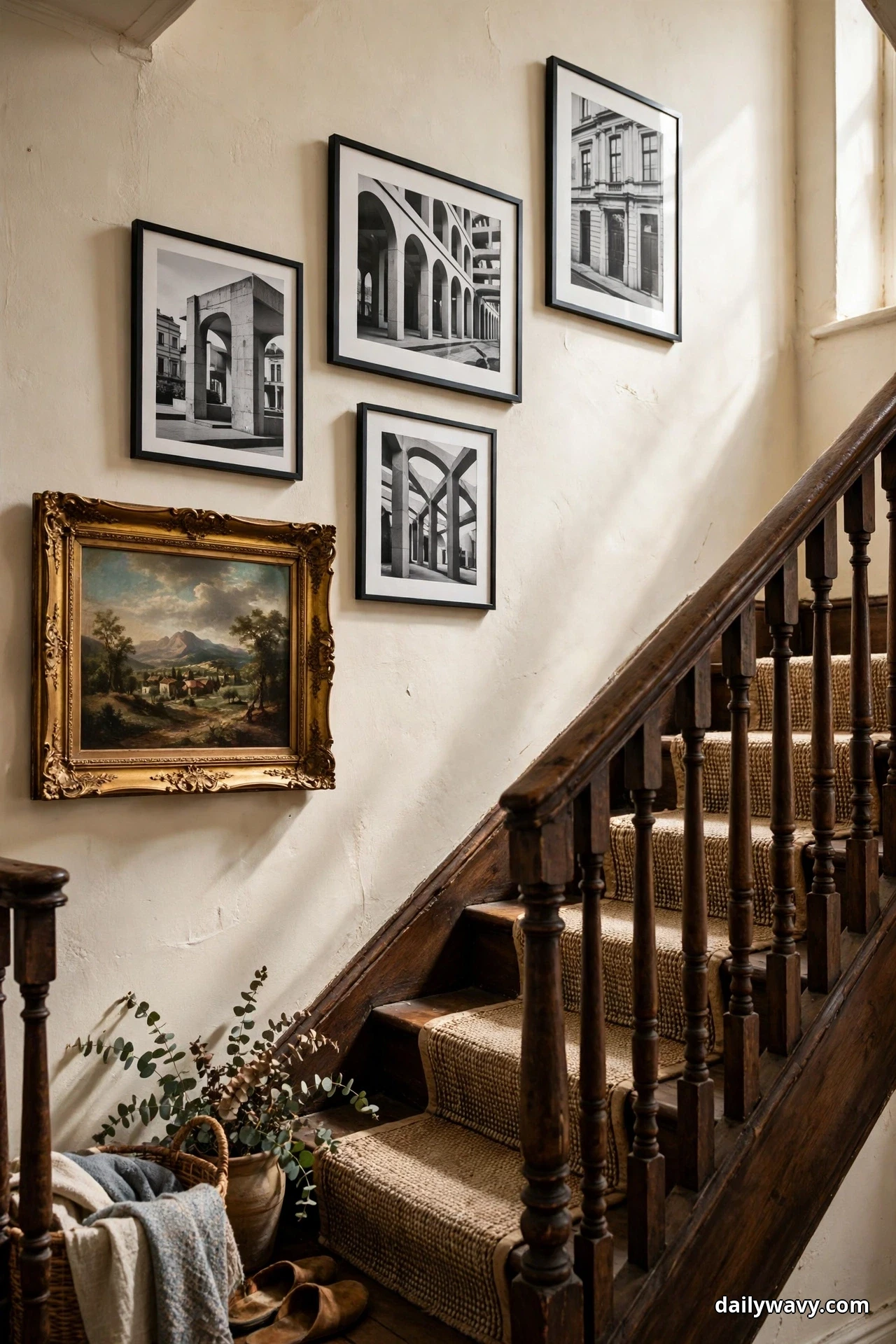
A thrifted gold frame next to a razor-thin black one is the kind of contrast that makes a gallery wall feel collected rather than decorated. The trick is letting one vintage piece anchor the arrangement and keeping the modern frames quiet around it.
Measure the wall and pick the landing-adjacent section for the ornate piece, where people stop and look. Hang the vintage frame first, centered at about 58 inches on the landing wall, then build four to six modern frames around and above it, following the stair slope. Keep the modern art restrained, black-and-white photography or simple line drawings, so the gold frame stays the star. Cost depends on the vintage find; ornate frames at flea markets run $15 to $40, modern frames another $40 to $80. If gold feels too much, spray a thrift frame with one coat of metallic paint for the same effect at a tenth of the price.
4. A Repeated Shape With Varied Textures

One shape repeated is calming; one shape repeated in different materials is interesting. All-round frames climbing the stair wall give you both at once. The circle is the easiest shape to work with because there are no corners to align.
Measure your vertical band, about 30 inches wide, and plan six to eight round frames from 6 to 14 inches across. Vary the materials deliberately: woven rattan, brushed brass, dark stained wood, white lacquer. Hang them so their centers follow the stair diagonal, two inches apart at the closest points. Because rounds have no orientation, small measurement errors disappear. A set of new round frames costs $70 to $140. The lower-cost alternative: embroidery hoops in different sizes, stained or painted, holding fabric or prints, which cost a few dollars each and look genuinely good.
5. A Corner-Spanning Arrangement
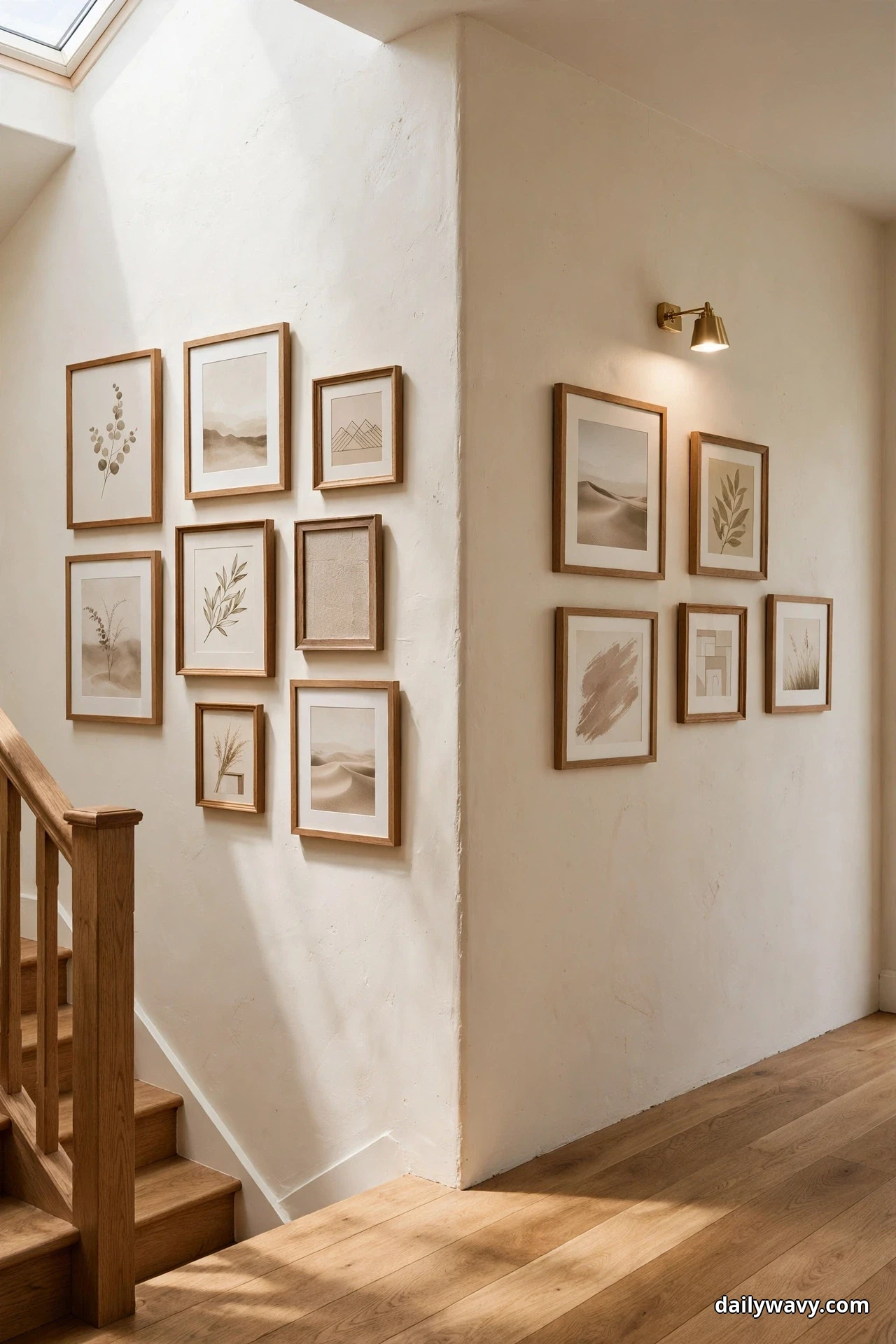
Staircase landings almost always have a corner, and wrapping the gallery around it turns a tight turn into a destination. This layout works best where the stairs meet a hallway or an upper landing.
Measure both walls from the corner outward, about 3 feet each way. Start the arrangement on the stair wall and let it flow around the corner onto the adjoining wall, keeping the two-inch spacing and the rising center line continuous. A small picture light mounted above the corner piece makes the wrap feel deliberate after dark. Use eight to twelve frames; the corner piece should be medium-sized so neither wall feels like an afterthought. Expect $100 to $180 for frames plus $25 to $50 for a plug-in picture light. The budget swap is skipping the light and placing the arrangement where a hallway sconce or window already gives it evening glow.
6. A Paired Composition With Generous Space
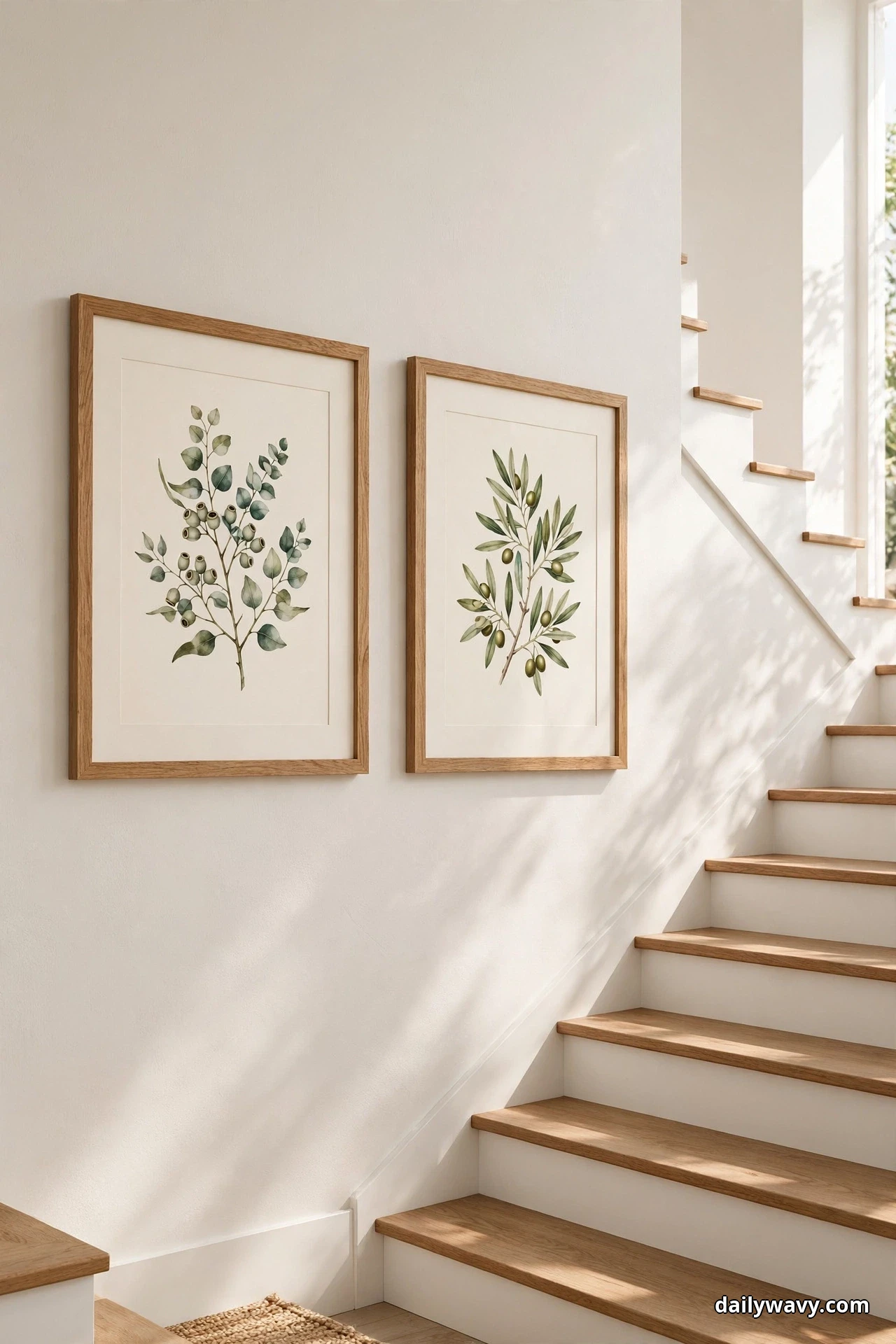
Not every staircase wall needs filling. Two large prints with wide empty margins around them can look more confident than a dozen small frames, especially in a modern home with clean lines.
Measure the wall section and choose two prints at least 24×36 inches each. Hang them side by side along the stair slope, centers following the diagonal, with 4 to 6 inches between them and at least 18 inches of empty wall on all outer sides. The empty space is the design; resist the urge to add more. Oversized prints in simple frames cost $80 to $200 for the pair. The lower-cost alternative is framing two large pieces of wrapping paper or fabric with a pattern you love, which reads as intentional art at this scale and costs under $30.
7. A Layered Display On A Secure Ledge
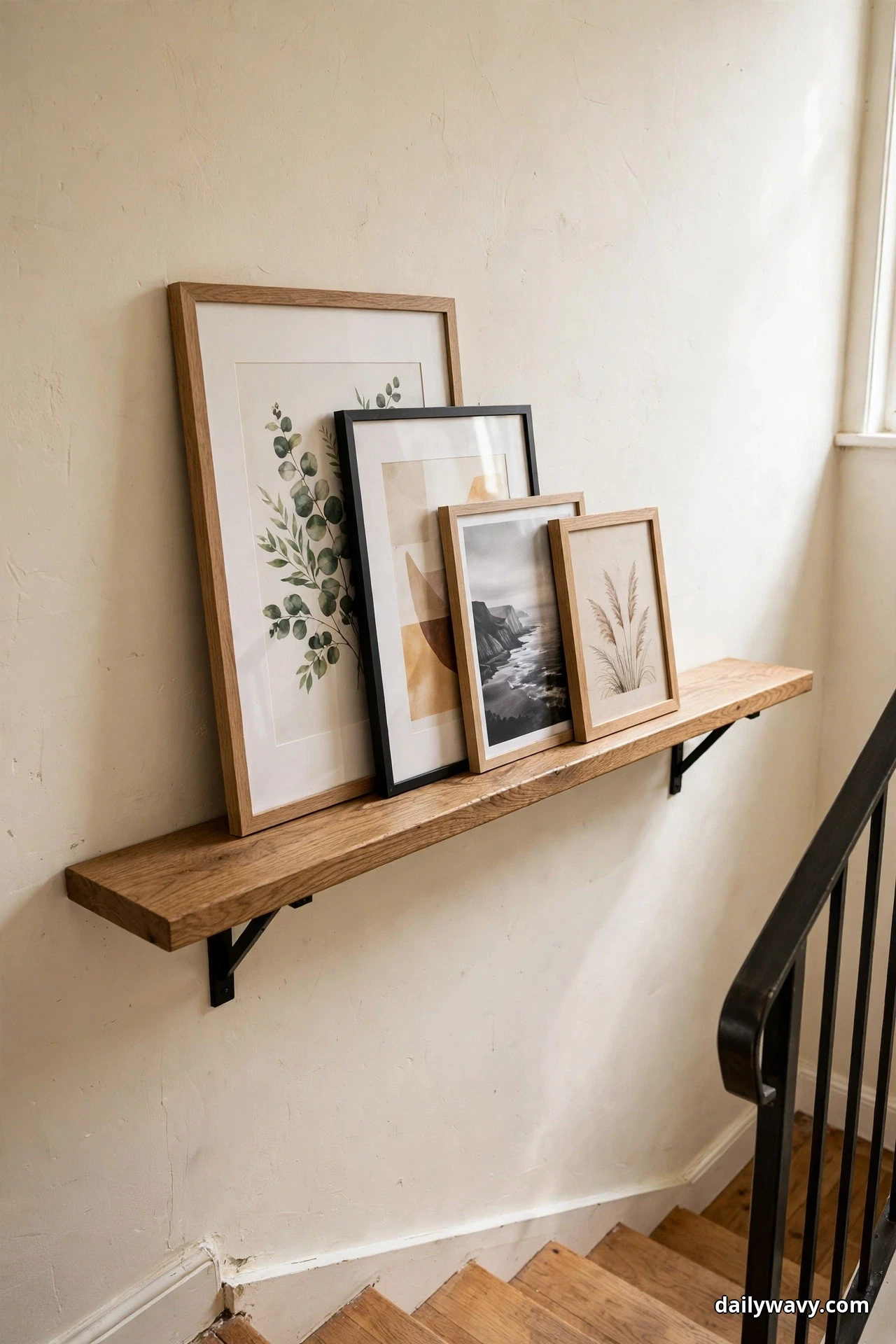
A picture ledge is the renter-adjacent, commitment-light way to do a staircase gallery wall: frames lean instead of hang, and you can rearrange in minutes. The ledge itself must be mounted properly, into studs, with screws rated for the load.
Measure the wall run and mount one continuous oak or painted ledge about 3 inches deep, following the stair slope in two or three stepped sections, or one long ledge on the landing wall. Layer four to six frames on each section, front ones leaning against the ones behind. The casual overlap is the whole point, so mix sizes freely. A 4-foot ledge costs $20 to $40, plus frames. Because frames just lean, you can swap art seasonally without touching the wall again. For renters, this is the layout to choose, but confirm the ledge mounting with your lease terms and always hit studs. For more on styling tight vertical spaces, see our narrow living room layout ideas for proportion tricks that transfer directly.
8. A Narrow Grouping Beside A Doorway
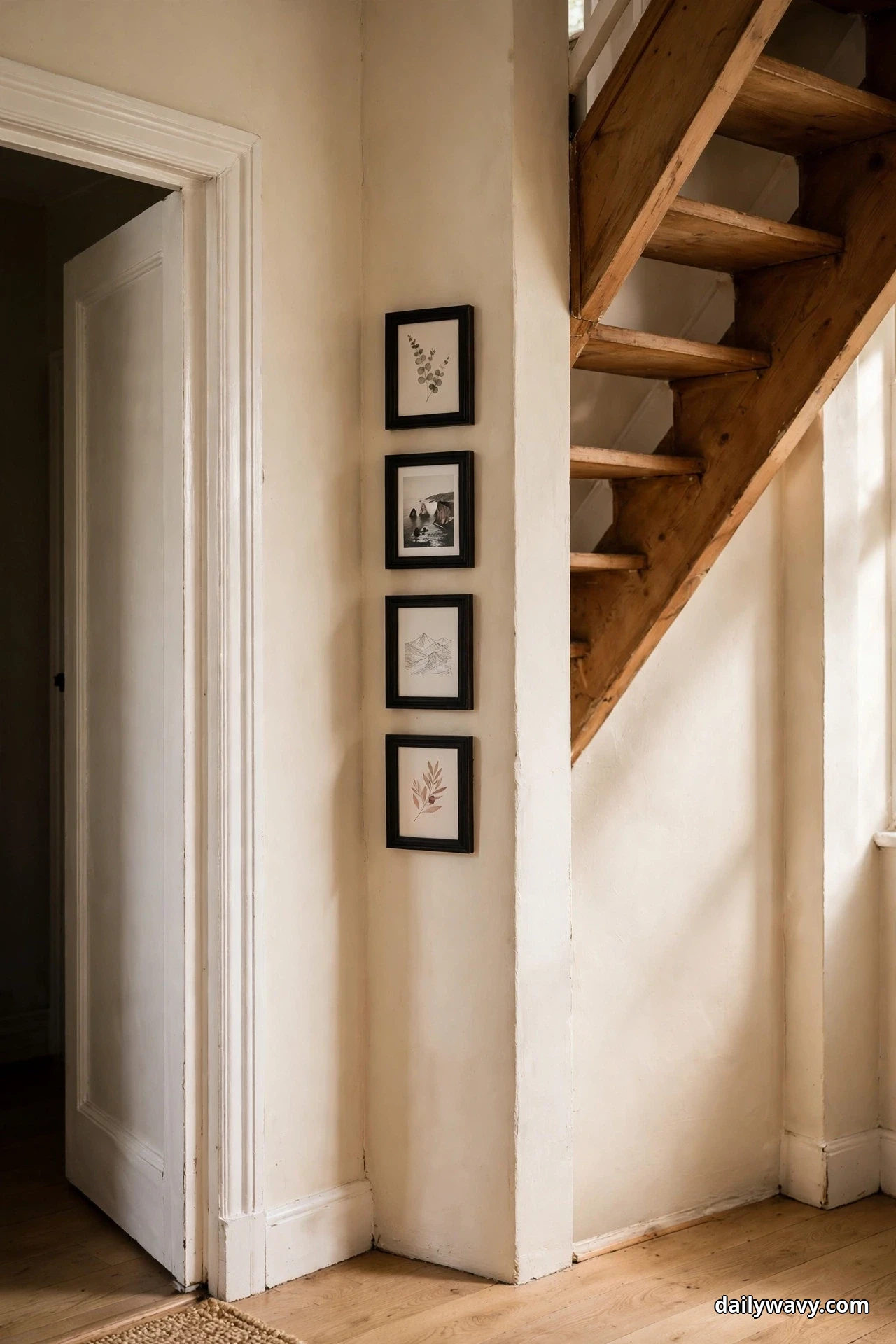
The slim strip of wall between a stair stringer and a door frame is easy to ignore and perfect for a narrow vertical column of small frames. It turns dead space into a moment.
Measure the strip; most run 12 to 20 inches wide. Plan four to six small frames, 5×7 or 8×10, in a single vertical line with two-inch spacing, centered in the strip. Keep the frames slim and dark so the column reads as one graphic stripe. Because the space is tight, use the paper-template method here without fail: a crooked frame in a 14-inch strip is obvious. Four small frames cost $20 to $50 new, under $15 thrifted. This is also the ideal spot for a chronological photo series, one image per frame, since the vertical format reads naturally top to bottom.
9. A Single Oversized Focal Item

One big piece on a staircase wall has the confidence of a gallery: a single 3×4-foot painting or textile, centered, with nothing competing. It works best on the tall wall section where the stairs turn, the spot with the most vertical room.
Measure the wall and choose art that fills roughly two-thirds of the available width. Hang it so its center sits at 58 to 60 inches above the nearest stair tread or landing floor. A large framed print costs $100 to $250; a large-scale textile or woven wall hanging in the same size runs $60 to $150 and adds texture the wall probably needs. Because there is only one hanging point to get right, spend the effort on a proper anchor: anything over 20 pounds needs a stud or a heavy-duty toggle anchor, and two hanging points keep a wide piece from tilting over time.
10. A Small Grouping Over A Bench
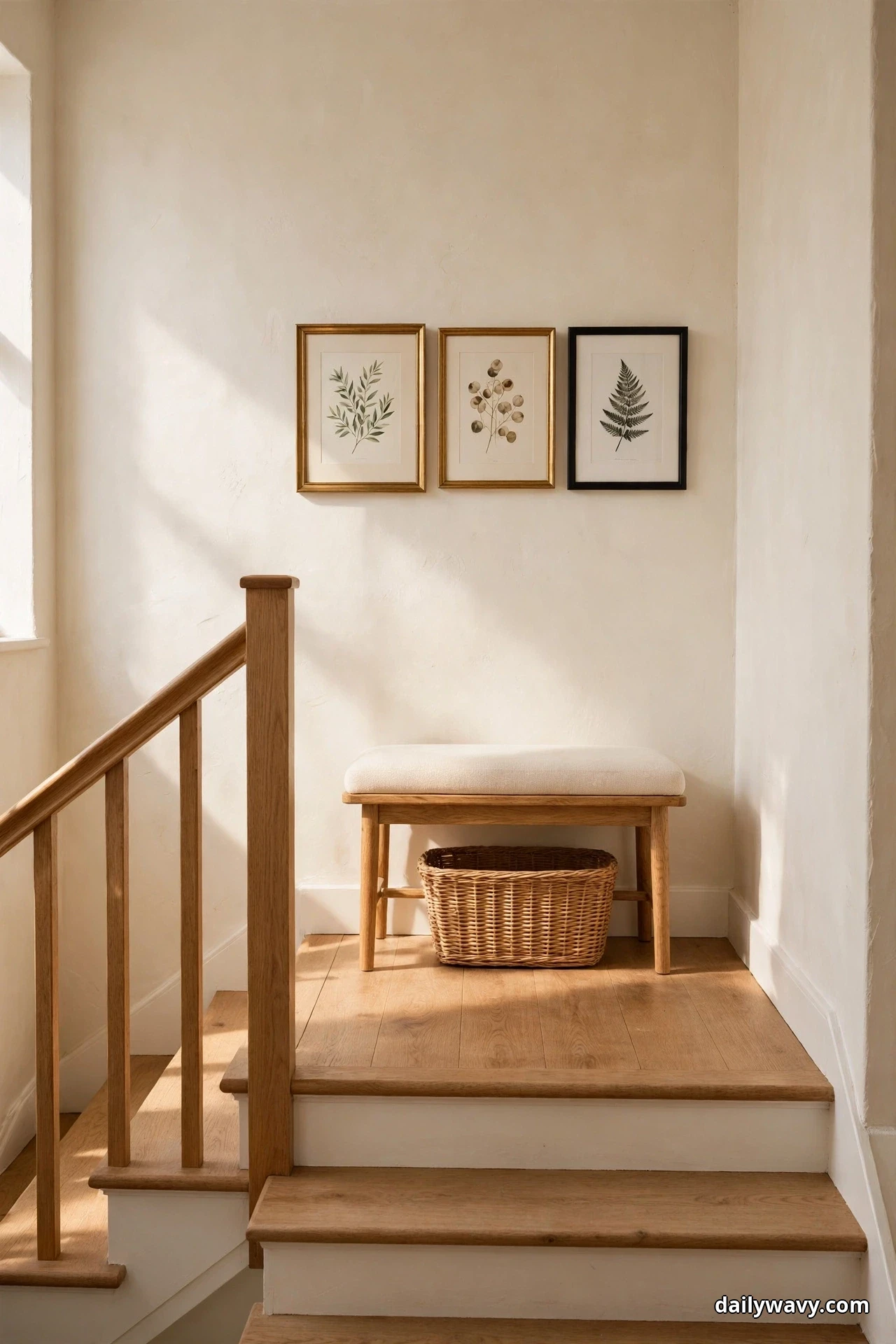
If your staircase has a landing with room for a bench, the bench plus three frames above it becomes a complete vignette: a place to pause with a reason to look. Measure the bench width first; the frame grouping should span about two-thirds of it.
Hang three frames in a tight triangle or row, centers about 8 to 12 inches above the bench back or seat, with two-inch spacing. The bench itself does styling work: a cushion, a folded throw, a basket underneath. A small oak or upholstered bench costs $60 to $150; the three frames add $30 to $70. The lower-cost swap is a sturdy lidded storage ottoman, which gives you the same landing spot plus hidden storage for shoes or throws.
11. A Composition Anchored To Furniture Width
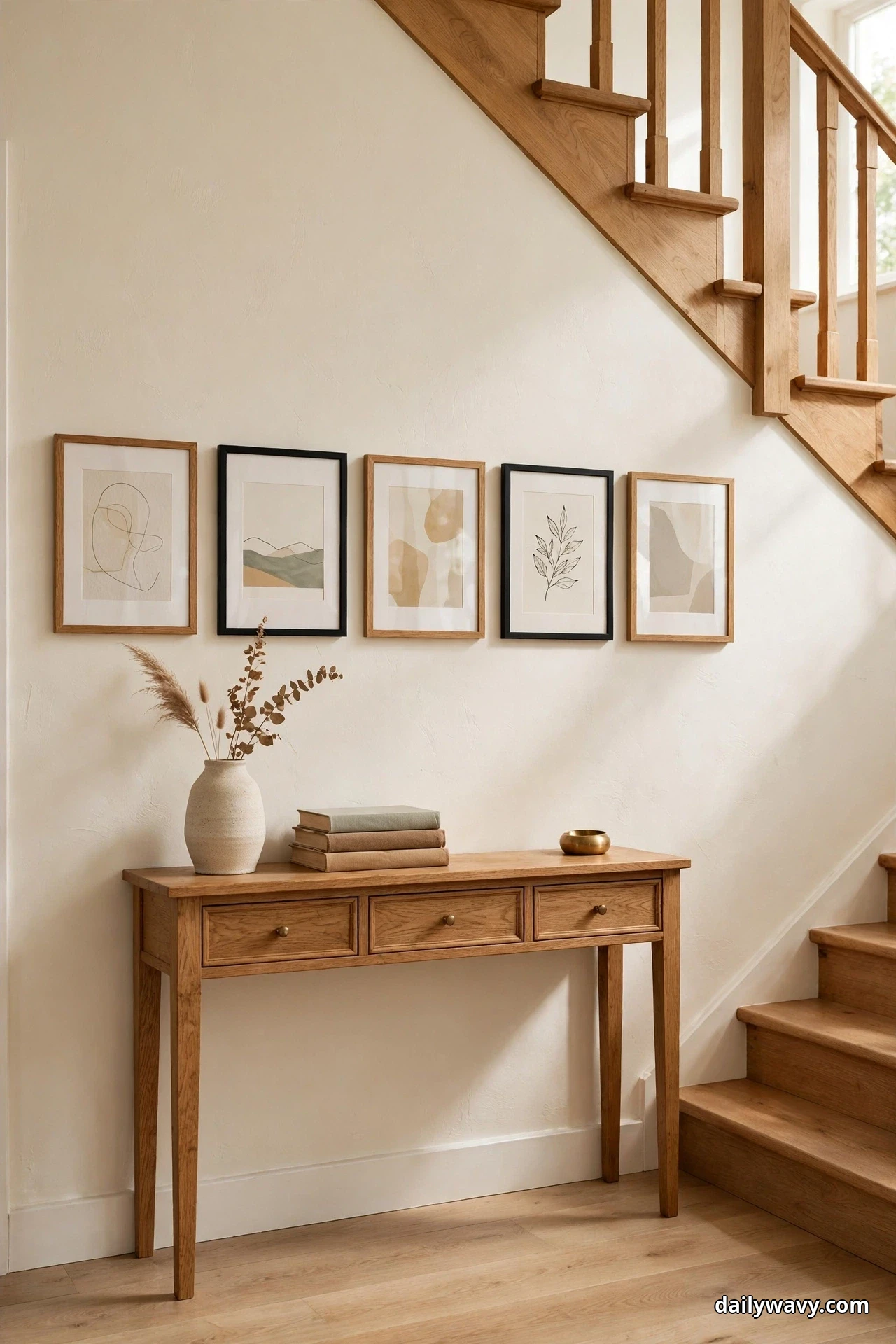
A gallery wall looks instantly more professional when its width matches the furniture below it. At the foot of the stairs, a narrow console table gives you the anchor; the frames above echo its width exactly.
Measure the console, usually 36 to 48 inches wide. Build the frame arrangement to the same total width, no wider, with its center aligned to the console’s center. Five frames in two rows works well: three on top, two below, or a loose cluster inside the invisible boundary. The alignment makes the whole base-of-stairs zone read as one designed moment. A console costs $80 to $200; frames $40 to $90. If you already own the console, this is one of the cheapest layouts on the list, just frames and nails.
12. A Balanced Grid Of Similar Sizes
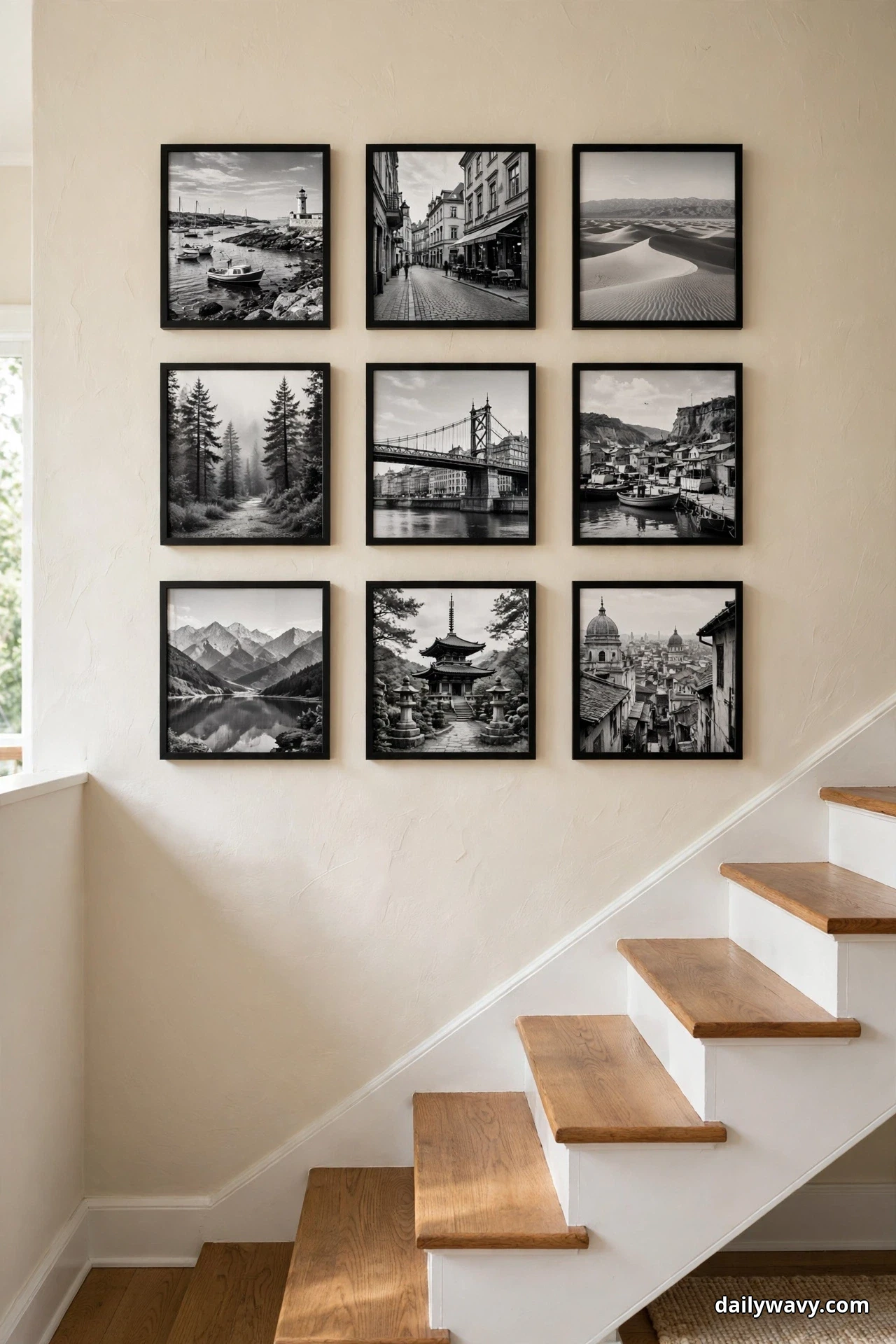
A grid is the most forgiving layout for beginners because the math does the designing. Nine identical square frames, evenly spaced, stepping up with the stairs, look crisp in any style of home.
Measure and mark a grid where each frame is 12×12 inches with two-inch gaps, and let the whole grid tilt upward in parallel with the stair slope, each row one step higher than the last. Use identical thin frames; black is the classic, white suits Scandinavian interiors. Black-and-white photography keeps the grid graphic. Nine matching frames cost $70 to $130; printing nine square photos costs about $20. The template method matters most here: tape up nine paper squares before committing, because a grid with one frame off by an inch ruins the effect.
13. A Loose Asymmetrical Cluster
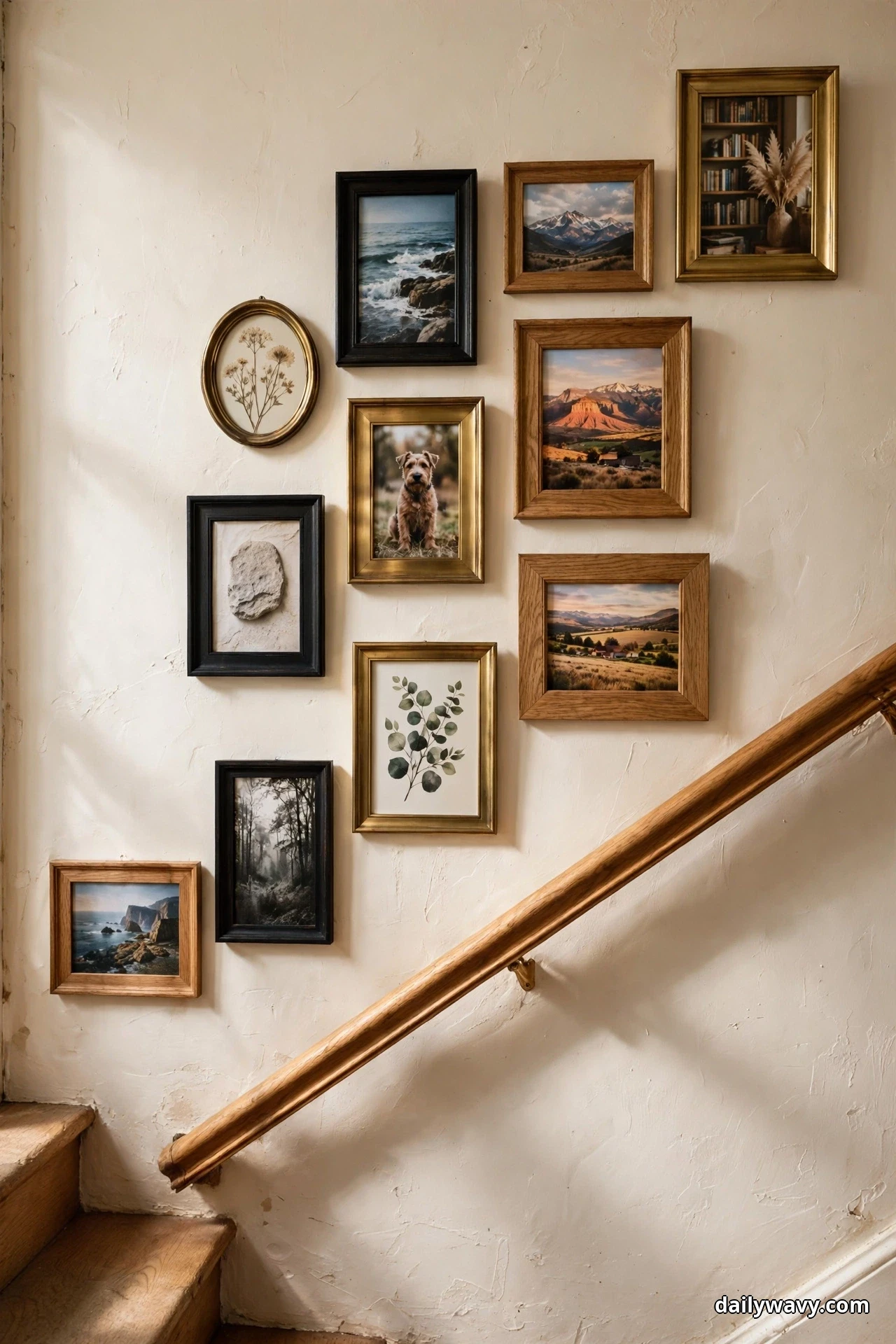
The collected-over-time look is the hardest to fake and the easiest to live with. An asymmetrical cluster of ten to twelve mixed frames feels personal because it is: start with what you own and add as you find pieces.
The only rule that keeps it from looking random is the two-inch spacing and a shared element, one repeated frame color, or a consistent mat color. Measure a generous zone, about 5 feet square rising with the stairs, and fill it from the center outward, biggest pieces first. Cost is whatever you already have plus a few thrifted frames at $3 to $8 each. This layout is ideal if you dislike measuring: the paper-template method still helps, but slight irregularities are part of the charm.
14. One Central Piece With Smaller Companions

Give the eye a place to land first: one medium centerpiece, 16×20 or so, with six smaller frames orbiting it. The hierarchy makes the arrangement feel designed even when the pieces are eclectic.
Hang the centerpiece first at the visual center of your wall zone, about 58 inches from the nearest tread. Then place the smaller frames around it with two-inch spacing, balancing the total visual weight on all four sides: if two small frames sit upper left, put two lower right. The centerpiece can be the best thing you own; companions can be simple. Total cost $50 to $120 depending on what you already have. This is the best layout for showing off one genuinely good piece of art without it floating alone on a big wall.
15. A Vertical Arrangement In A Narrow Area
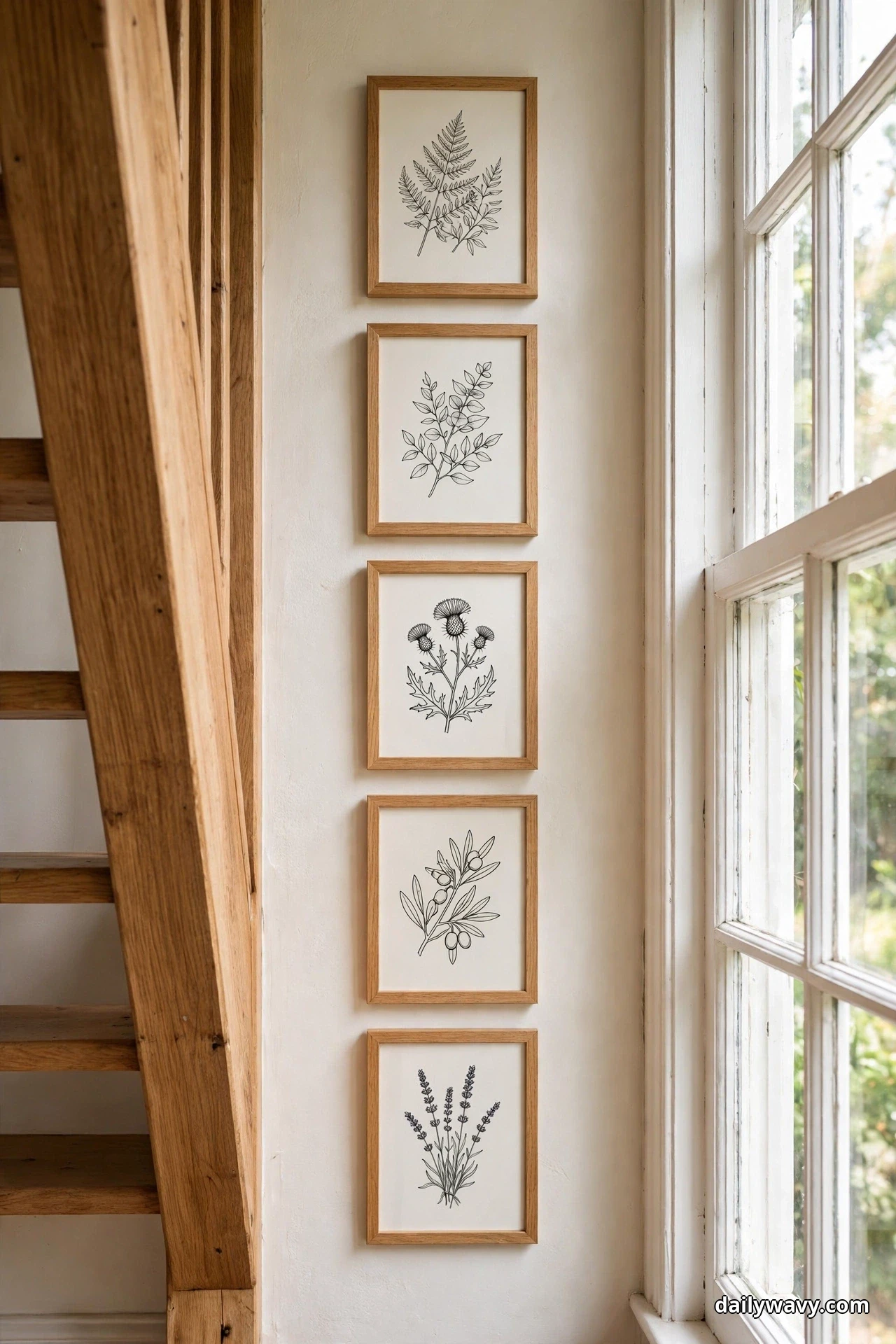
Between a window and the stair stringer, or beside a tall bookcase on the landing, narrow vertical strips of wall beg for a single column of frames. Five stacked frames turn a gap into a feature.
Measure the strip width and choose frames 2 to 4 inches narrower than it, all the same width for a clean column. Stack them with two-inch gaps, aligned on a center vertical line you mark with painter’s tape. Uniform frames, thin oak or black, with botanical prints or line drawings, keep the column elegant. Five matching frames cost $40 to $80. Because the column is narrow, check from the stairs at multiple heights as you hang; a frame that looks level up close can drift visibly when viewed from three steps down.
16. A Horizontal Row Above Furniture
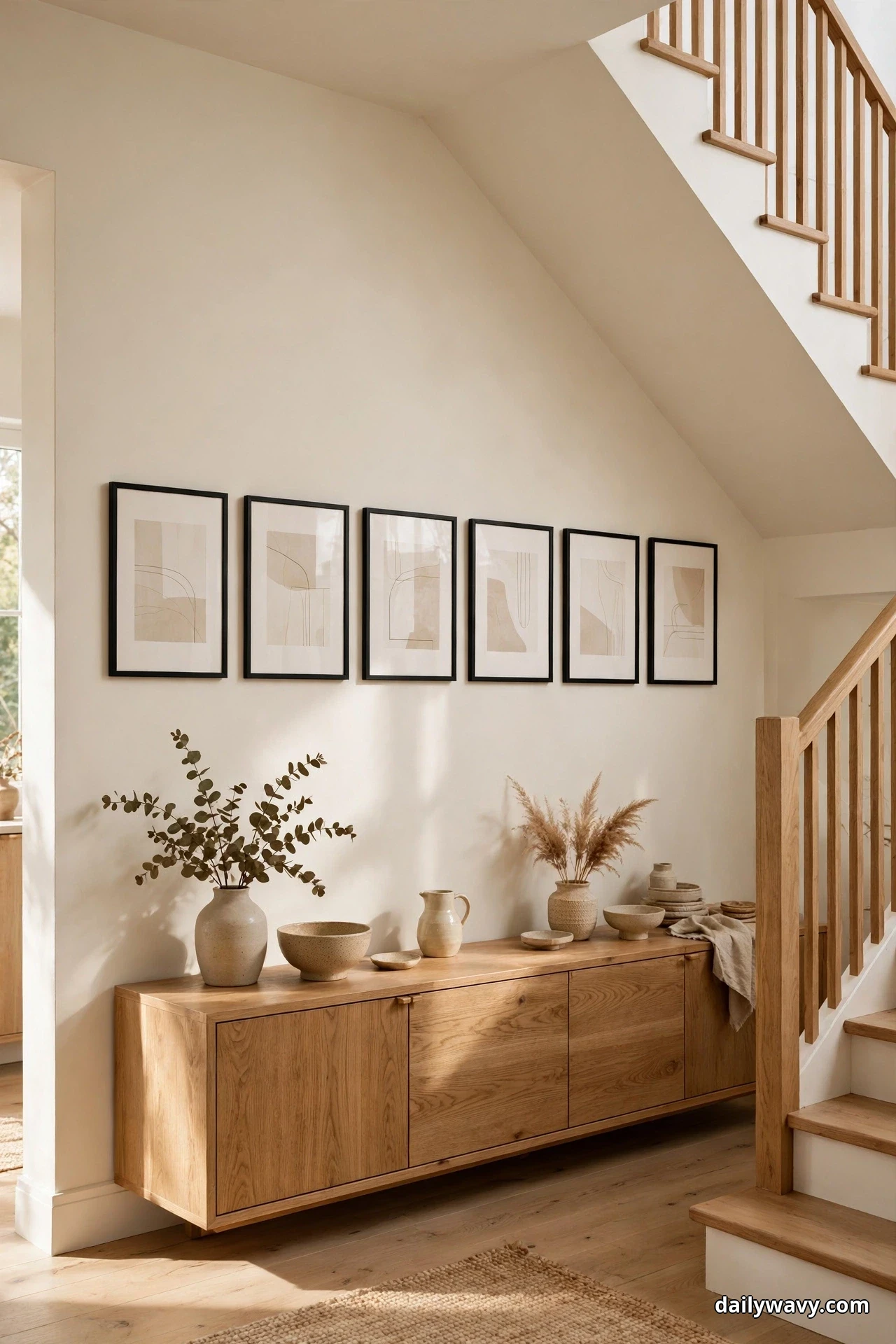
A single level row of frames above a sideboard or bench at the stair base brings calm to a busy diagonal space. The horizontal line contrasts the slope of the stairs, and contrast is interesting.
Measure the furniture and hang five to seven frames in one straight horizontal line, centers at about 60 inches from the floor, two-inch spacing, total width matching the furniture within a few inches. Use a laser level or a long spirit level; a row that drifts even half an inch over six feet is noticeable. Matching thin frames keep it crisp. Frames and prints run $60 to $120 total. The lower-cost version uses identical frames you already own with new mats cut to match, which unifies mismatched art for the price of mat board.
17. A Restrained Two-Color Composition
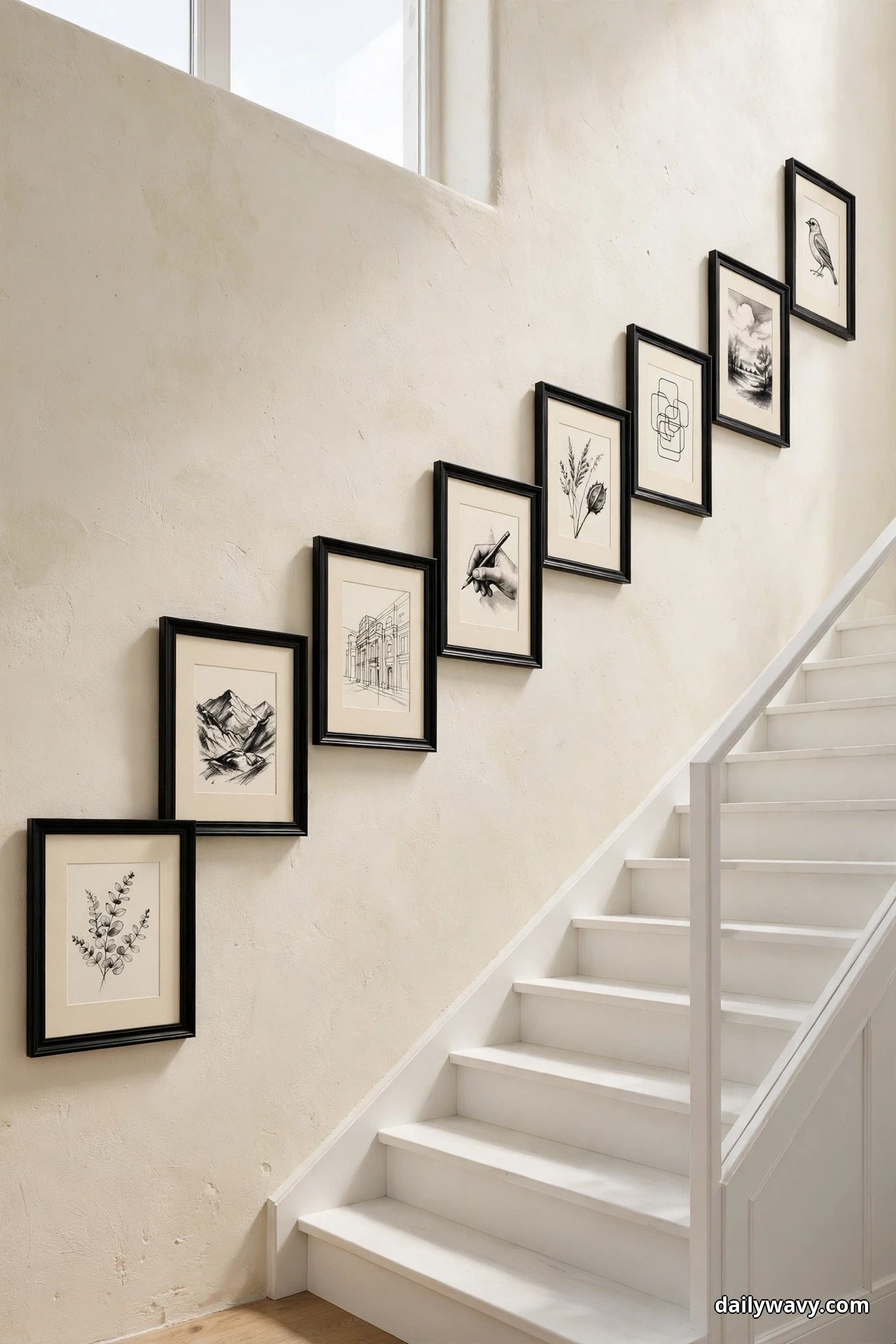
Limit the palette to black and cream and every frame choice gets easier: the only decisions left are size and placement. A two-color gallery wall looks graphic and intentional in both traditional and modern homes.
Use black frames with cream mats exclusively, and art in black, white, and gray: line drawings, charcoal sketches, black-and-white photography. Arrange seven to nine frames rising with the stairs, two-inch spacing. The discipline of the palette means you can mix art styles freely without chaos. New black frames cost $60 to $110 for the set; printing black-and-white photos is inexpensive. If your stairs already have black railings, this layout ties the whole staircase together with almost no effort.
18. A Mixed-Size Arrangement With Shared Spacing
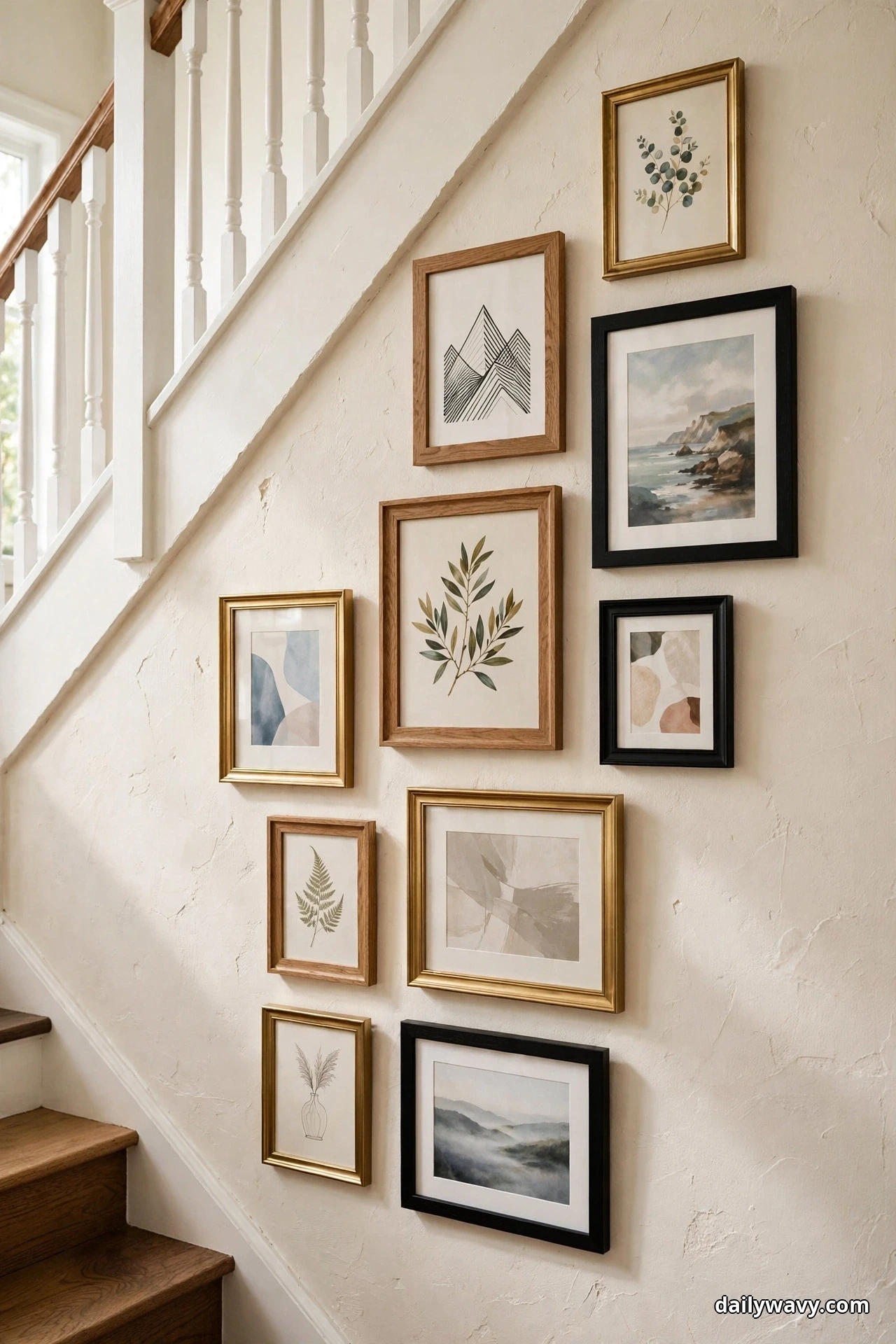
When sizes vary wildly, consistent spacing is the glue. Ten frames from 5×7 to 20×24 can hang together beautifully if every gap is exactly two inches; the rhythm of the gaps unifies what the sizes do not.
This layout demands the paper-template method. Cut every shape, tape them up, and adjust until the negative space feels even, then measure each gap before hanging. Build from the largest piece outward along the stair diagonal. Mixed frames cost $70 to $140 new, far less thrifted. The shared spacing trick also rescues existing frame collections: if your frames already vary, you do not need to buy matching ones, you only need discipline about the gaps.
19. A Low Arrangement Aligned To A Nearby Surface

Aligning the bottom edge of your frames to a nearby surface, a wainscot cap or a bench back, gives the arrangement an architectural logic that feels built-in rather than decorated.
Measure the surface height and mark a level baseline two inches above it. Hang five to seven frames so their bottom edges all sit on that invisible line, letting the tops vary naturally with the frame sizes. The shared baseline does the organizing work, so the art itself can be eclectic. This is especially effective in stairwells with wainscoting, where the frames echo the trim line. Frames cost $50 to $100. One caution: keep frame bottoms at least a hand’s width above any surface people touch, so daily use never knocks a frame.
20. A Group Unified By One Frame Finish

If matching art feels impossible, match the frames instead. Twelve frames in one finish, warm oak, say, can hold completely different art, photography, sketches, kids’ drawings, abstracts, and still read as one collection.
Buy or refinish frames to a single finish; a can of wood stain or a quart of paint unifies thrifted frames for under $15. Arrange them organically up the stair wall with two-inch spacing, biggest pieces distributed evenly so no area feels heavy. The single finish is doing all the visual work, which means the art can be whatever you love. Total cost $40 to $100 depending on how many frames you already own. For more ideas on making mismatched pieces feel intentional, browse our home decor category for rooms that pull the same trick.
Frequently Asked Questions
How do I hang frames on a staircase wall so they follow the slope?
Keep every frame level and let the centers rise with the stairs. Mark a diagonal guide line with painter’s tape about 60 inches above each tread nose, and place each frame’s center on that line. A small torpedo level on top of each frame as you hang keeps the line true.
What spacing should I use between frames in a gallery wall?
Two inches is the standard that works in almost every layout. Tighter spacing, about one and a half inches, suits small frames in a dense cluster; wider spacing, up to six inches, suits large frames with breathing room. Whatever you choose, keep it consistent across the whole arrangement.
How do I plan a gallery wall without making extra nail holes?
Trace each frame onto kraft paper, cut out the shapes, and tape them to the wall first. Mark the nail position on each paper, drive the nail through it, then tear the paper away. You can rearrange paper templates for days at zero cost.
Can I do a staircase gallery wall as a renter?
Yes, with the right hardware and permission. Lightweight frames work with adhesive picture-hanging strips rated for the frame’s weight; check the weight rating and the wall surface first. For anything heavy, or for picture ledges, confirm with your lease and use proper anchors. Always check what is behind the wall before drilling near stairwells, where wiring and plumbing often run.
How high should frames sit on a stair wall?
Aim for frame centers around 57 to 60 inches above the nearest stair tread or landing floor, which matches standard eye level. On a long stair run, keep the diagonal center line consistent rather than dropping frames lower as you climb; the line should parallel the stair slope.
What is the cheapest way to build a gallery wall?
Thrift stores and discount shops for frames, drugstore or online prints for art, and paint or stain to unify mismatched finishes. A twelve-frame staircase wall can come together for $30 to $60 this way. The paper-template method costs nothing and prevents the expensive mistake of extra holes to patch.
A Wall Worth Planning For
A staircase wall rewards a little planning more than almost any other spot in the house, because everyone in the household sees it daily and every guest passes it. Pick the layout that matches your wall, your frames, and your patience for measuring, tape up the paper templates, and hang with confidence. Start with one idea from this guide, live with it for a week, and add frames as you find pieces you love. For more on shaping the spaces around your stairs, see our small pantry organization ideas and narrow living room layout guide for rooms that connect to the stair hall.