13 Coastal Living Room Ideas to Make the Style Your Own
A coastal living room works best when it whispers instead of shouts. Think salt-washed blue against warm white, light wood…
A coastal living room works best when it whispers instead of shouts. Think salt-washed blue against warm white, light wood underfoot, and fibers you can actually feel. Below you will find thirteen buildable ideas, each one a small, doable move that layers the style without turning your room into a theme. Every idea names the materials to use, what to measure before you buy, and a lower-cost way to get the look. Start with one, live with it a week, then add the next.
Jump to an idea
- Textured cushions on a compact sofa
- Large artwork above the main seating
- Natural woven basket for blankets
- Paired lamps beside a balanced sofa
- Layered rug beneath a nesting table
- Vintage cabinet used as a focal point
- Soft ottoman replacing a sharp table
- Window seat with tailored cushions
- A floor lamp beside a book stack
- A large plant in a simple pot
- Two small tables instead of one large table
- An upholstered bench against the wall
- A narrow console behind the sofa

What “coastal” actually means in a living room
Forget the souvenir-shop version with anchors and painted driftwood. The coastal rooms that feel calmest share three things. First, a palette: warm white walls and upholstery, soft blue as the working accent, and light wood to keep everything grounded. Second, materials with visible texture: linen, nubby cotton, jute, seagrass, rattan, and pale oak or ash. Third, calm silhouettes: low arms, uncluttered lines, furniture that lets daylight move around it. When you change something, hold it against those three and you will stay in the right lane. Everything in this roundup follows them, and nothing here requires a full-room redo.
1. Textured Cushions On A Compact Sofa

A quick coastal upgrade you can make is on the sofa you already own. A mix of nubby linen, cable knit, and woven cotton cushions in soft blue and warm white turns a plain compact sofa into the room’s soft center. Texture matters more than pattern here. Flat cushions in two close shades read quiet and finished, while one deeper sea-glass blue cushion gives the group somewhere to land.
Your decision: keep the base warm white and let blue do the talking, or go fully blue on a white sofa. Pick one direction so the group looks chosen rather than random.
Measure: your sofa’s seat width. Each cushion should be 18 to 20 inches square on a compact sofa so they fill the seat without swallowing it. Count on five cushions for a loveseat.
Save: recover thrift-store cushion inserts with linen-look slipcovers instead of buying new pillows. Inserts are usually the expensive part, and you probably already have them.
2. Large Artwork Above The Main Seating

One generous piece of art above the sofa does more than a whole gallery wall. A soft blue abstract with plenty of pale space echoes the palette without illustrating it, and a thin light-wood frame keeps it from feeling gallery-stiff. The calm of the wall becomes the calm of the room. If you prefer a gallery approach instead, our living room gallery wall ideas show layouts you can recreate.
Your decision: one large canvas versus a diptych of two tall panels. Both work; choose based on whether your wall is wide (diptych) or tall and narrow (single piece).
Measure: the sofa’s width. Art should span roughly two-thirds to three-quarters of it, and hang so the bottom edge sits 6 to 8 inches above the sofa back.
Save: stretch a canvas drop cloth over a wood frame and wash it with watered-down blue paint in loose horizontal strokes. From three feet away it reads as abstract shoreline art.
3. Natural Woven Basket For Blankets

A seagrass or rattan basket beside the sofa is storage that also reads as decoration. Rolled or folded throws in soft blue and warm white give you warmth within reach and add one more layer of natural fiber to the mix. It also solves the very real problem of where throws go when guests sit down.
Your decision: one tall basket that holds three to four throws, or two shorter baskets tucked under a side table. Go tall if the corner is empty; go short if the spot is tight.
Measure: the empty floor space beside your sofa. Leave at least 2 inches of clearance on each side so the basket slides in without scuffing walls or furniture.
Save: line an inexpensive plain basket with a folded drop cloth and let the weave show through the gaps. The texture is the point, and paint never improves a basket.
4. Paired Lamps Beside A Balanced Sofa

Matching lamps on both sides of the sofa bring a quiet symmetry that coastal rooms love. Warm white drum shades with pale ceramic or weathered-wood bases glow softly at night and look sculptural by day. Symmetry like this calms a room, especially in open layouts where the eye needs an anchor.
Your decision: identical lamps on matching side tables, or identical lamps on mismatched tables. Identical everything is safest; identical lamps with different tables feels collected but still calm.
Measure: side table height plus lamp height should total roughly 58 to 64 inches so the light falls at a good reading level beside a seated person.
Save: buy one lamp you love, then ask the store about a floor model or return in the same line. Pairs often turn up secondhand because people redecorate one room and sell the other.
5. Layered Rug Beneath A Nesting Table
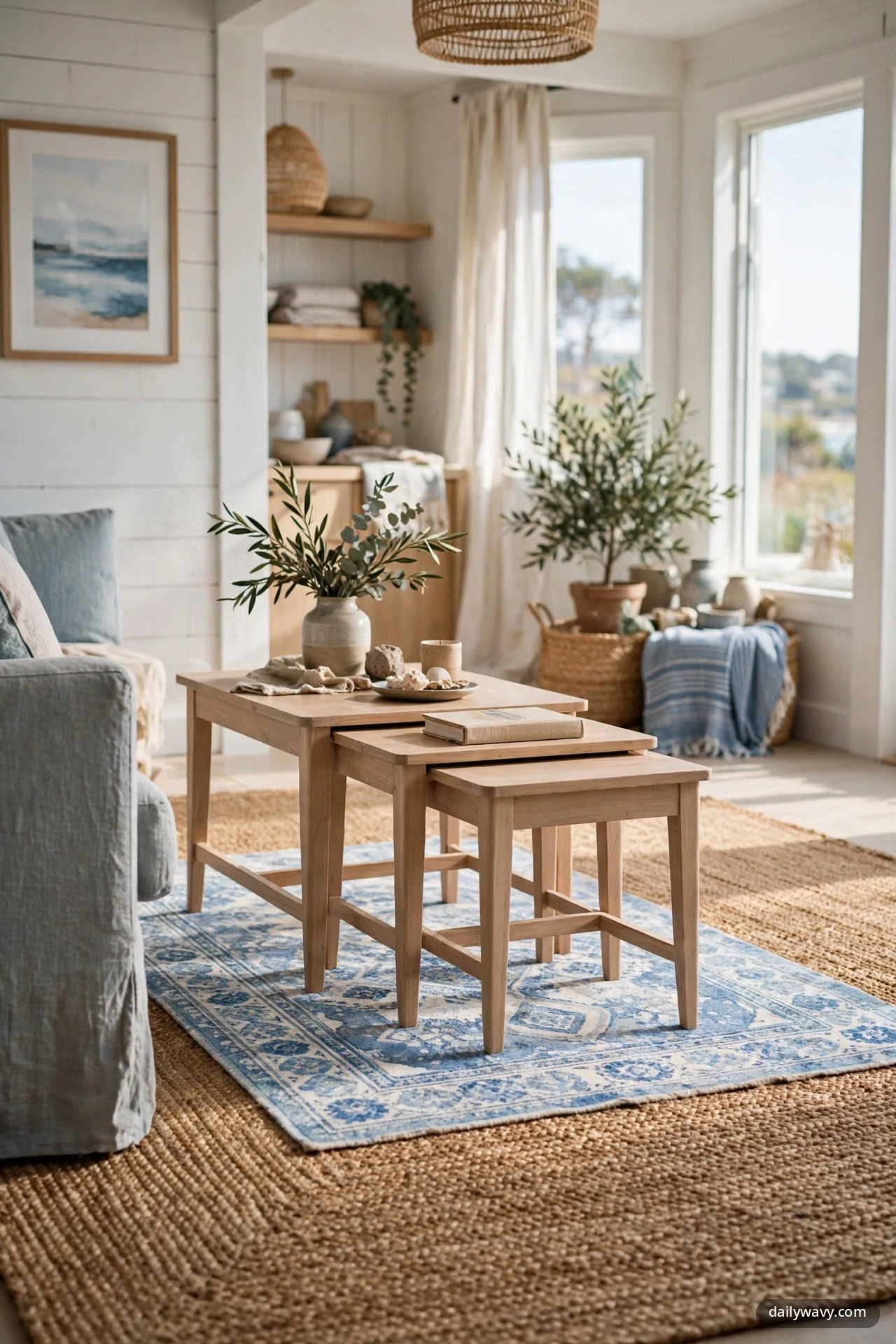
Start with a big natural-fiber rug, then float a smaller patterned one on top at an angle. Jute underneath gives texture and size for less money; a soft blue and white flatweave on top gives the pattern. The layering makes a standard rectangular room feel considered, and the two-rug look forgives furniture that does not line up perfectly.
Your decision: a patterned rug roughly two-thirds the size of the base rug, centered or offset slightly toward the seating. Offset feels more relaxed; centered feels more formal.
Measure: the seating area you want the rugs to cover. The base jute should reach under the front legs of the sofa and chairs, with 18 to 24 inches extending past them.
Save: choose a flatweave cotton top rug instead of wool. Cotton flatweaves cost far less, wash well, and the pattern stays crisp in coastal blues.
6. Vintage Cabinet Used As A Focal Point

A vintage cabinet with a weathered light finish gives the room its personality. Where the rest of the furniture stays quiet, one older piece with visible grain and history pulls the eye and holds it. Style the top simply: a small lamp, two or three ceramics, and breathing room. The cabinet becomes the reason the room feels collected rather than decorated.
Your decision: cabinet as media storage with doors closed, or as an open display with a few styled shelves. Closed keeps clutter out of sight; open works only if you commit to restraint.
Measure: the wall where it will stand. Leave at least 30 inches of walking space in front, and check that door swings and drawer pulls clear neighboring furniture by 2 inches.
Save: refinish a dated oak cabinet from a secondhand shop with a light matte seal instead of paint. Sanded-back pale wood reads coastal on its own, and you keep the character paint would hide. Work outdoors or in a well-ventilated space when sanding and sealing.
7. Soft Ottoman Replacing A Sharp Table
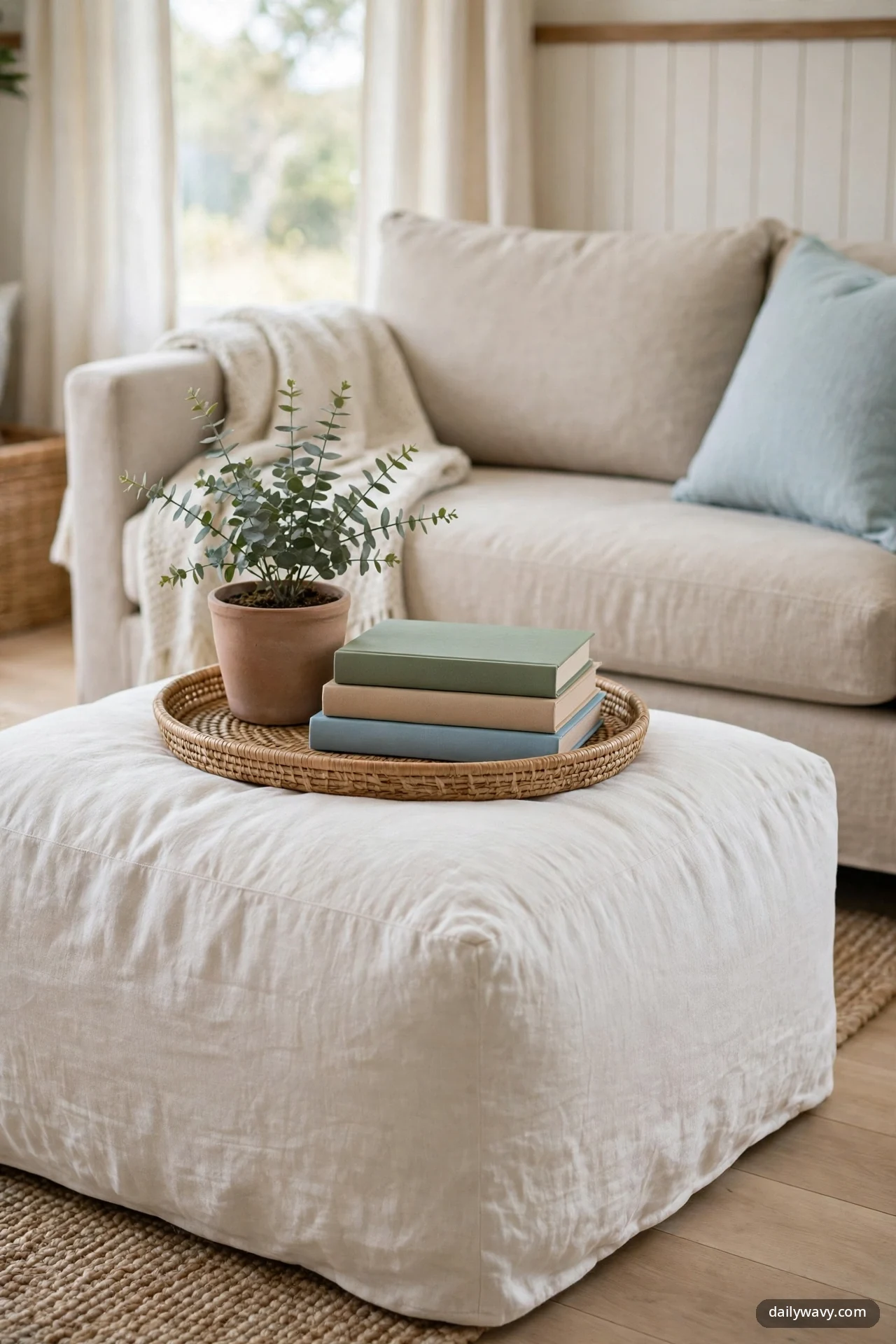
Swap the hard-edged coffee table for a large upholstered ottoman and the whole room softens. It doubles as extra seating, it is kind to shins, and topped with a tray it holds drinks and books just fine. In warm white linen with a tailored skirt, it looks custom rather than casual.
Your decision: one big ottoman that seats two, or two smaller ones you can push together. The pair flexes for guests; the single piece looks calmer.
Measure: keep 14 to 18 inches between the ottoman and the sofa so people can sit down and stand up without scooting furniture. The ottoman top should sit at or just below seat-cushion height.
Save: slipcover a used ottoman in a drop-cloth fabric and add a woven tray. The tray makes it function as a table; the slipcover makes it look intentional.
8. Window Seat With Tailored Cushions

If your windows allow it, a window seat with tailored, piped cushions turns a view into a destination. Deep soft blue and warm white cushions, a couple of small pillows, and it can become the brightest, most-used corner of the room. For window treatments that suit the look, see our living room curtain ideas.
Your decision: a built-in bench if you own the place, or a sturdy low bookcase topped with a cushion if you rent. The bookcase version adds storage and moves with you.
Measure: seat depth of at least 20 inches for real comfort, and a cushion thickness of 3 to 4 inches so it reads as furniture, not padding.
Save: buy a premade bench cushion and add piping with fabric glue tape. The piped edge is what separates tailored from makeshift, and it costs very little.
9. A Floor Lamp Beside A Book Stack

A slim floor lamp next to a tidy stack of books creates a reading corner without needing an armchair. The lamp’s warm pool of light in the evening balances the bright blue-and-white palette, and the book stack adds height and color at the sofa’s end. It is a small composition that makes the room feel lived in.
Your decision: an arc lamp that throws light over the sofa, or a straight stick lamp that glows beside it. Arc suits sectionals; straight suits a simple sofa and side table.
Measure: the shade’s bottom should hang 40 to 42 inches above the floor, roughly at seated eye level, so reading light falls on the page and not in your eyes.
Save: have a secondhand brass or wood lamp rewired by a licensed electrician and add a new warm white shade. The shade does the visual work; the base just needs good bones and a solid switch. Choose a lamp with a weighted base and keep it clear of walkways so it cannot tip.
10. A Large Plant In A Simple Pot

Every coastal living room needs something alive in the corner. A large leafy plant in a plain white ceramic pot adds height, movement, and a deep green that makes the blues and whites feel richer. Keep the pot simple so the plant is the statement. One confident plant usually beats three small ones competing for attention.
Your decision: a tall floor plant like a fiddle-leaf fig or a bushy olive tree in a warm bright room, or an easier broad-leaf plant in medium light. Match the plant to your window, not your wishes. Note: fiddle-leaf fig is toxic to cats and dogs if chewed, so skip it if pets roam the room; olive trees are pet-safe.
Measure: leave 24 to 36 inches of clear floor space in the corner, and check the mature height against your ceiling so the top leaves clear it by at least a foot.
Save: buy the small size of the same plant and a good white pot. The pot is what the eye registers first, and the plant grows into the statement while you water it.
11. Two Small Tables Instead Of One Large Table

Two small light-wood tables grouped together give you the surface of a coffee table with twice the flexibility. Split them apart when guests arrive, tuck one away when you need floor space, and let the negative space between them keep the room airy. It is also an easy fix for rooms where one big table never quite fit the seating. If the room itself feels tight, our guide to narrow living room layout shows how to arrange seating so every piece earns its place.
Your decision: matching round tops for a soft look, or two different heights for a more designed feel. Keep the finish the same light wood either way so they read as a pair.
Measure: the pair together should span roughly half to two-thirds of the sofa’s length. Leave 14 to 18 inches between the tables and the sofa.
Save: paint two secondhand stools or side tables in the same pale oak-toned shade. Identical finish unifies mismatched shapes instantly.
12. An Upholstered Bench Against The Wall

A low upholstered bench against the wall fills that dead stretch of space most living rooms have and adds seating for the crowd that spills past the sofa. In warm white linen with a couple of soft blue cushions, it looks like part of the plan instead of a waiting area. It also gives you a perch for folding the throws from the basket.
Your decision: a bench with open legs for a light look, or an upholstered cube with hidden storage inside. Choose storage if the room lacks closets; choose open legs if the floor already feels busy.
Measure: seat height of 17 to 19 inches matches standard sofa seats, and a length of 36 to 48 inches suits most wall runs without overwhelming them.
Save: turn a simple wood coffee table into a bench by topping it with a foam cushion wrapped in linen-look fabric. A skirted cushion hides everything underneath.
13. A Narrow Console Behind The Sofa

A console behind the sofa turns the back of the furniture into a styled surface. A small lamp, a stack of books, a ceramic vase: three things, different heights, done. It also marks the line between the seating area and whatever sits behind it, which matters in open rooms. And it gives you a landing spot for the remote, the charger, and the candle you actually light. If you light it, set it on a heatproof holder and keep it clear of the cushions and throws.
Your decision: a console as tall as the sofa back, or a few inches taller. Taller shows off the styling; level with the back keeps sightlines clean.
Measure: depth of 10 to 12 inches, no more, so the console hugs the sofa instead of crowding the walkway. Check the total depth against the room before you commit.
Save: use a wall-mounted shelf at sofa-back height instead of a freestanding console. It reads the same from the front and costs a fraction, with zero floor footprint.
Coastal living room questions, answered
What colors make a living room feel coastal without looking nautical?
Warm white as the base, soft blue as the accent, and light wood as the bridge between them. Keep navy to small doses, like one cushion or one vase, and skip the anchors and shells entirely. The palette does the work, not the props.
Can I do coastal with my existing dark furniture?
Yes, if you lighten everything around it. Layer warm white textiles, add a light rug, and bring in woven textures. One dark piece can ground the room; two or more start fighting the palette.
What kind of rug works best in a coastal living room?
Start with a large natural-fiber base like jute, then layer a smaller patterned flatweave in blue and white on top. The jute keeps costs down and the size generous, while the top rug brings the coastal pattern.
How do I keep the room from looking washed out?
Vary the depths. Pair pale walls with one deeper blue element, mix matte and woven textures, and let natural wood grain add visual warmth. Contrast comes from texture and tone, not from bright color.
What is the cheapest first move?
Textured cushions and a woven basket. Both can stay affordable if you shop secondhand, and together they change the materials story of the room in one afternoon.
Can I mix coastal with another style?
Yes. Keep the palette and materials consistent, then borrow one element at a time. Coastal and Scandinavian share light wood and calm lines, and coastal and modern both favor uncluttered silhouettes. Change one variable at a time so the room still reads as one style.
Keep building your coastal rooms
Thirteen small moves, none of them a renovation, and the room already feels different. The throughline is simple: soft blue against warm white, light wood underfoot, and fibers you can touch. Pick the idea that solves your biggest irritation first, whether that is seating, light, or storage. Then explore more ideas in our Home & Decor collection, or carry the same palette into the next room with our coastal bedroom ideas, and keep layering at your own pace. Your living room should look like you live near the water, even if the nearest coast is hours away.