13 Wood Fireplace Mantel Decor Ideas with Balanced Arrangements
A wood mantel has a warmth that stone or painted finishes never quite match. The grain, the weight, the way…
A wood mantel has a warmth that stone or painted finishes never quite match. The grain, the weight, the way it grounds a living room. It is also easy to get wrong: too many small objects and it reads cluttered, one oversized piece and the whole wall feels heavy. The thirteen ideas below keep the balance honest. Each one is built around one clear focal point, arranged with breathing room, and styled to respect the fireplace itself. Work through the primer first, pick the arrangement that fits your room, and give the mantel the quiet confidence it deserves.
In This Guide
- A Framed Botanical Pair
- A Restrained Row Of Bud Vases
- An Off-Center Stack Of Books
- A Trailing Plant Safely Away From Heat
- A Pair Of Sculptural Bookends
- A Wooden Bowl Beside A Small Frame
- A Tonal Collection Of Ceramic Vessels
- A Metal Tray With A Vase
- A Paper Lantern-Style Accent Placed Safely
- A Single Oversized Photograph
- A Woven Wall Accent Above The Mantel
- Large Leaning Artwork With A Small Vase
- An Arched Mirror With Low Ceramics

The Mantel Styling Rules Before You Start
Before you buy or borrow a single object, measure the mantel shelf. Most wood mantels give you a working depth of only six to ten inches, and that number decides everything: which frames can stand without leaning into the wall, whether a stack of books fits with room to spare, how far forward a vase can sit. Write down the full width too, then leave the outer four to six inches on each end empty. That breathing room is what makes an arrangement look deliberate instead of crowded.
Balance comes from three habits. First, work in odd numbers. A pair of frames wants a third object nearby; three vessels of different heights beat four matched ones. Second, vary the heights so the eye travels instead of stalling. A tall anchor at one end, something low at the other, and a medium piece to connect them is a formula that rarely fails. Third, anchor the composition instead of centering everything. The classic move is to weight one third of the mantel with the tallest, darkest piece and let the rest step down toward the other end. Off-center almost always looks more natural than dead-center symmetry.
Now the safety rules, because a mantel sits directly over fire. Keep anything combustible, paper prints, dried botanicals, fabric, books, well away from the firebox opening, and never style objects where they can be warmed by rising heat from a working fire. If your fireplace is used, check the manufacturer’s clearance guidance for your model and keep the area above the opening clear. If you style decor inside the firebox itself, that fireplace must be unused and stay unused while the decor is in place. Say it plainly to anyone in the house. A mantel should feel cozy, never risky.
1. A Framed Botanical Pair
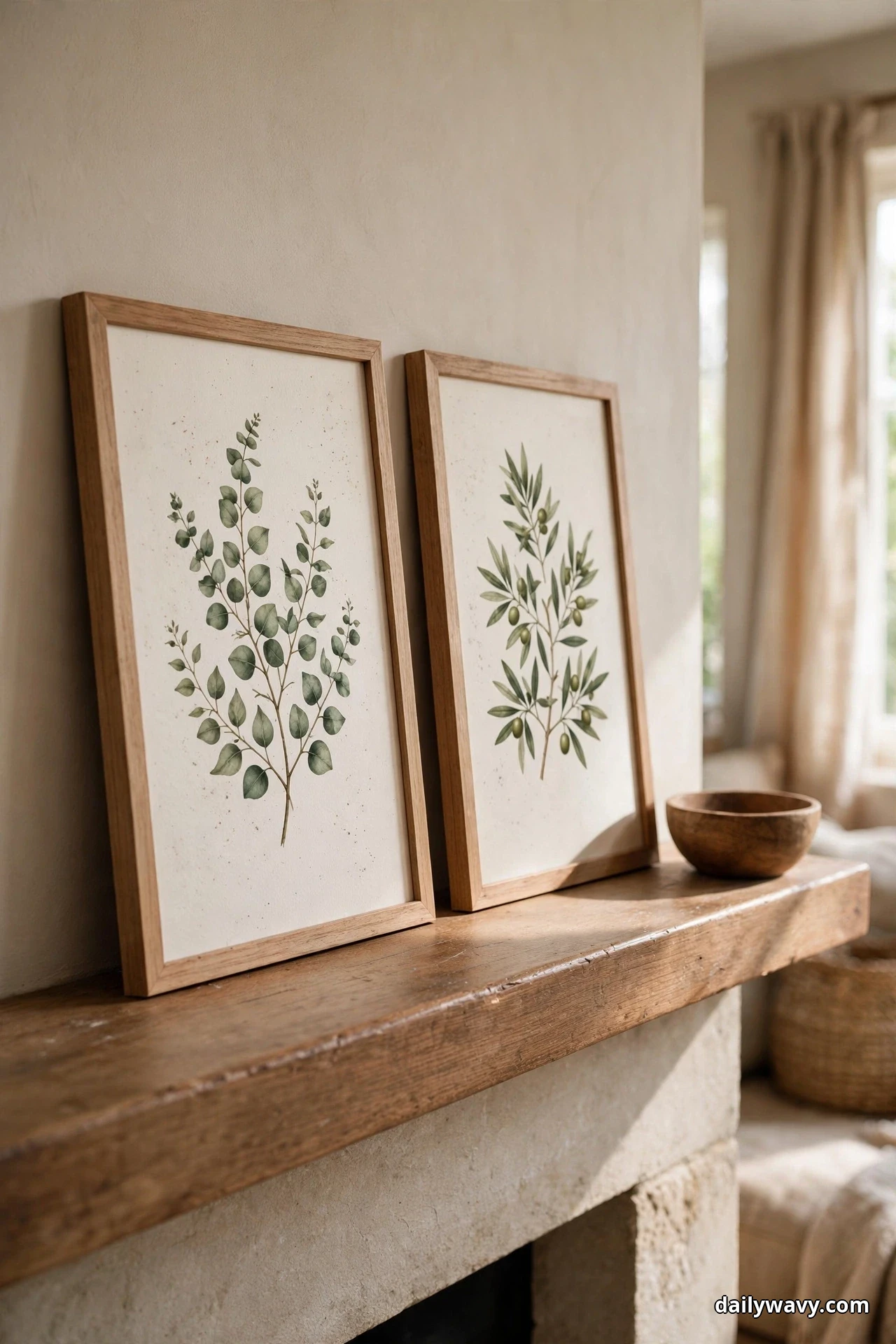
Two matching botanical prints, hung or leaned side by side, are the calmest possible anchor for a wood mantel. The symmetry suits the horizontal line of the shelf, and the paper tones sit softly against the grain without competing with it. Measure first: leave about two inches between the frames and keep the pair’s total width to roughly the middle third of the mantel. Frames in the 8 by 10 to 11 by 14 inch range work on most shelves; anything larger needs a deep mantel and a wall behind it.
Leaning is easier than hanging and kinder to plaster, but only if the frames have a real lip to catch. Stand them against the wall with a slight tilt, felt pads behind the corners, and check that the bottom edge sits a full inch back from the shelf edge. Then add one low object to one side, a small bowl or a short stack of books, so the pair does not float alone. Effort is minimal: an afternoon, a level, and two rated picture hooks if you hang. The lower-cost route is printing public-domain botanical plates at a copy shop and framing them in matching ready-made frames, which costs a fraction of gallery prints and looks nearly identical from across the room.
2. A Restrained Row Of Bud Vases
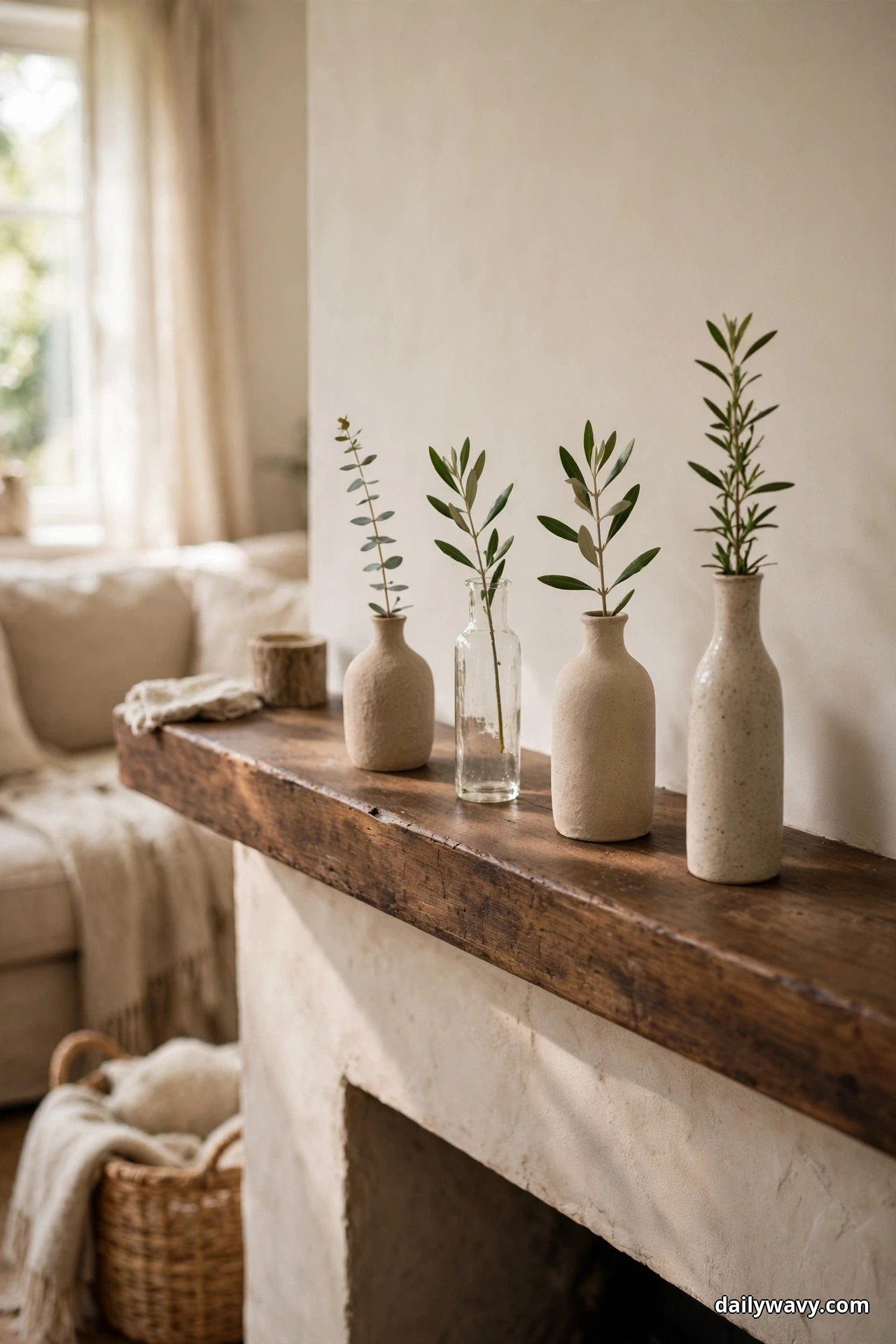
A row of small bud vases is the mantel equivalent of a deep breath. Each one holds a single stem or a sprig, and the repetition of glass or ceramic shapes gives the eye something to follow. The restraint is the point: three to five vases, each a slightly different height, spaced two to three inches apart. Measure the run they will occupy and keep it to about half the mantel width, placed off-center so the row reads as a deliberate accent rather than a fence.
Vary the heights by at least an inch between neighbors so the line has movement. Fill them with whatever is in season, fresh eucalyptus in winter, a few wildflowers in spring, or nothing at all if you prefer the quiet of empty glass. Water stains are the enemy here: use a small tray or felt pads under each vase, and wipe the shelf weekly. This is a thirty-minute arrangement with almost no cost if you gather vases you already own. The budget version is a set of small jam jars or recycled bottles in clear glass, which grouped tightly reads as intentional rather than improvised.
3. An Off-Center Stack Of Books
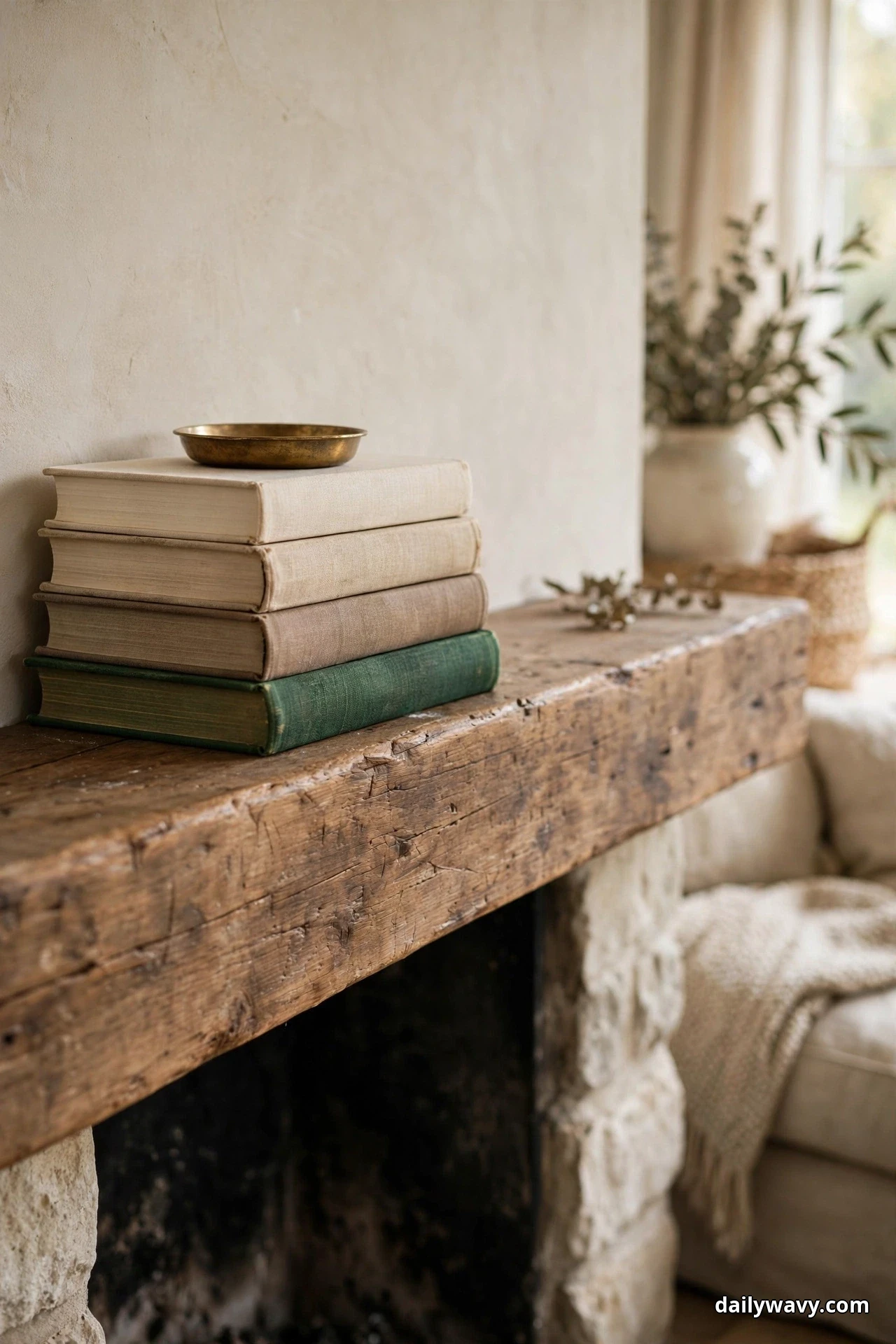
Books bring weight and color to a mantel without any visual noise, and stacking them off-center is one of the oldest styling tricks for a reason. Choose three to five hardcovers with spines in a restrained palette, creams, taupes, a deep green or oxblood, and stack them largest to smallest. Place the stack about a third of the way in from one end of the mantel. The asymmetry makes the whole shelf feel considered rather than decorated.
Measure the stack’s footprint before you commit: a pile of coffee-table books can easily be ten inches square, which overwhelms a narrow shelf. Standard hardcovers, around six by nine inches, fit most mantels comfortably. Top the stack with one small object, a stone, a small brass dish, a single candle that will never be lit near the firebox, to give it a finished top. Effort is nearly zero if the books come from your own shelves. The lower-cost alternative is wrapping mismatched books in kraft paper or linen fabric, which turns a chaotic shelf of paperbacks into a tonal stack for the price of a roll of paper.
4. A Trailing Plant Safely Away From Heat

A trailing plant softens the hard horizontal line of a wood mantel like nothing else, but placement is everything. Heat rises, and the air directly above a working firebox can dry out foliage fast. Put the plant at the far end of the mantel, at least 3 feet from the firebox opening, or on a side where the chimney breast shields it. If the fireplace is purely decorative and never used, you have more freedom, but still keep leaves from touching the wall where soot can stain.
Choose a forgiving trailer: pothos and philodendron tolerate the lower light of an interior wall and the occasional missed watering. Set the pot on a saucer or a small tray to protect the wood from moisture rings, and prune the vines before they reach the firebox. This is a weekend project at most, pot, plant, and a tray. The budget approach is a cutting rooted in water from a friend’s plant, which costs nothing and fills a small pot within a few months. Just remember the rule: green at the ends, never above the flames.
5. A Pair Of Sculptural Bookends

Sculptural bookends do double duty on a mantel: they hold a short run of books upright and they read as small artworks in their own right. Look for a pair with real presence, carved stone, cast metal, or heavy ceramic, and let them anchor the middle or one third of the shelf. Flank them with the books they are holding, spines in a quiet palette, and leave the rest of the mantel nearly empty so the pair commands the space.
Measure the height before you buy. Bookends that stand under six inches disappear against a tall chimney breast; nine to twelve inches gives them the presence the role demands. They should also be heavy enough to actually hold books, at least a couple of pounds each, or the whole arrangement slides at the first bump. This is a one-errand project. The lower-cost alternative is a pair of matching doorstops, decorative bricks wrapped in fabric, or heavy stones from a garden center, which provide the same mass and a similar silhouette for a fraction of the price.
6. A Wooden Bowl Beside A Small Frame

Wood on wood can be the richest combination on a mantel if the tones are close but not identical. A hand-carved wooden bowl, acacia, walnut, or olive wood, set beside a small framed print or photograph, creates a small still life that rewards a second look. Keep the bowl low and wide, four to six inches across, and the frame small, five by seven or so, leaning with its bottom edge tucked slightly behind the bowl’s rim for depth.
Place this vignette off-center, roughly a third of the way along the shelf, and resist the urge to add more around it. The pairing works because it is quiet. Measure the frame’s depth with the bowl in front: the two together should occupy no more than half the shelf depth, with clear wood visible in front. An afternoon’s arrangement, and the bowl doubles as a catchall for keys or matches. The budget version is a thrifted wooden salad bowl, sanded and oiled, which develops the same soft sheen as a new artisan piece after a coat of food-safe mineral oil.
7. A Tonal Collection Of Ceramic Vessels

A group of ceramic vessels in one color family, warm whites, oatmeal tones, soft grays, is the most forgiving arrangement a mantel can hold. Because the color stays constant, the eye reads the shapes instead: a tall cylinder, a squat rounded pot, a small bud vase, each a different height and profile. Gather three to five, step their heights by at least two inches, and cluster them slightly off-center with an inch or two between pieces.
The tonal rule is what keeps this from looking like a pottery shop. Stay within one family, all warm or all cool, and let matte and glazed finishes mix for texture. Measure the tallest vessel against the chimney breast: it should stop well short of any art hung above, leaving clear air between the top of the tallest piece and the bottom of the frame. Assembly takes an hour including a hunt through your cabinets. The lower-cost route is spray-painting mismatched thrifted vases in one matte tone, which unifies even the most random shapes into a deliberate collection.
8. A Metal Tray With A Vase

A metal tray turns a loose collection into a single composed unit, which is useful on a narrow mantel where objects tend to wander. Choose a tray with a raised edge, brass, aged bronze, or blackened steel, sized to hold a vase and one companion object, a candle in a sturdy holder, a small stack of coasters, a stone. The tray corrals everything into one footprint, and the metal’s sheen plays nicely against the matte warmth of wood.
Measure the tray against your shelf depth before buying: a twelve-inch tray on an eight-inch shelf overhangs and looks precarious. Nine to ten inches across is the sweet spot for most mantels. Set the vase slightly off the tray’s center and the smaller object beside it, keeping the tallest element toward the back. This is a twenty-minute arrangement. The budget alternative is a thrifted serving tray, which with a coat of metallic spray paint reads as a deliberate styling piece rather than a kitchen leftover.
9. A Paper Lantern-Style Accent Placed Safely
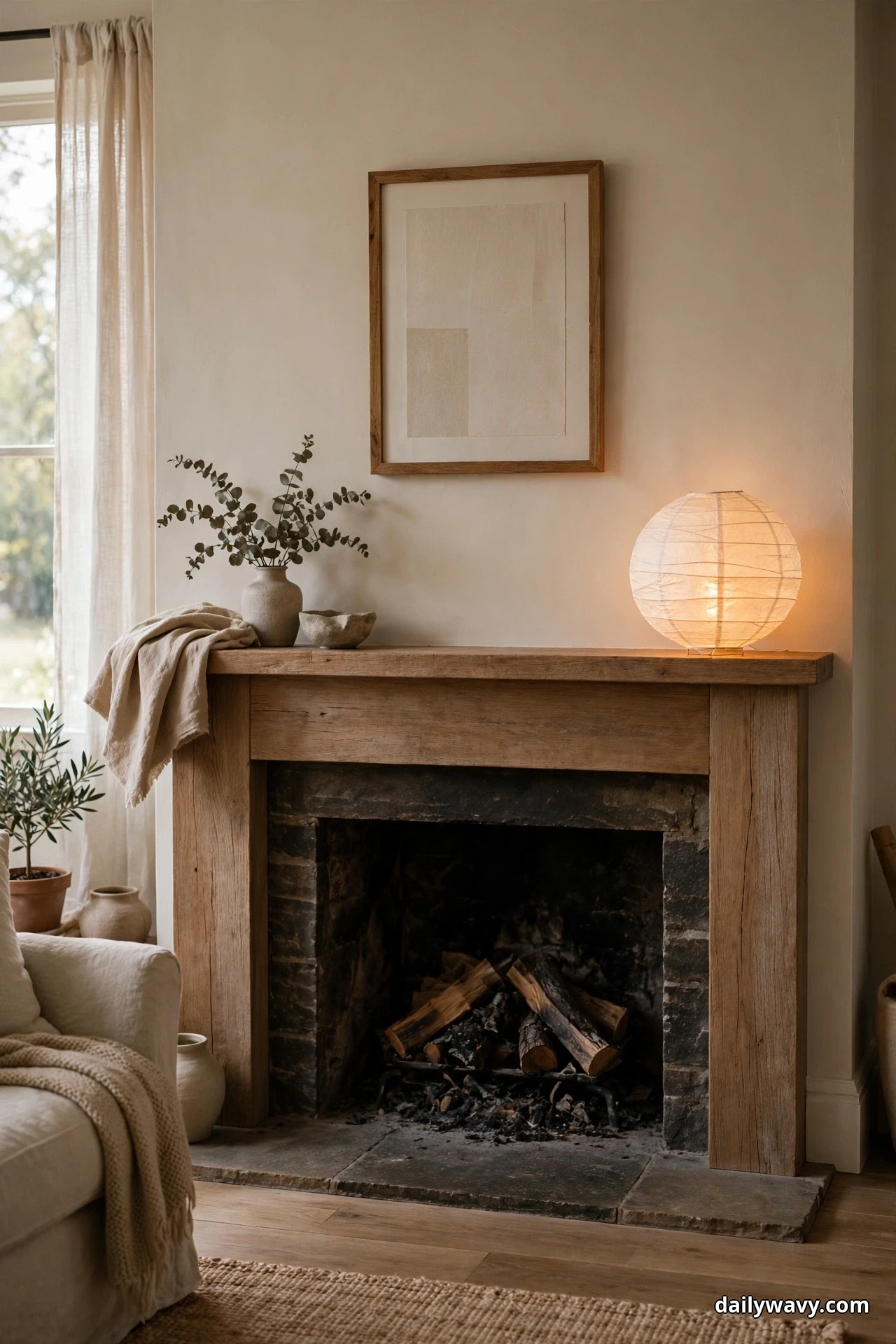
A paper lantern-style accent brings a soft glow and an airy shape to a mantel, but paper near a fireplace demands honest safety thinking. Place it only where heat cannot reach it: at the far end of a long mantel, or inside a firebox that is permanently unused. If you use the firebox, say so clearly in your own mind and to your household: this fireplace does not get lit while the lantern is in place. Battery-operated LED lights inside give the glow without any flame, and they are the only sensible choice here.
Size the lantern to the space. A ten to twelve inch sphere suits a standard mantel; anything larger crowds the shelf and anything smaller reads as an afterthought. Keep it clear of the wall by a few inches so the shape reads fully, and never let paper touch the firebox surround of a working fireplace. Setup takes minutes. The lower-cost version is a plain white paper lantern from a party supplier dressed up with a ribbon or a simple stand, which gives the same soft geometry for very little money.
10. A Single Oversized Photograph

One oversized photograph, leaned against the chimney breast, is the boldest and simplest mantel statement. It needs no companions, no balancing objects, just clear space on either side so the image carries the whole wall. Choose a print with some breathing room in its composition, a landscape, an architectural detail, a soft abstract, and size it to fill roughly two thirds of the mantel’s width without touching the ceiling.
Measure twice before ordering. The bottom of the frame should sit on the shelf with the top leaning back against the wall at a slight angle, so add two inches to the frame height for the lean. Anything over thirty inches tall usually needs a wall cleat or a hanging wire for safety, especially in a house with kids or pets. This is a one-weekend project including print ordering. The budget route is an engineering print from a copy shop, black and white, taped or clipped to a simple frame, which gives oversized impact for a very small price.
11. A Woven Wall Accent Above The Mantel

A woven wall hanging above the mantel adds texture that framed art cannot, and it softens the hard line where the shelf meets the wall. Macrame, a flat woven tapestry, or a simple jute and wood-bead piece all work, as long as the palette stays restrained: natural fibers, undyed wool, maybe one muted earth tone. Hang it centered over the mantel, with its bottom edge six to ten inches above the shelf so the mantel styling below can breathe.
Measure the width against the mantel: the hanging should span about half to two thirds of the shelf’s width. Wider than that and it competes with the mantel itself; narrower and it looks lost. Use a proper wall anchor rated for the weight, and if the fireplace is used, hang the piece only where the wall stays cool to the touch during a fire, because fibers and rising heat are a poor combination. Hanging takes an hour. The budget alternative is a DIY wall hanging from a dowel, cotton cord, and a simple online tutorial, which costs little and lets you match the palette exactly.
12. Large Leaning Artwork With A Small Vase

Large leaning artwork with a single small vase in front of it is a gallery trick that works beautifully on a mantel. The art provides the height and color, the vase provides the depth, and the overlap between them creates a layered look that feels collected rather than staged. Lean the frame against the wall with a gentle tilt, felt pads protecting both frame and wall and a dab of museum putty or a discreet top anchor keeping it from sliding, and set the vase a few inches in front of the frame’s lower corner, not centered on it.
Measure the frame’s footprint: a large leaner can be twenty-four by thirty-six inches, which needs a mantel at least eight inches deep to sit securely. The vase should be short enough not to cover the art’s focal point, roughly a third of the frame’s height. This is an afternoon’s work. The lower-cost version is a large framed poster or a stretched canvas from a discount store, which at leaning scale reads as intentional art, especially paired with a simple ceramic vase you already own.
13. An Arched Mirror With Low Ceramics

An arched mirror is the mantel’s best friend: it bounces light around the room, doubles whatever sits in front of it, and its curved top breaks up all the straight lines of shelf and chimney breast. Lean a medium arched mirror against the wall, then arrange two or three low ceramic pieces in front of it, a squat bowl, a short vase, a small lidded jar, in a tonal palette so the mirror stays the star.
Keep the ceramics genuinely low, under six inches, so they read as a foreground layer rather than competition. Measure the mirror’s width against the mantel: about half the shelf width keeps it from overwhelming the wall. Secure the top with a discreet wall anchor or museum putty at the base if the house has foot traffic or pets. This is a weekend project including mirror shopping. The budget alternative is an arched mirror from a discount home store, which at mantel scale looks far more expensive than it is, paired with small ceramics from a thrift shop.
Frequently Asked Questions
How do I keep mantel decor balanced without it looking cluttered?
Work in odd numbers, vary the heights, and leave empty space on purpose. A good test: step back to the doorway. If every object reads as its own shape with air around it, the balance is right. If two pieces blur together, remove one.
Can I style a mantel over a working fireplace?
Yes, with respect for the heat. Keep all decor well clear of the firebox opening, never place anything where rising heat can reach it, and follow the manufacturer’s clearance guidance for your fireplace model. Paper, fabric, and dried botanicals belong at the far ends of the mantel or not at all.
What is the safest way to style decor near heat?
Distance is the whole answer. Combustible materials stay away from the firebox, and anything placed inside a firebox means the fireplace stays unused while it is there. Battery LED lights give the glow of candles without the flame.
How tall should objects on a mantel be?
There is no single number, but a useful guide is that the tallest piece should reach roughly a third of the way from the shelf to the ceiling. On a standard eight-foot wall, that means most objects land between eight and eighteen inches tall, with one anchor piece allowed to go higher.
How do I hang heavy art above a mantel?
Use hardware rated for the weight and anchor into a stud or use proper wall anchors, never just a nail in drywall. For very heavy pieces, a French cleat spreads the load and keeps the frame level. If you are unsure, this is a fair job to hand to a professional.
What is a cheap way to refresh mantel decor?
Shop your own house first. Books, vases, bowls, and small frames from other rooms often look new in a mantel context. After that, thrift stores and the copy shop are your friends: a unified coat of paint or a fresh print in a matching frame refreshes a whole arrangement for very little.
A wood mantel rewards restraint. Pick one anchor, give it room, keep the heat in mind, and let the grain of the wood do half the work. If you are styling the rooms around the fireplace too, our guide to small entryway decor has the same calm, balanced approach for tight spaces, and narrow living room layout shows how to arrange furniture in a long, tight room while keeping the walking route open. For more ideas in this vein, browse the Home and Decor collection.